Wednesday, January 12, 2011

In Deep Galaxy Surveys, Astronomers Get a Boost -- from Gravity

Gravitational Lensing of Distant Galaxies. View this image
Illustration Credit: NASA, ESA, Z.Levay and A. Feild (STScI)

Science Credit: NASA, ESA, S. Wyithe (University of Melbourne), H. Yan (Ohio State University), R. Windhorst (Arizona State University), and S. Mao (Jodrell Bank Center for Astrophysics, and National Astronomical Observatories of China)

Astronomers who survey galaxies in the distant universe are getting some unexpected help from gravity, according to a new study.

In a presentation at the American Astronomical Society meeting this week and a related paper in the current issue of the journal Nature, researchers say that as many as 20 percent of the most distant galaxies currently detected appear brighter than they actually are, because of an effect called "strong gravitational lensing."

The discovery could change astronomers' notions of how galaxies formed in the early universe. It will also be important in the planning for how to effectively use NASA's planned James Webb Space Telescope (JWST) for hunting very distant galaxies.

Principal investigator Stuart Wyithe of the University of Melbourne calculated the lensing effect at various distances. Wyithe and Haojing Yan, postdoctoral fellow at the Center for Cosmology and Astro-Particle Physics at Ohio State University, collaborated with Rogier Windhorst at Arizona State University and Shude Mao of the University of Manchester and the Chinese Academy of Sciences.

Yan reports that astronomers have long known about strong gravitational lensing, but thought it only happens rarely and wouldn't have any real impact on galaxy surveys.

"On one hand, lensing is good for us in that it enables us to detect galaxies that would otherwise be invisible; but on the other hand, we will need to correct our surveys to obtain accurate tallies," Yan says.

From our view on Earth, if a faraway galaxy and a nearby galaxy line up on the sky, the gravity of the nearby galaxy bends the light from the faraway galaxy, as if the nearer galaxy were a magnifying glass, or lens.

Einstein predicted decades ago that gravity could bend light, and astronomers have since proven him right. In fact, modern astronomers exploit the effect to find distant objects that would otherwise be invisible, such as planets orbiting other stars.

And in this case, a statistical analysis revealed that gravitational lensing is brightening faraway galaxies that would otherwise be too faint to see.

Now that astronomers are aware of the effect, they can use it to their advantage.

"We just need to be aware that we are looking through ‘lenses,'" Yan said. "Take a real magnifying glass as an example: Through the lens we can see more details of an object — which is a good thing — but you should be aware that all those details are not actually the sizes that you see, because you're looking through a magnifying lens. The same is true when we're looking at galaxies."

"We predict that many galaxies in the most remote universe will only ever be visible to us because they are magnified in this way," he adds.

Clues From Hubble

Yan is part of an international team of astronomers who are using NASA's Hubble Space Telescope to probe the distant universe. They analyze images from the Hubble Ultra Deep Field (HUDF) survey, a collection of the furthest images of the universe ever taken.

The survey looks back in time 13 billion years, to when the universe was less than one billion years old. Astronomers want to know how many galaxies were bright or faint when the universe was still in that infant stage. So any magnification of those galaxies will interfere with astronomers' ability to judge.

Even through the eyes of Hubble, these faraway galaxies look very small, so it's hard to tell which ones have been magnified. Yet tallies from the HUDF survey are critical to scientists' understanding of how galaxies formed and evolved.

"Although we do not yet have an instrument to directly detect a lensing ‘signature' to unambiguously support our prediction, we now have some indirect, tentative evidence that the number of lensed galaxies could be high as we look into the early universe," Yan says. "The apparent association of very distant galaxies to galaxies in the foreground is the key."

Sometimes, the gravitational lensing distorts a galaxy's appearance, or alters its brightness. Other times, the lens splits the light from the faraway galaxy so that two or more galaxies will form around the lens, when there is really only one.

In fact, Yan and his colleagues began this work in order to understand why so many of the faraway galaxies they observed in HUDF survey images appear to be located near the line of sight to galaxies in the foreground.

Through a statistical analysis, they determined that strong gravitational lensing is the most likely explanation.

Yan stressed that the 20-percent estimate is an initial one, and could change in the future.

"We want to make it clear that the size of the effect depends on a number of uncertain factors. If, for example, very distant galaxies are much fainter than their nearby counterparts but much more numerous, the majority of such distant galaxies that we will detect in the foreseeable future could be lensed ones," he says.

According to Yan and his colleagues, the impact of gravitational lensing on galaxy surveys will be even higher in future studies.

Exactly how much is an open question, and Yan says that only the James Webb Space Telescope, set for launch later this decade, could provide a decisive answer.

Yan's discovery suggests that when astronomers use JWST to hunt for faraway galaxies, they should search close to foreground galaxies.

"At Hubble's resolution one literally can no longer see the whole ‘forest for the trees' at these extreme distances. Only the James Webb Space Telescope will have the exquisite resolution and sensitivity to disentangle these very distant objects from the foreground lensing galaxies,'' adds Windhorst.

"This also means that JWST needs to have a very good resolution, so that the galaxies won't just blend together," says Mao.

Funding for this work came from the Australian Research Council, the Space Telescope Science Institute, a NASA-JWST Interdisciplinary Scientist grant, and Yan's fellowship at the Center for Cosmology and Astro-Particle Physics at Ohio State.

CONTACT

Ray Villard
Space Telescope Science Institute, Baltimore, Md.
410-338-4514
villard@stsci.edu

Pam Frost Gorder
Ohio State University, Columbus, Ohio
614-292-9475
gorder.1@osu.edu

Haojing Yan
Ohio State University, Columbus, Ohio
(614) 247-1878
yan.374@osu.edu

Rogier Windhorst
Arizona State University, Tempe, Ariz.
480-965-7143 or 480-965-5081
rogier.windhorst@asu.edu

NASA Telescopes Help Identify Most Distant Galaxy Cluster

Astronomers have discovered a massive cluster of young galaxies forming in the distant universe. Image credit: Subaru/NASA/JPL-Caltech. Full image and caption

PASADENA, Calif. -- Astronomers have uncovered a burgeoning galactic metropolis, the most distant known in the early universe. This ancient collection of galaxies presumably grew into a modern galaxy cluster similar to the massive ones seen today.

The developing cluster, named COSMOS-AzTEC3, was discovered and characterized by multi-wavelength telescopes, including NASA's Spitzer, Chandra and Hubble space telescopes, and the ground-based W.M. Keck Observatory and Japan's Subaru Telescope.

"This exciting discovery showcases the exceptional science made possible through collaboration among NASA projects and our international partners," said Jon Morse, NASA's Astrophysics Division director at NASA Headquarters in Washington.

Scientists refer to this growing lump of galaxies as a proto-cluster. COSMOS-AzTEC3 is the most distant massive proto-cluster known, and also one of the youngest, because it is being seen when the universe itself was young. The cluster is roughly 12.6 billion light-years away from Earth. Our universe is estimated to be 13.7 billion years old. Previously, more mature versions of these clusters had been spotted at 10 billion light-years away.

The astronomers also found that this cluster is buzzing with extreme bursts of star formation and one enormous feeding black hole.

"We think the starbursts and black holes are the seeds of the cluster," said Peter Capak of NASA's Spitzer Science Center at the California Institute of Technology in Pasadena. "These seeds will eventually grow into a giant, central galaxy that will dominate the cluster -- a trait found in modern-day galaxy clusters." Capak is first author of a paper appearing in the Jan. 13 issue of the journal Nature.

Most galaxies in our universe are bound together into clusters that dot the cosmic landscape like urban sprawls, usually centered around one old, monstrous galaxy containing a massive black hole. Astronomers thought that primitive versions of these clusters, still forming and clumping together, should exist in the early universe. But locating one proved difficult-until now.

Capak and his colleagues first used the Chandra X-ray Observatory and the United Kingdom's James Clerk Maxwell Telescope on Mauna Kea, Hawaii, to search for the black holes and bursts of star formation needed to form the massive galaxies at the centers of modern galaxy cities. The astronomers then used the Hubble and Subaru telescopes to estimate the distances to these objects, and look for higher densities of galaxies around them. Finally, the Keck telescope was used to confirm that these galaxies were at the same distance and part of the same galactic sprawl.

Once the scientists found this lumping of galaxies, they measured the combined mass with the help of Spitzer. At this distance, the optical light from stars is shifted, or stretched, to infrared wavelengths that can only be observed in outer space by Spitzer. The lump sum of the mass turned out to be a minimum of 400 billion suns -- enough to indicate that the astronomers had indeed uncovered a massive proto-cluster. The Spitzer observations also helped confirm that a massive galaxy at the center of the cluster was forming stars at an impressive rate.

Chandra X-ray observations were used to find and characterize the whopping black hole with a mass of more than 30 million suns. Massive black holes are common in present-day galaxy clusters, but this is the first time a feeding black hole of this heft has been linked to a cluster that is so young.

Finally, the Institut de Radioastronomie Millimétrique's interferometer telescope in France and 30-meter (about 100-foot) telescope in Spain, along with the National Radio Astronomy Observatory's Very Large Array telescope in New Mexico, measured the amount of gas, or fuel for future star formation, in the cluster. The results indicate the cluster will keep growing into a modern city of galaxies.

"It really did take a village of telescopes to nail this cluster," said Capak. "Observations across the electromagnetic spectrum, from X-ray to millimeter wavelengths, were all critical in providing a comprehensive view of the cluster's many facets."

COSMOS-AzTEC3, located in the constellation Sextans, is named after the region where it was found, called COSMOS after the Cosmic Evolution Survey. AzTEC is the name of the camera used on the James Clerk Maxwell Telescope; this camera is now on its way to the Large Millimeter Telescope located in Mexico's Puebla state.

NASA's Jet Propulsion Laboratory, Pasadena, Calif., manages the Spitzer Space Telescope mission for NASA's Science Mission Directorate, Washington. Science operations are conducted at the Spitzer Science Center at Caltech in Pasadena. Caltech manages JPL for NASA. More information about Spitzer is at: http://spitzer.caltech.edu/ and http://www.nasa.gov/spitzer .

Contact

Whitney Clavin 818-354-4673

Jet Propulsion Laboratory, Pasadena, Calif.
whitney.clavin@jpl.nasa.gov

Trent Perrotto 202-358-0321
NASA Headquarters, Washington
trent.j.perrotto@nasa.gov

Planck sees new, mysterious components in Milky Way and Magellanic Clouds

Thanks to its broad spectral coverage and very high sensitivity, Planck is peering deep into the interstellar medium of the Milky Way and discovering new components and physical mechanisms taking place therein. The results emerging from Planck's first all-sky survey include strong evidence for the presence of extremely rapidly spinning dust grains, an excess emission explained in terms of a previously poorly quantified 'dark gas' and the characterisation of an excess emission arising from the interstellar medium that permeates the Small Magellanic Cloud, a nearby galaxy orbiting our own Milky Way. These are amongst the highlights presented by the Planck Collaboration at a conference held from 10 to 14 January 2011 in Paris, France.


Map of the galactic distribution of the excess emission, with insets showing anomalous dust emission from the Perseus and Rho Ophiuchus molecular clouds, superimposed on top of the all-sky image of the microwave sky as seen by Planck after its first-year survey. Credit: ESA/Planck Collaboration. Hi-Res [tif] - Hi-Res [jpg] - Wallpaper [jpg]

The interstellar medium (ISM), the mixture of gas and dust that permeates the Milky Way, plays a crucial role in regulating the life cycle of stars in the Galaxy. Although the general picture of its composition and dynamics is fairly well understood, many details are still poorly known. While performing its all-sky observations in the microwave and submillimetre regions of the electromagnetic spectrum, targeting the first light emitted in cosmic history, Planck's detectors also absorb substantial amounts of radiation emitted by the ISM: albeit a nuisance for cosmologists, these data represent a rich reservoir of information for all astrophysicists studying the dust and gas that fill our Galaxy.

The dust component in the ISM is known to shine brightly at far infrared and submillimetre wavelengths, but it is not expected to emit at the longest radio wavelengths. Surprisingly, in the 1990s a significant emission, coming from dust-dominated regions of the Milky Way, was detected in the microwave band of radio waves—this was dubbed the Anomalous Microwave Emission (AME). Several theoretical mechanisms have been developed since then to try and explain this mysterious emission and now, thanks to the broad spectral range of Planck and the excellent quality data collected during its first all-sky survey, astronomers are finally able to shed some light on this highly debated topic.

"We are now becoming rather confident that the emission is due to nano-scale spinning grains of dust, which rotate up to ten thousand million times per second," says Clive Dickinson from the University of Manchester, who led an analysis of the AME using Planck's maps. "These are the smallest dust grains known, comprising only 10 to 50 atoms; spun up by collisions with atoms or photons, they emit radiation at frequencies between 10 and 60 GHz," he explains.

Individual maps and three-colour composite of (left) the Perseus and (right) the Rho Ophiuchus molecular cloud, combining observations at 0.4 GHz, 30 GHz and 857 GHz and highlighting (in red) the anomalous dust emission arising from nano-sized spinning dust grains. Credit: ESA/Planck Collaboration. Perseus - RHo Ophiuchus

The investigation focussed on two, very well studied regions of star formation in the Milky Way, the Perseus and the Rho Ophiuchus molecular clouds. Thanks to Planck's high sensitivity and to its unprecedented spectral coverage, it has been possible to characterise the anomalous emission arising from these two objects in such great detail that many of the alternative theories could be discarded, and to show that at least a significant contribution to the AME, if not the only one, is due to nano-scale spinning dust grains.

The mechanism of spinning dust has also been invoked, in another study, to explain an anomalous emission detected in the Small Magellanic Cloud, one of our two, closest galactic neighbours. "Both Magellanic Clouds are known to exhibit an excess of radiation in the submillimetre range," explains Jean-Philippe Bernard from the Institut de Recherche en Astrophysique et Planétologie (IRAP) in Toulouse, France, who led an analysis of the Magellanic Clouds based on Planck data. "In the case of the Large Magellanic Cloud, we have demonstrated that this excess is due to the cosmic microwave background fluctuations, whereas, for the Small Magellanic Cloud, we have confirmed the previously recorded excess emission. The excess radiation can be explained in terms of a combination of emission from spinning dust grains and from large, amorphous dust grains," he adds.

Planck's first all-sky survey has also allowed astronomers to detect and for the first time quantify accurately on large scales another peculiar component of the ISM which had remained elusive thus far. Apparent as an excess of dust emission, sometimes referred to as 'dark gas', this component is thought to be composed of molecular gas which remained largely unnoticed because it contains too little carbon monoxide (CO), the molecule employed by astronomers to trace the presence and to measure the amount of molecular hydrogen (H2) in the interstellar medium. "We believe that this 'dark gas' may be associated with the periphery of dense molecular clouds, where energetic ultraviolet photons destroy the CO molecules but leave the H2) undisturbed," notes Bernard, who led also the study revealing this previously poorly quantified constituent of the ISM.

Map of the galactic distribution of the excess dust emission, superimposed on top of the all-sky image of the microwave sky as seen by Planck after its first-year survey. Credit: ESA/Planck Collaboration. Hi-Res [tif] - Hi-Res [jpg] - Wallpaper [jpg]

These results highlight the ability of Planck to measure the temperature and the column density of gas in the ISM with such a high accuracy that it has been possible to uncover the presence of components in the ISM which have previously been suspected but not confirmed. "By literally revealing to us what has only been guessed at before, Planck is enabling us to probe new components and physical processes in the ISM, in the process shedding new light on the complex mixture that regulates the evolution of the Milky Way and other galaxies," concludes Jan Tauber, ESA's Planck Project Scientist.

Notes for editors

ESA's Planck mission maps the sky in nine frequencies using two state-of-the-art instruments, designed to produce high-sensitivity, multi-frequency measurements of the diffuse sky radiation: the High Frequency Instrument (HFI) includes the frequency bands 100 – 857 GHz, and the Low Frequency Instrument (LFI) includes the frequency bands 30-70 GHz.

The Planck Early Release Compact Source Catalogue (ERCSC) and the first scientific results to emerge from this mission are being presented this week (10-14 January 2011) at the conference "The Millimeter and Submillimeter Sky in the Planck Mission Era" held in Paris, France.

The Planck Scientific Collaboration consists of all the scientists who have contributed to the development of the Planck mission, and who participate in the scientific exploitation of the Planck data during the proprietary period, which nominally ends with the release of the scientific products to the community 3.5 yr after launch, i.e. in January 2013. These scientists are members of one or more of four consortia: the LFI Consortium, the HFI Consortium, the DK-Planck Consortium, and ESA's Planck Science Office.

Related publications

Planck Collaboration 2011, "Planck Early Results: Origin of the submm excess dust emission in the Magellanic Clouds", submitted to Astronomy & Astrophysics

Planck Collaboration 2011, "Planck Early Results: All sky temperature and dust optical depth from Planck and IRAS: Constraints on the "dark gas" in our galaxy", submitted to Astronomy & Astrophysics

Planck Collaboration 2011,"Early Planck Results: New Light on Anomalous Microwave Emission from Spinning Dust Grains", submitted to Astronomy & Astrophysics

Contacts

Clive Dickinson
Jodrell Bank Centre for Astrophysics
University of Manchester
Manchester, UK
Email: Clive.Dickinson@manchester.ac.uk
Phone: +44 (0)161 275 4232

Jean-Philippe Bernard
Institut de Recherche en Astrophysique et Planétologie (IRAP)
Toulouse, France
Email: Jean-Philippe.Bernard@cesr.fr
Phone: +33 5 61 55 75 38

Jan Tauber
ESA Planck Project Scientist
Directorate of Science & Robotic Exploration
ESA, The Netherlands
Email: jtauber@rssd.esa.int
Phone: +31 71 565 5342

Planck sees traces of early structure formation in the cosmic infrared background

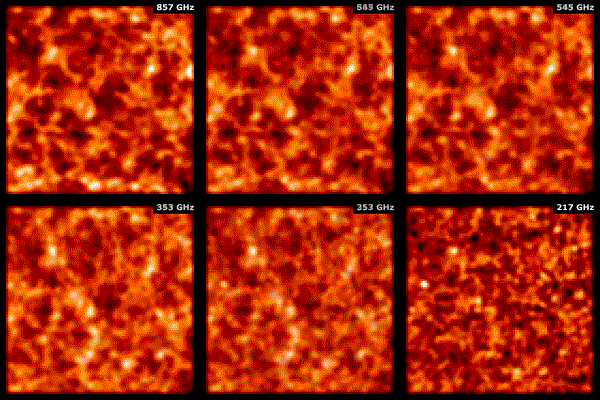
While targeting the Cosmic Microwave Background, Planck has also captured another important diffuse radiation, the Cosmic Infrared Background, which consists of the light emitted by all galaxies since their formation. This signal, detected by Planck at submillimetre wavelengths, exhibits a high degree of structure and enables astronomers to investigate the still unclear link between star-forming galaxies and the underlying distribution of dark matter, up to the earliest phases of the formation of cosmic structure. This result is amongst the highlights presented by the Planck Collaboration at a conference held from 10 to 14 January 2011 in Paris, France.

Animation showing the Cosmic Infrared Background fluctuations observed by Planck at various frequencies. Credit: ESA/Planck Collaboration

The main goal of ESA's Planck mission is to map the Cosmic Microwave Background (CMB), the relic radiation of the Big Bang which pervades the entire Universe, and to pinpoint its tiny fluctuations with unprecedented accuracy. In the process, Planck is also sensitive to another, very intriguing background emission which peaks at a different wavelength range, namely the Cosmic Infrared Background (CIB). The CIB, which is about 50 times weaker than the CMB, consists of the cumulative infrared emission from all galaxies throughout cosmic history and, being produced by the dust within such galaxies, it carries a wealth of information about the processes of star formation therein.

Dusty, star-forming galaxies at high redshift are extremely difficult to detect individually because they are so faint and numerous that confusion among sources plagues observations substantially; in addition, the angular resolution achievable in the far-infrared and submillimetre portions of the electromagnetic spectrum—the rather long wavelengths where such objects emit the bulk of their radiation—is not particularly good. In this context, the CIB represents an exceptional tool to study these objects and to trace their overall distribution.

"Thanks to Planck's extensive spectral coverage, we have been able to detect the CIB signal and its fluctuations with great accuracy in the submillimetre range, down to frequencies where it has never been seen before," comments Jean-Loup Puget from the Institut d'Astrophysique Spatiale in Orsay, France, who is principal investigator of the High Frequency Instrument (HFI) on board Planck, the instrument used in this study. "The quality of the data collected by Planck thus far is so good that, at the highest available frequency, it is possible to spot the fluctuations even by eye," he adds.

The fluctuations detected in the CIB trace the large-scale distribution of star-forming galaxies and, to some extent, the underlying distribution of the dark matter halos in which galaxies are believed to reside. "These data allow us to investigate how the processes of star formation taking place in galaxies are related to the dark matter, which constitutes the scaffold where galaxies form and evolve," explains Guilaine Lagache, also from the Institut d'Astrophysique Spatiale, who led this study along with Olivier Doré from the Jet Propulsion Laboratory/Caltech in Pasadena, USA.

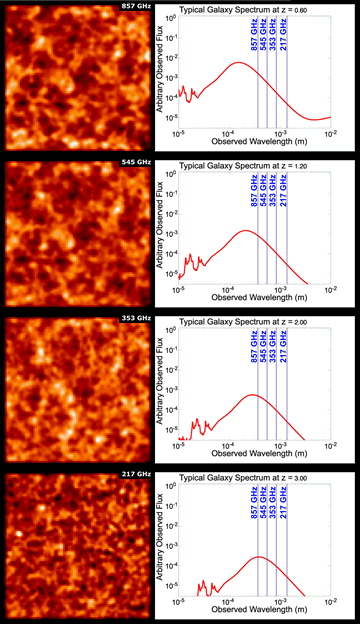
Animation showing the anisotropies in the Cosmic Infrared Background at different frequencies along with the typical spectra of galaxies at the redshifts to which each frequency channel is most sensitive. Credit: ESA/Planck Collaboration

Moving across the various frequencies probed by Planck's HFI, the amount and extent of structure observed are rather different, as a consequence of the fact that each frequency channel is most sensitive to the emission coming from galaxies at a certain redshift (z). Observations at the highest frequency, corresponding to 857 GHz, yield most information about galaxies up to z~1, whereas the lower frequencies offer a chance to peer farther and farther away, out to z~1–4, thus emphasising Planck's ability to track down the early phases of galaxy formation.

"At the moment, we are still learning how to work with these outstanding data. Since the CIB signal is an integrated emission, to which virtually all galaxies contribute, we need to put a lot of effort into properly modelling the data in order to interpret them and extract the wealth of valuable information they contain about the history of cosmic structure," adds Lagache.

The models employed for the data analysis rely on the results of numerical simulations of structure formation as well as on observations of the distribution of galaxies on large scales. "Additional information about the cosmic large-scale structure will also be provided by Planck in the future through the study of secondary anisotropies in the CMB," comments Hervé Dole, also from the Institut d'Astrophysique Spatiale. Secondary anisotropies are those fluctuations imprinted on the CMB as the photons travel throughout the cosmic web—an example is the gravitational lensing of the CMB—and they naturally retain a memory about the large-scale distribution of matter in the Universe. "A combined study of both the CMB and CIB, which will be possible with future Planck data, stands out as a promising tool to explore in even greater detail the connection between dark and luminous matter in the Universe," notes Dole.

The detection of the CIB anisotropies is the result of an extensive work of analysing Planck data, which required the development of a number of new technical tools. "For this study, we developed a specific method to robustly test and quantify all sources of uncertainties that is inherited from techniques usually employed in the analysis of the CMB anisotropies," explains Nicolas Ponthieu from the Institut d'Astrophysique Spatiale. "This project focussing on the CIB is a great example of the cooperation between researchers studying galaxies and those interested in the CMB, since the methods and expertise have been shared between the two groups," adds Doré. This is a notable advantage of the large Planck Collaboration, allowing for a fruitful synergy between many astrophysical communities.

Location on the sky of the first six fields used to detect the Cosmic Infrared Background anisotropies. Credit: ESA/Planck Collaboration. Hi-Res [jpg]

In order to perform these early measurements of the CIB, astronomers from the Planck Collaboration employed only about 2.5 per cent of the entire sky, focussing on a handful of fields located at high galactic latitude, where the foreground contamination due to the Milky Way's diffuse emission is less dramatic. The remarkable results achieved thus far are an exciting hint at the even more precise measurements which will be possible once the study is extended to the full-sky data.

"One of the unique features of Planck is the ability to reveal the fluctuations in the CIB on very large scales, an invaluable source of information in the quest to unravel the complete history of star and structure formation in the Universe," concludes Jan Tauber, Planck Project Scientist at ESA.

Notes for Editors

ESA's Planck mission maps the sky in nine frequencies using two state-of-the-art instruments, designed to produce high-sensitivity, multi-frequency measurements of the diffuse sky radiation: the High Frequency Instrument (HFI) includes the frequency bands 100 – 857 GHz, and the Low Frequency Instrument (LFI) includes the frequency bands 30-70 GHz.

The first scientific results to emerge from the mission, based on the scans gathered during Planck's first all-sky survey, between 13 August 2009 and 6 June 2010, are being presented this week (10-14 January 2011) at the conference "The Millimeter and Submillimeter Sky in the Planck Mission Era" held in Paris, France.

The Planck Scientific Collaboration consists of all the scientists who have contributed to the development of the Planck mission, and who participate in the scientific exploitation of the Planck data during the proprietary period, which nominally ends with the release of the scientific products to the community 3.5 yr after launch, i.e. in January 2013. These scientists are members of one or more of four consortia: the LFI Consortium, the HFI Consortium, the DK-Planck Consortium, and ESA's Planck Science Office.

Related Publication

Planck Collaboration 2011, "Planck Early Results: The Power Spectrum of CIB Anisotropies", submitted to Astronomy & Astrophysics

Contacts

Guilaine Lagache
Institut d'Astrophysique Spatiale, Université Paris-Sud 11 and CNRS,
Orsay, France
Email: guilaine.lagache@ias.u-psud.fr
Phone: +33 1 69 85 85 89

Olivier Doré
Jet Propulsion Laboratory/Caltech
Pasadena, CA, USA
Email: olivier.p.dore@jpl.nasa.gov
Phone: +1 818 354 1004

Jean-Loup Puget
Institut d'Astrophysique Spatiale, Université Paris-Sud 11 and CNRS
Orsay, France
Email: jean-loup.puget@ias.u-psud.fr
Phone: +33 1 69 85 85 08

Hervé Dole
Institut d'Astrophysique Spatiale, Université Paris-Sud 11, CNRS, and IUF,
Orsay, France
Email: Herve.Dole@ias.u-psud.fr
Phone: +33 1 69 85 85 72


Nicolas Ponthieu
Institut d'Astrophysique Spatiale, Université Paris-Sud 11 and CNRS,
Orsay, France
Email: nicolas.ponthieu@ias.u-psud.fr
Phone: +33 1 69 85 86 20

Jan Tauber
ESA Planck Project Scientist
Directorate of Science & Robotic Exploration
ESA, The Netherlands
Email: jtauber@rssd.esa.int
Phone: +31 71 5655342

ESO’s Hidden Treasures Brought to Light

PR Image eso1102a
The winners of ESO’s Hidden Treasures 2010 competition

PR Image eso1102b
Astronomy enthusiast Igor Chekalin from Russia

ESO’s Hidden Treasures 2010 astrophotography competition attracted nearly 100 entries, and ESO is delighted to announce the winners. Hidden Treasures gave amateur astronomers the opportunity to search ESO’s vast archives of astronomical data for a well-hidden cosmic gem. Astronomy enthusiast Igor Chekalin from Russia won the first prize in this difficult but rewarding challenge — the trip of a lifetime to ESO’s Very Large Telescope at Paranal, Chile.

The pictures of the Universe that can be seen in ESO’s releases are impressive. However, many hours of skilful work are required to assemble the raw greyscale data captured by the telescopes into these colourful images, correcting them for distortions and unwanted signatures of the instrument, and enhancing them so as to bring out the details contained in the astronomical data. ESO has a team of professional image processors, but for the ESO’s Hidden Treasures 2010 competition, the experts decided to give astronomy and photography enthusiasts the opportunity to show the world what they could do with the mammoth amount of data contained in ESO’s archives.

The enthusiasts who responded to the call submitted nearly 100 entries in total — far exceeding initial expectations, given the difficult nature of the challenge. “We were completely taken aback both by the quantity and the quality of the images that were submitted. This was not a challenge for the faint-hearted, requiring both an advanced knowledge of data processing and an artistic eye. We are thrilled to have discovered so many talented people,” said Lars Lindberg Christensen, Head of ESO’s education and Public Outreach Department.

Digging through many terabytes of professional astronomical data, the entrants had to identify a series of greyscale images of a celestial object that would reveal the hidden beauty of our Universe.

The chance of a great reward for the lucky winner was enough to spur on the competitors; the first prize being a trip to ESO’s Very Large Telescope in Paranal, Chile, with guided tours and the opportunity to participate in a night’s observations. Runner-up prizes included an iPod, books and DVDs. Furthermore, the highest ranked images will be released for the world to see on www.eso.org as Photo Releases or Pictures of the Week, co-crediting the winners.

The jury evaluated the entries based on the quality of the data processing, the originality of the image and the overall aesthetic feel. As several of the highest ranked images were submitted by the same people, the jury decided to make awards to the ten most talented participants, so as to give more people the opportunity to win a prize and reward their hard work and talent.

The ten winners of the competition are:

First prize, a trip to Paranal + goodies: Igor Chekalin (Russia).
Second prize, an iPod Touch + goodies: Sergey Stepanenko (Ukraine).
Third Prize, VLT laser cube model + goodies: Andy Strappazzon (Belgium).
Fourth to tenth prizes, Eyes on the Skies Book + DVD + goodies: Joseph (Joe) DePasquale (USA), Manuel (Manu) Mejias (Argentina), Alberto Milani (Italy), Joshua (Josh) Barrington (USA), Oleg Maliy (Ukraine), Adam Kiil (United Kingdom), Javier Fuentes (Chile).

The ten winners submitted the twenty highest ranked images:

1. M78 by Igor Chekalin.

2. NGC3169 & NGC3166 and SN 2003cg by Igor Chekalin.

3. NGC6729 by Sergey Stepanenko.

4. The Moon by Andy Strappazzon.

5. NGC 3621 by Joseph (Joe) DePasquale.

6. NGC 371 by Manuel (Manu) Mejias.

7. Dust of Orion Nebula (ESO 2.2m telescope) by Igor Chekalin.

8. NGC1850 EMMI by Sergey Stepanenko.

9. Abell 1060 by Manuel (Manu) Mejias.

10. Celestial Prominences NGC3582 by Joseph DePasquale.

11. Globular Cluster NGC288 by Alberto Milani.

12. Antennae Galaxies by Alberto Milani.

13. Sakurai's Object by Joshua (Josh) Barrington.

14. NGC 1929, N44 Superbubble by Manuel (Manu) Mejias.

15. NGC 3521 by Oleg Maliy.

16. NGC 6744 by Andy Strappazzon.

17. NGC 2217 by Oleg Maliy.

18. VIMOS.2008-01-31T07_16_47j by Adam Kiil.

19. NGC 2647 - number 2 by Josh Barrington.

20. Haffner 18 and 19 by Javier Fuentes.

Igor Chekalin, winner of the trip to Paranal, says: “It was a great experience and pleasure to work with such amazing data. As an amateur astrophotographer, this was the most difficult processing and post-processing job I have ever done. My participation in the Hidden Treasures competition gave me a range of challenges, from installing new software to studying techniques and even operating systems that I did not know before.”

The success of the ESO’s Hidden Treasures 2010 competition and the enthusiasm of the skilled participants made it easy to decide to run a follow-up to the competition. Stay tuned and check www.eso.org for news about ESO’s Hidden Treasures 2011.

More information

ESO, the European Southern Observatory, is the foremost intergovernmental astronomy organisation in Europe and the world’s most productive astronomical observatory. It is supported by 15 countries: Austria, Belgium, Brazil, the Czech Republic, Denmark, France, Finland, Germany, Italy, the Netherlands, Portugal, Spain, Sweden, Switzerland and the United Kingdom. ESO carries out an ambitious programme focused on the design, construction and operation of powerful ground-based observing facilities enabling astronomers to make important scientific discoveries. ESO also plays a leading role in promoting and organising cooperation in astronomical research. ESO operates three unique world-class observing sites in Chile: La Silla, Paranal and Chajnantor. At Paranal, ESO operates the Very Large Telescope, the world’s most advanced visible-light astronomical observatory and VISTA, the world’s largest survey telescope. ESO is the European partner of a revolutionary astronomical telescope ALMA, the largest astronomical project in existence. ESO is currently planning a 42-metre European Extremely Large optical/near-infrared Telescope, the E-ELT, which will become “the world’s biggest eye on the sky”.

Links

ESO’s Hidden Treasures 2010 competition: http://www.eso.org/public/outreach/hiddentreasures/index.html
Competition Flickr Group: http://www.flickr.com/groups/esohiddentreasures/
ESO Top 100 Images: http://www.eso.org/public/images/archive/top100/
ESO on Facebook: http://www.facebook.com/ESOAstronomy
ESO’s public science data archive: http://archive.eso.org/eso/eso_archive_main.html
Hubblecast on image processing: http://www.spacetelescope.org/images/ann0713/

Contacts

Olivier R. Hainaut
ESO, Astronomer and Science Liaison for the Education and Public Outreach Department
Garching bei München, Germany
Tel: +49 89 3200 6752
Cell: +49 151 2262 0554
Email: ohainaut@eso.org

Oana Sandu
ESO, Community Coordinator for the Education and Public Outreach Department
Garching bei München, Germany
Cell: +49 176 943 942 20
Email: osandu@eso.org

SOFIA Opens New Window on Star Formation in Orion

SOFIA’s mid-infrared image of Messier 42 (right) with comparison images of the same region made at other wavelengths by the Hubble Space Telescope (left) and European Southern Observatory (middle). (Credits: Visible-light image: NASA/ESA/HST/AURA/STScI/O’Dell & Wong; Near-IR image: ESO/McCaughrean et al.; Mid-IR image: NASA/DLR/SOFIA/USRA/DSI/FORCAST Team. View Larger Image


SOFIA mid-infrared mosaic image of the Messier 42 region from the Short Science 1 observing program, December 2010. (19 microns in green and 37 microns in red) (NASA/DLR/SOFIA/USRA/DSI/FORCAST Team. View Larger Image

A mid-infrared mosaic image from the Stratospheric Observatory for Infrared Astronomy, or SOFIA, offers new information about processes of star formation in and around the nebula Messier 42 in the constellation Orion. The image data were acquired using the Faint Object Infrared Camera for the SOFIA Telescope, or FORCAST, by principal investigator Terry Herter, of Cornell University during SOFIA’s Short Science 1 observing program in December 2010.

SOFIA’s mid-infrared image of Messier 42, plus comparison images of the same region made at other wavelengths by other observatories, are available at: http://www.nasa.gov/sofia.

SOFIA's view combines images at mid-infrared wavelengths of 19.7 microns (green) and 37.1 microns (red). The latter wavelength cannot be accessed by any telescope on the ground or currently in space. Detailed structures in the clouds of star construction material can be seen, as well as warm clouds of dust and gas surrounding, and partly obscuring, a cluster of luminous newborn stars at upper right.

The left and center panels of the three-image comparison have the same scale and orientation as the SOFIA image.

The image in the left panel, made at wavelengths visible to the human eye, shows dense clouds of interstellar dust blocking our view into parts of the star forming region, plus the rosy glow of hydrogen gas excited by radiation from the young stars just above the center.

In the center panel, the near-infrared image penetrates some of the dust and reveals numerous stars at various stages of formation, embedded inside the clouds.

SOFIA’s observations reveal distinctly different aspects of the M42 star formation complex than the other images. For example, the dense dust cloud at upper left is completely opaque in the visible-light image, partly transparent in the near-infrared image, and is seen shining with its own heat radiation in the SOFIA mid-infrared image. The hot stars of the Trapezium cluster are seen just above the centers of the visible-light and near-infrared images, but they are almost undetectable in the SOFIA image. At upper right, the dust-embedded cluster of high-luminosity stars that is the most prominent feature in the SOFIA mid-infrared image is less apparent in the near-infrared image and is completely hidden in the visible-light image.

For more information about SOFIA, visit:
http://www.nasa.gov/sofia
http://www.dlr.de/en/sofia

For information about SOFIA's science mission, visit:
http://www.sofia.usra.edu
http://www.dsi.uni-stuttgart.de/index.en.html

Contact
Cathy Weselby/Nicholas A. Veronico
NASA Ames Research Center, Moffett Field, Calif.
650-604-2791/650-604-4589
cathy.weselby@nasa.gov, nveronico@sofia.usra.edu

Beth Hagenauer
NASA Dryden Flight Research Center, Edwards, Calif.
661-276-7960
beth.hagenauer-1@nasa.gov

NASA Radar Reveals Features on Asteroid

A radar image of asteroid 2010 JL33, generated from data taken by NASA's Goldstone Solar System Radar on Dec. 11 and 12, 2010. Image credit: NASA/JPL-Caltech. Play video

Radar imaging at NASA's Goldstone Solar System Radar in the California desert on Dec. 11 and 12, 2010, revealed defining characteristics of recently discovered asteroid 2010 JL33. The images have been made into a short movie that shows the celestial object's rotation and shape. A team led by Marina Brozovic, a scientist at NASA's Jet Propulsion Laboratory in Pasadena, Calif., made the discovery.

"Asteroid 2010 JL33 was discovered on May 6 by the Mount Lemmon Survey in Arizona, but prior to the radar observations, little was known about it," said Lance Benner, a scientist at JPL. "By using the Goldstone Solar System Radar, we can obtain detailed images that reveal the asteroid's size, shape and rotational rate, improve its orbit, and even make out specific surface features."

Data from the radar reveal 2010 JL33 to be an irregular, elongated object roughly 1.8 kilometers (1.1 miles) wide that rotates once every nine hours. The asteroid's most conspicuous feature is a large concavity that may be an impact crater. The images in the movie span about 90 percent of one rotation.

At the time it was imaged, the asteroid was about 22 times the distance between Earth and the moon (8.5 million kilometers, or 5.3 million miles). At that distance, the radio signals from the Goldstone radar dish used to make the images took 56 seconds to make the roundtrip from Earth to the asteroid and back to Earth again.

The 70-meter (230-foot) Goldstone antenna in California's Mojave Desert, part of NASA's Deep Space network, is one of only two facilities capable of imaging asteroids with radar. The other is the National Science Foundation’s 1,000-foot-diameter (305 meters) Arecibo Observatory in Puerto Rico. The capabilities of the two instruments are complementary. The Arecibo radar is about 20 times more sensitive, can see about one-third of the sky, and can detect asteroids about twice as far away. Goldstone is fully steerable, can see about 80 percent of the sky, can track objects several times longer per day, and can image asteroids at finer spatial resolution. To date, Goldstone and Arecibo have observed 272 near-Earth asteroids and 14 comets with radar. JPL manages the Goldstone Solar System Radar and the Deep Space Network for NASA.

More information about asteroid radar research is at: http://echo.jpl.nasa.gov/

More information about the Deep Space Network is at: http://deepspace.jpl.nasa.gov/dsn

DC Agle (818) 393-9011
Jet Propulsion Laboratory, Pasadena, Calif.
agle@jpl.nasa.gov

New Telescope Exploring Solar System "Outback"

This artist's conception shows the dwarf planet Haumea, which is in the Kuiper Belt. Pan-STARRS is expected to find hundreds of new Kuiper Belt Objects during its operational lifetime. Credit: CfA. Animation (mov)

Seattle, WA - In the outer reaches of our solar system lies a mysterious region far more remote and difficult to explore than the Australian outback. It remains the only part of our solar system not visited by spacecraft. Called the Kuiper Belt, this area beyond Neptune is home to the dwarf planets Pluto, Eris, Makemake, and Haumea. It also harbors thousands of smaller objects that form a second, icy asteroid belt (or more appropriately, comet belt). In this realm of perpetual twilight, the distant sun looks like just another bright star.

A new telescope has begun to virtually explore the solar system outback, and already is scoring discoveries. The Panoramic Survey Telescope & Rapid Response System (Pan-STARRS) PS1 telescope has found ten Kuiper Belt residents. Based on their brightnesses, the newfound objects range in size from 180 to 300 miles (300 to 500 km).

"We're excited that Pan-STARRS is beginning to find these objects," said Smithsonian astronomer Matthew Holman, who leads the Pan-STARRS-1 Outer Solar System Key Project.

"It marks the tip of the iceberg for future Pan-STARRS discoveries," he added.

Holman presented the findings in a press conference at the 217th meeting of the American Astronomical Society.

The Outer Solar System Key Project is part of a larger survey to which 60 percent of Pan-STARRS telescope time will be devoted. Over the course of the coming months and years, PS1 will repeatedly survey the full sky that is visible from its location on Haleakala, spotting objects as faint as magnitude 23 (10 million times fainter than visible to the unaided eye). "The survey is expected to find a whole range of objects from small, nearby asteroids to possibly more dwarf planets," stated Harvard astronomer Pavlos Protopapas

"By the end of the survey, we'll have an essentially complete census of everything brighter than the survey's limiting magnitude," said Holman. This corresponds to Kuiper Belt Objects about 180 miles in diameter or larger.

"Pan-STARRS-1 offers us a remarkable opportunity to study the outer solar system in unprecedented detail," said team member Ying-Tung Chen, a graduate student at the National Central University of Taiwan.

Pan-STARRS will allow planetary astronomers to locate many new Kuiper Belt Objects and characterize their orbits. This will provide a firmer understanding of the structure, dynamics, and evolution of the outer solar system. Pan-STARRS is also likely to be a productive tool for discovering new comets.

Pan-STARRS-1 is a 1.8-meter (71-inch) telescope featuring the world's largest digital camera -- a 1.4-gigapixel (1,400-megapixel) monster that can photograph an area of the sky as large as 36 full moons in a single exposure. PS1 became fully operational in June 2010.

The Pan-STARRS Project is being led by the Institute for Astronomy, of the University of Hawaii and exploits the unique combination of superb observing sites and technical and scientific expertise available in Hawai'i. Funding for the development of the observing system has been provided by the US Air Force. The PS1 Surveys have been made possible through contributions of the Institute for Astronomy, the University of Hawai'i, the Pan-STARRS Project Office, the Max-Planck Society and its participating institutes, the Max Planck Institute for Astronomy, Heidelberg and the Max Planck Institute for Extraterrestrial Physics, Garching, The Johns Hopkins University, the University of Durham, the University of Edinburgh, the Queen's University Belfast, the Harvard-Smithsonian Center for Astrophysics, the Los Cumbres Observatory Global Telescope Network, Incorporated, the National Central University of Taiwan, and the National Aeronautics and Space Administration under Grant No. NNX08AR22G issued through the Planetary Science Division of the NASA Science Mission Directorate. Any opinions, findings, and conclusions or recommendations expressed in this press release are those of the author(s), and do not necessarily reflect the views of the National Aeronautics and Space Administration. Headquartered in Cambridge, Mass., the Harvard-Smithsonian Center for Astrophysics (CfA) is a joint collaboration between the Smithsonian Astrophysical Observatory and the Harvard College Observatory. CfA scientists, organized into six research divisions, study the origin, evolution and ultimate fate of the universe.

For more information, contact:

David A. Aguilar
Director of Public Affairs
Harvard-Smithsonian Center for Astrophysics
617-495-7462
daguilar@cfa.harvard.edu

Christine Pulliam
Public Affairs Specialist
Harvard-Smithsonian Center for Astrophysics
617-495-7463
cpulliam@cfa.harvard.edu

Tuesday, January 11, 2011

Astronomers Release the Largest Image of the Sky Ever Made

SDSS-III's new image contains a wealth of information on scales both small and large. At left is the SDSS-III view of a small part of the sky, centered on the galaxy Messier 33 (M33). A zoom-in on M33 at center shows the spiral arms of this galaxy, including the blue knots of intense star formation known as H II regions. At right, a further zoom into M33 shows the object NGC 604, one of the largest H II regions in that galaxy. (From M. Blanton and SDSS-III. Zoom-in

Seattle, WA – On Tuesday, Jan. 11, the Sloan Digital Sky Survey-III (SDSS-III) released the largest digital image of the sky ever made, and it’s free to all. The image has been put together over the last decade from millions of 2.8-megapixel images, thus creating a color image of more than a trillion pixels. This terapixel image is so big and detailed that one would need 500,000 high-definition TVs to view it at its full resolution.

“This image provides opportunities for many new scientific discoveries in the years to come,” exclaims Bob Nichol, a professor at the University of Portsmouth and Scientific Spokesperson for the SDSS-III collaboration.

The new image is at the heart of new data being released by the SDSS-III collaboration at the 217th American Astronomical Society meeting in Seattle. This new SDSS-III data release, along with the previous data releases that it builds upon, gives astronomers the most comprehensive view of the night sky ever made. SDSS data have already been used to discover nearly half a billion astronomical objects, including asteroids, stars, galaxies, and distant quasars. The latest, most precise positions, colors, and shapes for all these objects are also being released today.

“This is one of the biggest giveaways in the history of science,” says Professor Mike Blanton from New York University, who is leading the data archive work in SDSS-III. Blanton and many other scientists have been working for months preparing the release of all this data. This data will be a legacy for the ages, explains Blanton, as previous ambitious sky surveys, like the Palomar Sky Survey of the 1950s, are still being used as references even today. “We expect the SDSS data to have that sort of shelf life,” comments Blanton.

The image was started in 1998 using what was then the world’s largest digital camera – a 138-megapixel imaging detector on the back of a dedicated 2.5-meter telescope at the Apache Point Observatory in New Mexico. Over the last decade, the Sloan Digital Sky Survey has scanned a third of the whole sky. Now, this imaging camera is being retired, and will be part of the permanent collection at the Smithsonian in recognition of its contributions to Astronomy.

“It’s been wonderful to see the science results that have come from this camera,” says Connie Rockosi, an astronomer from the University of California at Santa Cruz, who started working on the camera in the 1990s as an undergraduate student with Jim Gunn, Professor of Astronomy at Princeton University and SDSS-I/II Project Scientist. Rockosi’s entire career so far has paralleled the history of the SDSS camera. “It’s a bittersweet feeling to see this camera retired, because I’ve been working with it for nearly 20 years,” she says.

But what next? This enormous image has formed the basis for new surveys of the universe using the SDSS telescope. These surveys rely on spectra, an astronomical technique that uses instruments to spread the light from a star or galaxy into its component wavelengths. Spectra can be used to find the distances to distant galaxies, and the properties (such as temperature and chemical composition) of different types of stars and galaxies.

“We have upgraded the existing SDSS instruments, and we are using them to measure distances to over a million galaxies detected in this image,” explains David Schlegel, an astronomer from the U.S. Department of Energy’s Lawrence Berkeley National Laboratory and the principal investigator of the new SDSS-III Baryon Oscillation Spectroscopic Survey (BOSS). Schlegel explains that measuring distances to galaxies is more time-consuming than simply taking their pictures, but in return it provides a detailed three-dimensional map of the galaxies’ distribution in space.

BOSS started taking data in 2009 and will continue until 2014, explains Schlegel. Once finished, BOSS will be the largest 3-D map of galaxies ever made, extending the original SDSS galaxy survey to a much larger volume of the universe. The goal of BOSS is to precisely measure how so-called dark energy has changed over the recent history of the universe. These measurements will help astronomers understand the nature of this mysterious substance. “Dark energy is the biggest conundrum facing science today,” says Schlegel, “and the SDSS continues to lead the way in trying to figure out what the heck it is!”

A map of the whole sky, derived from the SDSS-III image, is divided into the northern and southern hemispheres of our Milky Way galaxy. Visible in the map are the clusters and walls of galaxies that are the largest structures in the entire universe. (From M. Blanton and SDSS-III.

In addition to BOSS, the SDSS-III collaboration has been studying the properties and motions of hundreds of thousands of stars in the outer parts of our Milky Way galaxy. The survey, known as the Sloan Extension for Galactic Understanding and Exploration – or SEGUE – started several years ago but has now been completed as part of the first year of SDSS-III.

In conjunction with the image being released today, astronomers from SEGUE are also releasing the largest map of the outer Galaxy ever released. “This map has been used to study the distribution of stars in our galaxy,” says Rockosi, the principal investigator of SEGUE. “We have found many streams of stars that originally belonged to other galaxies torn apart by the gravity of our Milky Way. We’ve long thought that galaxies evolve by merging with others; the SEGUE observations confirm this basic picture.”

SDSS-III is also undertaking two other surveys of our galaxy through 2014. The first, called MARVELS, will use a new instrument to repeatedly measure spectra for approximately 8,500 nearby stars like our own sun, looking for the tell-tale wobble caused by large Jupiter-like planets orbiting them. MARVELS is predicted to discover around a hundred new giant planets, as well as potentially finding a similar number of brown dwarfs, which are intermediate between the most massive planets and the smallest stars.

The second survey is the APO Galactic Evolution Experiment (APOGEE), which is using one of the largest infrared spectrographs ever built to undertake the first systematic study of stars in all parts of our galaxy, even stars on the other side of our galaxy beyond the central bulge. Such stars are traditionally difficult to study as their visible light is obscured by large amounts of dust in the disk of our galaxy. However, by working at longer, infrared wavelengths, APOGEE can study them in great detail, thus revealing their properties and motions to explore how the different components of our galaxy were put together.

“The SDSS-III is an amazingly diverse project built on the legacy of the original SDSS and SDSS-II surveys,” summarizes Nichol. “This image is the culmination of decades of work by hundreds of people, and has already produced many incredible discoveries. Astronomy has a rich tradition of making all such data freely available to the public, and we hope everyone will enjoy it as much as we have.”

Additional information

SDSS-III announced Data Release Eight (DR8) on Jan. 11, 2011, at the 217th meeting of the American Astronomical Society. The release can be found at http://www.sdss3.org/dr8. All data published as part of DR8 is freely available to other astronomers, scientists, and the public. Technical journal papers describing DR8 and the SDSS-III project were also released on this date on the arXiv e-Print archive.

A composite image including the zoom in to NGC 604 and the northern and southern galactic maps is available at http://tinyurl.com/2amuwcj. Larger images of the maps in the northern and southern galactic hemispheres are available at http://tinyurl.com/27tntqb and http://tinyurl.com/25z4h3e.

The SDSS-III Collaboration (http://www.sdss3.org) includes many institutions from around the globe. Funding for SDSS-III has been provided by the Alfred P. Sloan Foundation, the Participating Institutions, the National Science Foundation, and the U.S. Department of Energy’s Office of Science. The SDSS-III is managed by the Astrophysical Research Consortium for the Participating Institutions of the SDSS-III Collaboration including the University of Arizona, the Brazilian Participation Group, Brookhaven National Laboratory, University of Cambridge, University of Florida, the French Participation Group, the German Participation Group, the Instituto de Astrofísica de Canarias, the Michigan State/Notre Dame/JINA Participation Group, Johns Hopkins University, Lawrence Berkeley National Laboratory, Max Planck Institute for Astrophysics, New Mexico State University, New York University, the Ohio State University, the Penn State University, University of Portsmouth, Princeton University, the Spanish Participation Group, University of Tokyo, the University of Utah, Vanderbilt University, University of Virginia, University of Washington, and Yale University.

Scientific contacts:

Michael Blanton
New York University, 646-279-5098

Connie Rockosi
University of California Santa Cruz, 831-459-5246

David Schlegel
Lawrence Berkeley National Laboratory, 510-495-2595

Bob Nichol
University of Portsmouth, SDSS-III Scientific Spokesperson, +44 7963 792049

Jordan Raddick
SDSS-III Public Information Officer, 443-570-7105

Planck traces the coldest objects in the nearby Universe

With its power to detect cosmic material at unprecedentedly low temperatures, Planck has completed the first unbiased, all-sky survey of compact cold and dusty objects in the Milky Way and, at the same time, the first all-sky survey of cool dust in other galaxies. These extensive data sets allow astronomers to shed new light on the earliest phases of star formation. The public release of the Planck Early Cold Core Catalogue will offer the community a large number of new, cold galactic targets to be studied with other telescopes, including ESA's Herschel Space Observatory. These are amongst the highlights presented by the Planck Collaboration at a conference held from 10 to 14 January 2011 in Paris, France.

The coldest agglomerations of matter found within molecular clouds, both in the Milky Way and in other galaxies, are a key element to understanding the very early stages of stellar formation, as it is from these cold and dense clumps that stars are born. Because of their extremely low temperatures, these still poorly understood objects emit most of their radiation in the sub-millimetre region of the electromagnetic spectrum, and therefore represent an ideal target for ESA's Planck mission.

Catalogue of Planck Objects (C3PO)
Credit: ESA/Planck Collaboration
Hi-Res [tif] - Hi-Res [jpg]

Using observations performed with the three highest frequency channels of the High Frequency Instrument (HFI) on board Planck, astronomers have obtained the first unbiased, all-sky survey of compact cold dust clumps. The full Cold Core Catalogue of Planck Objects (C3PO), assembled using data from Planck's first all-sky survey, contains over 10,000 objects, and the most reliable among those detections, amounting to 915 objects, have been compiled in the Early Cold Core Catalogue (ECC). The ECC is part of the Early Release Compact Source Catalogue (ERCSC), the first scientific product arising from this mission to be made publicly available.

"Thanks to Planck's ability to measure extremely low temperatures with very high accuracy over the entire sky, we have been able to track down the distribution of the coldest dust on very large scales throughout the Milky Way," comments Ludovic Montier from the Institut de Recherche en Astrophysique et Planétologie (IRAP) in Toulouse, France, who led the effort of compiling and analysing the C3PO sample. "Instead of the compact cores that we expected to find, we have detected mainly objects which are rather elongated and have very low temperatures, between 7 and 16 Kelvin. These clumps are not isolated but appear to be all linked to one other, forming huge filamentary structures," he adds.

Most of the cold clumps detected by Planck are located in the solar neighbourhood, but some are more distant, up to 4 kiloparsec away from us. As expected, they tend to be mostly concentrated along the Milky Way's plane, although several have been identified also at high galactic latitudes. "The majority of the cold material detected by Planck is either organised in filaments or located at the illuminated edges of pillars of dense gas," notes Mika Juvela from the University of Helsinki, in Finland, who co-led the investigation along with Ludovic Montier. "In addition, by combining the data with other observations we found that these cold clumps are aligned with hydrogen gas shells and other galactic regions of active star formation, supporting the scenario that the formation of stars might be triggered by earlier stellar populations," he adds.

The low angular resolution of Planck, however, does not allow it to peer into the small cores inside these cold clumps. "This is where Herschel comes into play," explains Isabelle Ristorcelli, also from the Institut de Recherche en Astrophysique et Planétologie (IRAP), who, along with Mika Juvela, led a first study based on follow-up observations of a handful of Planck's detections using ESA's infrared observatory, Herschel. "Thanks to Herschel's higher resolution, we have been able to peer deeply into the clumps detected by Planck and to scrutinise their detailed structure," she adds. The timely release of the Early Cold Core Catalogue provides the community with several hundred objects to follow up and investigate in greater detail, exploiting the unique opportunity of employing Planck and Herschel together in order to achieve a complete view of the distribution and properties of cold dust in the Milky Way on large and small scales alike.

Studying the emission from cold dust in our own Galaxy is also of enormous importance to understand the behaviour of dust and the overall star formation processes in other galaxies. "The data gathered within the Milky Way represent a local guidebook to interpret what we see, with much less detail, in galaxies outside our own," explains Dave Clements from Imperial College London, U.K., who guided a study based on Planck observations of almost 500 nearby galaxies, up to redshift z~0.25. "Understanding the role of cold dust in the local galaxy population is, in turn, extremely useful to calibrate observations of galaxies at much higher redshift, such as those that are currently being performed with Herschel. Together, these two ESA missions will allow us to build a ladder connecting our Milky Way to the faint and distant galaxies and uncovering the evolution of dusty, star forming galaxies throughout cosmic history," he adds.

Providing the first all-sky survey of cool dust in galaxies, Planck has enabled astronomers to see colder dust than has been detected so far, with temperatures as low as about 10 Kelvin, highlighting how this additional component has been missed until now in the observations of local galaxies. "The presence of previously undetected cold dust in these galaxies indicates that they must radiate a significantly larger amount of energy than we thought at far-infrared and sub-millimetre wavelengths," notes Ranga-Ram Chary from the U.S. Planck Data Center in Pasadena, California, U.S.A., who led an analysis of the emission, in these wavelengths, from a large sample of nearby galaxies detected by Planck. "This new evidence suggests that the extrapolations currently used for distant galaxies, which are based on local ones, are incorrect as there appears to be more dust than has been accounted for until now. This calls for a re-evaluation of these galaxies, which are still extreme objects, shining brightly and forming stars at a very high rate, but slightly less extreme than we previously believed," he adds.

Following the trail of cold material throughout the Universe, Planck is tracing cosmic dust down to some of the lowest temperatures measured thus far. "These exciting, first results show how Planck is an excellent machine to trace the densest and coldest regions of the interstellar medium in the Milky Way and, at the same time, to locate the coldest amongst outer galaxies," concludes Jan Tauber, ESA's Planck Project Scientist. "It is in these extremely cold objects that the history of star formation is encoded and, thanks to Planck, we are now starting to disclose the rich reservoir of information they conceal."

Notes for editors

ESA's Planck mission maps the sky in nine frequencies using two state-of-the-art instruments, designed to produce high-sensitivity, multi-frequency measurements of the diffuse sky radiation: the High Frequency Instrument (HFI) includes the frequency bands 100 – 857 GHz, and the Low Frequency Instrument (LFI) includes the frequency bands 30-70 GHz.

The Planck Early Release Compact Source Catalogue (ERCSC), including the Early Cold Core Catalogue, and the first scientific results to emerge from this mission are being presented this week (10-14 January 2011) at the conference "The Millimeter and Submillimeter Sky in the Planck Mission Era" held in Paris, France.

The ERCSC is based on the scans gathered during Planck's first all-sky survey, between 13 August 2009 and 6 June 2010. Planck will continue to gather data at least until the end of 2011, during which time it will have completed over four all-sky scans.

The Planck Scientific Collaboration consists of all the scientists who have contributed to the development of the Planck mission, and who participate in the scientific exploitation of the Planck data during the proprietary period, which nominally ends with the release of the scientific products to the community 3.5 yr after launch, i.e. in January 2013. These scientists are members of one or more of four consortia: the LFI Consortium, the HFI Consortium, the DK-Planck Consortium, and ESA's Planck Science Office.

A follow-up programme of Planck C3PO sources is being undertaken within the Herschel Open Time Key Programme "Galactic Cold Cores: A Herschel survey of the source populations revealed by Planck", PI: Mika Juvela. Some 100-150 separate fields will be mapped with Herschel at five far-infrared/submillimetre frequencies; to date about 15 fields have been observed with the remainder of the observations to be completed in 2011.
Related publications

Planck Collaboration 2011, "Planck Early Results: The Planck view of nearby galaxies", submitted to Astronomy & Astrophysics

Planck Collaboration 2011, "Planck Early Results: The submillimetre properties of a sample of Galactic cold clumps", submitted to Astronomy & Astrophysics
Planck Collaboration 2011, "Planck Early Results: The Galactic Cold Core Population revealed by the Planck first all sky survey", submitted to Astronomy & Astrophysics

Contacts

Ludovic Montier

Institut de Recherche en Astrophysique et Planétologie (IRAP)

Toulouse, France

Email:
montier@cesr.fr
Phone: +33 56 155 6551

Isabelle Ristorcelli
Institut de Recherche en Astrophysique et Planétologie (IRAP)

Toulouse, France
Email:
Isabelle.Ristorcelli@cesr.fr
Phone: +33 56 155 6551

Mika Juvela
Department of Physics University of Helsinki
Helsinki, Finland
Email:
mika.juvela@helsinki.fi
Phone: +358 40 7442367

David Clements

Imperial College London
United Kingdom
Email:
d.clements@imperial.ac.uk
Phone: +44 20 759 47693

Ranga-Ram Chary
U.S. Planck Data Center
Caltech Pasadena, CA, US
Email:
rchary@caltech.edu
Phone: +1-626-395-2693

Jan Tauber
ESA Planck Project Scientist

Directorate of Science & Robotic Exploration
ESA, The Netherlands
Email:
jtauber@rssd.esa.int
Phone: +31 71 5655342

Göran Pilbratt
Herschel Project Scientist
Research and Scientific Support Department
Science and Robotic Exploration Directorate
ESA, The Netherlands
Email:
gpilbratt@rssd.esa.int
Phone: +31 71 565 3621