Saturday, December 12, 2009

VISTA: Pioneering New Survey Telescope Starts Work

The Hidden Fires of the Flame Nebula

One Million Stars — towards the Dark Heart of the Milky Way

The Fornax Cluster of Galaxies

VISTA: the Visible and Infrared Survey Telescope for Astronomy

Details of the VISTA Flame Nebula Image

Details of the VISTA Galactic Centre Image

Details of the VISTA Fornax Galaxy Cluster image

Visible/IR Comparison of the VISTA Flame Nebula Image

Visible/IR Comparison of the VISTA Galactic Centre Image

VISTA’s Giant Infrared Camera

The Region of Orion’s Belt and the Flame Nebula

Wide-field View of the Centre of the Milky Way

Wide-field View of the Fornax Galaxy Cluster

The Hidden Fires of the Flame Nebula (Full Frame)

ESOCast 12: VISTA: A Pioneering New Survey Telescope Starts Work

Video News Release

Time-lapse video of VISTA at work (Part One)

Time-lapse video of VISTA at work (Part Two)

Zooming in on VISTA’s view
of the Flame Nebula

Zooming in on VISTA’s view of the centre of the Milky Way

Zooming in on VISTA’s view of the Fornax Galaxy Cluster

Infrared-visual crossfade,
Flame Nebula

Infrared-visual crossfade, centre of the Milky Way

Infrared-visual Crossfade, Flame Nebula (Annotated)

Infrared-visual crossfade, centre of the Milky Way (Annotated)

Panning across VISTA’s view of the Flame Nebula

Panning across VISTA’s view of the Centre of the Milky Way

Panning across VISTA’s view of the Fornax Galaxy Cluster

Video News Release (B-roll)

3D animation of the VISTA telescope

A new telescope — VISTA (the Visible and Infrared Survey Telescope for Astronomy) — has just started work at ESO’s Paranal Observatory and has made its first release of pictures. VISTA is a survey telescope working at infrared wavelengths and is the world’s largest telescope dedicated to mapping the sky. Its large mirror, wide field of view and very sensitive detectors will reveal a completely new view of the southern sky. Spectacular new images of the Flame Nebula, the centre of our Milky Way galaxy and the Fornax Galaxy Cluster show that it is working extremely well.

VISTA is the latest telescope to be added to ESO’s Paranal Observatory in the Atacama Desert of northern Chile. It is housed on the peak adjacent to the one hosting the ESO Very Large Telescope (VLT) and shares the same exceptional observing conditions. VISTA’s main mirror is 4.1 metres across and is the most highly curved mirror of this size and quality ever made — its deviations from a perfect surface are less than a few thousandths of the thickness of a human hair — and its construction and polishing presented formidable challenges.

VISTA was conceived and developed by a consortium of 18 universities in the United Kingdom [1] led by Queen Mary, University of London and became an in-kind contribution to ESO as part of the UK's accession agreement. The telescope design and construction were project-managed by the Science and Technology Facilities Council's UK Astronomy Technology Centre (STFC, UK ATC). Provisional acceptance of VISTA was formally granted by ESO at a ceremony at ESO's Headquarters in Garching, Germany, attended by representatives of Queen Mary, University of London and STFC, on 10 December 2009 and the telescope will now be operated by ESO.

“VISTA is a unique addition to ESO’s observatory on Cerro Paranal. It will play a pioneering role in surveying the southern sky at infrared wavelengths and will find many interesting targets for further study by the Very Large Telescope, ALMA and the future European Extremely Large Telescope,” says Tim de Zeeuw, the ESO Director General.

At the heart of VISTA is a 3-tonne camera containing 16 special detectors sensitive to infrared light, with a combined total of 67 million pixels. Observing at wavelengths longer than those visible with the human eye allows VISTA to study objects that are otherwise impossible to see in visible light because they are either too cool, obscured by dust clouds or because they are so far away that their light has been stretched beyond the visible range by the expansion of the Universe. To avoid swamping the faint infrared radiation coming from space, the camera has to be cooled to -200 degrees Celsius and is sealed with the largest infrared-transparent window ever made. The VISTA camera was designed and built by a consortium including the Rutherford Appleton Laboratory, the UK ATC and the University of Durham in the United Kingdom.

Because VISTA is a large telescope that also has a large field of view it can both detect faint sources and also cover wide areas of sky quickly. Each VISTA image captures a section of sky covering about ten times the area of the full Moon and it will be able to detect and catalogue objects over the whole southern sky with a sensitivity that is forty times greater than that achieved with earlier infrared sky surveys such as the highly successful Two Micron All-Sky Survey. This jump in observational power — comparable to the step in sensitivity from the unaided eye to Galileo’s first telescope — will reveal vast numbers of new objects and allow the creation of far more complete inventories of rare and exotic objects in the southern sky.

“We're delighted to have been able to provide the astronomical community with the VISTA telescope. The exceptional quality of the scientific data is a tribute to all the scientists and engineers who were involved in this exciting and challenging project,” adds Ian Robson, Head of the UK ATC.

The first released image shows the Flame Nebula (NGC 2024), a spectacular star-forming cloud of gas and dust in the familiar constellation of Orion (the Hunter) and its surroundings. In visible light the core of the object is hidden behind thick clouds of dust, but the VISTA image, taken at infrared wavelengths, can penetrate the murk and reveal the cluster of hot young stars hidden within. The wide field of view of the VISTA camera also captures the glow of NGC 2023 and the ghostly form of the famous Horsehead Nebula.

The second image is a mosaic of two VISTA views towards the centre of our Milky Way galaxy in the constellation of Sagittarius (the Archer). Vast numbers of stars are revealed — this single picture shows about one million stars — and the majority are normally hidden behind thick dust clouds and only become visible at infrared wavelengths.

For the final image, VISTA has stared far beyond our galaxy to take a family photograph of a cluster of galaxies in the constellation of Fornax (the Chemical Furnace). The wide field allows many galaxies to be captured in a single image including the striking barred-spiral NGC 1365 and the big elliptical galaxy NGC 1399.

VISTA will spend almost all of its time mapping the southern sky in a systematic fashion. The telescope is embarking on six major sky surveys with different scientific goals over its first five years. One survey will cover the entire southern sky and others will be dedicated to smaller regions to be studied in greater detail. VISTA's surveys will help our understanding of the nature, distribution and origin of known types of stars and galaxies, map the three-dimensional structure of our galaxy and the neighbouring Magellanic Clouds, and help determine the relation between the structure of the Universe and the mysterious dark energy and dark matter.

The huge data volumes — typically 300 gigabytes per night or more than 100 terabytes per year — will flow back into the ESO digital archive and will be processed into images and catalogues at data centres in the United Kingdom at the Universities of Cambridge and Edinburgh. All data will become public and be available to astronomers around the globe.

Jim Emerson of Queen Mary, University of London and leader of the VISTA consortium, is looking forward to a rich harvest of science from the new telescope: “History has shown us some of the most exciting results that come out of projects like VISTA are the ones you least expect — and I’m personally very excited to see what these will be!”

Notes

[1] The VISTA Consortium is led by Queen Mary, University of London and consists of: Queen Mary, University of London; Queen's University of Belfast; University of Birmingham; University of Cambridge; Cardiff University; University of Central Lancashire; University of Durham; The University of Edinburgh; University of Hertfordshire; Keele University; Leicester University; Liverpool John Moores University; University of Nottingham; University of Oxford; University of St Andrews; University of Southampton; University of Sussex and University College London.

More Information

ESO, the European Southern Observatory, is the foremost intergovernmental astronomy organisation in Europe and the world’s most productive astronomical observatory. It is supported by 14 countries: Austria, Belgium, the Czech Republic, Denmark, France, Finland, Germany, Italy, the Netherlands, Portugal, Spain, Sweden, Switzerland and the United Kingdom. ESO carries out an ambitious programme focused on the design, construction and operation of powerful ground-based observing facilities enabling astronomers to make important scientific discoveries. ESO also plays a leading role in promoting and organising cooperation in astronomical research. ESO operates three unique world-class observing sites in Chile: La Silla, Paranal and Chajnantor. At Paranal, ESO operates the Very Large Telescope, the world’s most advanced visible-light astronomical observatory and VISTA, the world’s largest survey telescope. ESO is the European partner of a revolutionary astronomical telescope ALMA, the largest astronomical project in existence. ESO is currently planning a 42-metre European Extremely Large optical/near-infrared Telescope, the E-ELT, which will become “the world’s biggest eye on the sky”.

Links

Contacts

Prof. Jim Emerson
Queen Mary, University of London, UK
Phone: +44 794 127 1548
E-mail:
j.p.emerson@qmul.ac.uk

PIO Contacts

Richard Hook
ESO Survey Telescopes PIO
Phone: +49 151 1055 5780
E-mail:
rhook@eso.org

Julia Maddock
Science and Technology Facilities Council, UK
Phone: +44 1793 44 2094
E-mail:
julia.maddock@stfc.ac.uk

Siân Halkyard
Queen Mary, University of London, UK
Phone: +44 20 7882 7454
E-mail:
s.halkyard@qmul.ac.uk

ESO Survey Telescopes PIO: Richard Hook - +49 151 1055 5780 - rhook@eso.org
ESO Press Officer in Chile: Valeria Foncea - +56 2 463 3123 - vfoncea@eso.org

National contacts for the media: http://www.eso.org/public/outreach/eson/
You may automatically receive notification and the full texts via email by subscribing to the ESO-NEWS Mailing List

Fermi Sees Brightest-Ever Blazar Flare

Unprecedented flares from the blazar 3C 454.3 in the constellation Pegasus now make it the brightest persistent gamma-ray source in the sky. That title usually goes to the Vela pulsar in our galaxy, which is millions of times closer. These all-sky images, which show the numbers of high-energy gamma-rays captured by Fermi's Large Area Telescope on December 3 and November 18, clearly show the change. Credit: NASA/DOE/Fermi LAT Collaboration

A galaxy located billions of light-years away is commanding the attention of NASA's Fermi Gamma-ray Space Telescope and astronomers around the globe. Thanks to a series of flares that began September 15, the galaxy is now the brightest source in the gamma-ray sky -- more than ten times brighter than it was in the summer.

Astronomers identify the object as 3C 454.3, an active galaxy located 7.2 billion light-years away in the constellation Pegasus. But even among active galaxies, it's exceptional.

"We're looking right down the barrel of a particle jet powered by the galaxy's supermassive black hole," said Gino Tosti at the National Institute of Nuclear Physics in Perugia, Italy. "Some change within that jet -- we don't know what -- is likely responsible for these flares."

Blazars, like many active galaxies, emit oppositely directed jets of particles traveling near the speed of light when matter falls toward their central supermassive black holes. What makes a blazar so bright in gamma rays is its orientation: One of the jets happens to be aimed straight at us.

Most of the time, the brightest persistent source in the gamma-ray sky is the Vela pulsar, which at a distance of about 1,000 light-years lies practically next door.

"3C 454.3 is millions of times farther away, yet the current flare makes it twice as bright as Vela," said Lise Escande at the Center for Nuclear Studies in Gradignan, near Bordeaux, France. "That represents an incredible energy release, and one the source can't sustain for very long."

According to Massimo Villata at Italy's Torino Observatory, 3C 454.3 also is flaring at radio and visible wavelengths, if less dramatically. "In red light, the blazar brightened by more than two and a half times to magnitude 13.7, and it is also very bright at high radio frequencies."

The Fermi team is alerting astronomers to monitor the event over as broad a range of wavelengths as possible. "That's our best bet for understanding what's going on inside that jet," Tosti said.

Related Link:

NASA's Fermi Mission, Namibia's HESS Telescopes Explore a Blazar

Francis Reddy
NASA's Goddard Space Flight Center

Friday, December 11, 2009

Suzaku Catches Retreat of a Black Hole's Disk

GX 339-4, illustrated here, is among the most dynamic binaries in the sky, with four major outbursts in the past seven years. In the system, an evolved star no more massive than the sun orbits a black hole estimated at 10 solar masses. Credit: ESO/L. Calçada

Studies of one of the galaxy's most active black-hole binaries reveal a dramatic change that will help scientists better understand how these systems expel fast-moving particle jets.

Binary systems where a normal star is paired with a black hole often produce large swings in X-ray emission and blast jets of gas at speeds exceeding one-third that of light. What fuels this activity is gas pulled from the normal star, which spirals toward the black hole and piles up in a dense accretion disk.

"When a lot of gas is flowing, the dense disk reaches nearly to the black hole," said John Tomsick at the University of California, Berkeley. "But when the flow is reduced, theory predicts that gas close to the black hole heats up, resulting in evaporation of the innermost part of the disk." Never before have astronomers shown an unambiguous signature of this transformation.

To look for this effect, Tomsick and an international group of astronomers targeted GX 339-4, a low-mass X-ray binary located about 26,000 light-years away in the constellation Ara. There, every 1.7 days, an evolved star no more massive than the sun orbits a black hole estimated at 10 solar masses. With four major outbursts in the past seven years, GX 339-4 is among the most dynamic binaries in the sky.

In September 2008, nineteen months after the system's most recent outburst, the team observed GX 339-4 using the orbiting Suzaku X-ray observatory, which is operated jointly by the Japan Aerospace Exploration Agency and NASA. At the same time, the team also observed the system with NASA's Rossi X-ray Timing Explorer satellite.

Instruments on both satellites indicated that the system was faint but in an active state, when black holes are known to produce steady jets. Radio data from the Australia Telescope Compact Array confirmed that GX 339-4's jets were indeed powered up when the satellites observed.

Despite the system's faintness, Suzaku was able to measure a critical X-ray spectral line produced by the fluorescence of iron atoms. "Suzaku's sensitivity to iron emission lines and its ability to measure the shapes of those lines let us see a change in the accretion disk that only happens at low luminosities," said team member Kazutaka Yamaoka at Japan's Aoyama Gakuin University.

X-ray photons emitted from disk regions closest to the black hole naturally experience stronger gravitational effects. The X-rays lose energy and produce a characteristic signal. At its brightest, GX 339-4's X-rays can be traced to within about 20 miles of the black hole. But the Suzaku observations indicate that, at low brightness, the inner edge of the accretion disk retreats as much as 600 miles.

"We see emission only from the densest gas, where lots of iron atoms are producing X-rays, but that emission stops close to the black hole -- the dense disk is gone," explained Philip Kaaret at the University of Iowa. "What's really happening is that, at low accretion rates, the dense inner disk thins into a tenuous but even hotter gas, rather like water turning to steam."

The dense inner disk has a temperature of about 20 million degrees Fahrenheit, but the thin evaporated disk may be more than a thousand times hotter.

The study, which appears in the Dec. 10 issue of The Astrophysical Journal Letters, confirms the presence of low-density accretion flow in these systems. It also shows that GX 339-4 can produce jets even when the densest part of the disk is far from the black hole.

"This doesn't tell us how jets form, but it does tell us that jets can be launched even when the high-density accretion flow is far from the black hole," Tomsick said. "This means that the low-density accretion flow is the most essential ingredient for the formation of a steady jet in a black hole system."

Francis Reddy
NASA's Goddard Space Flight Center

Thursday, December 10, 2009

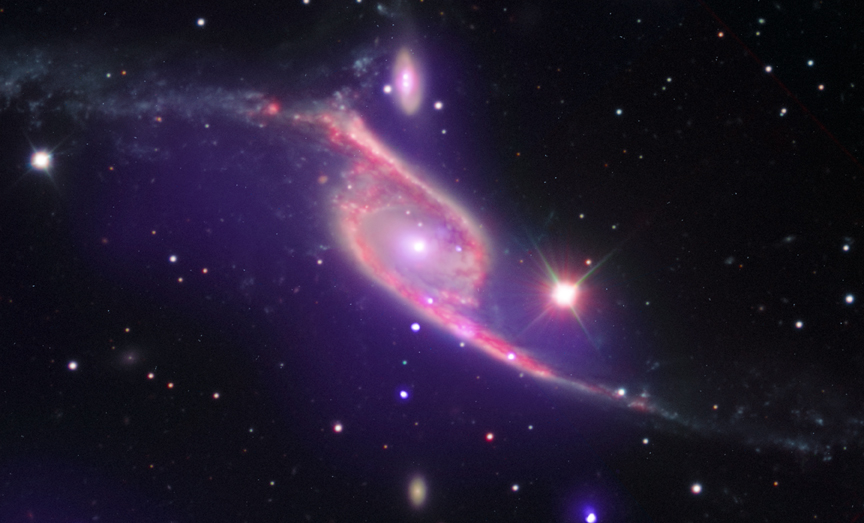
IC 4970 and NGC 6872: Galaxy Collision Switches on Black Hole

Credit X-ray: NASA/CXC/SAO/M.Machacek;
Optical: ESO/VLT;
This composite image of data from three different telescopes shows an ongoing collision between two galaxies, NGC 6872 and IC 4970. X-ray data from NASA's Chandra X-ray Observatory is shown in purple, while Spitzer Space Telescope's infrared data is red and optical data from ESO's Very Large Telescope (VLT) is colored red, green and blue.

Astronomers think that supermassive black holes exist at the center of most galaxies. Not only do the galaxies and black holes seem to co-exist, they are apparently inextricably linked in their evolution. To better understand this symbiotic relationship, scientists have turned to rapidly growing black holes - so-called active galactic nucleus (AGN) - to study how they are affected by their galactic environments.

The latest data from Chandra and Spitzer show that IC 4970, the small galaxy at the top of the image, contains an AGN, but one that is heavily cocooned in gas and dust. This means in optical light telescopes, like the VLT, there is little to see. X-rays and infrared light , however, can penetrate this veil of material and reveal the light show that is generated as material heats up before falling onto the black hole (seen as a bright point-like source).

Despite this obscuring gas and dust around IC 4970, the Chandra data suggest that there is not enough hot gas in IC 4970 to fuel the growth of the AGN. Where, then, does the food supply for this black hole come from? The answer lies with its partner galaxy, NGC 6872. These two galaxies are in the process of undergoing a collision, and the gravitational attraction from IC 4970 has likely pulled over some of NGC 6872's deep reservoir of cold gas (seen prominently in the Spitzer data), providing a new fuel supply to power the giant black hole.

Fast Facts for NGC 6872:

Scale: Image is 347 arcsec across (310,000 light years)
Category: Normal Galaxies & Starburst Galaxies
Coordinates:(J2000) RA 20h 16m 57s | Dec -70° 46' 06
Constellation: Pavo
Observation Date December 14 & 16, 2005
Observation Time: 21 hours
Obs. ID: 7248, 7059
Color Code: X-ray (Purple); Optical (Red, Green, Blue)
Instrument: ACIS
References: Machacek, et al., 2008 ApJ 674 142-150
Distance Estimate: About 180 million light years (redshift = 0.01338)

A faint star orbiting the Big Dipper's Alcor discovered

Caption: Alcor, a star in the middle of the Big Dipper's handle, has a newly found red dwarf companion (circled in green). Project 1640 astronomers discovered the faint star by blocking out almost all of Alcor's light with a coronagraph. The halo of speckles around the coronagraph's occulting mask is caused by the wave-like properties of light from Alcor's residual glare. The actual diameters of both stars take up just a tiny fraction of a pixel. Credit: Project 1640/AMNH and Digital Universe Atlas

Project 1640 sees the unknown using a novel technique known to Galileo

Next time you spy the Big Dipper, keep in mind that there is another star, invisible to the unaided eye, contributing to this constellation. According to a new paper published in The Astrophysical Journal, one of the stars that makes the bend in the ladle's handle, Alcor, has a smaller red dwarf companion. Newly discovered Alcor B orbits its larger sibling and was caught in the act with an innovative technique called "common parallactic motion" by members of Project 1640, an international collaborative team that includes astrophysicists at the American Museum of Natural History, the University of Cambridge's Institute of Astronomy, the California Institute of Technology, and NASA's Jet Propulsion Laboratory.

"We used a brand new technique for determining that an object orbits a nearby star, a technique that's a nice nod to Galileo," says Ben R. Oppenheimer, Curator and Professor in the Department of Astrophysics at the Museum. "Galileo showed tremendous foresight. Four hundred years ago, he realized that if Copernicus was right—that the Earth orbits the Sun—they could show it by observing the "parallactic motion" of the nearest stars. Incredibly, Galileo tried to use Alcor to see it but didn't have the necessary precision." If Galileo had been able to see change over time in Alcor's position, he would have had conclusive evidence that Copernicus was right. Parallactic motion is the way nearby stars appear to move in an annual, repeatable pattern relative to much more distant stars, simply because the observer on Earth is circling the Sun and sees these stars from different places over the year.

Alcor is a relatively young star twice the mass of the Sun. Stars this massive are relatively rare, short-lived, and bright. Alcor and its cousins in the Big Dipper formed from the same cloud of matter about 500 million years ago, something unusual for a constellation since most of these patterns in the sky are composed of unrelated stars. Alcor shares a position in the Big Dipper with another star, Mizar. In fact, both stars were used as a common test of eyesight—being able to distinguish "the rider from the horse"—among ancient people. One of Galileo's colleagues observed that Mizar itself is actually a double, the first binary star system resolved by a telescope. Many years later, the two components Mizar A and B were themselves determined each to be tightly orbiting binaries, altogether forming a quadruple system.

Now, Alcor, which is near the four stars of the Mizar system, also has a companion. This March, members of Project 1640 attached their coronagraph and adaptive optics to the 200-inch Hale Telescope at the Palomar Observatory in California and pointed to Alcor. "Right away I spotted a faint point of light next to the star," says Neil Zimmerman, a graduate student at Columbia University who is doing his PhD dissertation at the Museum. "No one had reported this object before, and it was very close to Alcor, so we realized it was probably an unknown companion star."

The team retuned a few months later and re-imaged the star, hoping to prove that the two stars are companions by mapping the tiny movement of both in relation to very distant background stars as the Earth moves around the Sun, in other words, by mapping its parallactic motion. If the proposed companion were just a background star, it wouldn't move along with Alcor.

"We didn't have to wait a whole year to get the results," says Oppenheimer. "We went back 103 days later and found the companion had the same motion as Alcor. Our technique is powerful and much faster than the usual way of confirming that objects in the sky are physically related." The more typical method involves observing the pair of objects over much longer periods of time, even years, to show that the two are moving through space together.

Alcor and its newly found, smaller companion Alcor B are both about 80 light-years away and orbit each other every 90 years or more. Over one year, the Alcor pair moves in an ellipse on the sky about 0.08 arc seconds in width because of the Earth's orbit around the Sun. This amount of motion, 0.08 arcsec, is about 1,000 times smaller than the eye can discern, but a fraction of this motion was easily measured by the Project 1640 scientists.

The team was also able to determine the color, brightness, and even rough composition of Alcor B because the novel method of observation that Project 1640 uses records images at many different colors simultaneously. The team determined that Alcor B is a common type of M-dwarf star or red dwarf that is about 250 times the mass of Jupiter, or roughly a quarter of the mass of our Sun. The companion is much smaller and cooler than Alcor A.

"Red dwarfs are not commonly reported around the brighter higher mass type of star that Alcor is, but we have a hunch that they are actually fairly common," says Oppenheimer. "This discovery shows that even the brightest and most familiar stars in the sky hold secrets we have yet to reveal."

The team plans to use parallactic motion again in the future. "We hope to use the same technique to check that other objects we find like exoplanets are truly bound to their host stars," says Zimmerman. "In fact, we anticipate other research groups hunting for exoplanets will also use this technique to speed up the discovery process."

***

In addition to Zimmerman and Oppenheimer, authors include Anand Sivaramakrishnan, Sasha Hinkley, and Douglas Brenner of the Astrophysics Department at the Museum; Lynne Hillenbrand, Charles Beichman, Justin Crepp, Antonin Bouchez and Richard Dekany of the California Institute of Technology; Ian Parry, David King, and Stephanie Hunt of the Institute of Astronomy at Cambridge University; Rémi Soummer of the Space Telescope Institute in Baltimore; and Gautam Vasisht, Rick Burruss, Michael Shao, Lewis Roberts, and Jennifer Roberts of the Jet Propulsion Laboratory at California Institute of Technology. Project 1640 is funded by the National Science Foundation.

Contact:

Source: EurekaAlert

Newly discovered star one of hottest in Galaxy

Image of the Bug Nebula taken with the new Wide Field Camera 3
on the Hubble Space Telescope.
Credit: Anthony Holloway, JBCA.

Credit for video:Tim O'Brien & Anthony Holloway, University of Manchester

Image of the Bug Nebula with zoomed in section
showing the newly discovered central star.
Credit: Anthony Holloway & Tim O'Brien, JBCA.

Central section of the Bug Nebula with newly
discovered central star indicated by a circle.
Credit: Anthony Holloway, JBCA.

Astronomers at The University of Manchester's Jodrell Bank Centre for Astrophysics have discovered one of the hottest stars in the Galaxy - with a surface temperature of around 200,000 degrees, it is 35 times hotter than the Sun.

Despite numerous attempts by astronomers across the world, the mysterious dying star at the heart of the Bug nebula - one of the brightest and most beautiful of the planetary nebulae - has never been seen before.

"This star was so hard to find because it is hidden behind a cloud of dust and ice in the middle of the nebula", explained Professor Albert Zijlstra of the University of Manchester.

"Planetary nebulae like the Bug form when a dying star ejects much of its gas back into space and are among the most beautiful objects in the night sky,"

"Our own Sun will do this in about 5 billion years time. The Bug nebula, which is about 3500 light years away in the constellation Scorpius, is one of the most spectacular of all planetary nebulae."

Using the recently refurbished Hubble Space Telescope (HST), a team of astronomers led by Professor Zijlstra have shed new light on the nebula with a set of spectacular images.

The images were taken to show off the new improved HST after it began work again in September this year and will be published in the Astrophysical Journal next week.

The Manchester astronomers were amazed to find that the images unexpectedly revealed the missing central star.

Cezary Szyszka, lead author on the paper and a research student at the University of Manchester currently working at the European Southern Observatory, said: "We are extremely lucky that we had the opportunity to catch this star near its hottest point, from now on it will gradually cool as it dies. This is truly an exceptional object."

Professor Zijlstra added: "It's extremely important to understand planetary nebulae such as the Bug Nebula, as they are crucial to understanding our own existence on Earth".

That is because the elements necessary for life, especially carbon, are created inside stars, and ejected into space as part of these planetary nebulae.

Planets such as the Earth form from small dust particles, which also form within planetary nebulae. The cloud of dust and ice in the Bug Nebula contains the seeds of a future generation of planets."

Finding the star was made possible by the Space Shuttle's final servicing mission of the HST, earlier this year. During the mission, astronauts installed the new Wide Field Camera 3 which was used to take these images.

"How a star ejects a nebula like this is still a mystery", added Dr Tim O'Brien of the University of Manchester.

"It seems most stars, including the Sun, will eject as much as 80 per cent of their mass when they finally run out of nuclear fuel at the end of their lives. Material that then goes on to help form the next generation of stars and planets.

"These observations have shown that the star at the heart of the Bug Nebula is only about 2/3 as heavy as the Sun, but was several times heavier before it threw off its outer layers to form the nebula which had previously hidden it from our view.

"Images like these are remarkable not only for their beauty but also for what they tell us about our own origins."

Notes

The research will be published in a paper entitled "Detection of the Central Star of the Planetary Nebula NGC~6302", by Cezary Szyszka, Jeremy Walsh, Albert Zijlstra, and Yannis Tsamis. It will be published in The Astrophysical Journal and can be downloaded from the astro-ph archive.

Contacts

Mike Addelman
Media Relations
The University of Manchester
0161 275 0790

Prof. Albert Zijlstra
0161 306 3925
e-mail:
albert.zijlstra@manchester.ac.uk

Dr Tim O'Brien
0161 275 4165
e-mail:
tim.obrien@manchester.ac.uk

Wednesday, December 09, 2009

Saturn's Mysterious Hexagon Emerges from Winter Darkness

This movie from Cassini, made possible only as Saturn's north pole emerged from winter darkness, shows new details of a jet stream that follows a hexagon-shaped path and has long puzzled scientists.

After waiting years for the sun to illuminate Saturn's north pole again, cameras aboard NASA's Cassini spacecraft have captured the most detailed images yet of the intriguing hexagon shape crowning the planet.

The new images of the hexagon, whose shape is the path of a jet stream flowing around the north pole, reveal concentric circles, curlicues, walls and streamers not seen in previous images. Images and the three-frame animation are available at http://www.nasa.gov/cassini , http://saturn.jpl.nasa.gov and http://ciclops.org .

The last visible-light images of the entire hexagon were captured by NASA's Voyager spacecraft nearly 30 years ago, the last time spring began on Saturn. After the sunlight faded, darkness shrouded the north pole for 15 years. Much to the delight and bafflement of Cassini scientists, the location and shape of the hexagon in the latest images match up with what they saw in the Voyager pictures.

"The longevity of the hexagon makes this something special, given that weather on Earth lasts on the order of weeks," said Kunio Sayanagi, a Cassini imaging team associate at the California Institute of Technology. "It's a mystery on par with the strange weather conditions that give rise to the long-lived Great Red Spot of Jupiter."

The hexagon was originally discovered in images taken by the Voyager spacecraft in the early 1980s. It encircles Saturn at about 77 degrees north latitude and has been estimated to have a diameter wider than two Earths. The jet stream is believed to whip along the hexagon at around 100 meters per second (220 miles per hour).

Early hexagon images from Voyager and ground-based telescopes suffered from poor viewing perspectives. Cassini, which has been orbiting Saturn since 2004, has a better angle for viewing the north pole. But the long darkness of Saturnian winter hid the hexagon from Cassini's visible-light cameras for years. Infrared instruments, however, were able to obtain images by using heat patterns. Those images showed the hexagon is nearly stationary and extends deep into the atmosphere. They also discovered a hotspot and cyclone in the same region.

The visible-light cameras of Cassini's imaging science subsystem, which have higher resolution than the infrared instruments and the Voyager cameras, got their long-awaited glimpse of the hexagon in January, as the planet approached equinox. Imaging team scientists calibrated and stitched together 55 images to create a mosaic and three-frame movie. The mosaics do not show the region directly around the north pole because it had not yet fully emerged from winter night at that time.

Scientists are still trying to figure out what causes the hexagon, where it gets and expels its energy and how it has stayed so organized for so long. They plan to search the new images for clues, taking an especially close look at the newly identified waves that radiate from the corners of the hexagon -- where the jet takes its hardest turns -- and the multi-walled structure that extends to the top of Saturn's cloud layer in each of the hexagon's six sides. Scientists are also particularly intrigued by a large dark spot that appeared in a different position in a previous infrared image from Cassini. In the latest images, the spot appears in the 2 o'clock position.

Because Saturn does not have land masses or oceans on its surface to complicate weather the way Earth does, its conditions should give scientists a more elementary model to study the physics of circulation patterns and atmosphere, said Kevin Baines, an atmospheric scientist at NASA's Jet Propulsion Laboratory, Pasadena, Calif., who has studied the hexagon with Cassini's visual and infrared mapping spectrometer.

"Now that we can see undulations and circular features instead of blobs in the hexagon, we can start trying to solve some of the unanswered questions about one of the most bizarre things we've ever seen in the solar system," Baines said. "Solving these unanswered questions about the hexagon will help us answer basic questions about weather that we're still asking about our own planet."

The Cassini-Huygens mission is a cooperative project of NASA, the European Space Agency and the Italian Space Agency. JPL, a division of Caltech, manages the Cassini mission for NASA's Science Mission Directorate, Washington. The Cassini orbiter and its two onboard cameras were designed, developed and assembled at JPL. The imaging team is based at the Space Science Institute, Boulder, Colo.

Jia-Rui C. Cook, 818-354-0850
Jet Propulsion Laboratory, Pasadena, Calif.

jia-rui.c.cook@jpl.nasa.gov

Joe Mason, 720-974-5859
Space Science Institute, Boulder, Colo.

jmason@ciclops.org

XMM-Newton celebrates decade of discovery

Credits: ESA (Image by C. Carreau)

ESA’s XMM-Newton X-ray observatory is celebrating its 10th anniversary. During its decade of operation, this remarkable space observatory has supplied new data for every aspect of astronomy. From our cosmic backyard to the further reaches of the Universe, XMM-Newton has changed the way we think of space.

On 10 December 1999, an Ariane 5 blasted off from Europe’s Spaceport in Kourou, French Guiana, carrying the 10 m-long XMM-Newton satellite. It spent eight days manoeuvring into its operational orbit around Earth, a highly elliptical circuit that reaches a third of the way to the Moon. XMM-Newton’s three gold-coated mirror modules began focusing X-rays onto its five instruments soon afterwards. An optical monitoring camera allows astronomers to pinpoint their targets. What began as a steady stream of new data turned into a flood, with more than 2200 research papers now published based upon XMM-Newton’s observations.

“10 years is a long time for a space mission; we have made progress in all aspects of astronomy,” says Norbert Schartel, ESA Project Scientist for the mission.

X-rays from space are usually produced under the most extreme conditions, often from dramatic celestial events. They can be generated in the intense gravitational and magnetic fields surrounding celestial objects such as neutron stars and black holes, or when gigantic clouds of gas collide within clusters of galaxies.

Credits: ESA (Image by C. Carreau)

XMM-Newton has excelled at studying black holes or, more accurately, their environment. By identifying X-rays given off by iron atoms, it has probed the way black holes twist the fabric of space-time around themselves. It has also revealed the way in which supermassive black holes grow and drive the evolution of the most massive galaxies in the Universe, and it has traced the development of the largest structures in space: galaxy clusters. It has tracked the production and dispersal of heavy chemical elements by exploding stars, and measured powerful magnetic activity coming from young Sun-like stars.

Credits: Dr Pedro Rodríguez Pascual, XMM-Newton SOC, ESAC

Closer to home, XMM-Newton has discovered that Mars has a vastly larger atmosphere than previously thought. The Red Planet’s tenuous outer layer, known as its exosphere, extends to six times Mars’ radius. It has shown that icy comets from the outer Solar System give off X-rays. Perhaps one of the most extraordinary results has been that XMM-Newton pinpointed a hot spot on a neutron star, 552 light-years away. The hotspot was just 60 m across, a minuscule patch to see so clearly from Earth orbit. The satellite then went on to make similar discoveries on two other neutron stars.

Credits: Panel A: XMM-Newton EPIC (Guedel et al.), Panel B: AAAS/Science (ESA XMM-Newton and NASA Spitzer data)

XMM-Newton has played its part in the study of dark matter, the hypothetical substance thought to outweigh normal matter by five to one. The favoured variety of dark matter would release X-rays or gamma rays if a particle decays. XMM-Newton has looked for these ‘decay lines’ in galaxy clusters but not found anything, helping theorists to constrain their ideas.

Today, XMM-Newton remains at the forefront of astronomy, supplying data to some 2000 astronomers around the world, who currently produce around 300 refereed papers every year. Every second of observing time is highly contested, with astronomers regularly requesting seven-fold the amount available every time the project team asks for new observing proposals.

As for the future, there is plenty left to study. The earlier Rosat telescope catalogued 125 000 X-ray sources, whereas XMM-Newton has studied only about 4300 of them. Even after its decade in space, the satellite remains in excellent shape. “Technologically, there’s nothing to stop us continuing for another decade,” says Schartel.

For more information:

Norbert Schartel, ESA XMM-Newton Project Scientist

Email: Norbert.Schartel@esa.int

Tuesday, December 08, 2009

Hubble's deepest view of Universe unveils never-before-seen galaxies


The new Wide Field Camera 3 aboard the NASA/ESA Hubble Space Telescope has taken the deepest image yet of the Universe in near-infrared light. The faintest and reddest objects in the image are likely the oldest galaxies ever identified, having formed between only 600–900 million years after the Big Bang.

In 2004, Hubble created the Hubble Ultra Deep Field (HUDF), the deepest visible-light image of the Universe, and now, with its brand-new camera, Hubble is seeing even farther. This image was taken in the same region as the visible HUDF, but is taken at longer wavelengths. Hubble’s newly installed Wide Field Camera 3 (WFC3) collects light from near-infrared wavelengths and therefore looks even farther back towards the Big Bang, because the light from hot young stars in these very distant galaxies is stretched out of the ultraviolet and visible regions of the spectrum into near-infrared wavelengths by the expansion of the Universe. This new deep view also provides insights into how galaxies grew in their formative years early in the Universe's history.

A boon to astronomers worldwide, the new WFC3 data — taken by the HUDF09 team — have set a multitude of teams to work, furiously searching for the most distant galaxies yet discovered. In just three months, twelve scientific papers on these new data have been submitted.

This image was taken by the HUDF09 team [1], which has made it available for research by astronomers worldwide. The photo was taken with the new WFC3/infrared camera on Hubble in late August 2009, during a total of four days of pointing for 173 000 seconds of total exposure time. Infrared light is invisible to the human eye and therefore does not have colours that can be perceived. The representation is "natural" in that shorter infrared wavelengths are represented as blue and the longer wavelengths as red. The faintest objects are about one billion times fainter than the dimmest visible objects seen with the naked eye.

These Hubble observations are blazing a trail for Hubble’s successor, the NASA/ESA James Webb Space Telescope (JWST), which will look even farther into the Universe than Hubble, at infrared wavelengths. The launch of JWST is planned for 2014.

Notes for editors:

[1] The HUDF09 team members are Garth Illingworth (University of California Observatories/Lick Observatory and the University of California, Santa Cruz), Rychard Bouwens (University of California Observatories/Lick Observatory and Leiden University), Pascal Oesch and Marcella Carollo (Swiss Federal Institute of Technology, Zurich (ETH)), Marijn Franx (Leiden University), Ivo Labbe (Carnegie Institute of Washington), Daniel Magee (University of California, Santa Cruz), Massimo Stiavelli (Space Telescope Science Institute), Michele Trenti (University of Colorado, Boulder), and Pieter van Dokkum (Yale University).Image credit: NASA, ESA, G. Illingworth (UCO/Lick Observatory and the University of California, Santa Cruz), R. Bouwens (UCO/Lick Observatory and Leiden University) and the HUDF09 Team

Links:

NASA release
Oxford release
Wilkins et al. science paper
McLure et al. science paper
Bunker et al. science paper

Contacts:

Garth Illingworth
University of California Observatories/Lick Observatory and University of California, Santa Cruz
Tel: +1-831-459-2843
E-mail:
gdi@ucolick.org

Colleen Sharkey
Hubble/ESA, Garching, Germany
Tel: +49-89-3200-6306
Cell: +49-151-1537-3591
E-mail:
csharkey@eso.org

Ray Villard
Space Telescope Science Institute, Baltimore, Md.
Tel: +1-410-338-4514
E-mail:
villard@stsci.edu

Monday, December 07, 2009

Brightness Variations of Sun-like Stars: The Mystery Deepens

The life of Sun-like stars

Astronomers facing Socratic “ignorance”

An extensive study made with ESO’s Very Large Telescope deepens a long-standing mystery in the study of stars similar to the Sun. Unusual year-long variations in the brightness of about one third of all Sun-like stars during the latter stages of their lives still remain unexplained. Over the past few decades, astronomers have offered many possible explanations, but the new, painstaking observations contradict them all and only deepen the mystery. The search for a suitable interpretation is on.

“Astronomers are left in the dark, and for once, we do not enjoy it,” says Christine Nicholls from Mount Stromlo Observatory, Australia, lead author of a paper reporting the study. “We have obtained the most comprehensive set of observations to date for this class of Sun-like stars, and they clearly show that all the possible explanations for their unusual behaviour just fail.”

The mystery investigated by the team dates back to the 1930s and affects about a third of Sun-like stars in our Milky Way and other galaxies. All stars with masses similar to our Sun become, towards the end of their lives, red, cool and extremely large, just before retiring as white dwarfs. Also known as red giants, these elderly stars exhibit very strong periodic variations in their luminosity over timescales up to a couple of years.

“Such variations are thought to be caused by what we call ‘stellar pulsations’,” says Nicholls. “Roughly speaking, the giant star swells and shrinks, becoming brighter and dimmer in a regular pattern. However, one third of these stars show an unexplained additional periodic variation, on even longer timescales — up to five years.”

In order to find out the origin of this secondary feature, the astronomers monitored 58 stars in our galactic neighbour, the Large Magellanic Cloud, over two and a half years. They acquired spectra using the high resolution FLAMES/GIRAFFE spectrograph on ESO’s Very Large Telescope and combined them with images from other telescopes [1], achieving an impressive collection of the properties of these variable stars.

Outstanding sets of data like the one collected by Nicholls and her colleagues often offer guidance on how to solve a cosmic puzzle by narrowing down the plethora of possible explanations proposed by the theoreticians. In this case, however, the observations are incompatible with all the previously conceived models and re-open an issue that has been thoroughly debated. Thanks to this study, astronomers are now aware of their own “ignorance” — a genuine driver of the knowledge-seeking process, as the ancient Greek philosopher Socrates is said to have taught.

“The newly gathered data show that pulsations are an extremely unlikely explanation for the additional variation,” says team leader Peter Wood. “Another possible mechanism for producing luminosity variations in a star is to have the star itself move in a binary system. However, our observations are strongly incompatible with this hypothesis too.”

The team found from further analysis that whatever the cause of these unexplained variations is, it also causes the giant stars to eject mass either in clumps or as an expanding disc. “A Sherlock Holmes is needed to solve this very frustrating mystery,” concludes Nicholls.
Note

[1] Precise brightness measurements were made by the MACHO and OGLE collaborations, running on telescopes in Australia and Chile, respectively. The OGLE observations were made at the same time as the VLT observations.
More Information

This research was presented in two papers: one appeared in the November issue of the Monthly Notices of the Royal Astronomical Society (“Long Secondary Periods in Variable Red Giants”, by C. P. Nicholls et al.), and the other has just been published in the Astrophysical Journal (“Evidence for mass ejection associated with long secondary periods in red giants”, by P. R. Wood and C. P. Nicholls).

The team is composed of Christine P. Nicholls and Peter R. Wood (Research School of Astronomy and Astrophysics, Australia National University), Maria-Rosa L. Cioni (Centre for Astrophysics Research, University of Hertfordshire, UK) and Igor Soszyński (Warsaw University Observatory).

ESO, the European Southern Observatory, is the foremost intergovernmental astronomy organisation in Europe and the world’s most productive astronomical observatory. It is supported by 14 countries: Austria, Belgium, the Czech Republic, Denmark, France, Finland, Germany, Italy, the Netherlands, Portugal, Spain, Sweden, Switzerland and the United Kingdom. ESO carries out an ambitious programme focused on the design, construction and operation of powerful ground-based observing facilities enabling astronomers to make important scientific discoveries. ESO also plays a leading role in promoting and organising cooperation in astronomical research. ESO operates three unique world-class observing sites in Chile: La Silla, Paranal and Chajnantor. At Paranal, ESO operates the Very Large Telescope, the world’s most advanced visible-light astronomical observatory. ESO is the European partner of a revolutionary astronomical telescope ALMA, the largest astronomical project in existence. ESO is currently planning a 42-metre European Extremely Large optical/near-infrared Telescope, the E-ELT, which will become “the world’s biggest eye on the sky”.

Links
Research papers: http://arxiv.org/abs/0907.2975 and http://arxiv.org/abs/0910.4418

Contacts

Christine Nicholls and Peter Wood
Mount Stromlo Observatory, Australia
Phone: +61-2-6125 0222; +61-2-6125 8032
E-mail:
Nicholls@mso.anu.edu.au; wood@mso.anu.edu.au

ESO La Silla - Paranal - ELT Press Officer: Henri Boffin - +49 89 3200 6222 - hboffin@eso.org
ESO Press Officer in Chile: Valeria Foncea - +56 2 463 3123 - vfoncea@eso.org

National contacts for the media: http://www.eso.org/public/outreach/eson/