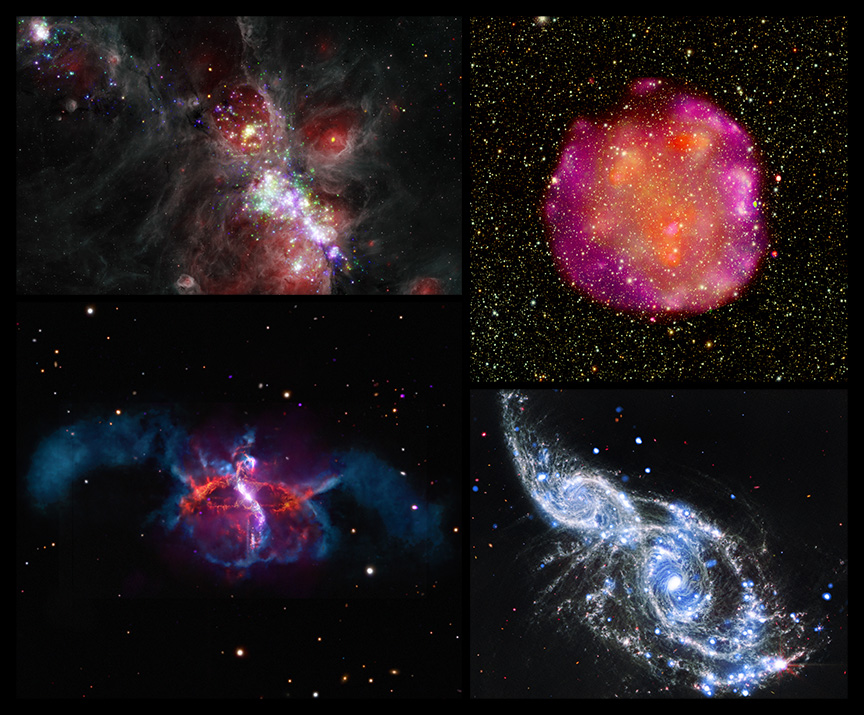
- Four images that one can imagine connections to fall have been released by NASA’s Chandra X-ray Observatory.
- The images are the star-forming region NGC 6334, supernova remnant G272.2-0.3, interacting spiral galaxies NGC 2207 and IC 2163, as well as R Aquarii.
- Each image contains X-rays from Chandra that have been combined with data from other telescopes that detect different types of light.
- Pareidolia is the phenomenon that allows people to see familiar patterns or shapes in data.
Before fall gives way to winter in the
northern hemisphere, NASA’s Chandra X-ray Observatory has several images
that celebrate autumn and its many delights to share. In spirit of the
season, this collection gathers Chandra data with those from its
telescopic family including NASA’s James Webb, Hubble, and Spitzer Space
Telescopes, plus others in space and on the ground.
Here is a sample of the seasonal offerings that space has in store:

For many, nothing evokes fall more than fallen leaves. In this view of NGC 6334, glowing pockets of dust and gas in the nebula resemble leaves that have been picked up by a wind gust. This region is actually home to strong winds blowing from the young stars that have formed there. This image contains X-ray data from Chandra (blue, green, and yellow) that shows the effects of these winds, which have been combined with infrared data from the now-retired Spitzer Space Telescope (red, brown), which shows the dust and gas that fuels the growing stars.

Born after a violent explosion of a star, this cosmic gourd is the supernova remnant G272.2-03.2. X-ray observations (orange and magenta) from Chandra provide evidence that G272 is the result of a Type Ia supernova explosion, where a white dwarf star pulls material from a companion star until it triggers a thermonuclear explosion and obliterates the star. The inside of the “pumpkin” is superheated gas that is filling the space cleared out by the explosion as it moves outward.

Multiple telescopes teamed up to capture an image that looks like a cozy sweater with fuzzy arms. X-rays from Chandra and ESA’s XMM-Newton (purple), optical light data from Hubble and the Very Large Telescope in Chile (orange, red, and violet), and an optical image from astrophotographer Bob Fera (deep blue) combine to reveal R Aquarii. Nestled within the cozy ‘body’ of R Aquarii is a pair of stars where a white dwarf is pulling material from a much larger red giant companion. When enough material accumulates on the surface of the white dwarf, it triggers an outburst that sends a jet out into space. Over time, these jets twist and loop around each other weaving the structure seen today.

A cornucopia is a horn-shaped basket that traditionally carries fruits and vegetables. There is nothing edible in this pair of galactic cornucopias but there are a bounty of stars, dust, and other ingredients than make up these two spiral galaxies, known as NGC 2207 (right) and IC 2163 (left), that we see face-on. This view of NGC 2207 and IC 2163 takes a James Webb infrared image (white, gray, and red) and adds the X-ray view from Chandra (blue). Together, it is quite an eye-catching result.
NASA's Marshall Space Flight Center in Huntsville, Alabama, manages the Chandra program. The Smithsonian Astrophysical Observatory's Chandra X-ray Center controls science operations from Cambridge, Massachusetts, and flight operations from Burlington, Massachusetts.
NASA's Marshall Space Flight Center in Huntsville, Alabama, manages the Chandra program. The Smithsonian Astrophysical Observatory's Chandra X-ray Center controls science operations from Cambridge, Massachusetts, and flight operations from Burlington, Massachusetts.
Quick Look: Before Fall Leaves, See Seasonal Offer ings from NASA's Chandra
Source: NASA’s Chandra X-ray Observatory
Visual Description:
This release highlights a collection of four composite images,
presented in a two-by-two grid. Each image features data gathered by the
Chandra X-ray Observatory and additional NASA and other telescopes.
At our upper left is NGC 6334, a massive nebula and star-forming region. In this image, scores of glowing young stars, depicted as tiny specs of distant light, illuminate an otherwise dark scene. The specs of red, green, yellow, purple, and white, are clustered near the center of the image, but extend to the edges of the frame in faint streaks. Partially masking the specs of color are tendrils of grey clouds; strong winds of dust and gas blowing from the still-forming stars.
The image at our upper right features a supernova remnant called G272.2-3.2. Here, a white dwarf star has pulled material from a companion star, triggering a thermonuclear explosion. What remains is a giant ball of superheated gas, set against a densely-packed field of distant stars and galaxies. In this image, the ball of gas is a mottled, translucent orange sphere with patches of hot pink at the outer edges.
The image at the grid's lower right depicts a pair of colliding spiral galaxies. Here, both spirals are shown face on, with the smaller of the two galaxies, IC 2163, at the upper left of the larger galaxy, NGC 2207, which dominates the center and lower right of the image. Both galaxies have long, spiraling, silver blue arms, dotted with specs of blue and red. Toward our upper left, the curving arms overlap, and bend toward their neighbors' core.
Finally, at our lower left, is R Aquarii, a symbiotic binary star. Here, a white dwarf star pulls material from a much larger red giant companion, sending looping jets of matter into space. In this composite image, which includes an optical image from astrophotographer Bob Fera, the resulting structure resembles a cozy sweater with a red body, and blue wooly arms opened wide.
Fast Facts for NGC 6334:
Credit: X-ray: NASA/SAO/CXC; Infrared: NASA/JPL/CalTech/Spitzer; Image Processing: NASA/CXC/SAO/J. Schmidt
Release Date: November 24, 2025
Scale: Image is about 72 arcmin (115.2 light-years) across.
Category: Normal Stars and Star Clusters
Coordinates (J2000): RA: 17h 20m 50.9s | Dec: -36° 06' 54"
Constellation: Scorpius
Observation Date(s): 10 observations from August 2002 to July 2016
Observation Time: 85 hours 28 minutes (3 days 13 hours 28 minutes)
Obs. IDs: 2573, 2574 ,3844, 4591, 8975, 12382, 13436, 18082, 18081, 18876
Instrument: ACIS
Color Code: X-ray: red, orange, green, and purple; Infrared: white and red
Distance Estimate: About 5,500 light-years from Earth
Fast Facts for SNR G272.2-03.2:
Credit: X-ray: NASA/CXC/SA0; Optical: NOIRLab/DECaPS2; Image Processing: NASA/CXC/SAO/L. Frattare
Release Date: November 24, 2025
Scale: Image is about 2.8 arcmin (5.7 light-years) across.
Category: Supernovas & Supernova Remnants
Coordinates (J2000): RA: 9h 06m 47s | Dec: -52° 05' 50"
Constellation: Vela
Observation Date(s): 2 observations Aug 26-27, 2008
Observation Time: 17 hours 55 minutes
Obs. IDs: 9147, 10572
Instrument: ACIS
Color Code: X-ray: cyan, yellow, and magenta; Optical: red, green, and blue
Distance Estimate: About 7,000 light-years from Earth
Fast Facts for R Aquarii:
Scale: Image is about 9.5 arcmin (1.8 light-years) across.
Category: White Dwarfs and Planetary Nebulas
Coordinates (J2000): RA: 23h 43m 49.5s | Dec: -15° 17' 04"
Constellation: Aquarius
Observation Date(s): 3 pointings between Sep 2001 and Oct 2005
Observation Time: 34 hours 54 minutes (1 day 10 hours 54 minutes)
Obs. IDs: 651, 4546, 5438
Instrument: ACIS
Fast Facts for NGC 2207 & IC 2163:
Credit: X-ray: NASA/CXC/SAO; Infrared: NASA/ESA/CSA/STScI/Webb; Image Processing: NASA/CXC/SAO/L. Frattare
Release Date: November 24, 2025
Scale Image is about 5 arcmin (189,000 light-years) across.
Category: Normal Galaxies, Starburst Galaxies, & Black Holes
Coordinates (J2000): RA: 6h 16m 22.1s | Dec: -21° 22′ 22"
Constellation: Canis Major
Observation Date(s): 4 observations from July 2010 to August 2013
Observation Time: 17 hours 20 minutes
Obs. IDs: 11228, 14914, 14799, 14915
Instrument: ACIS
Color Code: X-ray: blue; Infrared: white, red, green, and blue
Distance Estimate: About 130 million light-years from Earth
At our upper left is NGC 6334, a massive nebula and star-forming region. In this image, scores of glowing young stars, depicted as tiny specs of distant light, illuminate an otherwise dark scene. The specs of red, green, yellow, purple, and white, are clustered near the center of the image, but extend to the edges of the frame in faint streaks. Partially masking the specs of color are tendrils of grey clouds; strong winds of dust and gas blowing from the still-forming stars.
The image at our upper right features a supernova remnant called G272.2-3.2. Here, a white dwarf star has pulled material from a companion star, triggering a thermonuclear explosion. What remains is a giant ball of superheated gas, set against a densely-packed field of distant stars and galaxies. In this image, the ball of gas is a mottled, translucent orange sphere with patches of hot pink at the outer edges.
The image at the grid's lower right depicts a pair of colliding spiral galaxies. Here, both spirals are shown face on, with the smaller of the two galaxies, IC 2163, at the upper left of the larger galaxy, NGC 2207, which dominates the center and lower right of the image. Both galaxies have long, spiraling, silver blue arms, dotted with specs of blue and red. Toward our upper left, the curving arms overlap, and bend toward their neighbors' core.
Finally, at our lower left, is R Aquarii, a symbiotic binary star. Here, a white dwarf star pulls material from a much larger red giant companion, sending looping jets of matter into space. In this composite image, which includes an optical image from astrophotographer Bob Fera, the resulting structure resembles a cozy sweater with a red body, and blue wooly arms opened wide.
Fast Facts for NGC 6334:
Credit: X-ray: NASA/SAO/CXC; Infrared: NASA/JPL/CalTech/Spitzer; Image Processing: NASA/CXC/SAO/J. Schmidt
Release Date: November 24, 2025
Scale: Image is about 72 arcmin (115.2 light-years) across.
Category: Normal Stars and Star Clusters
Coordinates (J2000): RA: 17h 20m 50.9s | Dec: -36° 06' 54"
Constellation: Scorpius
Observation Date(s): 10 observations from August 2002 to July 2016
Observation Time: 85 hours 28 minutes (3 days 13 hours 28 minutes)
Obs. IDs: 2573, 2574 ,3844, 4591, 8975, 12382, 13436, 18082, 18081, 18876
Instrument: ACIS
Color Code: X-ray: red, orange, green, and purple; Infrared: white and red
Distance Estimate: About 5,500 light-years from Earth
Fast Facts for SNR G272.2-03.2:
Credit: X-ray: NASA/CXC/SA0; Optical: NOIRLab/DECaPS2; Image Processing: NASA/CXC/SAO/L. Frattare
Release Date: November 24, 2025
Scale: Image is about 2.8 arcmin (5.7 light-years) across.
Category: Supernovas & Supernova Remnants
Coordinates (J2000): RA: 9h 06m 47s | Dec: -52° 05' 50"
Constellation: Vela
Observation Date(s): 2 observations Aug 26-27, 2008
Observation Time: 17 hours 55 minutes
Obs. IDs: 9147, 10572
Instrument: ACIS
Color Code: X-ray: cyan, yellow, and magenta; Optical: red, green, and blue
Distance Estimate: About 7,000 light-years from Earth
Fast Facts for R Aquarii:
Credit: X-ray: NASA/CXC/SAO; ESA/XMM-Newton; Optical HST: NASA/ESA/STScI; Optical Ground: Deep Space Remote observatories/B. Fera; ESO/VLT; Image Processing: NASA/CXC/SAO/L. Frattare
Release Date: November 24, 2025Scale: Image is about 9.5 arcmin (1.8 light-years) across.
Category: White Dwarfs and Planetary Nebulas
Coordinates (J2000): RA: 23h 43m 49.5s | Dec: -15° 17' 04"
Constellation: Aquarius
Observation Date(s): 3 pointings between Sep 2001 and Oct 2005
Observation Time: 34 hours 54 minutes (1 day 10 hours 54 minutes)
Obs. IDs: 651, 4546, 5438
Instrument: ACIS
Color Code: X-ray: purple and blue; Optical (HST): cyan and orange; Optical (Ground): red, green, and blue; Radio: red with green
Distance Estimate: About 650 light-years from EarthFast Facts for NGC 2207 & IC 2163:
Credit: X-ray: NASA/CXC/SAO; Infrared: NASA/ESA/CSA/STScI/Webb; Image Processing: NASA/CXC/SAO/L. Frattare
Release Date: November 24, 2025
Scale Image is about 5 arcmin (189,000 light-years) across.
Category: Normal Galaxies, Starburst Galaxies, & Black Holes
Coordinates (J2000): RA: 6h 16m 22.1s | Dec: -21° 22′ 22"
Constellation: Canis Major
Observation Date(s): 4 observations from July 2010 to August 2013
Observation Time: 17 hours 20 minutes
Obs. IDs: 11228, 14914, 14799, 14915
Instrument: ACIS
Color Code: X-ray: blue; Infrared: white, red, green, and blue
Distance Estimate: About 130 million light-years from Earth