Videos
Cosmoview Episode 66: A Sharper Look at the First Image of a Black Hole
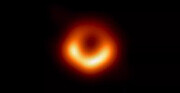
Transition Between Original and PRIMO Images
Cosmoview Episodio 66: Científicos logran mejorar la nitidez de la primera imagen de un agujero negro
Machine learning reconstructs new image of Messier 87 from Event Horizon Telescope data
A team of researchers, including an
astronomer with NSF’s NOIRLab, has developed a new machine-learning
technique to enhance the fidelity and sharpness of radio interferometry
images. To demonstrate the power of their new approach, which is called
PRIMO, the team created a new, high-fidelity version of the iconic Event
Horizon Telescope's image of the supermassive black hole at the center
of Messier 87, a giant elliptical galaxy located 55 million light-years
from Earth.
The iconic image of the supermassive black hole at the center of Messier 87
has received its first official makeover, thanks to a new
machine-learning technique known as PRIMO. This new image better
illustrates the full extent of the object’s dark central region and the
surprisingly narrow outer ring. To achieve this result, a team of
researchers used the original 2017 data obtained by the Event Horizon
Telescope (EHT) collaboration and created a new image that, for the first time, represents the full resolution of the EHT. [1]
PRIMO, which stands for principal-component interferometric modeling,
was developed by EHT members Lia Medeiros (Institute for Advanced
Study), Dimitrios Psaltis (Georgia Tech), Tod Lauer (NSF’s NOIRLab), and
Feryal Ozel (Georgia Tech). A paper describing their work is published
in The Astrophysical Journal Letters.
In 2017 the EHT collaboration used a network of seven radio telescopes
at different locations around the world to form an Earth-sized virtual
telescope with the power and resolution capable of observing the
“shadow” of a black hole’s event horizon. [2]
Though this technique allowed astronomers to see remarkably fine
details, it lacked the collecting power of an actual Earth-sized
telescope, leaving gaps in the data. The researchers’ new
machine-learning technique helped fill in those gaps.
“With our new machine-learning technique, PRIMO, we were able to achieve the maximum resolution of the current array,” says lead author Lia Medeiros. “Since
we cannot study black holes up close, the detail in an image plays a
critical role in our ability to understand its behavior. The width of
the ring in the image is now smaller by about a factor of two, which
will be a powerful constraint for our theoretical models and tests of
gravity.”
PRIMO relies on a branch of machine learning known as dictionary
learning, which teaches computers certain rules by exposing them to
thousands of examples. The power of this type of machine learning has
been demonstrated in numerous ways, from creating Renaissance-style
works of art to completing the unfinished work of Beethoven.
Applying PRIMO to the EHT image of Messier 87, computers analyzed
over 30,000 high-fidelity simulated images of gas accreting onto a black
hole to look for common patterns in the images. The results were then
blended to provide a highly accurate representation of the EHT
observations, simultaneously providing a high-fidelity estimate of the
missing structure of the image. A paper pertaining to the algorithm
itself was published previously in The Astrophysical Journal on 3 February 2023.
“PRIMO is a new approach to the difficult task of constructing images from EHT observations,” said Lauer. “It
provides a way to compensate for the missing information about the
object being observed, which is required to generate the image that
would have been seen using a single gigantic radio telescope the size of
the Earth.”
The team confirmed that the newly rendered image is consistent with
the EHT data and with theoretical expectations, including the bright
ring of emission expected to be produced by hot gas falling into the
black hole.
The new image should lead to more accurate determinations of the mass
of the Messier 87 black hole and the physical parameters that determine
its present appearance. The data also provide an opportunity for
researchers to place greater constraints on alternatives to the event
horizon (based on the darker central brightness depression) and perform
more robust tests of gravity (based on the narrower ring size). PRIMO
can also be applied to additional EHT observations, including those of Sagittarius A*, the central black hole in our own Milky Way Galaxy.
“The 2019 image was just the beginning,” said Medeiros. “If
a picture is worth a thousand words, the data underlying that image
have many more stories to tell. PRIMO will continue to be a critical
tool in extracting such insights.”
More Information
[1] One of the telescopes comprising the EHT, the South Pole
Telescope, was not part of the Messier 87 observation. Since that time,
the EHT has added additional telescopes to the array.
[2] The shadow of a black hole is the closest we can come to an
image of the black hole itself, a completely dark object from which
light cannot escape. In the case of Messier 87, the black hole’s
boundary — the event horizon from which the EHT takes its name — is
around 2.5 times smaller than the shadow it casts and measures just
under 40 billion kilometers across.
Development of the PRIMO algorithm was enabled through the support of
a National Science Foundation Astronomy and Astrophysics Postdoctoral
Fellowship.
NSF’s NOIRLab, the US center for ground-based optical-infrared astronomy, operates the International Gemini Observatory (a facility of NSF, NRC–Canada, ANID–Chile, MCTIC–Brazil, MINCyT–Argentina, and KASI–Republic of Korea), Kitt Peak National Observatory (KPNO), Cerro Tololo Inter-American Observatory (CTIO), the Community Science and Data Center (CSDC), and Vera C. Rubin Observatory (operated in cooperation with the Department of Energy’s SLAC National Accelerator Laboratory). It is managed by the Association of Universities for Research in Astronomy (AURA)
under a cooperative agreement with NSF and is headquartered in Tucson,
Arizona. The astronomical community is honored to have the opportunity
to conduct astronomical research on Iolkam Du’ag (Kitt Peak) in Arizona,
on Maunakea in Hawai‘i, and on Cerro Tololo and Cerro Pachón in Chile.
We recognize and acknowledge the very significant cultural role and
reverence that these sites have to the Tohono O’odham Nation, to the
Native Hawaiian community, and to the local communities in Chile,
respectively.
Links
Contacts:
Tod Lauer
NSF’s NOIRLab
Email: tod.lauer@noirlab.edu
Charles Blue
NSF’s NOIRLab
Tel: +1 202 236 6324
Email: charles.blue@noirlab.edu