Wednesday, August 07, 2013

The Odd Couple

Two very different glowing gas clouds in the Large Magellanic Cloud
 
An odd couple of glowing gas clouds in the constellation of Dorado
 
Wide-field view of NGC 2014 and NGC 2020 in the Large Magellanic Cloud

Videos

Zooming in on glowing gas clouds NGC 2014 and NGC 2020

Pan across new VLT image of NGC 2014 and NGC 2020

Two very different gas clouds in the galaxy next door

ESO’s Very Large Telescope has captured an intriguing star-forming region in the Large Magellanic Cloud — one of the Milky Way’s satellite galaxies. This sharp image reveals two distinctive glowing clouds of gas: red-hued NGC 2014, and its blue neighbour NGC 2020. While they are very different, they were both sculpted by powerful stellar winds from extremely hot newborn stars that also radiate into the gas, causing it to glow brightly.

This image was taken by the Very Large Telescope (VLT) at ESO's Paranal Observatory in Chile — the best place in the southern hemisphere for astronomical observing. But even without the help of telescopes like the VLT, a glance towards the southern constellation of Dorado (The Swordfish or Dolphinfish [1]) on a clear, dark night reveals a blurry patch which, at first sight, appears to be just like a cloud in the Earth's atmosphere.

At least, this may have been explorer Ferdinand Magellan's first impression during his famous voyage to the southern hemisphere in 1519. Although Magellan himself was killed in the Philippines before his return, his surviving crew announced the presence of this cloud and its smaller sibling when they returned to Europe, and these two small galaxies were later named in Magellan's honour. However, they were undoubtedly seen by both earlier European explorers and observers in the southern hemisphere, although they were never reported.

The Large Magellanic Cloud (LMC) is actively producing new stars. Some of its star-forming regions can even be seen with the naked eye, for example, the famous Tarantula Nebula. However, there are other smaller — but no less intriguing — regions that telescopes can reveal in intricate detail. This new VLT image explores an oddly mismatched pair: NGC 2014 and NGC 2020.

The pink-tinged cloud on the right, NGC 2014, is a glowing cloud of mostly hydrogen gas. It contains a cluster of hot young stars. The energetic radiation from these new stars strips electrons from the atoms within the surrounding hydrogen gas, ionising it and producing a characteristic red glow.

In addition to this strong radiation, massive young stars also produce powerful stellar winds that eventually cause the gas around them to disperse and stream away. To the left of the main cluster, a single brilliant and very hot star [2] seems to have started this process, creating a cavity that appears encircled by a bubble-like structure called NGC 2020. The distinctive blueish colour of this rather mysterious object is again created by radiation from the hot star — this time by ionising oxygen instead of hydrogen.

The strikingly different colours of NGC 2014 and NGC 2020 are the result of both the different chemical makeup of the surrounding gas and the temperatures of the stars that are causing the clouds to glow. The distances between the stars and the respective gas clouds also play a role.

The LMC is only about 163 000 light-years from our galaxy, the Milky Way, and so is very close on a cosmic scale. This proximity makes it a very important target for astronomers, as it can be studied in far more detail than more distant systems. It was one of the motivations for building telescopes in the southern hemisphere, which led to the establishment of ESO over 50 years ago. Although enormous on a human scale, the LMC contains less than one tenth of the mass of the Milky Way, and spans just 14 000 light-years — by contrast, the Milky Way covers some 100 000 light-years. Astronomers refer to the LMC as an irregular dwarf galaxy; its irregularity, combined with its prominent central bar of stars, suggests that interactions with the Milky Way and another nearby galaxy, the Small Magellanic Cloud, could have caused its chaotic shape.

This image was acquired using the visual and near-ultraviolet FOcal Reducer and low dispersion Spectrograph (FORS2) instrument attached to ESO's VLT, as part of the ESO Cosmic Gems programme [3].

Notes

[1] Although this constellation is often identified with the swordfish there are reasons to think that the less commonly known dolphinfish may be a better match. More details are given here.

[2] This star is an example of a rare class called Wolf-Rayet stars. These short-lived objects are very hot — their surfaces can be more than ten times as hot as the surface of the Sun — and very bright and dominate the regions around them.

[3] This picture comes from the ESO Cosmic Gems programme, an outreach initiative to produce images of interesting, intriguing or visually attractive objects using ESO telescopes, for the purposes of education and public outreach. The programme makes use of telescope time that cannot be used for science observations. All data collected may also be suitable for scientific purposes, and are made available to astronomers through ESO’s science archive.

More information

ESO is the foremost intergovernmental astronomy organisation in Europe and the world’s most productive ground-based astronomical observatory by far. It is supported by 15 countries: Austria, Belgium, Brazil, the Czech Republic, Denmark, France, Finland, Germany, Italy, the Netherlands, Portugal, Spain, Sweden, Switzerland and the United Kingdom. ESO carries out an ambitious programme focused on the design, construction and operation of powerful ground-based observing facilities enabling astronomers to make important scientific discoveries. ESO also plays a leading role in promoting and organising cooperation in astronomical research. ESO operates three unique world-class observing sites in Chile: La Silla, Paranal and Chajnantor. At Paranal, ESO operates the Very Large Telescope, the world’s most advanced visible-light astronomical observatory and two survey telescopes. VISTA works in the infrared and is the world’s largest survey telescope and the VLT Survey Telescope is the largest telescope designed to exclusively survey the skies in visible light. ESO is the European partner of a revolutionary astronomical telescope ALMA, the largest astronomical project in existence. ESO is currently planning the 39-metre European Extremely Large optical/near-infrared Telescope, the E-ELT, which will become “the world’s biggest eye on the sky”.

Links

Contacts


Richard Hook
ESO, Public Information Officer
Garching bei München, Germany
Tel: +49 89 3200 6655
Cell: +49 151 1537 3591
Email:
rhook@eso.org


Subaru Telescope’s Imaging Discovery of a Second Jupiter Shows the Power and Significance of the SEEDS Project

Astronomers in the Strategic Explorations of Exoplanets and Disks with Subaru (SEEDS) Project have recently discovered and captured an image of the least massive planet ever imaged so far--a so-called "second Jupiter" (Figure 1). This discovery marks an important step toward the direct imaging of much fainter Earth-like planets in the future and may lead to new models of planet formation. It also illustrates the important role that the SEEDS project plays in observational astronomy.

Figure 1: Near-infrared color composite images of a "second Jupiter" around the Sun-like star GJ 504. A coronagraph and differential techniques suppress the bright light from the central star. On the left is the intensity image, which shows the radiant power passing through the area, while on the right is the signal-to-noise ratio image, which shows the weakest signal that the detecting system can recognize. (Credit: NAOJ)

Observations of Exoplanets

Exoplanets are planets orbiting stars other than our Sun, outside of our Solar System. As of July 2013, most of the 890 exoplanets reported thus far have been discovered by indirect observation techniques, e.g. monitoring the host star for radial velocity variation or planetary transits (Note 1). Such techniques require observations over at least one orbital period and are impractical for detecting planets that are widely separated from their host stars and have long orbital periods. In contrast, direct imaging may be the most important way to observe exoplanets, because it yields information about the planet's luminosity, temperature, atmosphere, and orbit. However, this method is technically challenging, because these distant planets are not only faint but also close to their bright central stars, the glare of which easily obscures an indication of a planet. It's like trying to see a firefly around a distant lighthouse. Only a dozen planets with a location similar in scale to that of the Solar System have been discovered. In spite of these technical challenges, 8 m class telescopes with adaptive optics and coronagraphs that block the light of the central star have reached the high performance necessary to image massive planets at large orbital separations. The Subaru SEEDS project is in the forefront of using direct observation to discover and explore the features of exoplanets.

Discovery of a "Second Jupiter"

Since 2009, SEEDS, an international project approved by the National Astronomical Observatory of Japan (NAOJ) and led by Motohide Tamura (University of Tokyo and NAOJ), has been probing this new frontier with its five-year direct imaging survey of exoplanets and disks around a targeted total of 500 stars. The team is composed of more than 120 members (two-thirds from Japan and one-third in the United States and Europe) and over 25 institutes.


Video: An explanation of what an exoplanet is and why direct imaging of a "second Jupiter" around the Sun-like star GJ 504 is so significant. (Credit: NAOJ)

During the SEEDS survey, a team led by members from the Tokyo Institute of Technology (TiTech), the University of Tokyo, and NAOJ used the High Contrast Instrument for the Subaru Next Generation Adaptive Optics (HiCIAO) (Note 2) mounted on the Subaru Telescope to discover and image planet candidate GJ 504 b that orbits a Sun-like star GJ 504, which is in the constellation Virgo about 60 light years from Earth (Figure 2). They used a mature (160 Myr) host star as a natural guide star for the AO 188 (adaptive optics with 188 elements). GJ 504 is bright and visible to the naked-eye (~5 magnitudes), but the planet is very dim (17-20 magnitudes at infrared wavelengths).

Since a single direct imaging cannot distinguish planet candidates from background stars that happen to be within the small field of view of the camera, the team conducted seven observations, including the use of IRCS (Infrared Camera and Spectrograph) with AO 188, to confirm that GJ 504 b orbits around GJ 504 and is NOT a background star.

What is the mass of this planet? Planet mass is estimated from age and luminosity. However, mass estimates for planets suffer from the uncertainties of cooling models for giant planets. Planetary mass estimates usually assume a hot start, in which the planet is initially in a hot-temperature and luminous state. However, recent theoretical models suggest that giant planets could be much colder initially. The difference between the relation of mass to luminosity decreases with an exoplanet's age and converges after 100 Myr for a five-Jupiter-mass planet. Regardless of which model is used to calculate the mass of this cold, dim object, GJ 504 b, the central star GJ 504 is mature enough (160 Myr) to predict a planetary rather than brown dwarf mass.

Based on the relation of its observed luminosity and estimated age in comparison with the theoretical model, scientists can infer that GJ 504 b has a mass as small as three Jovian masses. If so, it is the lightest-mass planet ever imaged. The apparent distance between the central star and planet is 44 AU (astronomical unit), which is larger than Neptune's orbit and comparable to Pluto's, and the team concludes that they have finally imaged a "second Jupiter". This is an important step toward the direct imaging of much fainter Earth-like planets in future.

The question remains: How did such a giant planet form around a Sun-like star? The standard core accretion model based on our Solar System does not provide an adequate explanation for the formation of these outer planets situated so far from their central stars. This model maintains that the core reaches a critical mass from the accretion of bodies of rock or ice (planetesimals) and subsequently increases with the rapid and direct accumulation of gas from its protoplanetary disk. However, it falls short of explaining how planets beyond 30 AU have developed.

Perhaps another model like gravitational instability of formation sites could supply the answer. This model maintains that a massive protoplanetary disk becomes gravitationally unstable in its outer regions. Consequently, the outer disk fragments, collapsing directly into one or more giant planets. However, gravitational instability has its own challenge. The theory requires that Sun-like stars have very massive disks around them, and it is unlikely that they could obtain enough mass in such outer regions. 

At this point scientists cannot definitely say what led to the formation of GJ 504 b. Its features provide the basis for continuing investigation. Subsequent observations reveal that the planet has a unique blue color (Figure 2), which indicates that its atmosphere is less cloudy than that of other imaged planets.

Figure 2: Near-infrared color and magnitude of the planet GJ 504 b, compared with other imaged planets and brown dwarfs. (Credit: NAOJ)
Its relatively cold temperature, less cloudiness, and light mass place it in a physically distinct category from previously imaged planets, which are hotter and have cloudier atmospheres. Additional interesting features include its age (oldest among all directly imaged planets) as well as its wide separation and orbit around a main sequence star with a Sun-like mass.

Other Fruits of the SEEDS Project

In line with the project's aim of using the Subaru Telescope to directly image young planetary-mass objects and circumstellar structures located at relatively large distances from central stars, observers have used HiCIAO (Notes 2 & 3) with the Subaru Telescope to directly image two exoplanets and provide detailed images of more than ten protoplanetary and two debris disks (Figure 3). Observations have yielded reports of the following;
They have also detected interesting fine structures of the disks around many young stars, which show gaps, spiral arms, and rings; these structures may be "signposts of planets". In addition, the image of a companion around HAT-P-7 may explain the retrograde motion of its planet HAT-P-7 b ("The Origin and Maintenance of a Retrograde Exoplanet")


Figure 3: Gallery of disks imaged in the near-infrared by Subaru SEEDS. Note the spirals and gaps in the disks that the images reveal. (Credit: NAOJ)

The Promise of Future Research

The SEEDS Project has finished more than three-quarters of its allotted 120 observation nights. About 500 stars will eventually be observed, and the statistical results on the frequency of outer planets will provide clues to planet formation. Scientists can address such questions as: "How numerous are outer planets?"; "Where and how did they form?"; "What do their atmospheres look like ?"

The team has detected many gaps and spiral-arm structures in disks at the same radial distance where outer planets were discovered. Planets within the disks could explain the formation of these structures and allow scientists to hypothesize that outer planets have formed or are close to their birth. At the very least, the SEEDS results demonstrate that it is now time to revisit current planet formation theory and include the findings about outer planets and disk structures. 

SEEDS also will explore the inner regions near the central star with a very advanced adaptive optics system called the Subaru Telescope Coronagraphic Extreme Adaptive Optics (SCExAO, Note 4), which will become available soon. Observations with this technology promise to contribute to better understandings of exoplanetary systems.

Since observations from SEEDS include data on very young stars as well as relatively old ones, these data are and will be used to explore the links between planets and disks as well as the evolution of protoplanetary systems and debris disks. The SEEDS data set will become a dominant source of information in this important field of research for many years to come.

Notes:
  1. Indirect observations detect exoplanets by noting the central star's velocity shift (radial velocity method) or the dimming of stellar light as the planet passes by (transit method). In contrast, direct observations directly image the exoplanet rather than inferring its presence by indirect means.
  2. HiCIAO is an acronym for High Contrast Instrument for the Subaru Next Generation Adaptive Optics, which has various differential imaging modes (wavelengths, polarizations). This technologically adaptable system replaced the Coronographic Imager with Adaptive Optics (CIAO) in 2007 and has been used with AO 188 for the SEEDS project since October, 2009. Scientists use it to directly observe exoplanets and circumstellar disks. Since the bright light from a central star can hinder the detection of planets, the instrument uses a coronagraph to suppress the bright light of the central star.
  3. Adaptive Optics (AO) is a technique for obtaining a high resolution image by correcting for atmospheric distortion during the observation. It measures the atmospheric distortion and then compensates for and corrects the wave plane by using a deformable mirror in real time.
  4. SCExAO will utilize much more actuators than the current AO system to obtain stellar images that are almost comparable to those obtained in space. It will also utilize a new coronagraphic technique to obtain a higher contrast by about two orders of magnitude.

References:

Acknowledgements:
  • The SEEDS team acknowledges the continuous support given to them by the Subaru Telescope and its instrument teams. This research was supported in part by Grants-in-Aid (# 22000005, 23103002, 23103004), Ministry of Education, Culture, Sports, Science and Technology (MEXT), Japan.

Tuesday, August 06, 2013

Image of M31 Heralds the Dawn of HSC's Productivity

A stunning image of M31 captured by Subaru Telescope's Hyper Suprime-Cam (HSC) displays the fruits of international collaboration and technological sophistication aligned with cutting-edge science. In addition to providing information about a nearby galaxy that resembles our own, this image demonstrates HSC's capability to fulfill Subaru Telescope's intention of producing a large-scale survey of the Universe. The combination of a large mirror, a wide field of view, and sharp imaging represents a giant step into a new era of observational astronomy and will contribute to answering questions about the nature of dark energy and matter. It marks another successful stage in HSC's commissioning process, which involves checking all of HSC's capabilities before it is ready for open use.

Figure 1: M31 captured by HSC. 
(Credit: HSC Project / NAOJ)

HSC's first beautiful image of M31 gives an answer to the question: Does HSC really deliver what it promises in terms of image quality? It displays a resounding "yes" by demonstrating the sharp, detailed resolution of which the camera is capable across the wide field of view that it embraces. The image indicates why this powerful instrument is unique within the domain of current observational technology, enabling high-resolution images from observations with a large primary mirror (8.2 m) and large field of view (1.5 degrees).

M31, also known as the Andromeda Galaxy, is the spiral galaxy nearest to our own Milky Way Galaxy, 2.5 million light years from Earth. It is one of the brightest objects listed in the Messier catalog and has garnered the attention of observers since 964 A.D., when the Persian astronomer al-Sufi wrote about it. Messier catalogued it as M31 in 1764, 800 years later, and it continues to intrigue the public and astronomers alike. It is visible to the naked eye on moonless nights, even in areas with moderate light pollution. Astronomers find it particularly interesting, because it is quite similar to the Milky Way Galaxy and can provide valuable information about how our own galaxy formed. Since the galactic center is visible, it is possible to investigate how star formation varies in relation to distance from the center of the galaxy. Of particular significance in HSC's image is the consistently high quality of resolution of the objects throughout the frame, which surpasses the clear resolution of the image of the Andromeda Galaxy captured by the Subaru Prime Focus Camera (Suprime-Cam) in 2001 (Figure 2). ("Sister Star World 2.5 Million Light-Years Away"). Although HSC's field of view is seven times larger than that of its predecessor, Suprime-Cam, there is no degradation of the image at the edges.

Figure 2: A comparison of the images of M31 captured by Suprime-Cam (bottom left and middle) and HSC (right). The yellow-outlined boxes within HSC's image illustrate the dramatic difference between Suprime-Cam's field of view and HSC's as well as the high quality of resolution in the HSC image. An image of the apparent diameter of the Moon is shown as a standard by which to compare the fields of view of the Suprime-Cam and HSC images. (Credit: NAOJ)

HSC's image of M31 gives tangible evidence of features that HSC's developers had envisioned as early as 2002, when astronomers at Subaru Telescope tried to anticipate the future demands of cosmology-related research that existing technology could not handle. Their foresight led to the establishment of the HSC Project in 2008 and was a catalyst for international collaboration among major research partners-- National Astronomical Observatory of Japan (NAOJ Japan), Kavli Institute for the Physics and Mathematics of the Universe (Kavli IPMU, Japan, from 2007), the School of Science at the University of Tokyo (Japan), KEK (High Energy Accelerator Research Organization, Japan), Academia Sinica Institute of Astronomy and Astrophysics (ASIAA, Taiwan, from 2005), Princeton University (U.S.A., from 2007)--and with outstanding companies from industry--Hamamatsu Photonics K.K., Canon Inc., and Mitsubishi Electric Corporation.
The cooperation of so many institutions and organizations resulted in the completion and installation of the major components of HSC (116 charge-coupled devices, the seven, high-optical quality lenses of the wide field corrector in an innovative ceramic lens barrel, and the prime focus unit) onto the Subaru Telescope on August 16-17, 2012 ("Hyper Suprime-Cam Ushers in a New Era of Observational Astronomy"). Scientists at Princeton University have worked closely with their Japanese colleagues at NAOJ and Kavli IPMU on the software pipelines that are analyzing terabytes of raw data, which not only yield beautiful images but also precise measurements of the brightness, position and shape of every galaxy and star.

Figure 3: Views of HSC from below and above the top ring. The image on the left shows the position of HSC (without the filter exchange unit or FEU) when mounted on the inner, top ring of the Subaru Telescope. This location is at prime focus, and HSC is 15 meters above the primary mirror. (Credit: NAOJ) The image on the right is a close-up of the top part of HSC with the FEU installed on it. (Credit: ASIAA)

The more recently installed filter exchange unit (FEU) is another example of the fruit of international collaboration. ASIAA (Taiwan) received valuable input from NAOJ about the overall concept of the unit, its requirements, and definition of the interface with the camera. Regular meetings between the partners every few months enhanced the development of the unit. ASIAA and their domestic partner, the Aeronautical Systems Research Division of Taiwan's Chung-Shan Institute of Science and Technology (ASRD), developed and delivered the unit, the building of which took place mainly in Taiwan. As a result of these combined efforts, the completed FEU was ready to use on HSC for the observation of M31. The unit can store up to six filters and position one of them in the optical path. During the exchange process, a motorized cart grasps the required filter and pushes it from the jukebox storing its filters. FEU's operation is fully automated, and it can complete the entire exchange sequence in 14 minutes, a relatively short period of time for such sophisticated, heavy technology. HSC's filters in the FEU help the implementation of HSC's science goals by providing a multi-color data set.

Dr. Satoshi Miyazaki, director of the HSC Project, expressed his deep satisfaction with the high performance of HSC, which shows the significant role that it will play as a tool to realize the scientific objectives envisioned in its design: "The sharp resolution in the current image augurs the instrument's capabilities for capturing weak lensing, which is central to HSC's scientific goals of surveying the parameters and properties of dark matter and dark energy in the Universe as well as exploring the causes of the accelerating expansion of the Universe. In essence, this means an expansion of applications that derive from the instrument's capacity to make nearly invisible, distant faint objects, visible and for bringing dark energy and dark matter into the arena of scientific identification and investigation. The design of HSC facilitates this task with faster survey speed and tenfold expansion of file size, while maintaining quality equivalent to Suprime Cam's."

Dr. Masahiro Takada (Kavli IPMU), the chair of the HSC science working group, enthusiastically affirmed how much the performance of HSC expands the range of potential scientific research: "This first image from HSC is truly exciting. We can now start the long-awaited, largest-ever galaxy survey for understanding the evolutionary history and fate of the expanding Universe. A "cosmic census", i.e. a large-scale imaging survey of every galaxy over a wide solid angle in the sky and in sufficient depth to probe the distant Universe, will include the detailed measurement of hundreds of millions of galaxy shapes and assessment of the effects of gravitational lensing. Such data will allow scientists to map the distribution of dark matter, constrain the nature of dark energy, and search for baby galaxies that were just born in the early Universe."

Astronomers have long dreamed of being able to image billions of galaxies across the sky. As HSC proceeds along a successful path of testing and demonstrates its capabilities, that dream is becoming a reality.

Funding for the HSC Project was provided in part by the following grants: Grant-in-Aid for Scientific Research (ID 15340065) to S. Miyazaki (NAOJ); Grant-in-Aid for Scientific Research on Priority Areas (ID 18072003) to H. Karoji (first at NAOJ, then at Kavli IPMU); and the Funding Program for World-Leading Innovative R&D on Science and Technology (FIRST) entitled, "Uncovering the Origin and Future of the Universe-ultra-wide-field imaging and spectroscopy reveal the nature of dark matter and dark energy" to H. Murayama (Kavli IPMU).

Monday, August 05, 2013

Sunset in Mordor

Credit: ESA/Hubble & NASA
Acknowledgement: Judy Schmidt

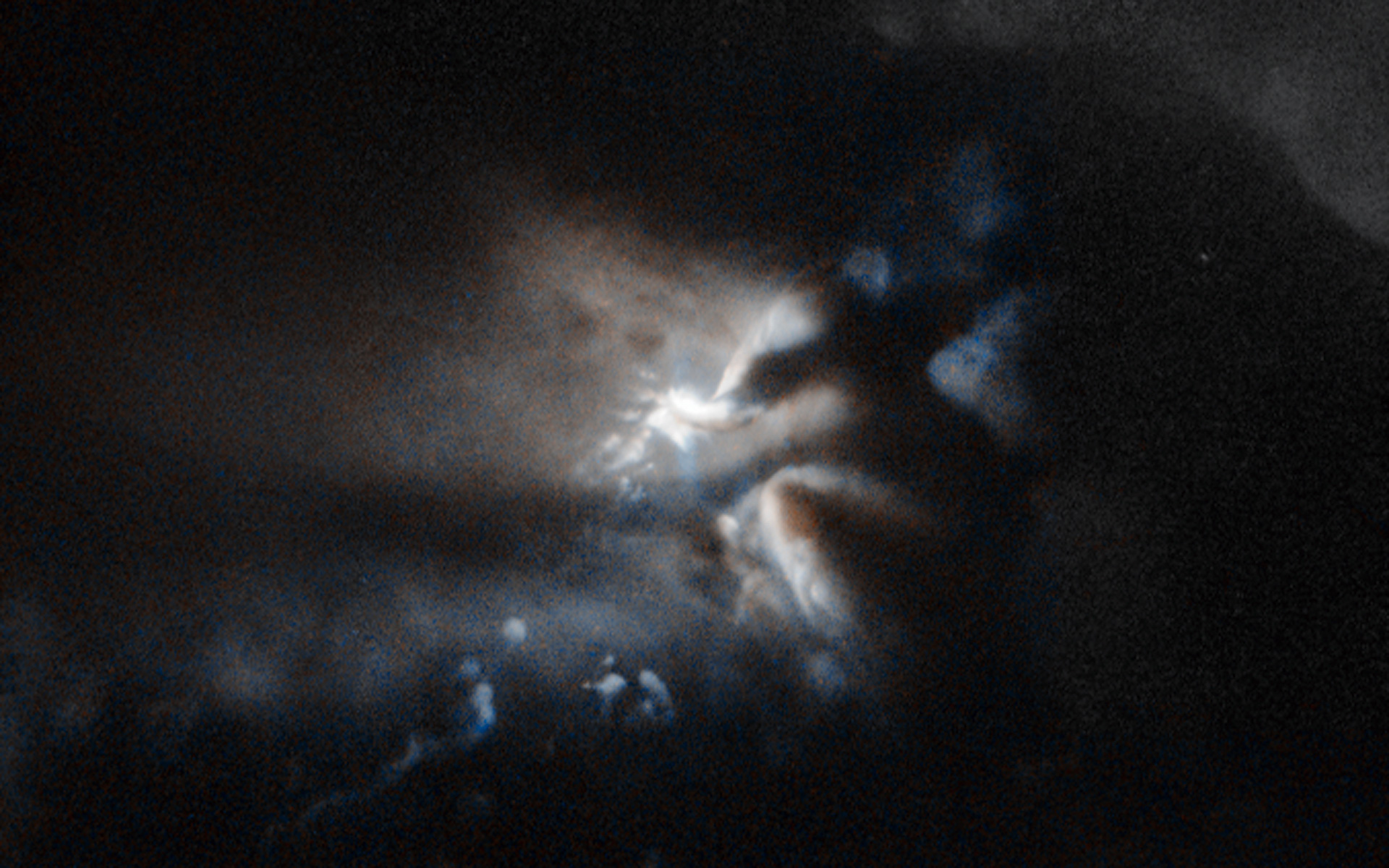
Don’t be fooled by the title; the mysterious, almost mystical bright light emerging from these thick, ominous clouds is actually a telltale sign of star formation. Here, a very young star is being born in the guts of the dark cloud LDN 43 — a massive blob of gas, dust, and ices, gathered 520 light-years from Earth in the constellation of Ophiuchus (The Serpent Bearer).

Stars are born from cosmic dust and gas, which floats freely in space until gravity forces it to bind together. The hidden newborn star in this image, revealed only by light reflected onto the plumes of the dark cloud, is named RNO 91. It is what astronomers call a pre-main sequence star, meaning that it has not yet started burning hydrogen in its core.

The energy that allows RNO 91 to shine comes from gravitational contraction. The star is being compressed by its own weight until, at some point, a critical mass will be reached and hydrogen, its main component, will begin to fuse together, releasing huge amounts of energy in the process. This will mark the beginning of adulthood for the star. But even before this happens the adolescent star is bright enough to shine and generate powerful stellar winds, emitting intense X-ray and radio emission.

RNO 91 is a variable star around half the mass of the Sun. Astronomers have been able to observe the existence of a dusty, icy disc surrounding it, stretching out to over 1700 times the distance from Earth to the Sun. It is believed that this disc may host protoplanets — planets in the process of being formed — and will eventually evolve into a fully-fledged planetary system.

This image is based on data gathered by the NASA/ESA Hubble Space Telescope. A version of this image was entered into the Hubble’s Hidden Treasures image processing competition by contestant Judy Schmidt.


Searching for Type Ia Supernovae Progenitors through Circumstellar Material


Fig. 1: Artist impression of the two widely accepted type Ia progenitors.
(Top) A white dwarf accreting material from a non-degenerate companion. Copyright: David A. Hardy/AstroArt.org.
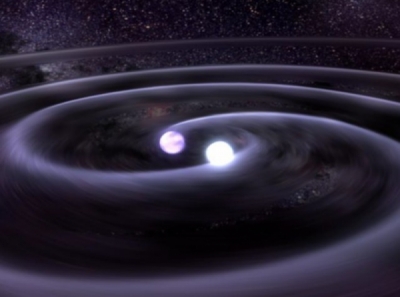
(Bottom) Two white dwarf stars spiraling in towards a merger due to gravitational wave emission. Copyright: GSFC/D. Berry.

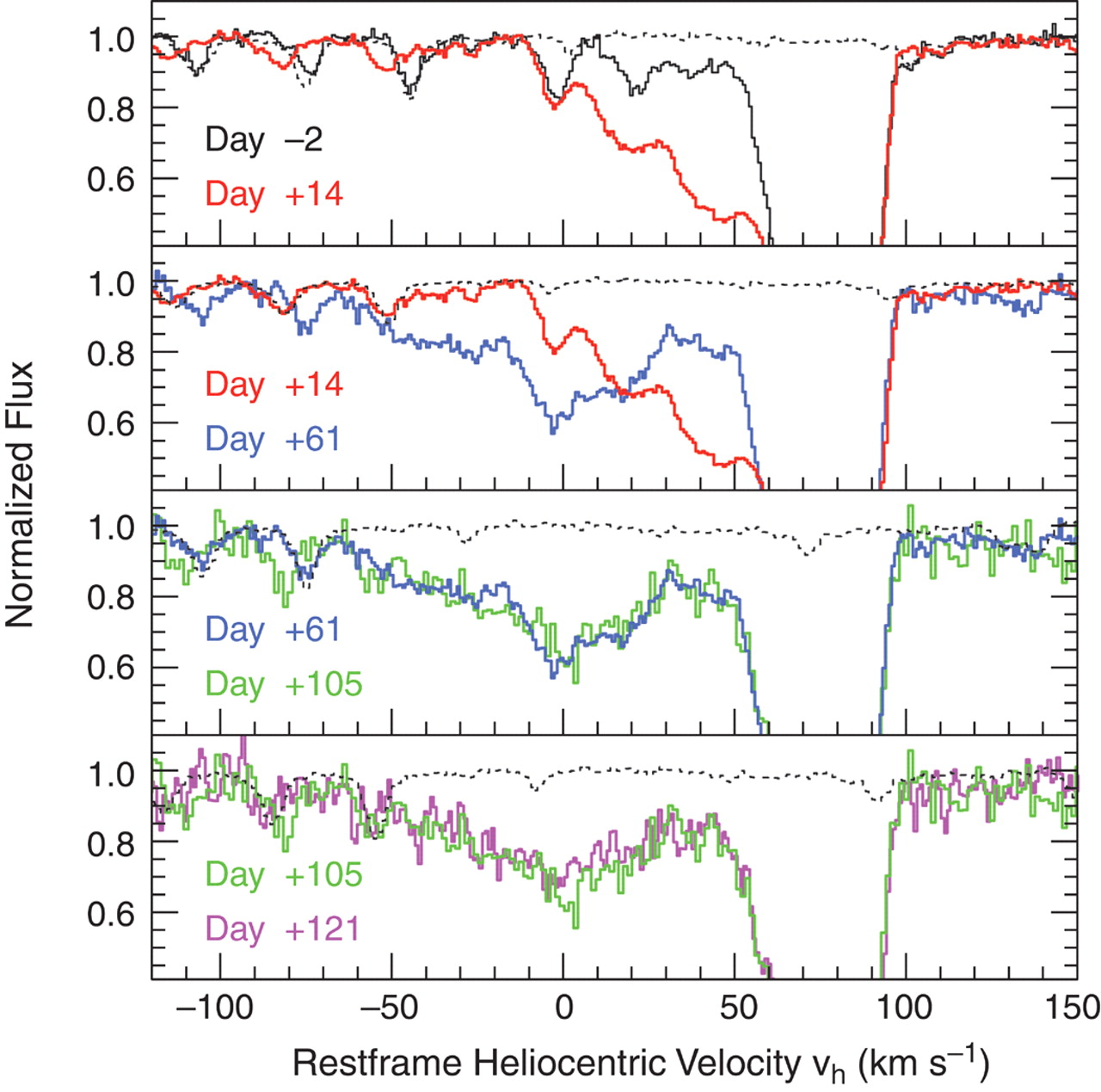
Fig. 2: Multi-epoch spectra of SN 2006X showing the time-variable behavior interpreted as a signature of circumstellar material close to the exploding white dwarf. Image taken from Patat et al. 2007 (doi: 10.1126/science.1143005). 

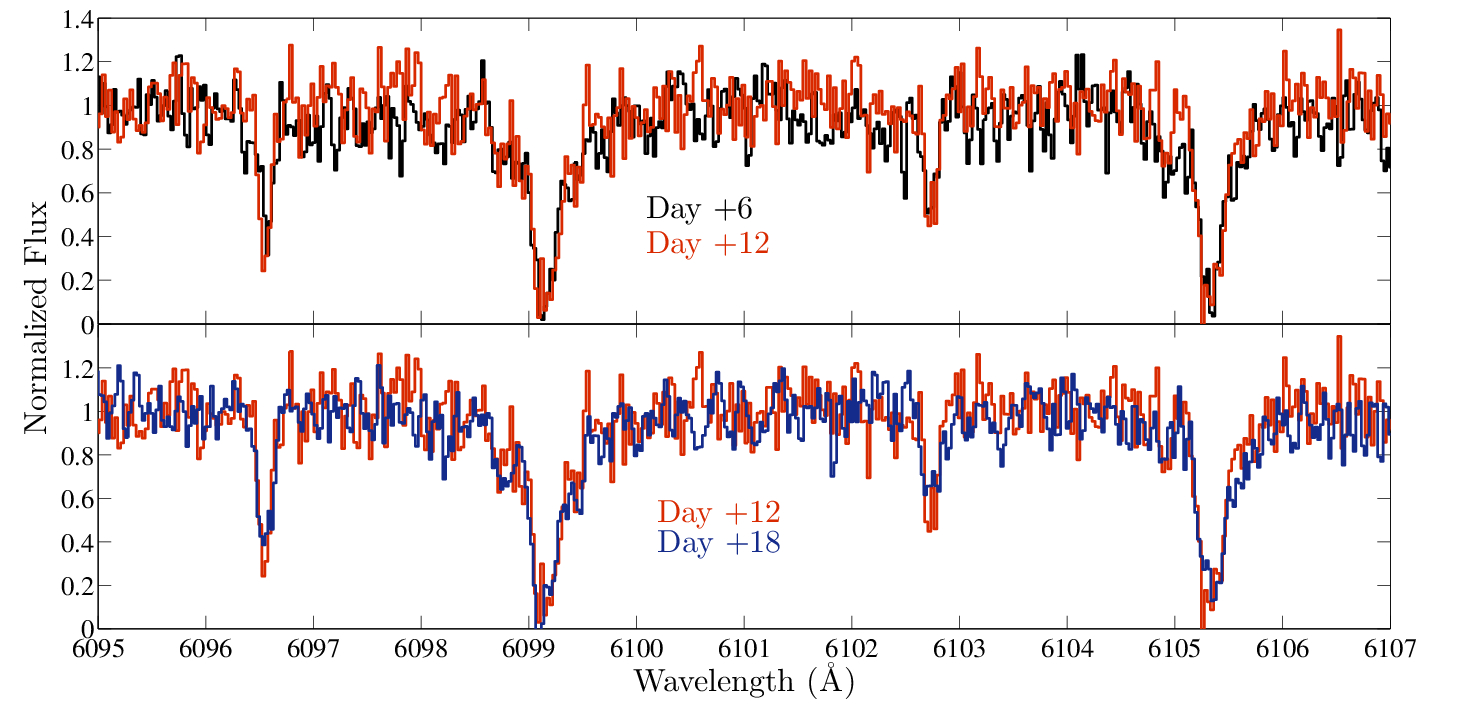
Fig. 3: Multi-epoch spectra of SN 2008dt. The slight variability that is observed is within the noise level. These observations are consistent with a non-detection of time-variable features. Hence, there no sign of CSM along the line-of-sight to this event. Adapted from Sternberg et al. 2013. 

Signatures of the circumstellar material in the spectra of type Ia supernova might shed light on the progenitors of these cosmic explosions. Scientists at MPA have now analysed multi-epoch spectra of about a dozen supernova explosion of Type Ia and come to the preliminary conclusion that only a minority show clear signatures of such material that is consistent with a single-degenerate progenitor system.  

Type Ia supernovae (SNe Ia) are very luminous explosions that are used as standerdizable candles to measure distances on a cosmic scale. These measurements can then be used to reconstruct the expansion history of the Universe. Knowing the full nature of the progenitors of these events might help to standardize them more accurately, allowing for a more accurate reconstruction result. Moreover, SNe Ia are thought to be the end product of binary systems. Understanding their progenitors will help us to better understand the evolution and end product of certain binary stars. Hence, the nature of SN Ia progenitors is an important open question in need of an answer. 

It is widely accepted that a SN Ia event is the explosion of a carbon-oxygen white dwarf star. For a white dwarf to explode it needs to accrete material that will trigger carbon-burning. Due to the degenerate state of the white dwarf material this burning is a runaway process that produces enough energy to unbind and totally disrupt the white dwarf. The two leading models for the progenitors of these events are the single-degenerate model (Fig. 1, top) – in which material from a non-degenerate companion is transferred onto the white dwarf – and the double-degenerate model (Fig. 1, bottom) – in which a degenerate companion, another white dwarf, merges with the primary. 

One of the major discriminants between the different progenitor scenarios is the environment in which the white dwarf explodes. In the single-degenerate scenario the white dwarf if engulfed by circumstellar material (CSM) that was expelled from the system due to mass loss processes. This material should have relatively low outflowing velocities. In the double-degenerate scenario the white dwarf explodes in a cleaner environment. Even though some recent work suggests CSM might be present also in a certain double-degenerate progenitor, this would have different properties, namely higher velocities. 

Therefore, the detection of CSM in type Ia spectra can help disentangle the different progenitor scenarios and allow us to determine the binary pathway, or pathways, that lead to them. The question then arises what the manifestation of this CSM should be. Material that is close to the exploding white dwarf should be ionized by the ultra-violet radiation emitted during the explosion. As time progresses this material should recombine and return to its previous neutral/ionization-level. Thus, in early-time spectra, not long after the explosion, we expect to see little or no features of the neutral/low-ionization-level. In later-time spectra we expect to see these features emerge and/or intensify. Material that is further away at the time of explosion will not be ionized, but given its relatively low outflowing velocity it should manifest itself as a blue-shifted absorption feature. An ideal element to use in this search is neutral sodium, as it is a strong line, even when only small amounts of sodium are present. 

The first widely accepted detection of CSM in a type Ia was reported for SN 2006X by a group led by Ferdinando Patat from ESO (Fig 2). Following this detection two more events were reported to show signs of CSM – SN 2007le and PTF11kx – and three events for which such material was not detected – SN 2000cx, SN 2007af, and SN 20011fe. These mixed result might be due to viewing-angle effects that will cause the CSM to be visible only in part of the SNe Ia, *if there is* (?) a mix of at least two classes of progenitors - one with CSM and one without xxx– or more likely a combination of both xxx. (Both? Viewing angle and mixing? Delete or explain) The small size of this sample does not allow any robust conclusions to be made. A larger sample is needed to robustly conclude what the prevalence of cases like SN 2006X, SN 2007le, and PTF11kx is. Moreover, a larger sample including more cases with CSM detection will allow the study of the CSM properties. Non-detection of CSM can be used to estimate upper limits to the CSM mass. With these we can exclude implausible models and set constraints to the plausible ones. 

A group led by Assaf Sternberg showed that SNe Ia exhibit an overabundance of features indicative of outflowing material. This overabundance was shown to be consistent with circumstellar material. Nevertheless, as this analysis was based on single-epoch data, it can not be used to probe the properties of the CSM, as it is not possible to tell which individual features are circumstellar and which are interstellar. 

In collaboration with scientists world-wide we are leading a renewed effort to obtain a large multi-epoch spectroscopic sample of SNe Ia in hope to shed light on the elusive progenitors of SNe Ia. So far, we have already obtained multi-epoch spectra of 13 SNe Ia (Fig. 3), more then tripling the currently published sample. This enlarged sample suggests that only ~17% of SNe Ia exhibit time-variable absorption features that are associated with CSM. Though this result is in agreement with other previously published work, due to the size of our sample this result may still change. Moreover, in future analysis we will estimate upper limits for the CSM mass and will try to determine which binary pathways may be excluded as progenitors for the events in our sample. This is still work in progress. We hope to reach a sample size that is comparable with the Sternberg et al, single-epoch sample within the next couple of years, and that its analysis will help answer the long-standing type Ia progenitor question.

Assaf Sternberg and Wolfgang Hillebrandt

References

Patat, F., Chandra, P., Chevalier, R., et al. 2007 Science, 317, 924

Simon, J. D., Gal-Yam, A., Gnat, O., et al. 2009, ApJ, 702, 1157

Dilday, B., Howell, D. A., Cenko, S. B., et al. 2012, Science, 337, 942

Sternberg, A., Gal-Yam, A., Simon, J. D., et al. 2011, Science, 333, 856

Sternberg, A., Patat, F., Hillebrandt, W., et al, 2013, in preperation 


Saturday, August 03, 2013

Hubble Finds 'Smoking Gun' After Gamma-Ray Blast

GRB 130603B, SDS J112848.22+170418.5
Credit: NASA, ESA, N. Tanvir (University of Leicester), A. Fruchter (STScI), and A. Levan (University of Warwick .  More Images

NASA's Hubble Space Telescope has provided the strongest evidence yet that short-duration gamma-ray bursts are triggered by the merger of two small, super-dense stellar objects, such as a pair of neutron stars or a neutron star and a black hole.

The definitive evidence came from Hubble observations in near-infrared light of the fading fireball produced in the aftermath of a short gamma-ray burst (GRB). The afterglow reveals for the first time a new kind of stellar blast called a kilonova, an explosion predicted to accompany a short-duration GRB.

A kilonova is about 1,000 times brighter than a nova, which is caused by the eruption of a white dwarf. Such a stellar blast, however, is only 1/10th to 1/100th the brightness of a typical supernova, the self-detonation of a massive star.

Gamma-ray bursts are mysterious flashes of intense high-energy radiation that appear from random directions in space. Short-duration blasts last at most a few seconds, but they sometimes generate faint afterglows in visible and near-infrared light that continue for several hours or days.

The afterglows have helped astronomers determine that GRBs lie in distant galaxies. The cause of short-duration GRBs, however, remains a mystery. The most popular theory is that astronomers are witnessing the energy released as two compact objects crash together. But, until now, astronomers have not gathered enough strong evidence to prove it, say researchers.
A team of researchers led by Nial Tanvir of the University of Leicester in the United Kingdom has used Hubble to study a recent short-duration burst in near-infrared light. The observations revealed the fading afterglow of a kilonova explosion, providing the "smoking gun" evidence for the merger hypothesis.

"This observation finally solves the mystery of the origin of short gamma-ray bursts," Tanvir said. "Many astronomers, including our group, have already provided a great deal of evidence that long-duration gamma-ray bursts (those lasting more than two seconds) are produced by the collapse of extremely massive stars. But we only had weak circumstantial evidence that short bursts were produced by the merger of compact objects. This result now appears to provide definitive proof supporting that scenario."

Astrophysicists have predicted that short-duration GRBs are created when a pair of super-dense neutron stars in a binary system spiral together. This event happens as the system emits gravitational radiation, tiny ripples in the fabric of space-time. The energy dissipated by the waves causes the two objects to sweep closer together. In the final milliseconds, as the two objects merge, the death spiral kicks out highly radioactive material. This material heats up and expands, emitting a burst of light. This powerful kilonova blast emits as much visible and near-infrared light every second as the Sun does every few years. A kilonova lasts for about a week.

In a recent science paper Jennifer Barnes and Daniel Kasen of the University of California, Berkeley, and the Lawrence Berkeley National Laboratory presented new calculations predicting how kilonovas should look. They predicted that the same hot plasma producing the radiation will also act to block the visible light, causing the gusher of energy from the kilonova to flood out in near-infrared light over several days.
An unexpected opportunity to test this model came on June 3 when NASA's Swift Space Telescope picked up the extremely bright gamma-ray burst, cataloged as GRB 130603B, in a galaxy located almost 4 billion light-years away. Although the initial blast of gamma rays lasted just one-tenth of a second, it was roughly 100 billion times brighter than the subsequent kilonova flash.

The visible-light afterglow was detected at the William Herschel Telescope and its distance was determined with the Gran Telescopio Canarias, both located in the Canary Islands.

"We quickly realized this was a chance to test Barnes' and Kasen's new theory by using Hubble to hunt for a kilonova in near-infrared light," Tanvir said. The calculations suggested that the light would most likely be brightest in near-infrared wavelengths about 3 to 11 days after the initial blast. The researchers needed to act quickly before the light faded, so they requested Director's Discretionary Observing Time with Hubble's Wide Field Camera 3.

On June 12-13 Hubble searched the location of the initial burst, spotting a faint red object. An independent analysis of the data from another research team confirmed the detection. Subsequent Hubble observations three weeks later, on July 3, revealed that the source had faded away, therefore providing the key evidence it was the fireball from an explosive event.

"Previously, astronomers had been looking at the aftermath of short-period bursts largely in optical light, and were not really finding anything besides the light of the gamma-ray burst itself," explained Andrew Fruchter of the Space Telescope Science Institute in Baltimore, Md., a member of Tanvir's research team. "But this new theory predicts that when you compare near-infrared and optical images of a short gamma-ray burst about a week after the blast, the kilonova should pop out in the infrared, and that's exactly what we're seeing."

In addition to confirming the nature of short GRBs, the discovery has two important implications. First, the origin of many heavy chemical elements in the universe, including gold and platinum, has long been a puzzle. Kilonovas are predicted to form such elements in abundance, spraying them out into space where they could become part of future generations of stars and planets.

Second, the mergers of compact objects are also expected to emit intense gravitational waves, first predicted by Albert Einstein. Gravity waves have not yet been discovered, but new instruments under development may make the first detections within a few years. "Now it seems that by hunting for kilonovas, astronomers may be able to tie together the events giving rise to both phenomena," Tanvir said.
The team's results will appear online on Aug. 3 in the journal Nature.

CONTACT


Donna Weaver / Ray Villard
Space Telescope Science Institute, Baltimore, Md.
410-338-4493 / 410-339-4514

dweaver@stsci.edu / villard@stsci.edu

Nial Tanvir
University of Leicester, Leicester, U.K.
011-44-7980-136499

nrt3@le.ac.uk

Andy Fruchter
Space Telescope Science Institute, Baltimore, Md.
410-338-5018

fruchter@stsci.edu


Monster Galaxies Lose Their Appetite With Age

This image shows two of the galaxy clusters observed by NASA's Wide-field Infrared Survey Explorer (WISE) and Spitzer Space Telescope missions. Galaxy clusters are among the most massive structures in the universe. The central and largest galaxy in each grouping, called the brightest cluster galaxy or BCG, is seen at the center of each image. Image credit: NASA/JPL-Caltech/SDSS/NOA .  › Full image and caption

Figure 1 (left) shows the cluster known as Abell 2199, which is relatively nearby at a distance of 400 million light-years from Earth (redshift of 0.0302). This image combines infrared data from WISE (in red) with shorter wavelengths of light extending into the visible spectrum from the Sloan Digital Sky Survey (in blue and green).

Figure 2 (right) is the cluster ISCS 1433.9+3330, which is significantly farther away at a distance of 4.4 billion light-years (redshift of 0.42). Infrared data from Spitzer (red) is combined with similar shorter wavelength data taken by the Mayall Telescope on Kitt Peak, Ariz.

Our universe is filled with gobs of galaxies, bound together by gravity into larger families called clusters. Lying at the heart of most clusters is a monster galaxy thought to grow in size by merging with neighboring galaxies, a process astronomers call galactic cannibalism.

New research from NASA's Spitzer Space Telescope and Wide-field Infrared Survey Explorer (WISE) is showing that, contrary to previous theories, these gargantuan galaxies appear to slow their growth over time, feeding less and less off neighboring galaxies.

"We've found that these massive galaxies may have started a diet in the last 5 billion years, and therefore have not gained much weight lately," said Yen-Ting Lin of the Academia Sinica in Taipei, Taiwan, lead author of a study published in the Astrophysical Journal.

Peter Eisenhardt, a co-author from NASA's Jet Propulsion Laboratory in Pasadena, Calif., said, "WISE and Spitzer are letting us see that there is a lot we do understand -- but also a lot we don't understand -- about the mass of the most massive galaxies." Eisenhardt identified the sample of galaxy clusters studied by Spitzer, and is the project scientist for WISE.

The new findings will help researchers understand how galaxy clusters -- among the most massive structures in our universe -- form and evolve.

Galaxy clusters are made up of thousands of galaxies, gathered around their biggest member, what astronomers call the brightest cluster galaxy, or BCG. BCGs can be up to dozens of times the mass of galaxies like our own Milky Way. They plump up in size by cannibalizing other galaxies, as well as assimilating stars that are funneled into the middle of a growing cluster.

To monitor how this process works, the astronomers surveyed nearly 300 galaxy clusters spanning 9 billion years of cosmic time. The farthest cluster dates back to a time when the universe was 4.3 billion years old, and the closest, when the universe was much older, 13 billion years old (our universe is presently 13.8 billion years old).

"You can't watch a galaxy grow, so we took a population census," said Lin. "Our new approach allows us to connect the average properties of clusters we observe in the relatively recent past with ones we observe further back in the history of the universe."

Spitzer and WISE are both infrared telescopes, but they have unique characteristics that complement each other in studies like these. For instance, Spitzer can see more detail than WISE, which enables it to capture the farthest clusters best. On the other hand, WISE, an infrared all-sky survey, is better at capturing images of nearby clusters, thanks to its larger field of view. Spitzer is still up and observing; WISE went into hibernation in 2011 after successfully scanning the sky twice.

The findings showed that BCG growth proceeded along rates predicted by theories until 5 billion years ago, or a time when the universe was about 8 billion years old. After that time, it appears the galaxies, for the most part, stopped munching on other galaxies around them.

The scientists are uncertain about the cause of BCGs' diminished appetites, but the results suggest current models need tinkering.

"BCGs are a bit like blue whales -- both are gigantic and very rare in number. Our census of the population of BCGs is in a way similar to measuring how the whales gain their weight as they age. In our case, the whales aren't gaining as much weight as we thought. Our theories aren't matching what we observed, leading us to new questions," said Lin.

Another possible explanation is that the surveys are missing large numbers of stars in the more mature clusters. Clusters can be violent environments, where stars are stripped from colliding galaxies and flung into space. If the recent observations are not detecting those stars, it's possible that the enormous galaxies are, in fact, continuing to bulk up.

Future studies from Lin and others should reveal more about the feeding habits of one of nature's largest galactic species.

JPL manages the Spitzer Space Telescope mission for NASA's Science Mission Directorate, Washington. Science operations are conducted at the Spitzer Science Center at the California Institute of Technology in Pasadena. Data are archived at the Infrared Science Archive housed at the Infrared Processing and Analysis Center at Caltech. Caltech manages JPL for NASA. For more information about Spitzer, visit http://spitzer.caltech.edu and http://www.nasa.gov/spitzer .

JPL managed and operated WISE for NASA's Science Mission Directorate. Edward Wright is the principal investigator and is at UCLA. The mission was selected competitively under NASA's Explorers Program managed by the agency's Goddard Space Flight Center in Greenbelt, Md. The science instrument was built by the Space Dynamics Laboratory in Logan, Utah. The spacecraft was built by Ball Aerospace & Technologies Corp. in Boulder, Colo. Science operations and data processing take place at the Infrared Processing and Analysis Center at the California Institute of Technology in Pasadena. Caltech manages JPL for NASA. More information is online at http://www.nasa.gov/wise and http://wise.astro.ucla.edu and http://jpl.nasa.gov/wise .

Whitney Clavin 818-354-4673
Jet Propulsion Laboratory, Pasadena, Calif.

whitney.clavin@jpl.nasa.gov  


Friday, August 02, 2013

New Class of Star Cluster Discovered

An example of the new type of star cluster discovered (left), and an example of a previously known globular star cluster (right). The images were taken with the Hubble Space Telescope and their distances from Earth confirmed by the Keck II telescope.

Kamuela, Hawaii – Star clusters with properties not seen before have been discovered by an international team of astrophysicists, led by Swinburne University of Technology’s Professor Duncan Forbes.

Using data from the Hubble Space Telescope and the W. M. Keck Observatory in Hawaii, the researchers found several star clusters with sizes and masses that were previously not known to exist.

“Old, compact star clusters, such as globular clusters, are well known to amateur astronomers,” Professor Forbes said. “Although globular star clusters were first discovered in 1665, it has taken more than 340 years to fully appreciate all the different types of star clusters that are made in the Universe.”

The researchers confirmed the existence of a number of different star clusters, overturning the idea that star clusters only come in certain types.

“We now know that star clusters have a rather continuous range of size and mass without any gaps in their properties,” Professor Forbes said. “Our discovery was made possible by using the Hubble Space Telescope to measure the sizes of the star clusters and long exposures on the Deep Extragalactic Imaging Multi-Object Spectrograph fitted to the Keck II telescope to obtain distances and confirm their status.” Professor Jean Brodie, a team member from the University of California, said.

They also measured the color of the star clusters, finding the lower mass ones to be red and the higher mass ones to be blue in color, suggesting differences in their chemical composition.

“No single model for the formation of these star clusters can currently reproduce the diversity of structural properties we have observed for old star clusters,” Professor Forbes said. “Our observations present a challenge to researchers aiming to reproduce star clusters in computer simulations.”

The research team included Vincenzo Pota and Christopher Usher (Swinburne University of Technology), Jay Strader (Michigan State University), Aaron Romanowsky (San Jose State University), Jean Brodie and Jacob Arnold (University of California), and Lee Spitler (Macquarie University).

The paper has been accepted for publication in the Monthly Notices of the Royal Astronomical Society, published by Oxford University Press. 

The Keck II telescope’s DEIMOS instrument is capable of gathering spectra from 130 galaxies or more in a single exposure. In “Mega Mask” mode, DEIMOS can take spectra of more than 1,200 objects at once, using a special narrow-band filter.

The W. M. Keck Observatory operates the largest, most scientifically productive telescopes on Earth. The two, 10-meter optical/infrared telescopes on the summit of Mauna Kea on the Island of Hawaii feature a suite of advanced instruments including imagers, multi-object spectrographs, high-resolution spectrographs, integral-field spectroscopy and a world-leading laser guide star adaptive optics system. The Observatory is a private 501(c) 3 non-profit organization and a scientific partnership of the California Institute of Technology, the University of California and NASA.


A spiral galaxy crowned by a star

Credit: ESA/Hubble & NASA

Another treasure unearthed from the Hubble archives, this beautiful image shows a spiral galaxy named NGC 4517. Slightly bigger than our Milky Way, it is seen edge-on, crowned by a very bright star. The star is actually much closer to us than the galaxy, explaining why it appears to be so big and bright in the picture. 

NGC 4517 is located approximately 40 million light-years away in the constellation of Virgo (The Virgin). It has a bright centre, but this is not visible in this Hubble image. Its orientation has led to it being included in many studies of globular clusters, clumps of stars that orbit the centres of galaxies like satellites.

The galaxy was discovered in 1784 by William Herschel, who described this region as having “a pretty bright star situated exactly north of the centre of an extended milky ray”. Of course the “milky ray” seen by Herschel is actually this spiral galaxy, but with his 17th century observing gear he could only tell that there a fuzzy, blurry structure below the much brighter star.

This image is composed from visible and infrared light gathered by NASA/ESA Hubble Space Telescope. A version of this image was entered into the Hubble’s Hidden treasures image processing competition by contestant Gilles Chapdelaine.


Thursday, August 01, 2013

When galaxies switch off

Sample of non-star-forming galaxies from the COSMOS survey
The full COSMOS field (UltraVISTA)
The field around the COSMOS survey (ground-based image)

Videos

Zoom on the COSMOS field (UltraVISTA)

Hubble's COSMOS survey solves "quenched" galaxy mystery

Some galaxies hit a point in their lives when their star formation is snuffed out, and they become "quenched". Quenched galaxies in the distant past appear to be much smaller than the quenched galaxies in the Universe today. This has always puzzled astronomers — how can these galaxies grow if they are no longer forming stars? A team of astronomers has now used a huge set of Hubble observations to give a surprisingly simple answer to this long-standing cosmic riddle.

Until now, these small, snuffed-out galaxies were thought to grow into the larger quenched galaxies we see nearby.

As these galaxies are no longer forming new stars, they were thought to grow by colliding and merging with other smaller quenched galaxies some five to ten times less massive. However, these mergers would require many such small galaxies floating around for the quenched population to snack on — which we do not see.
Until recently it had not been possible to explore a sufficient number of quenched galaxies, but now a team of astronomers has used observations from the Hubble COSMOS survey to identify and count these switched-off galaxies throughout the last eight billion years of cosmic history.

"The apparent puffing up of quenched galaxies has been one of the biggest puzzles about galaxy evolution for many years," says Marcella Carollo of ETH Zurich, Switzerland, lead author on a new paper exploring these galaxies. "No single collection of images has been large enough to enable us to study very large numbers of galaxies in exactly the same way — until Hubble's COSMOS," adds co-author Nick Scoville of Caltech, USA.

The team used the large set of COSMOS images [1], alongside additional observations from the Canada–France–Hawaii Telescope and the Subaru Telescope, both in Hawaii, USA, to peer back to when the Universe was less than half its present age. These observations mapped an area in the sky almost nine times that of the full Moon.

The quenched galaxies seen at these times are small and compact — and surprisingly, it seems they stay that way. Rather than puffing up and growing via mergers over time, these small galaxies mostly keep the size they had when their star formation switched off [2]. So why do we see these galaxies apparently growing larger over time?

"We found that a large number of the bigger galaxies instead switch off at later times, joining their smaller quenched siblings and giving the mistaken impression of individual galaxy growth over time," says co-author Simon Lilly, also of ETH Zurich. "It's like saying that the increase in the average apartment size in a city is not due to the addition of new rooms to old buildings, but rather to the construction of new, larger apartments," adds co-author Alvio Renzini of INAF Padua Observatory, Italy.

This tells us a lot about how galaxies have evolved over the last eight billion years of the Universe's history. It was already known that actively star-forming galaxies were smaller in the early Universe, explaining why they were smaller when their star formation first switched off.

"COSMOS provided us with simply the best set of observations for this sort of work — it lets us study very large numbers of galaxies in exactly the same way, which hasn't been possible before," adds co-author Peter Capak, also of Caltech. "Our study offers a surprisingly simple and obvious explanation to this puzzle. Whenever we see simplicity in nature amidst apparent complexity, it's very satisfying," concludes Carollo.

Notes

[1] In making the COSMOS survey, Hubble photographed 575 slightly overlapping views of the Universe using the Advanced Camera for Surveys (ACS) aboard Hubble. It took nearly 1000 hours of observations and is the largest project ever conducted with Hubble. This survey has proved invaluable; it has helped to map dark matter in 3D (heic0701), to further understand the effects of gravitational lensing (heic0806), and to characterise the expansion of the Universe (heic1005).

[2] There is still the possibility of growth via mergers for a fraction of this quenched population, but not a majority, as previously thought.

Notes for editors

The Hubble Space Telescope is a project of international cooperation between ESA and NASA.

The research is presented in a paper entitled “Newly-quenched galaxies as the cause for the apparent evolution in average size of the population”, for publication in The Astrophysical Journal.

[1] The international team of astronomers in this study consists of C. M. Carollo (Swiss Federal Institute of Technology [ETH Zurich], Switzerland), T. J. Bschorr (Swiss Federal Institute of Technology [ETH Zurich], Switzerland), A. Renzini (Padova Observatory, Italy), S. J. Lilly (Swiss Federal Institute of Technology [ETH Zurich], Switzerland), P. Capak (Spitzer Science Center, California Institute of Technology, USA), A. Cibinel (Swiss Federal Institute of Technology [ETH Zurich], Switzerland), O. Ilbert (Laboratoire d’Astrophysique de Marseille, France), M. Onodera (Swiss Federal Institute of Technology [ETH Zurich], Switzerland), N. Scoville (California Institute of Technology, USA), E. Cameron (Swiss Federal Institute of Technology [ETH Zurich], Switzerland), B. Mobasher (University of California, USA), D. Sanders (University of Hawaii, USA), Y. Taniguchi (Ehime University, Japan).

More information

Image credit: NASA, ESA, M. Carollo (ETH Zurich)

Links

Contacts

Marcella Carollo
ETH Zurich
Zurich, Switzerland
Tel: +4144633 3725
Email:
marcella@phys.ethz.ch

Alvio Renzini
INAF, Astronomical Observatory of Padova
Padova, Italy
Tel: 049 8293 503
Email:
alvio.renzini@oapd.inaf.it

Peter Capak
California Institute of Technology
California, USA
Tel: +1-626-395-6422
Email:
capak@astro.caltech.edu

Nicky Guttridge
ESA/Hubble
Garching, Germany
Tel: +49-89-3200-6855
Email:
nguttrid@partner.eso.org


Spitzer Discovers Young Stars with a 'Hula Hoop'

In this artist's impression, a disk of dusty material leftover from star formation girds two young stars like a hula hoop. As the two stars whirl around each other, they periodically peek out from the disk, making the system appear to "blink" every 93 days. Image credit: NASA/JPL-Caltech. › Full image and caption

Astronomers using NASA's Spitzer Space Telescope have spotted a young stellar system that "blinks" every 93 days. Called YLW 16A, the system likely consists of three developing stars, two of which are surrounded by a disk of material left over from the star-formation process.

As the two inner stars whirl around each other, they periodically peek out from the disk that girds them like a hula hoop. The hoop itself appears to be misaligned from the central star pair, probably due to the disrupting gravitational presence of the third star orbiting at the periphery of the system. The whole system cycles through bright and faint phases, with the central stars playing a sort of cosmic peek-a-boo as the tilted disk twirls around them. It is believed that this disk should go on to spawn planets and the other celestial bodies that make up a solar system.

Spitzer observed infrared light from YLW 16A, emitted by the warmed gas and dust in the disk that still swathes the young stars. Other observations came from the ground-based 2MASS survey, as well as from the NACO instrument at the European Southern Observatory's Very Large Telescope in Chile.

YLW 16A is the fourth example of a star system known to blink in such a manner, and the second in the same star-forming region Rho Ophiuchus. The finding suggests that these systems might be more common than once thought. Blinking star systems with warped disks offer scientists a way to study how planets form in these environments. The planets can orbit one or both of the stars in the binary star system. The famous science fictional planet Tatooine in "Star Wars" orbits two stars, hence its double sunsets. Such worlds are referred to as circumbinary planets. Astronomers can record how light is absorbed by planet-forming disks during the bright and faint phases of blinking stellar systems, which in turn reveals information about the materials that comprise the disk.

"These blinking systems offer natural probes of the binary and circumbinary planet formation process," said Peter Plavchan, a scientist at the NASA Exoplanet Science Institute and Infrared Processing and Analysis Center at the California Institute of Technology, Pasadena, Calif., and lead author of a new paper accepted for publication in Astronomy & Astrophysics.

NASA's Jet Propulsion Laboratory, Pasadena, Calif., manages the Spitzer Space Telescope mission for NASA's Science Mission Directorate, Washington. Science operations are conducted at the Spitzer Science Center at Caltech. Data are archived at the Infrared Science Archive housed at the Infrared Processing and Analysis Center. Caltech manages JPL for NASA. For more information about Spitzer, visit http://spitzer.caltech.edu and http://www.nasa.gov/spitzer .

Written by Adam Hadhazy

Contact:

 
Whitney Clavin 818-354-4673
Jet Propulsion Laboratory, Pasadena, Calif.

whitney.clavin@jpl.nasa.gov