Fig. 1:
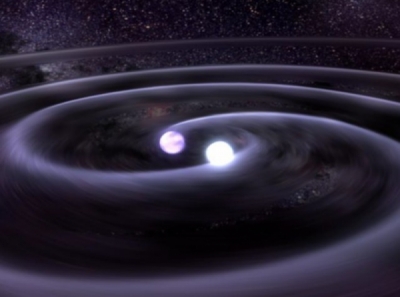
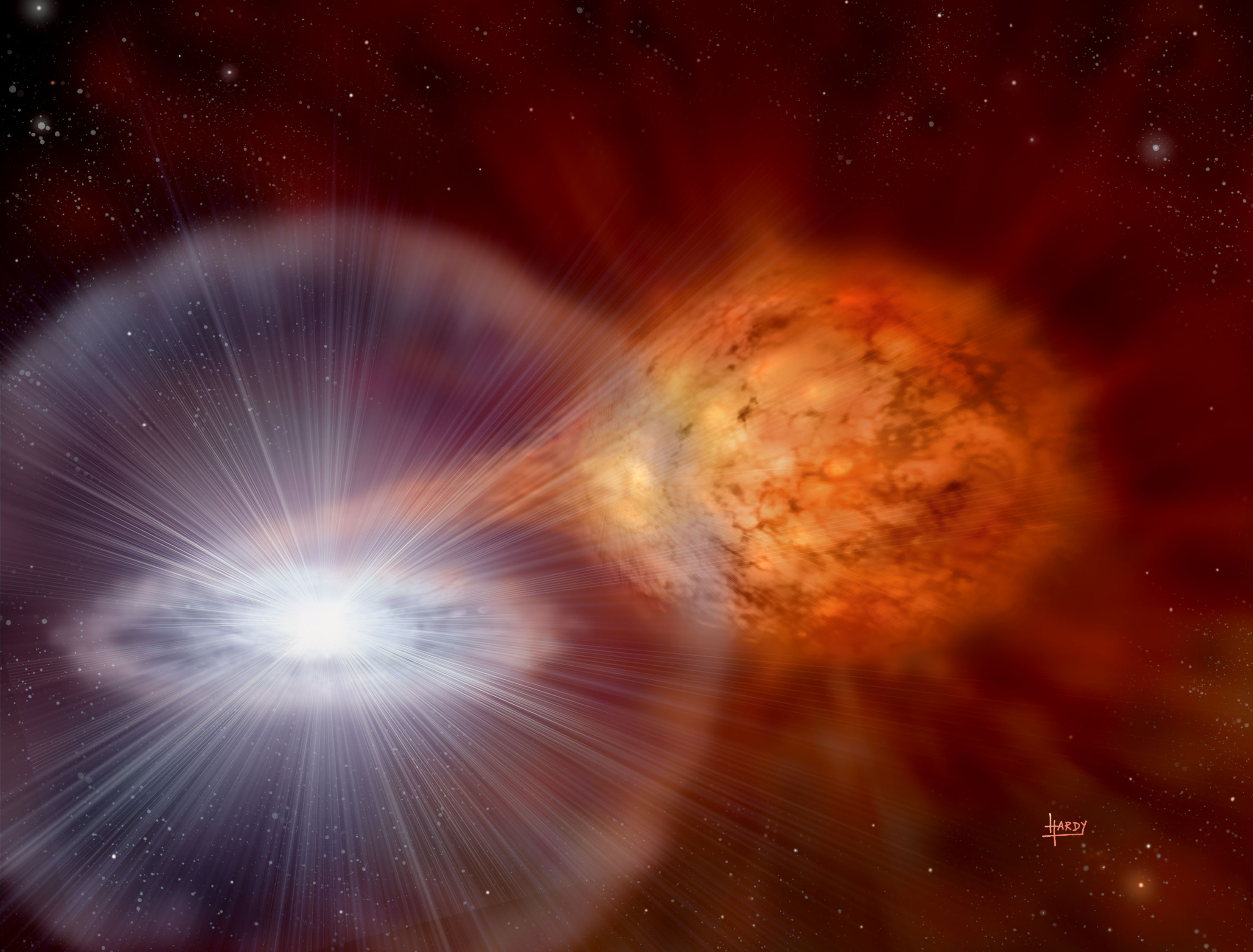
Artist impression of the two widely accepted type Ia
progenitors.
(Top) A white dwarf accreting material from a non-degenerate companion. Copyright: David A. Hardy/AstroArt.org.
(Bottom) Two white dwarf stars spiraling in towards a merger due to gravitational wave emission. Copyright: GSFC/D. Berry.
(Top) A white dwarf accreting material from a non-degenerate companion. Copyright: David A. Hardy/AstroArt.org.
(Bottom) Two white dwarf stars spiraling in towards a merger due to gravitational wave emission. Copyright: GSFC/D. Berry.

Fig. 2:
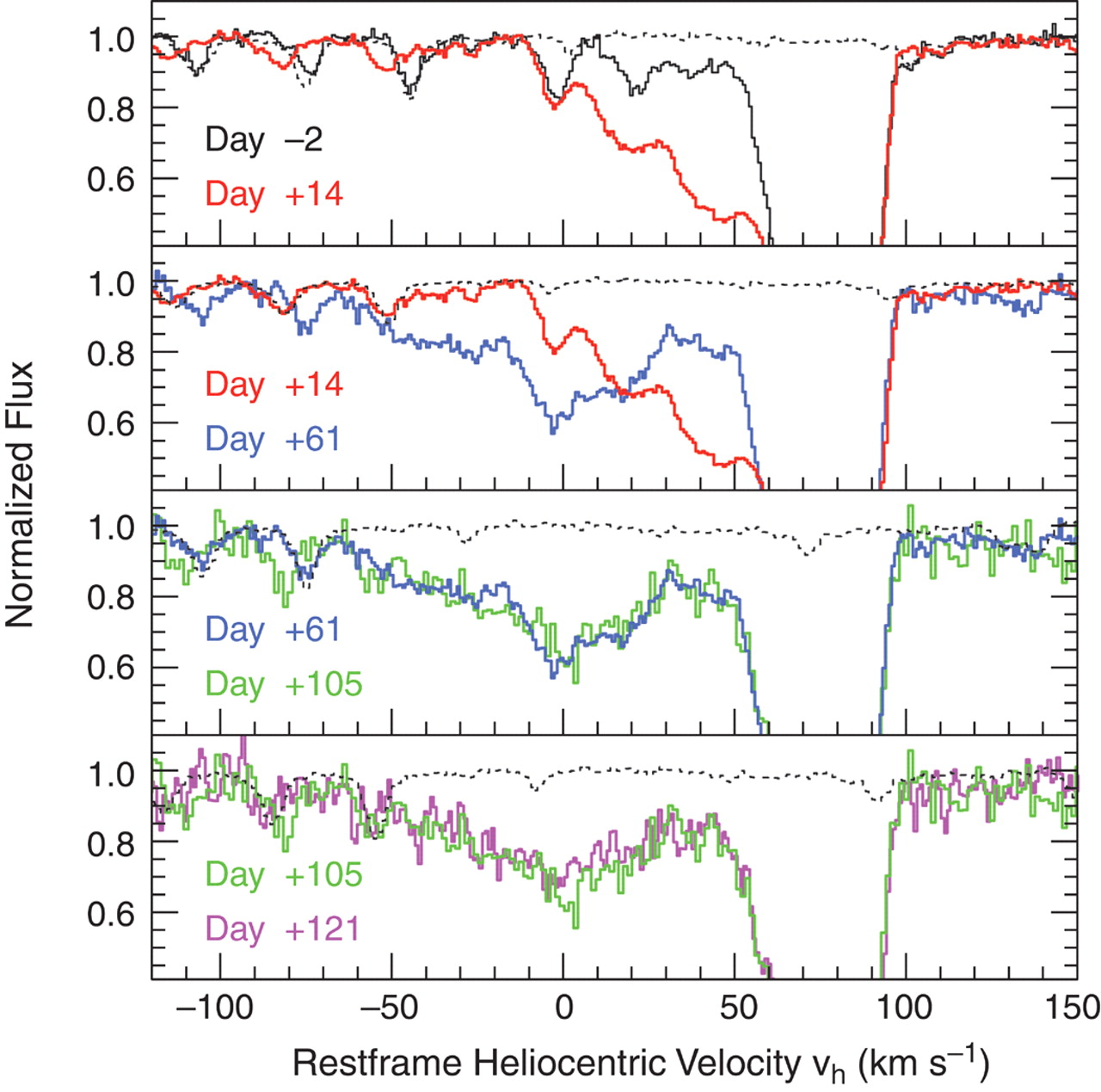
Multi-epoch spectra of SN 2006X showing the time-variable
behavior interpreted as a signature of circumstellar material close to
the exploding white dwarf. Image taken from Patat et al. 2007 (doi:
10.1126/science.1143005).

Fig. 3:
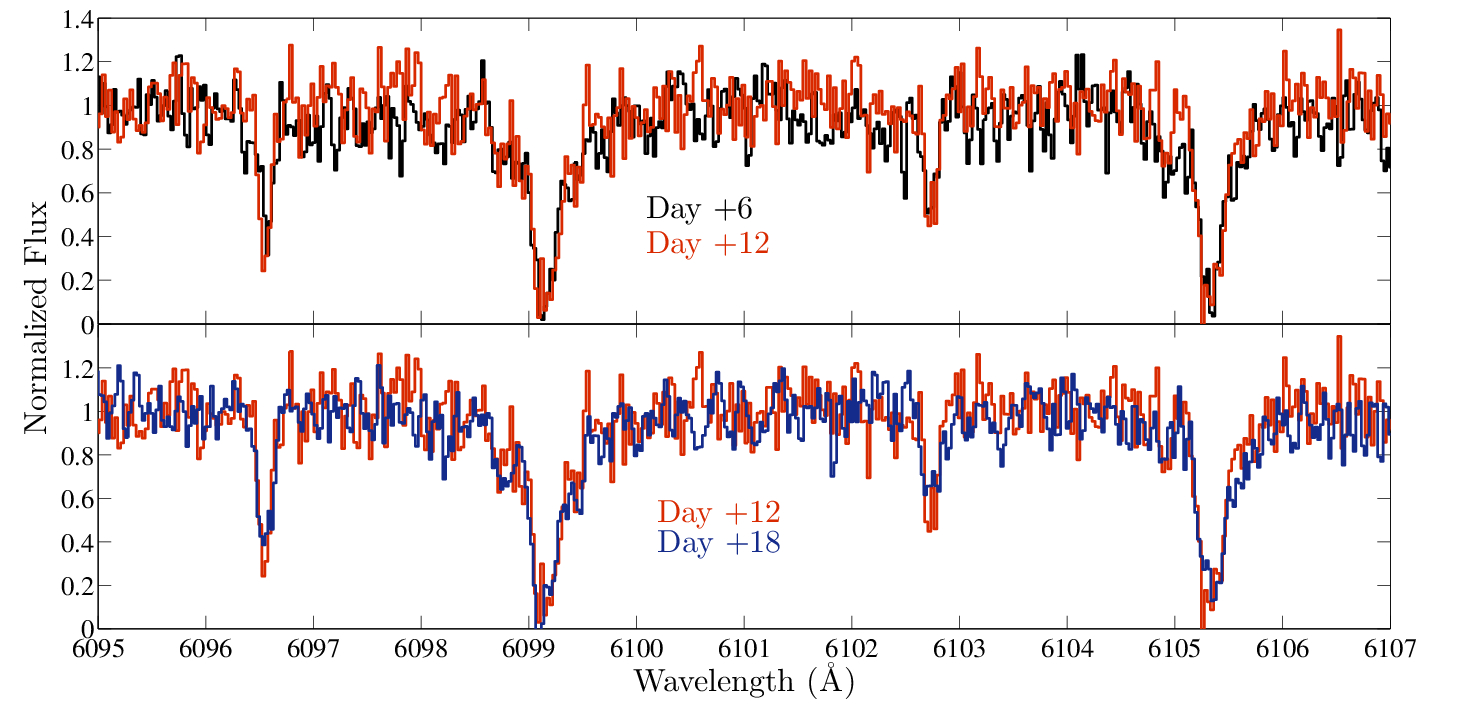
Multi-epoch spectra of SN 2008dt. The slight variability that is
observed is within the noise level. These observations are consistent with
a non-detection of time-variable features. Hence, there no sign of CSM
along the line-of-sight to this event. Adapted from Sternberg et al. 2013.
Signatures of the circumstellar material in the spectra of type Ia
supernova might shed light on the progenitors of these cosmic explosions.
Scientists at MPA have now analysed multi-epoch spectra of about a dozen
supernova explosion of Type Ia and come to the preliminary conclusion that
only a minority show clear signatures of such material that is consistent
with a single-degenerate progenitor system.
Type Ia supernovae (SNe Ia) are very luminous explosions that are used
as standerdizable candles to measure distances on a cosmic
scale. These measurements can then be used to reconstruct the
expansion history of the Universe. Knowing the full nature of the
progenitors of these events might help to standardize them more
accurately, allowing for a more accurate reconstruction
result. Moreover, SNe Ia are thought to be the end product of binary
systems. Understanding their progenitors will help us to better
understand the evolution and end product of certain binary
stars. Hence, the nature of SN Ia progenitors is an important open
question in need of an answer.
It is widely accepted that a SN Ia event is the explosion of a
carbon-oxygen white dwarf star. For a white dwarf to explode it needs
to accrete material that will trigger carbon-burning. Due to the
degenerate state of the white dwarf material this burning is a runaway
process that produces enough energy to unbind and totally disrupt the
white dwarf. The two leading models for the progenitors of these
events are the single-degenerate model (Fig. 1, top) – in which
material from a non-degenerate companion is transferred onto the white
dwarf – and the double-degenerate model (Fig. 1, bottom) – in which a
degenerate companion, another white dwarf, merges with the primary.
One of the major discriminants between the different progenitor
scenarios is the environment in which the white dwarf explodes. In the
single-degenerate scenario the white dwarf if engulfed by
circumstellar material (CSM) that was expelled from the system due to
mass loss processes. This material should have relatively low
outflowing velocities. In the double-degenerate scenario the white
dwarf explodes in a cleaner environment. Even though some recent work
suggests CSM might be present also in a certain double-degenerate
progenitor, this would have different properties, namely higher
velocities.
Therefore, the detection of CSM in type Ia spectra can help
disentangle the different progenitor scenarios and allow us to
determine the binary pathway, or pathways, that lead to them. The
question then arises what the manifestation of this CSM should
be. Material that is close to the exploding white dwarf should be
ionized by the ultra-violet radiation emitted during the explosion.
As time progresses this material should recombine and return to its
previous neutral/ionization-level. Thus, in early-time spectra, not
long after the explosion, we expect to see little or no features of
the neutral/low-ionization-level. In later-time spectra we expect to
see these features emerge and/or intensify. Material that is further
away at the time of explosion will not be ionized, but given its
relatively low outflowing velocity it should manifest itself as a
blue-shifted absorption feature. An ideal element to use in this
search is neutral sodium, as it is a strong line, even when only small
amounts of sodium are present.
The first widely accepted detection of CSM in a type Ia was reported
for SN 2006X by a group led by Ferdinando Patat from ESO (Fig
2). Following this detection two more events were reported to show
signs of CSM – SN 2007le and PTF11kx – and three events for which such
material was not detected – SN 2000cx, SN 2007af, and SN
20011fe. These mixed result might be due to viewing-angle effects that
will cause the CSM to be visible only in part of the SNe Ia, *if there
is* (?) a mix of at least two classes of progenitors - one with CSM
and one without xxx– or more likely a combination of both xxx. (Both?
Viewing angle and mixing? Delete or explain) The small size of this
sample does not allow any robust conclusions to be made. A larger
sample is needed to robustly conclude what the prevalence of cases
like SN 2006X, SN 2007le, and PTF11kx is. Moreover, a larger sample
including more cases with CSM detection will allow the study of the
CSM properties. Non-detection of CSM can be used to estimate upper
limits to the CSM mass. With these we can exclude implausible models
and set constraints to the plausible ones.
A group led by Assaf Sternberg showed that SNe Ia exhibit an
overabundance of features indicative of outflowing material. This
overabundance was shown to be consistent with circumstellar
material. Nevertheless, as this analysis was based on single-epoch
data, it can not be used to probe the properties of the CSM, as it is
not possible to tell which individual features are circumstellar and
which are interstellar.
In collaboration with scientists world-wide we are leading a renewed
effort to obtain a large multi-epoch spectroscopic sample of SNe Ia in
hope to shed light on the elusive progenitors of SNe Ia. So far, we
have already obtained multi-epoch spectra of 13 SNe Ia (Fig. 3), more
then tripling the currently published sample. This enlarged sample
suggests that only ~17% of SNe Ia exhibit time-variable absorption
features that are associated with CSM. Though this result is in
agreement with other previously published work, due to the size of our
sample this result may still change. Moreover, in future analysis we
will estimate upper limits for the CSM mass and will try to determine
which binary pathways may be excluded as progenitors for the events in
our sample. This is still work in progress. We hope to reach a sample
size that is comparable with the Sternberg et al, single-epoch sample
within the next couple of years, and that its analysis will help
answer the long-standing type Ia progenitor question.
Assaf Sternberg and Wolfgang Hillebrandt
References
Patat, F., Chandra, P., Chevalier, R., et al. 2007 Science, 317, 924Simon, J. D., Gal-Yam, A., Gnat, O., et al. 2009, ApJ, 702, 1157
Dilday, B., Howell, D. A., Cenko, S. B., et al. 2012, Science, 337, 942
Sternberg, A., Gal-Yam, A., Simon, J. D., et al. 2011, Science, 333, 856
Sternberg, A., Patat, F., Hillebrandt, W., et al, 2013, in preperation