Wednesday, January 13, 2010

VLT Captures First Direct Spectrum of an Exoplanet

Spectrum of the planet around HR 8799 (annotated)

The system around HR 8799 (annotated)

Spectrum of planet around HR 8799 (annotated)

Spectrum of the planet around HR 8799

The system around HR 8799

Spectrum of planet around HR 8799

By studying a triple planetary system that resembles a scaled-up version of our own Sun’s family of planets, astronomers have been able to obtain the first direct spectrum — the “chemical fingerprint” [1] — of a planet orbiting a distant star [2], thus bringing new insights into the planet's formation and composition. The result represents a milestone in the search for life elsewhere in the Universe.

“The spectrum of a planet is like a fingerprint. It provides key information about the chemical elements in the planet’s atmosphere,” says Markus Janson, lead author of a paper reporting the new findings. “With this information, we can better understand how the planet formed and, in the future, we might even be able to find tell-tale signs of the presence of life.”

The researchers obtained the spectrum of a giant exoplanet that orbits the bright, very young star HR 8799. The system is at about 130 light-years from Earth. The star has 1.5 times the mass of the Sun, and hosts a planetary system that resembles a scaled-up model of our own Solar System. Three giant companion planets were detected in 2008 by another team of researchers, with masses between 7 and 10 times that of Jupiter. They are between 20 and 70 times as far from their host star as the Earth is from the Sun; the system also features two belts of smaller objects, similar to our Solar System's asteroid and Kuiper belts.

“Our target was the middle planet of the three, which is roughly ten times more massive than Jupiter and has a temperature of about 800 degrees Celsius,” says team member Carolina Bergfors. “After more than five hours of exposure time, we were able to tease out the planet's spectrum from the host star's much brighter light.”

This is the first time the spectrum of an exoplanet orbiting a normal, almost Sun-like star has been obtained directly. Previously, the only spectra to be obtained required a space telescope to watch an exoplanet pass directly behind its host star in an “exoplanetary eclipse”, and then the spectrum could be extracted by comparing the light of the star before and after. However, this method can only be applied if the orientation of the exoplanet’s orbit is exactly right, which is true for only a small fraction of all exoplanetary systems. The present spectrum, on the other hand, was obtained from the ground, using ESO’s Very Large Telescope (VLT), in direct observations that do not depend on the orbit’s orientation.

As the host star is several thousand times brighter than the planet, this is a remarkable achievement. “It's like trying to see what a candle is made of, by observing it from a distance of two kilometres when it’s next to a blindingly bright 300 Watt lamp,” says Janson.

The discovery was made possible by the infrared instrument NACO, mounted on the VLT, and relied heavily on the extraordinary capabilities of the instrument’s adaptive optics system [3]. Even more precise images and spectra of giant exoplanets are expected both from the next generation instrument SPHERE, to be installed on the VLT in 2011, and from the European Extremely Large Telescope.

The newly collected data show that the atmosphere enclosing the planet is still poorly understood. “The features observed in the spectrum are not compatible with current theoretical models,” explains co-author Wolfgang Brandner. “We need to take into account a more detailed description of the atmospheric dust clouds, or accept that the atmosphere has a different chemical composition from that previously assumed.”

The astronomers hope to soon get their hands on the fingerprints of the other two giant planets so they can compare, for the first time, the spectra of three planets belonging to the same system. “This will surely shed new light on the processes that lead to the formation of planetary systems like our own,” concludes Janson.

Notes

[1] As every rainbow demonstrates, white light can be split up into different colours. Astronomers artificially split up the light they receive from distant objects into its different colours (or “wavelengths”). However, where we distinguish five or six rainbow colours, astronomers map hundreds of finely nuanced colours, producing a spectrum — a record of the different amounts of light the object emits in each narrow colour band. The details of the spectrum — more light emitted at some colours, less light at others — provide tell-tale signs about the chemical composition of the matter producing the light. This makes spectroscopy, the recording of spectra, an important investigative tool in astronomy.

[2] In 2004, astronomers used NACO on the VLT to obtain an image and a spectrum of a 5 Jupiter mass object around a brown dwarf — a “failed star”. It is however thought that the pair probably formed together, like a petite stellar binary, instead of the companion forming in the disc around the brown dwarf, like a star–planet system (see ESO 28/04, ESO 15/05 and ESO 19/06).

[3] Telescopes on the ground suffer from a blurring effect introduced by atmospheric turbulence. This turbulence causes the stars to twinkle in a way that delights poets but frustrates astronomers, since it smears out the fine details of the images. However, with adaptive optics techniques, this major drawback can be overcome so that the telescope produces images that are as sharp as theoretically possible, i.e. approaching conditions in space. Adaptive optics systems work by means of a computer-controlled deformable mirror that counteracts the image distortion introduced by atmospheric turbulence. It is based on real-time optical corrections computed at very high speed (several hundreds of times each second) from image data obtained by a wavefront sensor (a special camera) that monitors light from a reference star.

More information

This research was presented in a paper in press as a Letter to the Astrophysical Journal (“Spatially resolved spectroscopy of the exoplanet HR 8799 c”, by M. Janson et al.).

The team is composed of M. Janson (University of Toronto, Canada), C. Bergfors, M. Goto, W. Brandner (Max-Planck-Institute for Astronomy, Heidelberg, Germany) and D. Lafrenière (University of Montreal, Canada). Preparatory data were taken with the IRCS instrument at the Subaru telescope.

ESO, the European Southern Observatory, is the foremost intergovernmental astronomy organisation in Europe and the world’s most productive astronomical observatory. It is supported by 14 countries: Austria, Belgium, the Czech Republic, Denmark, France, Finland, Germany, Italy, the Netherlands, Portugal, Spain, Sweden, Switzerland and the United Kingdom. ESO carries out an ambitious programme focused on the design, construction and operation of powerful ground-based observing facilities enabling astronomers to make important scientific discoveries. ESO also plays a leading role in promoting and organising cooperation in astronomical research. ESO operates three unique world-class observing sites in Chile: La Silla, Paranal and Chajnantor. At Paranal, ESO operates the Very Large Telescope, the world’s most advanced visible-light astronomical observatory, and VISTA, the world’s largest survey telescope. ESO is the European partner of a revolutionary astronomical telescope ALMA, the largest astronomical project in existence. ESO is currently planning a 42-metre European Extremely Large optical/near-infrared Telescope, the E-ELT, which will become “the world’s biggest eye on the sky”.

Links
Max Planck Institute for Astronomy

Contacts

Markus Janson
University of Toronto
Toronto, Canada
Tel: +1 416 946 5465 and +49 6221 528 493
Email:
janson@astro.utoronto.ca

Wolfgang Brandner
Max-Planck-Institute for Astronomy
Heidelberg, Germany
Tel: +49 6221 528 289
Email:
brandner@mpia.de

Henri Boffin
La Silla/Paranal/E-ELT PiO
ESO ePOD, Garching, Germany
Tel: +49 89 3200 6222
Email:
hboffin@eso.org

Tuesday, January 12, 2010

Unprecedented details on the surface of the Betelgeuse star

By using interferometry, an international team led by an astronomer of Paris Observatory (LESIA) obtained an unprecedented image of the surface of the red supergiant Betelgeuse, in the constellation of Orion. The image reveals the presence of two giant bright spots, whose size is equivalent to the distance Earth-Sun: they cover a large fraction of the surface. It is a first strong and direct indication of the presence of phenomena of convection, transport of heat by the moving matter, in a star other than the Sun. This result allows to better understand the structure and the evolution of supergiants.

Betelgeuse is a red supergiant located in the constellation of Orion. This star is quite different from our Sun: 600 times larger in dimension, it radiates approximately 100 000 times more energy. But following the Sun, this type of object also reveals a surface with bright and dark spots, i.e. hotter and colder spots. These structures would be mainly due to the phenomenon of convection, i.e. the transport of heat by the matter currents. This phenomenon is observed every day in the boiling water. On the surface of the Sun, these spots are rather well-known and visible. However, it is not at all the case for other stars and in particular the supergiants. The size, the physical characteristics and the life time of these dynamical structures remain unknown.

Figure 1: The surface of Betelgeuse in near infrared at 1.64 micron in wavelength, obtained with the interferometre IOTA (Arizona). The image has been re-constructed with two different algorithms, which yield the same details, of 9 mas (milli-arcsecond). The star diametre is about 40 mas.

Other images of less quality, of Betelgeuse surface had already been obtained in the past. They were primarily models of the surface constrained from the interferometric data. Now, the researchers have a true image whose richness exceeds what is possible to imagine from a model. For the first time, one can say that two spots are present and determine the size of the largest. Perhaps this difference in dimension correspond to different physical phenomena.

The analysis of the brightness of the spots shows a variation of 500 degrees compared to the average temperature of the star (3 600 Kelvins). The largest of the two structures has a dimension equivalent to the quarter of the star diametre (or one and a half the distance Earth-Sun). This marks a clear difference with the Sun where the cells of convection are much finer and reach hardly 1/20th of the solar radius (a few Earth radius). These characteristics are compatible with the idea of luminous spots produced by the convection. These results constitute a first strong and direct indication of the presence of convection on the surface of a star other than the Sun.

Reference

X. Haubois, G. Perrin, S. Lacour, T. Verhoelst, S. Meimon, L. Mugnier, E. Thiebaut, J.P. Berger, S.T. Ridgway, J.D. Monnier, R. Millan-Gabet, W. Traub: Imaging the spotty surface of Betelgeuse in the H band, 2009, A&A, 508, 923

Contact

Xavier Haubois (Observatoire de Paris, LESIA, et CNRS)
Guy Perrin (Observatoire de Paris, LESIA, et CNRS)

A massive star is born

Artist’s conception of the rotating disk of hot, ionized gas surrounding Orion Source I, blocking the star from our view. A cool wind of gas is driven from the upper and lower surfaces of the disk and is sculpted into an hourglass shape by tangled magnetic field lines.
Image: Bill Saxton, National Radio Astronomy Observatory/Associated Universities, Incorporated/National Science Foundation

Time-lapse movie shows that massive stars — which may hold clues about the origins of life — form like their smaller siblings.

A team of astronomers led by Lynn D. Matthews at the MIT Haystack Observatory has discovered a disk of gas swirling close to a young massive star, which they say offers the first evidence that massive stars form similarly to smaller stars. Because massive stars are believed to be responsible for creating most of the chemical elements in the universe that are critical for the formation of Earth-like planets and life, understanding how they form may help unravel mysteries about the origins of life.

Until now, it had been difficult to prove how massive stars form because they are rare, form very quickly and tend to be enshrouded in dense, dusty material, making it hard to observe them. By using the National Science Foundation’s Very Long Baseline Array (VLBA) radio telescope to take images of the wavelengths of light emitted by a massive young star located 1,350 light years away in the Orion constellation, Matthews’ team has produced a high-resolution time-lapse movie that reveals a disk rotating around the star, known as Source I (when spoken, “Source Eye”).

“It is the first really ironclad confirmation that massive young stars are surrounded by orbiting accretion disks, and the first strong suggestion that these disks launch magnetically driven winds,” said University of California at Santa Cruz astronomy and astrophysics professor Mark Krumholz of the time-lapse movie, which is described in a paper published in the Jan. 1 issue of the Astrophysical Journal.

For almost 20 years, astronomers have known that low-mass stars form as a result of disk-mediated accretion, or from material formed from a structure rotating around a central body and driven by magnetic winds. But it had been impossible to confirm whether this was true for massive stars, which are eight to 100 times larger than low-mass stars. Without any hard data, theorists proposed many models for how massive stars might form, such as via collisions of smaller stars. “This work should rule out many of them,” Krumholz said of Matthews’ movie.

Movie created from real data collected by Matthews’ team showing the motions of gas clumps around Source I over the course of 22 months. The gas emission is color-coded according to the velocity of the material. Video : Matthews et al. (Click here to see the time-lapse movie)

Piercing the Dusty Cloud Click here to see the time-lapse movie.

A network of 10 radio telescope dishes located across North America, the VLBA can be thought of as a virtual telescope 5,000 miles in diameter, according to Matthews. Used as a zoom lens to penetrate the dusty cloud surrounding the massive star, the VLBA captured images up to 1,000 times sharper than those previously obtained by other telescopes, including NASA’s Hubble Space Telescope.

By assembling 19 individual images of Source I taken by the VLBA at monthly intervals between March 2001 and December 2002, the high-resolution movie reveals thousands of masers, radio emitting gas clouds that can be thought of as naturally occurring lasers, located close to the massive star. According to Matthews, only three massive stars in the entire galaxy are known to have silicon monoxide masers. Because the silicon monoxide masers emit beams of intense radiation that can pierce the dusty material surrounding Source I, the scientists could probe the material close to the star and measure the motions of individual gas clumps.

By tracking the gas motions through space, the astronomers discovered the rotating accretion disk comprised of gas clumps orbiting the central star, as well as clumps moving away from it that appear to be caught in an outflowing wind. Such gas outflows help form stars by carrying momentum away from the system.

One interesting implication of the masers near Source I is that some gas particles appear to move away from the massive star along curved trajectories that wrap in a helix shape resembling Twizzlers candy. “To induce that kind of curvature, our observations seem to suggest, there is some role of magnetic fields during this process,” Matthews said.

To better understand this possible magnetic field, researchers plan to measure the polarization of the light from gas around the star, which will help them quantify its strength and geometry. The group would also like to extend the time span of the movie to several years to see the evolution of the material around the star over longer time scales.

“Full-motion movies are actually quite rare in astronomy,” Krumholz said. “With a few exceptions, most processes take place much too slowly for noticeable changes to occur over a human lifetime.”

Matthews’ team includes scientists from the Harvard-Smithsonian Center for Astrophysics, the National Radio Astronomy Observatory and the University of Illinois at Urbana-Champaign, Department of Physics.

How Galaxies came to be: Astronomers explain Hubble Sequence

For the first time, two astronomers have explained the diversity of galaxy shapes seen in the universe. The scientists, Dr Andrew Benson of the California Institute of Technology (Caltech) and Dr Nick Devereux of Embry-Riddle University in Arizona, tracked the evolution of galaxies over thirteen billion years from the early Universe to the present day. Their results appear in the journal Monthly Notices of the Royal Astronomical Society. (Image illustrating the Hubble Sequence appears above: Ville Koistinen)

Galaxies are the collections of stars, planets, gas and dust that make up most of the visible component of the cosmos. The smallest have a few million and the largest as many as a million million (a trillion) stars.

American astronomer Edwin Hubble first developed a taxonomy for galaxies in the 1930s that has since become known as the ‘Hubble Sequence’. There are three basic shapes: spiral, where arms of material wind out in a disk from a small central bulge, barred spirals, where the arms wind out in a disk from a larger bar of material and elliptical, where the galaxy’s stars are distributed more evenly in a bulge without arms or disk. For comparison, the galaxy we live in, the Milky Way, has between two and four hundred thousand million stars and is classified as a barred spiral.

Explaining the Hubble Sequence is complex. The different types clearly result from different evolutionary paths but until now a detailed explanation has eluded scientists.

Benson and Devereux combined data from the infrared Two Micron All Sky Survey (2MASS) with their sophisticated GALFORM computer model to reproduce the evolutionary history of the Universe over thirteen billion years. To their surprise, their computations reproduced not only the different galaxy shapes but also their relative numbers.

“We were completely astonished that our model predicted both the abundance and diversity of galaxy types so precisely”, said Devereux. “It really boosts my confidence in the model”, added Benson.

The astronomers’ model is underpinned by and endorses the ‘Lambda Cold Dark Matter’ model of the Universe. Here ‘Lambda’ is the mysterious ‘dark energy’ component believed to make up about 72% of the cosmos, with cold dark matter making up another 23%. Just 4% of the Universe consists of the familiar visible or ‘baryonic’ matter that makes up the stars and planets of which galaxies are comprised.

Galaxies are thought to be embedded in very large haloes of dark matter and Benson and Devereux believe these to be crucial to their evolution. Their model suggests that the number of mergers between these haloes and their galaxies drives the final outcome – elliptical galaxies result from multiple mergers whereas disk galaxies have seen none at all. Our Milky Way galaxy’s barred spiral shape suggests it has seen a complex evolutionary history, with only a few minor collisions and at least one episode where the inner disk collapsed to form the large central bar.

“These new findings set a clear direction for future research. Our goal now is to compare the model predictions with observations of more distant galaxies seen in images obtained with the Hubble and those of the soon to be launched James Webb Space Telescope (JWST)”, said Devereux.

CONTACTS

Dr Andrew Benson
California Institute of Technology
Tel: +1 626 407 4953
Mob: +1 626 319 0158
E-mail:
abenson@its.caltech.edu

Dr Nicholas Devereux
Embry-Riddle University
Arizona
Tel: +1 928 777 3715
Mob: +1 928 273 9069
E-mail:
devereux@erau.edu

Dr Robert Massey
Press and Policy Officer
Royal Astronomical Society
Tel: +44 (0)7734 3307
Mob: +44 (0)794 124 8035
E-mail:
rm@ras.org.uk

IMAGES AND CAPTIONS

The image shows some of the galaxies generated by the computer model. The yellow objects are most distant and therefore appear as they were 13 billion years ago, whilst those closer are seen as they looked more recently. Image: A. Benson (University of Durham), NASA / STScI

A figure illustrating the Hubble sequence. On the left are elliptical galaxies, with their shapes ranging from spherical (E0) to elongated (E7). Type S0 is intermediate between elliptical and spiral galaxies. The upper right line of objects stretch from Sa (tightly wound spiral) to Sc (loosely wound spiral). The lower right line shows the barred spirals that range from the tightly wound SBa to loosely wound SBc types. Image: Ville Koistinen

FURTHER INFORMATION

A preprint of the MNRAS paper can be found at
http://arxiv.org/abs/0911.4480

NOTES FOR EDITORS

THE ROYAL ASTRONOMICAL SOCIETY

The Royal Astronomical Society (RAS), founded in 1820, encourages and promotes the study of astronomy, solar-system science, geophysics and closely related branches of science. The RAS organizes scientific meetings, publishes international research and review journals, recognizes outstanding achievements by the award of medals and prizes, maintains an extensive library, supports education through grants and outreach activities and represents UK astronomy nationally and internationally. Its more than 3000 members (Fellows), a third based overseas, include scientific researchers in universities, observatories and laboratories as well as historians of astronomy and others.

Monday, January 11, 2010

Results from the Rosetta Encounter with Asteroid 2867 Steins

Last week, scientists on the OSIRIS camera team ESA's Rosetta mission published the peer-reviewed report on their observations of asteroid 2867 Steins. Steins is an E-type asteroid that was visited by Rosetta on September 5, 2008, with the closest approach taking place at 18:38:20 UTC at a distance of 803 kilometers. Rosetta's OSIRIS high-resolution camera system imaged about 60 percent of Steins' surface during the flyby. Unfortunately, due to stringent limits set on onboard fault protection software, the narrow-angle camera component of OSIRIS (the highest-resolution camera instrument on Rosetta) went into "safe mode" before closest approach, but the wide-angle camera returned photos throughout the encounter. The following description of the asteroid is based upon an article published in the January 8, 2010 issue of Science by H. Uwe Keller and numerous coauthors and on a related press release (in German).

OSIRIS WAC view of Steins flyby
The wide-angle camera on Rosetta snapped photos of Steins throughout its 800-kilometer flyby on September 6, 2008. The animation begins three minutes before closest approach, from a distance of about 2,000 kilometers, and ends four minutes after closest approach. At the start of the animation, the Sun illuminated the asteroid from directly behind the spacecraft, so no shadows are visible on its surface, which shines brilliantly. As the flyby continued, the spacecraft viewed it from increasingly higher phase angles, making the asteroid appear darker and bringing more surface features into view through topographic shading. Credit: ESA ©2007 MPS for OSIRIS Team MPS / UPD / LAM / IAA / RSSD / INTA / UPM / DASP / IDA

Dimensions

Rosetta's images showed Steins to have the shape of a brilliant-cut diamond, with overall dimensions of 6.67 by 5.81 by 4.47 kilometers, equivalent in volume to a sphere with a radius of 2.65 kilometers.

Surface Properties

Although the wide-angle camera system on Rosetta is capable of color imaging and took color data on Steins, the resulting images still look gray; Steins shows no significant color variations across its surface. Like other E-type asteroids, it has a high geometric albedo of about 0.4 at visible wavelengths, meaning that it reflects about 40 percent of the light that strikes it. (For comparison, this is roughly four times more reflective than the Moon.)

The south pole of Steins (which is at the top in the Rosetta images) is dominated by a large impact crater 2.1 kilometers in diameter. The impact crater is big enough that if Steins were a solid body, the impact should have shattered it; therefore, Steins was likely already fractured when the crater formed, and is probably even more rubbly in the crater's aftermath. Trailing from the crater to the north is a chain or "catena" of seven circular indentations. Although they look like impact craters, their similar size and geometric alignment suggest that they are not. Rather they are more likely to be collapse pits, where dusty surface material has drained into a subsurface fracture. There is a north-south groove located on the opposite side of Steins as well.

Catenae on Steins
Rosetta visited asteroid 2867 Steins on September 5, 2008. Its images showed Steins to have the shape of a brilliant-cut diamond. Its south pole has been blasted away by an impact making a crater 2.1 kilometers in diameter. Radial to the crater is a chain or "catena" of seven craters and a noticeable groove on the opposite side of Steins. Credit: MPS for OSIRIS Team (MPS / UPD / LAM / IAA / RSSD / INTA / UPM / DASP / IDA)

Steins' impact craters can be used to explore its history. Like Ida and Mathilde (visited by Galileo and NEAR, respectively), Steins is not "saturated" with craters, meaning that there are uncratered surfaces in between impact craters. That implies that Steins' surface has been modified since it formed as part of the main belt of asteroids. It is quite likely that the large south polar impact crater -- whenever the impact occurred -- "reset" the surface. Different models for impact cratering processes in the asteroid belt produce widely varying estimates for when this might have happened, ranging from 150 million to 1.5 billion years.

Notably, there are few small impact craters on Steins' surface. Small craters on Steins may be erased due to landslides. Being a small body, Steins is affected by YORP, an acronym for the Yarkovsky-O'Keefe-Radzievskii-Paddack effect, a variety of different mechanisms by which solar radiation exerts torques on small celestial bodies. YORP causes the rotation rate (and even the pole position) of small asteroids to change with time, often increasing the rotation it to very high speeds. The high-speed rotation can alter the shape of "rubble pile" asteroids. In fact, the conical shape of Steins' northern hemisphere matches the shapes aquired by other small asteroids after they have been spun up by YORP; presumably the southern hemisphere also once had this shape before the large impact occurred. Curiously, though, Steins' present rotation rate of once per 6.05 hours is too slow to cause such shape changes.

Rosetta saw Steins at a wide range of phase angles -- from zero ("full") phase to a crescent-like 132 degrees. Studying how the brightness of Steins varies with phase provides clues to the nature of Steins' surface. Steins' surface roughness was found to be similar to Gaspra, and higher than for typical C- and S-type asteroids.

Composition

Spectral data from the flyby match well with observations made from Earth and confirm that Steins is an E-type asteroid. E-type asteroids have low iron content and surfaces made of iron-poor minerals such as enstatite (magnesium-rich pyroxene), forsterite (magnesium-rich olivine) and feldspar. Further, the OSIRIS data confirm the presence of an unusual and poorly understood absorption feature in Steins' spectrum at a wavelength of 490 nanometers, which some workers attribute to the presence of sulfides. E-type asteroids are linked with a type of meteorite called an aubrite that is theorized to have formed deep within the mantle of a parent body as crystals that settled out of a solidifying body of rock melt at a temperature above 1000 degrees Celsius. Therefore, Steins is likely a chunk from deep within some primordial planetesimal that was blasted apart in a destructive impact.

Steins as seen by Rosetta
These images of asteroid (2867) Steins were captured during the seven minutes surrounding Rosetta's approach to within 800 kilometers of the asteroid on September 5, 2008. Credit: ESA ©2007 MPS for OSIRIS Team MPS / UPD / LAM / IAA / RSSD / INTA / UPM / DASP / IDA / montage by Emily Lakdawalla

Distant Galaxies Grow “Inside-out” and Through Minor Mergers

Fig. 1: The NIRI/Altair near-infrared (K band) image of galaxy 12008481 shows that the stellar mass is physically compact, while the sub-structure within the image is evidence of past minor mergers.

Looking into the distant universe, astronomers look into the past. Observations of distant galaxies directly reveal those galaxies as they once were. They also indicate indirectly the stages of development that result in the nearby galaxies that are typical of our own Milky Way and other older galaxies today.

Christopher Conselice (University of Nottingham, UK) and collaborators used the Near Infrared Imager (NIRI) with the adaptive optics system Altair and laser guide stars on the Gemini North telescope to investigate galaxies at redshifts from z =1 to 2 (when the universe was only 25 to 40% of its current age). They show that the massive galaxies of their sample tended to be extremely compact. These instruments afford high angular resolution, which is essential to measure fine spatial scales in the distant galaxies. In a sense, the galaxies grow "inside-out," adding mass to the outer regions beyond an initial dense core.

Moreover, the sensitive images show evidence for minor mergers, in which these galaxies consume some of their lower-mass companions (Figure 1). This merging process thus accounts for some of the growth in both size and mass to produce the normal galaxies of the local universe. Conselice presented this work at the 215th meeting of the American Astronomical Society, and full results will be published in the Monthly Notices of the Royal Astronomical Society (E. R. Carrasco, C. J. Conselice, and I. Trujillo, 2010).

Friday, January 08, 2010

Dynamical Analysis of the Abell 1882 Super Group of Galaxies

Gemini Astronomer Percy Gomez presented the work of and international research team (Gemini, Chile and Canada) studying the dynamics of the super group of galaxies Abell 1882. His oral presentation on Wednesday, January 6th was part of the Galaxy Cluster I session at the 215th meeting of the American Astronomical Society.

The Abell 1882 super group of galaxies is located at redshift z=0.138, and it is anticipated to eventually form a massive galaxy cluster like Coma. The adjacent figure from this work presents an overlay of the extended X-ray emission originating from at least three distinct groups of galaxies. It also shows the position of the galaxies in the cluster.

The team identified over 300 galaxy member candidates (open circles) in the cluster from the SDSS photometric survey and used the Gemini Multi-Object Spectrograph on Gemini South (GMOS-S) to measure new redshifts for over 90 galaxy members. In this way the team almost tripled the number of available redshifts for this system.

A comparison of the kinematical data with N-body numerical simulations allowed the team to estimate the mass of the system (~ 2x10¹⁴ solar masses) and predict that in about 2Gyr the system will form a Coma-like cluster. Unlike high-z super clusters, which will eventually coalesce and form very massive cluster, Abell 1882 will form a typical galaxy cluster like Coma.

Studying clusters like Abell 1882 allow researchers to understand in great detail the birth of common clusters. Moreover, this system is located in the nearby universe so it is possible to study it in greater detail than is possible for other super groups at higher redshifts. According to Gomez, the GMOS-S data add an important piece of information to the current pool of X-ray, mid-infrared and upcoming near-infrared data.

Thursday, January 07, 2010

Second smallest exoplanet found to date discovered at Keck

This graphic shows the data confirming the existence of extrasolar planet HD 156668b as discovered using Keck/HIRES. The planet has a mass of roughly 4.15 Earth masses and is the second smallest exoplanet discovered to date. It orbits its host star (HD 156668) every 4.6 days.
Credit: Andrew Howard, UCB

WASHINGTON D.C.— Planet hunters using Keck Observatory have detected an extrasolar planet that is only four times the mass of Earth. The planet is the second smallest exoplanet ever discovered and adds to astronomers’ growing cadre of low mass planets called super-Earths.

“This is quite a remarkable discovery,” said astronomer Andrew Howard of the University of California at Berkeley, or UCB. “It shows that we can push down and find smaller and smaller planets.” He announced the discovery at the 215th American Astronomical Society meeting held Jan. 4-7, 2010 in Washington D.C.

Dubbed HD156668b, the planet orbits its parent star in just over four days and is located roughly 80 light years from Earth in the direction of the constellation Hercules. Howard, along with his colleagues from the California Planet Search team (CPS) Geoff Marcy of UCB, Debra Fischer of Yale University, John Johnson of the California of Institute of Technology and Jason Wright of Penn State University, discovered the new planet with the 10-meter Keck I telescope atop Mauna Kea in Hawai’i.

The researchers used the radial velocity or wobble method, which relies on Keck’s High Resolution Echelle Spectrograph, or HIRES instrument, to spread light collected from the telescope into its component wavelengths or colors. The result is called a spectrum. When the planet orbits around the back of the parent star, its gravity pulls slightly on the star causing the star’s spectrum to shift toward redder wavelengths. When the planet orbits in front of the star, it pulls the star in the other direction. The star’s spectrum shifts toward bluer wavelengths.

The color shifts give astronomers the mass of the planet and the characteristics of its orbit, such as the time it takes to orbit the star. Nearly 400 planets around other stars were discovered using this technique. But, the majority of these planets are Jupiter-sized or larger.

“It’s been astronomers long-standing goal to find low mass planets, but they are really hard to detect,” Howard said. He added that the new discovery has implications for not only exoplanet research but also for solving the puzzle of how planets and planetary systems form and evolve.

Astronomers have pieces of the formation and evolutionary puzzle from the discovery of hundreds of high-mass planets. But, “there are important pieces, we don’t have yet. We need to understand how low mass planets, like super-Earths, form and migrate,” Howard said.

The goal of the Eta-Earth Survey for Low Mass Planets, which was the brainchild of Marcy, was to find these super-Earths. So far the survey has discovered two near-Earth-mass planets with more are on the way, Howard said.

He and his colleagues were granted time at Keck Observatory through NASA and the University of California.

The W. M. Keck Observatory operates two 10-meter optical/infrared telescopes on the summit of Mauna Kea on the island of Hawaii and is a scientific partnership of the California Institute of Technology, the University of California and NASA. For more information please call 808.881.3827 or visit http://www.keckobservatory.org.

Runaway anti-matter production makes for a spectacular stellar explosion

Garnavich and his collaborators discovered the exploding star during the "ESSENCE" supernova search that identified over 200 weaker stellar explosions.

"ESSENCE found many explosions in our 6 years of searching, but Y-155 stood out as the most powerful and unusual of all our discoveries" says Garnavich.

Y-155 exploded about 7 billion years ago, when the universe was half its current age. It was discovered in the constellation Cetus (just south of Pisces) with the National Optical Astronomy Observatory's (NOAO) 4-m Blanco telescope in Chile in November of 2007 during the last weeks of the six-year ESSENCE project. The Keck 10-m telescope in Hawaii, the 6.5-m Magellan telescope in Chile, and the MMT telescope in Arizona rapidly focused on the new star, revealing that the wavelengths of light emitted from the supernova were stretched or "redshifted" by 80% due to the expansion of the universe.

Once the distance to the explosion was established, Garnavich and his collaborators calculated that, at its peak, Y-155 was generating energy at a rate 100 billion times greater than the sun's output. To do this, Y-155 must have synthesized between 6 and 8 solar masses of radioactive nickel. It is the decay of radioactive elements that drives the light curves of supernovae. A normal "Type Ia" thermonuclear supernova makes about one tenth as much radioactive nickel.

"In our images, Y-155 appeared a million times fainter than the unaided human eye can detect, but that is because of its enormous distance," Garnavich said. "If Y-155 had exploded in the Milky Way it would have knocked our socks off."

Over 40 years ago scientists proposed that massive stars could become unstable through the production of matter/anti-matter particle pairs, but only recently have large-scale searches of the sky, like the ESSENCE project, permitted the discovery of these bright, but rare, events.

Most stars bigger than 8 times the Sun's mass lose their battle with gravity and produce a "core-collapse" supernova or directly form a black hole. But there is a range of masses, 150 to 300 times the mass of the sun, where the pair-instability is thought to operate. Such massive stars are expected to form in pristine gas that has not been polluted with elements heavier than hydrogen and helium by early generations of stars. Deep imaging with the Large Binocular Telescope in Arizona shows that Y-155 originated in a very low mass host galaxy. On average, small galaxies have a low abundance of heavy atoms, so are excellent locations for pair-instability explosions.

The ESSENCE project was a six-year NOAO Survey Program led by Christopher Stubbs of Harvard University and included an international team of astronomers from the United States, Germany, Australia, and Chile. The ESSENCE project was designed to precisely map the expansion history of the universe by discovering type Ia supernovae and using them as distance markers. The ultimate goal is to understand the mysterious dark energy that is driving the accelerating expansion.

The discovery was announced today at the 215th meeting of the American Astronomical Society in Washington, D.C., with coauthors Peter Garnavich (University of Notre Dame) and the ESSENCE collaboration (http://www.ctio.noao.edu/essence/team.html).

Provided by University of Notre Dame (news : web)

Violent explosions in space

Fig. 1: Snapshots of the merger of two equal size white dwarf stars from 36 seconds prior to the explosion until 10 seconds afterwards. The colour-coding indicates the density of material, which is increasing from blue to red. Please note the different scaling on the plots.
(Image: Max Planck Institute for Astrophysics)

Astronomers simulate how white dwarf stars merge and become a supernova

Supernovae are spectacular events: Suddenly somewhere in the heavens a "new star" lights up and shines as bright as a whole galaxy consisting of billions of stars. The mechanisms behind these cosmic catastrophes are varied. Researchers at the Max-Planck-Institute for Astrophysics in Garching have now used computer simulations to confirm that some of these bright supernovae are due to the merger of two white dwarfs, compact remnants of extinguished stars. As supernovae are used by astronomers to measure cosmic distances and study the expansion history of our Universe, understanding their mechanism is one of the key challenges in astrophysics. (Nature, 7. January 2010)

Intermediate-mass stars such as our Sun end their lives as white dwarfs consisting of carbon and oxygen. The stellar fusion reactor in their centre is no longer active due to a lack of fuel. The stars have only the size of the Earth, but a high density. One teaspoon of matter would weigh about as much as a car on our planet.

In a binary system, two such exotic white dwarfs can form. As they orbit each other, they are emitting gravitational waves. The resulting energy loss shrinks the orbit, the stars approach each other and ultimately they merge. It has long been speculated that these events may produce Type Ia supernova explosions.

The supernova research group at the Max Planck Institute for Astrophysics has now performed computer simulations of two merging white dwarfs in unprecedented detail. In the case of equal masses of the two white dwarfs, the merger is particularly violent. Part of the material of one white dwarf crashes into the other and heats up the carbon/oxygen material such that a thermonuclear explosion triggers (see Figure). This disrupts the stars in a supernova explosion.

"With our detailed explosion simulations, we could predict observables that indeed closely match actual observations of Type Ia supernovae," explains Friedrich Röpke of the supernova team. Therefore it has been demonstrated that white dwarf mergers contribute to Type Ia supernovae, although this scenario probably cannot account for all these explosions.

"Supernovae are among the brightest observed cosmic explosions," explains Wolfgang Hillebrandt, director at the Max Planck Institute for Astrophysics and co-author of the Nature article. "How they form, however, remains largely unknown. With our simulations we have now shed light on at least part of the old riddle of the progenitors of Type Ia supernovae."

Further support for the picture that Type Ia supernovae originate from mergers of white dwarfs comes from a recent paper by another supernova research group at MPA. In an upcoming Nature publication, they show that the bulk of observed supernovae cannot be due to the white dwarf gradually accreting material from a normal companion star - the standard theory so far. At present the only alternative is the merger of two white dwarf stars.
Original publication:

Rüdiger Pakmor, Markus Kromer, Friedrich K. Röpke, Stuart A.Sim, Ashley J. Ruiter, Wolfgang Hillebrandt, "Sub-luminous type Ia supernovae from the mergers of equal-mass white dwarfs with M~0.9 M_solar", Nature, 7. January 2010

Links:

Website of the
supernova research group
Computer simulation of two merging white dwarfs ( MPEG4 Format , MPEG1 Format )

Contact:

Dr. Hannelore Hämmerle
Press Officer
Max Planck Institute for Astrophysics
and Max Planck Institute for extraterrestrial Physics
Phone: +49 89 30000-3980
E-Mail:
hhaemmerle@mpa-garching.mpg.de

Prof. Wolfgang Hillebrandt
Max Planck Institute for Astrophysics
Phone: +49 89 30000-2200
E-mail:
whillebrandt@mpa-garching.mpg.de

Dr. Friedrich K. Röpke
Max Planck Institute for Astrophysics
Phone: +49 89 30000-2212
E-mail:
froepkempa-garching.mpg.de

Rüdiger Pakmor
Max Planck Institute for Astrophysics
Phone: +49 89 30000-2271
E-mail:
rpakmor@mpa-garching.mpg.de

Acknowledgement:
We thank Elena Erastova and Markus Rampp (Max-Planck-Rechenzentrum Garching) for the movie. The use of the Splotch visualization package by K. Dolag, M. Reinecke, C. Gheller and S. Imboden is acknowledged.

Astronomers Say Alien Dust Is Nothing To Sneeze At

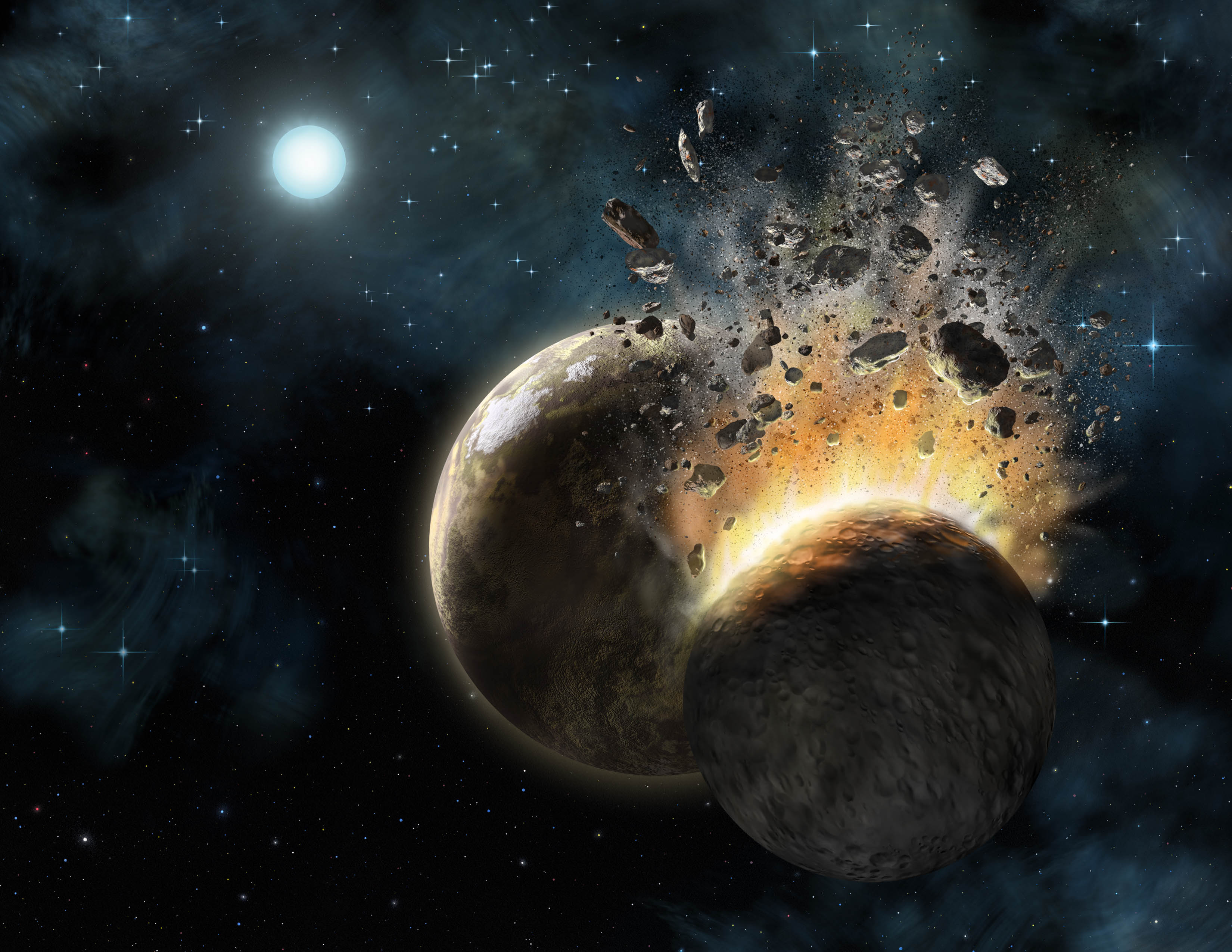
Figure 1. Artist's rendering of what HD 131488's inner planetary system might look like as two large rocky bodies collide. Inset illustrates the location of HD 131488's dust belts (top) and comparable regions to our own Solar System (bottom). HD 131488's hot inner dust belt has similar separations from its host star as the terrestrial planet zone (TPZ) around our Sun while the star's cool dust belt has similar separations from its host star as the Kuiper Belt region in our Solar System. Also shown for our Solar System are the orbits of Jupiter, Saturn, Uranus, and Neptune. Image Credit: Lynette Cook for Gemini Observatory/AURA

Inset with Background JPG 774 KB | TIFF 25.3 MB

Background Image JPG 754 KB | TIFF 25.3 MB

Inset Image JPG 287 KB | TIFF 16.2 MB

Figure 2. Mid-infrared spectroscopy of a sample of stars known to host warm dust in their terrestrial planet zones. The three spectra at the top of the plot illustrate the features of olivine and pyroxene dust species whereas the bottom three spectra illustrate the features of silica dust species. These species of dust are commonly found in comets and asteroids in our own Solar System. The solid middle curve shows the Gemini-South T-ReCS spectrum of HD 131488 which exhibits a dust spectral feature that is significantly different from the others shown. Comparison spectra were taken from the Spitzer-IRS archive

Using the Gemini South telescope in Chile, astronomers at UCLA have found dusty evidence for the formation of young, rocky planets around a star some 500 light years distant. But these potential extrasolar worlds are alien in an even more intriguing way… In the aftermath of collisions between planetary embryos around this star the researchers discovered that the dusty debris bears no resemblance to the planetary building blocks of our own Solar System.

"Until now, warm dust found around other stars has been very similar in composition to asteroidal or cometary material in our Solar System,” said Dr. Carl Melis, who led the research while a graduate student at UCLA. “This newly discovered dusty star is a compelling exception.” Melis reported these findings today at the 215th American Astronomical Society meeting in Washington, DC.

The star, known as HD 131488, appears to be surrounded by warm dust in a region called the terrestrial planet zone, where the star heats the dust to temperatures similar to those found on Earth. "What makes HD 131488 truly unique is the unidentified dust species released from the colliding bodies as well as the presence of cold dust far away from the star,” said UCLA professor of physics and astronomy Dr. Benjamin Zuckerman, who is a co-author of the research which is pending publication. “These two characteristics make HD 131488 unlike any other star with evidence for massive quantities of dust in its terrestrial planet zone."

Infrared imaging and spectroscopy of the HD 131488 system using an instrument called T-ReCS on the Gemini South telescope in Chile provided the data used by the team in analyzing the warm inner dust. "Typically, dust debris around other stars, or our own Sun, is of the olivine, pyroxene, or silica variety, minerals commonly found on Earth," said Melis. “The material orbiting HD 131488 is not one of these dust types. We have yet to identify what species it is - it really appears to be a completely alien type of dust.”

The amount of cold and warm dust around HD 131488 is comparable to the amount of cool material seen around other dusty main sequence stars (the majority of a star's life where it is stable like our Sun is spent on the main-sequence). Melis and his team argue that the most plausible explanation for the unusually large quantity of warm dust is a recent collision of two rocky planetary mass bodies. Such a collision would provide an appropriate source of dust particles that are needed to explain the observations.

While the mysteriously composed warm dust is located at a distance from HD 131488 that is comparable to the Earth–Sun separation, the team also found cooler dust about 45 times further out. This outer dusty region is analogous to the Kuiper Belt in our own Solar System where many minor planets orbit the Sun just beyond the orbit of Neptune.

"The hot dust almost certainly came from a recent catastrophic collision between two large rocky bodies in HD 131488's inner planetary system," Melis said. "The cooler dust, however, is unlikely to have been produced in a catastrophic collision and is probably left over from planet formation that took place farther away from HD 131488."

"Although dusty telltales of planetary formation processes in the outer regions surrounding young stars have often been seen with infrared-sensitive space telescopes, for some reason stars that have large amounts of orbiting warm dust do not also show evidence for the presence of cold dust. HD 131488 dramatically breaks this pattern," said Zuckerman.

HD 131488 joins five other stars with masses a few times larger than the Sun and with evidence of dust in their terrestrial planet zone. According to Melis, "Of the thousands of intermediate mass stars that could have been detected with such large quantities of terrestrial planet zone dust, only these five were. Interestingly, all five of these stars have ages in the range of 10-30 million years. This finding indicates that the epoch of final catastrophic mass accretion for terrestrial planets, the likes of which could have resulted in the formation of the Earth-Moon system in our own Solar System, occurs in this narrow age range for stars somewhat more massive than the Sun." Similar statistics for stars of solar mass are not yet available for comparison.

The team will continue to study HD 131488 to try and uncover the nature of its strange dust composition and search for additional stars with evidence for rocky planet formation.

HD 131488 is located in the direction of the constellation Centaurus and is three times more massive and 33 times more luminous than our own Sun. The star is part of a major southern hemisphere star forming region known as the Upper-Centaurus-Lupus association whose members are believed to be about 10 million years old. By contrast, the Sun and Earth are about 4.6 billion years old.

These results are based on infrared observations made with the Gemini South telescope, the Infrared Astronomical Satellite (IRAS) space-based infrared observatory (which made the original observations that eventually let to the team’s discovery of infrared excess around HD 131488), the NASA Infrared Telescope Facility (IRTF), and the Keck II telescope and optical observations from the Keck I telescope, the Siding Spring Observatory (SSO) 2.3-meter telescope, and the Tycho space-based imager/astrometer that flew aboard the ESA Hipparcos mission.

In addition to Melis and Zuckerman, co-authors include Inseok Song, a professor in the University of Georgia's Department of Physics and Astronomy; Joseph Rhee, a UCLA postdoctoral scholar in astronomy; M.S. Bessell of the Australian National University's Research School of Astronomy and Astrophysics; and Simon Murphy a graduate student at the Australian National University's Research School of Astronomy and Astrophysics.

Contacts:

Carl Melis
University of California San Diego
(858) 449-0437 (Cell)

Peter Michaud
Gemini Observatory, Hilo Hawai‘i
(808) 936-6643 (Cell)

The Gemini Observatory is an international collaboration with two identical 8-meter telescopes. The Frederick C. Gillett Gemini Telescope is located at Mauna Kea, Hawai'i (Gemini North) and the other telescope at Cerro Pachón in central Chile (Gemini South), and hence provide full coverage of both hemispheres of the sky. Both telescopes incorporate new technologies that allow large, relatively thin mirrors under active control to collect and focus both optical and infrared radiation from space.

The Gemini Observatory provides the astronomical communities in each partner country with state-of-the-art astronomical facilities that allocate observing time in proportion to each country's contribution. In addition to financial support, each country also contributes significant scientific and technical resources. The national research agencies that form the Gemini partnership include: the US National Science Foundation (NSF), the UK Science and Technology Facilities Council (STFC), the Canadian National Research Council (NRC), the Chilean Comisión Nacional de Investigación Cientifica y Tecnológica (CONICYT), the Australian Research Council (ARC), the Argentinean Consejo Nacional de Investigaciones Científicas y Técnicas (CONICET) and the Brazilian Conselho Nacional de Desenvolvimento Científico e Tecnológico CNPq).

Wednesday, January 06, 2010

NASA's WISE Eye Spies First Glimpse of the Starry Sky

This infrared snapshot of a region in the constellation Carina near the Milky Way was taken shortly after NASA's Wide-field Infrared Survey Explorer (WISE) ejected its cover. Image credit: NASA/JPL-Caltech/UCLA. Full image and caption

PASADENA, Calif. -- NASA's Wide-field Infrared Survey Explorer, or WISE, has captured its first look at the starry sky that it will soon begin surveying in infrared light.

Launched on Dec. 14, WISE will scan the entire sky for millions of hidden objects, including asteroids, "failed" stars and powerful galaxies. WISE data will serve as navigation charts for other missions, such as NASA's Hubble and Spitzer Space Telescopes, pointing them to the most interesting targets the mission finds.

A new WISE infrared image was taken shortly after the space telescope's cover was removed, exposing the instrument's detectors to starlight for the first time. The picture shows about 3,000 stars in the Carina constellation and can be viewed online at http://www.nasa.gov/mission_pages/WISE/multimedia/wise20100106.html

The image covers a patch of sky about three times larger than the full moon, and was presented today at the 215th meeting of the American Astronomical Society in Washington. The patch was selected because it does not contain any unusually bright objects, which could damage instrument detectors if observed for too long. The picture was taken while the spacecraft was staring at a fixed patch of sky and is being used to calibrate the spacecraft's pointing system.

When the WISE survey begins, the spacecraft will scan the sky continuously as it circles the globe, while an internal scan mirror counteracts its motion. This allows WISE to take "freeze-frame" snapshots every 11 seconds, resulting in millions of images of the entire sky.

"Right now, we are busy matching the rate of the scan mirror to the rate of the spacecraft, so we will capture sharp pictures as our telescope sweeps across the sky," said William Irace, the mission's project manager at NASA's Jet Propulsion Laboratory in Pasadena, Calif.

To sense the infrared glow of stars and galaxies, the WISE spacecraft cannot give off any detectable infrared light of its own. This is accomplished by chilling the telescope and detectors to ultra-cold temperatures. The coldest of WISE's detectors will operate at less than 8 Kelvin, or minus 445 degrees Fahrenheit.

The first sky survey will be complete in six months, followed by a second scan of one-half of the sky lasting three months. The mission ends when the frozen hydrogen that keeps the instrument cold evaporates away, an event expected to occur in October 2010.

Preliminary survey images are expected to be released six months later, in April 2011, with the final atlas and catalog coming 11 months later, in March 2012. Selected images will be released to the public beginning in February 2010.

JPL manages WISE for NASA's Science Mission Directorate in Washington. The mission was competitively selected under NASA's Explorers Program, managed by NASA's Goddard Space Flight Center in Greenbelt, Md. The science instrument was built by the Space Dynamics Laboratory in Logan, Utah, and the spacecraft was built by Ball Aerospace & Technologies Corp. in Boulder, Colo. Science operations and data processing take place at the Infrared Processing and Analysis Center at the California Institute of Technology in Pasadena.

More information is online at
http://www.nasa.gov/wise and http://wise.astro.ucla.edu.

J.D. Harrington 202-358-5241
Headquarters, Washington

j.d.harrington@nasa.gov

Whitney Clavin 818-354-4673
Jet Propulsion Laboratory, Pasadena, Calif.

whitney.clavin@jpl.nasa.gov

Massive Stars: Good Targets for Planet Hunts, Bad Targets for SETI

This artist's conception shows a Jupiter-sized planet forming from a disk of dust and gas surrounding a young, massive star. The planet's gravity has cleared a gap in the disk. Of more than 500 stars examined in the W5 star-forming region, 15 show evidence of central clearing that may be due to forming planets. Credit: David A. Aguilar, CfA

In this artist's conception, a hypothetical alien world and its moon orbit a hot, massive, type B star. Due to the short lifetime of such a star, complex life is unlikely to be found there. Although not good targets in the hunt for extraterrestrials, such planetary systems help give us a better understanding of planet formation. Credit: David A. Aguilar, CfA

This infrared portrait of the W5 star-forming region is from NASA's Spitzer Space Telescope. Astronomers examined more than 500 massive stars in W5 looking for infrared evidence of dusty disks. They found that about one-tenth of the stars examined appear to possess such disks. The stars in W5 are only about two to five million years old, yet most have already lost the raw materials needed to form planets. This indicates that, at least for type A and B stars, planets must form quickly or not at all. This image is a three-color composite showing infrared observations from two Spitzer instruments. Blue represents 3.6-micron light and green shows light of 8 microns, both captured by Spitzer's infrared array camera. Red is 24-micron light detected by Spitzer's multiband imaging photometer. Credit: NASA/JPL-Caltech/Harvard-Smithsonian CfA.

Washington, DC - Most searches for planets around other stars, also known as exoplanets, focus on Sun-like stars. Those searches have proven successful, turning up more than 400 alien worlds. However, Sun-like stars aren't the only potential homes for planets. New research by astronomers at the Harvard-Smithsonian Center for Astrophysics (CfA) and the National Optical Astronomy Observatory (NOAO) confirms that planet formation is a natural by-product of star formation, even around stars much heftier than the Sun.

"We see evidence of planet formation on fast forward," said Xavier Koenig of the CfA, who presented the research in a press conference today at the 215th meeting of the American Astronomical Society.

Koenig and his colleagues examined the star-forming region named W5, which lies about 6,500 light-years away in the constellation Cassiopeia. They employed NASA's Spitzer Space Telescope and the ground-based Two Micron All-Sky Survey (2MASS) to look for infrared evidence of dusty planet-forming disks. They targeted over 500 type A and B stars, which are about two to 15 times as massive as the Sun. Sirius and Vega, not included in this study, are two type A stars easily visible to backyard skygazers.

The team found that about one-tenth of the stars examined appear to possess dusty disks. Of those, 15 showed signs of central clearing, which suggests that newborn Jupiter-sized planets are sucking up material.

"The gravity of a Jupiter-sized object could easily clear the inner disk out to a radius of 10 to 20 astronomical units, which is what we see," said Lori Allen of NOAO. (An astronomical unit is the average Earth-Sun distance of 93 million miles.)

Planet formation around A and B stars is a battle between opposing forces. On one hand, the stars' disks tend to be more massive and contain more of the raw materials to build planets. On the other hand, fierce stellar radiation and winds try to destroy the disks rapidly.

The stars in W5 are only about two to five million years old, yet most have already lost the raw materials needed to form planets. This indicates that, at least for type A and B stars, planets must form quickly or not at all.

The prospects for hypothetical alien life are disappointing. The habitable zone, or region where liquid water could exist on a rocky surface, is at a greater distance from the star for A and B stars than for sun-like stars due to their greater luminosity. However, that luminosity comes at the price of a short lifetime. A and B stars live for only about 10 - 500 million years before running out of fuel.

Life existed on Earth for 3.5 billion years in very simple forms, before the Cambrian explosion led to the diversity of life forms we see today. Planets in W5 around these more massive stars wouldn't have that opportunity.

"These stars aren't good targets in the hunt for extraterrestrials," said Koenig, "but they give us a great new way to get a better understanding of planet formation."

NASA's Jet Propulsion Laboratory, Pasadena, Calif., manages the Spitzer Space Telescope mission for NASA's Science Mission Directorate, Washington. Science operations are conducted at the Spitzer Science Center at the California Institute of Technology, also in Pasadena. Caltech manages JPL for NASA. For more information about Spitzer, visit http://www.spitzer.caltech.edu/spitzer and http://www.nasa.gov/spitzer. Headquartered in Cambridge, Mass., the Harvard-Smithsonian Center for Astrophysics (CfA) is a joint collaboration between the Smithsonian Astrophysical Observatory and the Harvard College Observatory. CfA scientists, organized into six research divisions, study the origin, evolution and ultimate fate of the universe.

For more information, contact:

David A. Aguilar
Director of Public Affairs
Harvard-Smithsonian Center for Astrophysics
617-495-7462

daguilar@cfa.harvard.edu

Christine Pulliam
Public Affairs Specialist
Harvard-Smithsonian Center for Astrophysics
617-495-7463

cpulliam@cfa.harvard.edu