Monday, November 23, 2009

Spitzer Telescope Observes Baby Brown Dwarf

This image shows two young brown dwarfs, objects that fall somewhere between planets and stars in terms of their temperature and mass. Image credit: NASA/JPL-Caltech/Calar Alto Obsv./Caltech Sub. Obsv.

This artist's rendering gives us a glimpse into a cosmic nursery as a star is born from the dark, swirling dust and gas of this cloud. Image credit: NASA/JPL-Caltech

PASADENA, Calif. -- NASA's Spitzer Space Telescope has contributed to the discovery of the youngest brown dwarf ever observed -- a finding that, if confirmed, may solve an astronomical mystery about how these cosmic misfits are formed.

Brown dwarfs are misfits because they fall somewhere between planets and stars in terms of their temperature and mass. They are cooler and more lightweight than stars and more massive (and normally warmer) than planets. This has generated a debate among astronomers: Do brown dwarfs form like planets or like stars?

Brown dwarfs are born of the same dense, dusty clouds that spawn stars and planets. But while they may share the same galactic nursery, brown dwarfs are often called "failed" stars because they lack the mass of their hotter, brighter stellar siblings. Without that mass, the gas at their core does not get hot enough to trigger the nuclear fusion that burns hydrogen -- the main component of these molecular clouds -- into helium. Unable to ignite as stars, brown dwarfs end up as cooler, less luminous objects that are more difficult to detect -- a challenge that was overcome in this case by Spitzer's heat-sensitive infrared vision.

To complicate matters, young brown dwarfs evolve rapidly, making it difficult to catch them when they are first born. The first brown dwarf was discovered in 1995 and, while hundreds have been found since, astronomers had not been able to unambiguously find them in their earliest stages of formation until now. In this study, an international team of astronomers found a so-called "proto brown dwarf" while it was still hidden in its natal star-forming region. Guided by Spitzer data collected in 2005, they focused their search in the dark cloud Barnard 213, a region of the Taurus-Auriga complex well known to astronomers as a hunting ground for young objects.

"We decided to go several steps back in the process when (brown dwarfs) are really hidden," said David Barrado of the Centro de Astrobiología in Madrid, Spain, lead author of the paper on the discovery in the Astronomy & Astrophysics journal. "During this step they would have an (opaque) envelope, a cocoon, and they would be easier to identify due to their strong infrared excesses. We have used this property to identify them. This is where Spitzer plays an important role because Spitzer can have a look inside these clouds. Without it this wouldn't have been possible."

Spitzer's longer-wavelength infrared camera penetrated the dusty natal cloud to observe a baby brown dwarf named SSTB213 J041757. The data, confirmed with near-infrared imaging from Calar Alto Observatory in Spain, revealed not one but two of what would potentially prove to be the faintest and coolest brown dwarfs ever observed.

Barrado and his team embarked on an international quest for more information about the two objects. Their overarching scientific objective was to observe and characterize the presence of this dusty envelope -- proof of the celestial womb of sorts that would indicate that these brown dwarfs were, in fact, in their earliest evolutionary stages.

The twins were observed from around the globe, and their properties were measured and analyzed using a host of powerful astronomical tools. One of the astronomers' stops was the Caltech Submillimeter Observatory in Hawaii, which captured the presence of the envelope around the young objects. That information, coupled with what they had from Spitzer, enabled the astronomers to build a spectral energy distribution -- a diagram that shows the amount of energy that is emitted by the objects in each wavelength.

From Hawaii, the astronomers made additional stops at observatories in Spain (Calar Alto Observatory), Chile (Very Large Telescopes) and New Mexico (Very Large Array). They also pulled decade-old data from the Canadian Astronomy Data Centre archives that allowed them to comparatively measure how the two objects were moving in the sky. After more than a year of observations, they drew their conclusions.

"We were able to estimate that these two objects are the faintest and coolest discovered so far," Barrado said. Barrado said the findings potentially solve the mystery about whether brown dwarfs form more like stars or planets. The answer? They form like low-mass stars. This theory is bolstered because the change in brightness of the objects at various wavelengths matches that of other very young, low-mass stars.

While further study will confirm whether these two celestial objects are in fact proto brown dwarfs, they are the best candidates so far, Barrado said. He said the journey to their discovery, while difficult, was fun. "It is a story that has been unfolding piece by piece. Sometimes nature takes its time to give up its secrets."

These observations were made before Spitzer ran out of its liquid coolant in May 2009, beginning its "warm" mission.

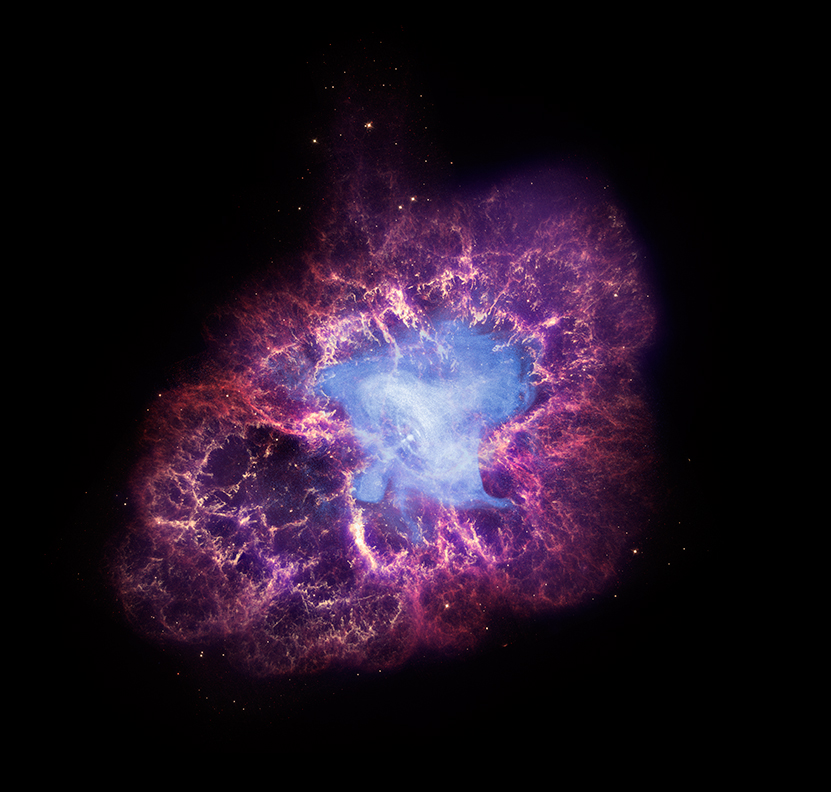
Crab Nebula: The Crab Nebula: A Cosmic Icon

Credit X-ray: NASA/CXC/SAO/F.Seward;
Optical: NASA/ESA/ASU/J.Hester & A.Loll;
Infrared: NASA/JPL-Caltech/Univ. Minn./R.Gehrz


A star's spectacular death in the constellation Taurus was observed on Earth as the supernova of 1054 A.D. Now, almost a thousand years later, a super dense object -- called a neutron star -- left behind by the explosion is seen spewing out a blizzard of high-energy particles into the expanding debris field known as the Crab Nebula. X-ray data from Chandra provide significant clues to the workings of this mighty cosmic "generator," which is producing energy at the rate of 100,000 suns.

This composite image uses data from three of NASA's Great Observatories. The Chandra X-ray image is shown in blue, the Hubble Space Telescope optical image is in red and yellow, and the Spitzer Space Telescope's infrared image is in purple. The X-ray image is smaller than the others because extremely energetic electrons emitting X-rays radiate away their energy more quickly than the lower-energy electrons emitting optical and infrared light. Along with many other telescopes, Chandra has repeatedly observed the Crab Nebula over the course of the mission's lifetime. The Crab Nebula is one of the most studied objects in the sky, truly making it a cosmic icon.

Fast Facts for Crab Nebula:

Scale: Image is 5 arcmin across
Category: Supernovas & Supernova Remnants, Neutron Stars/X-ray Binaries
Coordinates: (J2000) RA 05h 34m 32s | Dec +22° 0.0' 52.00"
Constellation: Taurus
Observation Date: 03/14/2001 and 01/27/2004
Observation Time: 11 hours 30 minutes
Obs. ID: 1997, 4607
Color Code: X-ray: Blue; Optical: Red-Yellow; Infrared: Purple
Instrument: ACIS
References: F.Seward et al 2006, ApJ, 652, 1277
Distance Estimate: About 6,000 light years

Friday, November 20, 2009

Watching a Cannibal Galaxy Dine

The “meal” of Centaurus A

The “meal” of Centaurus A

Visible and infrared views of giant,
cannibal galaxy Centaurus A

Inside Centaurus A

A new technique using near-infrared images, obtained with ESO’s 3.58-metre New Technology Telescope (NTT), allows astronomers to see through the opaque dust lanes of the giant cannibal galaxy Centaurus A, unveiling its “last meal” in unprecedented detail — a smaller spiral galaxy, currently twisted and warped. This amazing image also shows thousands of star clusters, strewn like glittering gems, churning inside Centaurus A.

Centaurus A (NGC 5128) is the nearest giant, elliptical galaxy, at a distance of about 11 million light-years. One of the most studied objects in the southern sky, by 1847 the unique appearance of this galaxy had already caught the attention of the famous British astronomer John Herschel, who catalogued the southern skies and made a comprehensive list of nebulae.

Herschel could not know, however, that this beautiful and spectacular appearance is due to an opaque dust lane that covers the central part of the galaxy. This dust is thought to be the remains of a cosmic merger between a giant elliptical galaxy and a smaller spiral galaxy full of dust.

Between 200 and 700 million years ago, this galaxy is indeed believed to have consumed a smaller spiral, gas-rich galaxy — the contents of which appear to be churning inside Centaurus A's core, likely triggering new generations of stars.

First glimpses of the “leftovers” of this meal were obtained thanks to observations with the ESA Infrared Space Observatory , which revealed a 16 500 light-year-wide structure, very similar to that of a small barred galaxy. More recently, NASA’s Spitzer Space Telescope resolved this structure into a parallelogram, which can be explained as the remnant of a gas-rich spiral galaxy falling into an elliptical galaxy and becoming twisted and warped in the process. Galaxy merging is the most common mechanism to explain the formation of such giant elliptical galaxies.

The new SOFI images, obtained with the 3.58-metre New Technology Telescope at ESO’s La Silla Observatory, allow astronomers to get an even sharper view of the structure of this galaxy, completely free of obscuring dust. The original images, obtained by observing in the near-infrared through three different filters (J, H, K) were combined using a new technique that removes the dark, screening effect of the dust, providing a clear view of the centre of this galaxy.

What the astronomers found was surprising: “There is a clear ring of stars and clusters hidden behind the dust lanes, and our images provide an unprecedentedly detailed view toward it,” says Jouni Kainulainen, lead author of the paper reporting these results. “Further analysis of this structure will provide important clues on how the merging process occurred and what has been the role of star formation during it.”

The research team is excited about the possibilities this new technique opens: “These are the first steps in the development of a new technique that has the potential to trace giant clouds of gas in other galaxies at high resolution and in a cost-effective way,” explains co-author João Alves. “Knowing how these giant clouds form and evolve is to understand how stars form in galaxies.”

Looking forward to the new, planned telescopes, both on the ground and in space, “this technique is very complementary to the radio data ALMA will collect on nearby galaxies, and at the same time it poses interesting avenues of research for extragalactic stellar populations with the future European Extremely Large Telescope and the James Webb Space Telescope, as dust is omnipresent in galaxies,” says co-author Yuri Beletsky.

Previous observations done with ISAAC on the VLT (ESO 04/01) have revealed that a supermassive black hole lurks inside Centaurus A. Its mass is about 200 million times the mass of our Sun, or 50 times more massive than the one that lies at the centre of our Milky Way. In contrast to our own galaxy, the supermassive black hole in Centaurus A is continuously fed by material falling onto into it, making the giant galaxy a very active one. Centaurus A is in fact one of the brightest radio sources in the sky (hence the “A” in its name). Jets of high energy particles from the centre are also observed in radio and X-ray images.

The new image of Centaurus A is a wonderful example of how frontier science can be combined with aesthetic aspects. Fine images of Centaurus A have been obtained in the past with ESO’s Very Large Telescope (ESO PR Photo 05b/00) and with the Wide Field Imager on the MPG/ESO 2.2-metre telescope at La Silla.

More Information

This research was presented in a paper in Astronomy and Astrophysics (vol. 502): “Uncovering the kiloparsec-scale stellar ring of NGC5128”, by J.T. Kainulainen et al.

The team is composed of J. T. Kainulainen (University of Helsinki, Finland, and MPIA, Germany), J. F. Alves (Calar Alto Observatory, Spain and University of Vienna, Austria), Y. Beletsky (ESO), J. Ascenso (Harvard-Smithsonian Center for Astrophysics, USA), J. M. Kainulainen (TKK/Department of Radio Science and Engineering, Finland), A. Amorim, J. Lima, F. D. Santos, and A. Moitinho (SIM-IDL, University of Lisbon, Portugal), R. Marques and J. Pinhão (University of Coimbra, Portugal), and J. Rebordão (INETI, Amadora, Portugal).

SOFI (Son of ISAAC) is an infrared spectro-imager attached to ESO's 3.58-metre New Technology Telescope (NTT) and a simplified version of the Short Wavelength arm of ISAAC on the Very Large Telescope.

ESO, the European Southern Observatory, is the foremost intergovernmental astronomy organisation in Europe and the world’s most productive astronomical observatory. It is supported by 14 countries: Austria, Belgium, the Czech Republic, Denmark, France, Finland, Germany, Italy, the Netherlands, Portugal, Spain, Sweden, Switzerland and the United Kingdom. ESO carries out an ambitious programme focused on the design, construction and operation of powerful ground-based observing facilities enabling astronomers to make important scientific discoveries. ESO also plays a leading role in promoting and organising cooperation in astronomical research. ESO operates three unique world-class observing sites in Chile: La Silla, Paranal and Chajnantor. At Paranal, ESO operates the Very Large Telescope, the world’s most advanced visible-light astronomical observatory. ESO is the European partner of a revolutionary astronomical telescope ALMA, the largest astronomical project in existence. ESO is currently planning a 42-metre European Extremely Large optical/near-infrared Telescope, the E-ELT, which will become “the world’s biggest eye on the sky”.


Contacts

Jouni Kainulainen
MPIA, Germany
Phone: +49-6221-528427
E-mail: jtkainul@mpia-hd.mpg.de

Yuri Beletsky
ESO, Chile
Phone: +56 55 43 5311
E-mail: ybialets@eso.org

João Alves
Calar Alto Observatory, Spain
Phone: +34 950 632 501
E-mail: jalves@caha.es

ESO La Silla - Paranal - ELT Press Officer: Henri Boffin - +49 89 3200 6222 - hboffin@eso.org
ESO Press Officer in Chile: Valeria Foncea - +56 2 463 3123 - vfoncea@eso.org

National contacts for the media: http://www.eso.org/public/outreach/eson/

Cassini's Big Sky: The View from the Center of Our Solar System

In this illustration, the multicolored (blue and green) bubble represents the new measurements of the emission of particles known as energetic neutral atoms. Image credit: NASA/JPL/JHUAPL

NASA's Cassini spacecraft created this image of the bubble around our solar system based on emissions of particles known as energetic neutral atoms. Image credit: NASA/JPL/JHUAPL

When NASA's Cassini spacecraft began orbiting Saturn five years ago, a dozen highly-tuned science instruments set to work surveying, sniffing, analyzing and scrutinizing the Saturnian system.

But Cassini recently revealed new data that appeared to overturn the decades-old belief that our solar system resembled a comet in shape as it moves through the interstellar medium (the matter between stars in our corner of the Milky Way galaxy).

Instead, the new results suggest our heliosphere more closely resembles a bubble - or a rat - being eaten by a boa constrictor: as the solar system passes through the "belly" of the snake, the ribs, which mimic the local interstellar magnetic field, expand and contract as the rat passes. An animation is available here.

"At first I was incredulous," said Tom Krimigis, principal investigator of the Magnetospheric Imaging Instrument (MIMI) at Johns Hopkins University's Applied Physics Laboratory in Laurel, Md. "The first thing I thought was, 'What's wrong with our data?'"

Krimigis and his colleagues on the instrument team published the Cassini findings in the Nov. 13 issue of the journal Science, which featured complementary results from NASA's Interstellar Boundary Explorer (IBEX). Together, the results create the first map of the heliosphere and its thick outer layer known as the heliosheath, where solar wind streaming out from the sun gets heated and slowed as it interacts with the interstellar medium.

The Cassini data also provide a much more direct indication of the thickness of the heliosheath, whereas scientists previously had to rely on calculations from models. The new results from Cassini show that the heliosheath is about 40 to 50 astronomical units (3.7 billion to 4.7 billion miles) thick and that NASA's twin Voyager spacecraft, which are traveling through the heliosheath now, will cross into true interstellar space well before the year 2020. Estimates as far out as 2030 had been suggested.

"These new data from Cassini really redefine our sense of our home in the galaxy, and we can now do better studies of whether our solar system resembles those elsewhere," Krimigis said.

The Voyagers have sent back rich data on the heliosphere and heliosheath, but just at two locations. Scientists want more context. One way to learn about the region is to track energetic neutral atoms streaming back toward the sun from the heliosheath.

Energetic neutral atoms form when cold, neutral gas collides with electrically-charged particles in a cloud of plasma, which is a gas-like state of matter so hot that the atoms split into an ion and an electron. The positively-charged ions in plasma can't reclaim their own electrons, which are moving too fast, but they can steal an electron from the cold gas atoms. Since the resulting particles are neutrally charged, they are able to escape magnetic fields and zoom off into space. The emission of these particles often occurs in the magnetic fields surrounding planets, but also happens when the solar wind mingles with the interstellar medium.

How did Cassini, with 22,000 wire connections and 14 kilometers (8.7 miles) of cabling specifically tweaked to get the most out of its investigation of the solar system's second largest gas bag, recently end up helping to redefine how we look at our entire solar system?

Krimigis and his Cassini colleagues working with MIMI weren't sure their instrument could pick up emissions from far-out, exotic locations, such as from the boundary of our heliosphere, the region of our sun's influence.

Last year, after spending four years focused on the energetic electrons and ions trapped in the magnetic field that surrounds Saturn, as well as the offspring of these particles known as energetic neutral atoms, the team started combing through the data from the instrument's Ion and Neutral Camera, looking for particles arriving from far beyond Saturn.

"We thought we could get some hits from energetic neutral atoms from the heliosheath because Cassini has really been in an excellent position to detect these particles," said Don Mitchell, MIMI instrument scientist and a researcher at the Applied Physics Laboratory.

Cassini was farther away from the sun than previous spacecraft trying to image the heliosphere and even swung very far away from Saturn on some of its orbits, Mitchell said. The data would likely be free of much of the interference that hampered other efforts.

Mitchell, Krimigis and their team were able to stitch together data from late 2003 to the summer of 2009. They created a color-coded map of the intensity of the energetic neutral atoms and discovered a belt of hot, high-pressure particles where the interstellar wind flowed by our heliosheath bubble.

The data matched up nicely with the IBEX images of lower-energy particles and connected that data set to the Voyager data on higher-energy particles.

"I was initially skeptical because the instrument was designed for Saturn's magnetosphere," Mitchell said, "But our camera had long exposures of months to years, so we could accumulate and map each particle that streamed through the tiny aperture from the far reaches of the heliosphere. It was luck, but also a lot of hard work."

The Cassini-Huygens mission is a cooperative project of NASA, the European Space Agency and the Italian Space Agency. NASA's Jet Propulsion Laboratory, a division of the California Institute of Technology in Pasadena, Calif. manages the mission for NASA's Science Mission Directorate, Washington, D.C.

Link: http://photojournal.jpl.nasa.gov/catalog/PIA12310

For more information about the Cassini-Huygens mission visit http://saturn.jpl.nasa.gov and http://www.nasa.gov/cassini.

Wednesday, November 18, 2009

Baffling boxy bulge

Still an astrophysical mystery, the evolution of the bulges in spiral galaxies led astronomers to the edge-on galaxy NGC 4710. When staring directly at the centre of the galaxy, one can detect a faint, ethereal "X"-shaped structure. Such a feature, which astronomers call a "boxy" or "peanut-shaped" bulge, is due to the vertical motions of the stars in the galaxy's bar and is only evident when the galaxy is seen edge-on. This curiously shaped puff is often observed in spiral galaxies with small bulges and open arms, but is less common in spirals with arms tightly wrapped around a more prominent bulge, such as NGC 4710. Credit: NASA E ESA


18-Nov-2009: Just as many people are surprised to find themselves packing on unexplained weight around the middle, astronomers find the evolution of bulges in the centres of spiral galaxies puzzling. A recent NASA/ESA Hubble Space Telescope image of NGC 4710 is part of a survey that astronomers have conducted to learn more about the formation of bulges, which are a substantial component of most spiral galaxies.

When targeting spiral galaxy bulges, astronomers often seek edge-on galaxies, as their bulges are more easily distinguishable from the disc. This exceptionally detailed edge-on view of NGC 4710 taken by the Advanced Camera for Surveys (ACS) aboard Hubble reveals the galaxy's bulge in the brightly coloured centre. The luminous, elongated white plane that runs through the bulge is the galaxy disc. The disc and bulge are surrounded by eerie-looking dust lanes.

When staring directly at the centre of the galaxy, one can detect a faint, ethereal "X"-shaped structure. Such a feature, which astronomers call a "boxy" or "peanut-shaped" bulge, is due to the vertical motions of the stars in the galaxy's bar and is only evident when the galaxy is seen edge-on. This curiously shaped puff is often observed in spiral galaxies with small bulges and open arms, but is less common in spirals with arms tightly wrapped around a more prominent bulge, such as NGC 4710.

NGC 4710 is a member of the giant Virgo Cluster of galaxies and lies in the northern constellation of Coma Berenices (the Hair of Queen Berenice). It is not one of the brightest members of the cluster, but can easily be seen as a dim elongated smudge on a dark night with a medium-sized amateur telescope. In the 1780s, William Herschel discovered the galaxy and noted it simply as a "faint nebula". It lies about 60 million light-years from the Earth and is an example of a lenticular or S0-type galaxy – a type that seems to have some characteristics of both spiral and elliptical galaxies.

Astronomers are scrutinising these systems to determine how many globular clusters they host. Globular clusters are thought to represent an indication of the processes that can build bulges. Two quite different processes are believed to be at play regarding the formation of bulges in spiral galaxies: either they formed rather rapidly in the early Universe, before the spiral disc and arms formed; or they built up from material accumulating from the disc during a slow and long evolution. In this case of NGC 4710, researchers have spotted very few globular clusters associated with the bulge, indicating that its assembly mainly involved relatively slow processes.

Notes for editors:

The Hubble Space Telescope is a project of international cooperation between ESA and NASA.

These observations were obtained by a team led by Paul Goudfrooij from the Space Telescope Science Institute in Baltimore, Maryland, USA.

Contacts:

Colleen Sharkey
Hubble/ESA, Garching, Germany
Tel: +49 89 3200 6306
Cell: +49 151 153 73591
E-mail:
csharkey@eso.org

Tuesday, November 17, 2009

Discovery of a Retrograde or Highly Tilted Extrasolar Planet

The panels show two possibilities for the bizarre orbit of HAT-P-7b. The top panel shows a "polar" orbit in which the planet goes over the north and south poles of the star. The bottom panel shows a "retrograde" orbit in which the planet revolves in the opposite direction as the star's rotation. Astronomers cannot distinguish these two possibilities because the exact orientation of the star's rotation axis is not yet known. Illustrations: Simon Albrecht/MIT

Figure 1
An illustration of the concept of the Rossiter-McLaughlin effect. Each star generally rotates by itself and has an approaching part and a receding part. During a planetary transit, we can see the Rossiter-McLaughlin effect, which is an apparent anomaly of the stellar radial velocity, the star appears to be receding if the transiting planet hides an approaching part and vice versa. We can observe this effect by precise radial velocity measurements. Note that if the planet orbits in a prograde manner, the planet first hides an approaching side and subsequently hides a receding side. Inversely, if the planet orbits in a retrograde manner, the effect occurs in reverse.

Figure 2 
The observational result of the Rossiter-McLaughlin effect on UT May 30, 2008 taken with the Subaru HDS (Narita et al. 2009). This figure shows that the HAT-P-7b first hides a receding part of the HAT-P-7 and subsequently hides an approaching side.


Figure 3
The observational result of the Rossiter-McLaughlin effect on UT July 1, 2009 taken with the Subaru HDS (Winn et al. 2009). This result also indicates a retrograde orbit of HAT-P-7b as well as the previous figure.

Two teams of astronomers have found that extrasolar planet HAT-P-7b, discovered in 2008, has a retrograde or highly tilted orbit. On UT May 30, 2008, a Japanese collaboration led by Norio Narita (National Astronomical Observatory of Japan) used the Subaru Telescope’s High Dispersion Spectrograph (HDS) to observe the HAT-P-7 planetary system, which is about 1000 light years distant from Earth, and found the first evidence of a retrograde orbit of the extrasolar planet HAT-P-7b. On UT July 1, 2009, a US collaboration led by Joshua N. Winn (Massachusetts Institute of Technology) also used the Subaru Telescope’s HDS to independently observe the HAT-P-7 system and likewise concluded that extrasolar planet HAT-P-7b has a retrograde or polar orbit. Both observational results were independently submitted and accepted to scientific journals in August 2009, and were published in October 2009.

The HAT-P-7b is the first planet that indicates a retrograde orbit at the time of publications in scientific journals. Such retrograde or spin-orbit misaligned planets are important for understanding the diversity of planetary systems, and they provide important evidence for assessing current planetary migration models. It is now well known that extrasolar planets have diverse orbits, and recent planetary migration models have predicted the existence of such retrograde or highly tilted extrasolar planets. The Subaru findings provide an important milestone for understanding the orbital evolution of planetary systems.

Extrasolar planets are planets beyond our Solar System. With the advent of large ground-based telescopes and innovative instruments to enhance the flexibility of observations since the 1990s, over 400 extrasolar planets have been discovered since the first one was identified in 1995. The discoveries taught us that orbits of extrasolar planets are very different from those of the planets in the Solar System. For instance, dozens of extrasolar Jovian planets orbit their host stars with a period of a few days ("hot Jupiters"), and many of the extrasolar planets have significant eccentricities ("eccentric planets"). In order to understand the diversity of planetary orbits, many theoretical models for planetary migration have been developed.

Widely held beliefs about planetary system formation have maintained that planetary systems form in rotating protoplanetary disks surrounding protostars. Thus the planetary orbital axis and the stellar spin axis are generally considered to be well aligned, as is true for the planets in the Solar System. However, recent theories have not followed suit. For example, planetary migration models considering gravitational interactions between multiple giant planets ("planet-planet scattering models") or considering Kozai cycles due to a distant companion star ("Kozai migration") predict that a significant fraction of migrated planets have tilted, or even retrograde orbits to the stellar spin axis. Retrograde orbits are those in which the planetary orbit is tilted by over 90 degrees to the stellar spin axis.

A collaboration led by Norio Narita at National Astronomical Observatory of Japan has used the Subaru Telescope to make observations that test such planetary migration models. The team focused on the Rossiter-McLaughlin effect, which is an apparent irregularity in the star’s radial velocity; the star appears to be receding if the transiting planet hides an approaching part and vice versa. By measuring the Rossiter-McLaughlin effect, one can estimate the sky-projected angle between the stellar spin axis and the planetary orbital axis. The Subaru telescope succeeded in detecting the effect in the TrES-1 transiting planetary system in 2007 (a press release at the Subaru website on August 23, 2007), and since then the Subaru Telescope has made observations of several transiting planetary systems. During the observation of the planetary system on UT May 30, 2008, the Japanese team found the first evidence of a retrograde or highly tilted orbit of the HAT-P-7b based on the Rossiter-McLaughlin effect. The result indicates that the planet first hides the receding part of the stellar surface and then the approaching part. The independent observations on UT July 1, 2009 of the US collaboration led by Joshua N. Winn at MIT confirmed these findings (a press release at the MIT website on November 12, 2009).

At this point, however, the migration model for HAT-P-7b has not yet been firmly discriminated. Thus further observations of this system to search for outer massive planets or a binary companion would be interesting. In addition, since the HAT-P-7 system is within the field of view of the Kepler mission, further characterization of this interesting planet HAT-P-7b will be undertaken in the near future.

These studies were published in the Publications of Astronomical Society of Japan Letters (issue published on October 25, 2009) and the Astrophysical Journal Letters (issue publised on October 1, 2009).

REFERENCES:

Norio Narita, Bun'ei Sato, Teruyuki Hirano, Motohide Tamura, 2009 "First Evidence of a Retrograde Orbit of a Transiting Exoplanet HAT-P-7b" Publ. Astron. Soc. Japan, Vol. 61, No. 5, L35-L40.

Joshua N. Winn, John Asher Johnson, Simon Albrecht, Andrew W. Howard, Geoffrey W. Marcy, Ian J. Crossfield, Matthew J. Holman, 2009 "HAT-P-7: A Retrograde or Polar Orbit, and a Third Body" The Astrophysical Journal Letters, Volume 703, Issue 2, pp. L99-L103.

Ticking Stellar Time Bomb Identified

The expanding shell
around V445 Puppis

Around the nova
V445 Puppis annotated

Around the nova V445 Puppis

Shell around V445 Puppis
(March 2005)

Shell around V445 Puppis
(December 2005)

Shell around V445 Puppis
(October 2006)

Shell around V445 Puppis
(March 2007)

The expanding shell
around V445 Puppis

Artist’s impression of vampire star

Astronomers find prime suspect for a Type Ia supernova

Using ESO’s Very Large Telescope and its ability to obtain images as sharp as if taken from space, astronomers have made the first time-lapse movie of a rather unusual shell ejected by a “vampire star”, which in November 2000 underwent an outburst after gulping down part of its companion’s matter. This enabled astronomers to determine the distance and intrinsic brightness of the outbursting object. It appears that this double star system is a prime candidate to be one of the long-sought progenitors of the exploding stars known as Type Ia supernovae, critical for studies of dark energy.

“One of the major problems in modern astrophysics is the fact that we still do not know exactly what kinds of stellar system explode as a Type Ia supernova,” says Patrick Woudt, from the University of Cape Town and lead author of the paper reporting the results. “As these supernovae play a crucial role in showing that the Universe’s expansion is currently accelerating, pushed by a mysterious dark energy, it is rather embarrassing.”

The astronomers studied the object known as V445 in the constellation of Puppis (“the Stern”) in great detail. V445 Puppis is the first, and so far only, nova showing no evidence at all for hydrogen. It provides the first evidence for an outburst on the surface of a white dwarf [1] dominated by helium. “This is critical, as we know that Type Ia supernovae lack hydrogen,” says co-author Danny Steeghs, from the University of Warwick, UK, “and the companion star in V445 Pup fits this nicely by also lacking hydrogen, instead dumping mainly helium gas onto the white dwarf.”

In November 2000, this system underwent a nova outburst, becoming 250 times brighter than before and ejecting a large quantity of matter into space.

The team of astronomers used the NACO adaptive optics instrument [2] on ESO’s Very Large Telescope (VLT) to obtain very sharp images of V445 Puppis over a time span of two years. The images show a bipolar shell, initially with a very narrow waist, with lobes on each side. Two knots are also seen at both the extreme ends of the shell, which appear to move at about 30 million kilometres per hour. The shell — unlike any previously observed for a nova — is itself moving at about 24 million kilometres per hour. A thick disc of dust, which must have been produced during the last outburst, obscures the two central stars.

“The incredible detail that we can see on such small scales — about hundred milliarcseconds, which is the apparent size of a one euro coin seen from about forty kilometres — is only possible thanks to the adaptive optics technology available on large ground-based telescopes such as ESO’s VLT,” says Steeghs.

A supernova is one way that a star can end its life, exploding in a display of grandiose fireworks. One family of supernovae, called Type Ia supernovae, are of particular interest in cosmology as they can be used as “standard candles” to measure distances in the Universe [3] and so can be used to calibrate the accelerating expansion that is driven by dark energy.

One defining characteristic of Type Ia supernovae is the lack of hydrogen in their spectrum. Yet hydrogen is the most common chemical element in the Universe. Such supernovae most likely arise in systems composed of two stars, one of them being the end product of the life of sun-like stars, or white dwarfs. When such white dwarfs, acting as stellar vampires that suck matter from their companion, become heavier than a given limit, they become unstable and explode [4].

The build-up is not a simple process. As the white dwarf cannibalises its prey, matter accumulates on its surface. If this layer becomes too dense, it becomes unstable and erupts as a nova. These controlled, mini-explosions eject part of the accumulated matter back into space. The crucial question is thus to know whether the white dwarf can manage to gain weight despite the outburst, that is, if some of the matter taken from the companion stays on the white dwarf, so that it will eventually become heavy enough to explode as a supernova.

Combining the NACO images with data obtained with several other telescopes [5] the astronomers could determine the distance of the system — about 25 000 light-years from the Sun — and its intrinsic brightness — over 10 000 times brighter than the Sun. This implies that the vampire white dwarf in this system has a high mass that is near its fatal limit and is still simultaneously being fed by its companion at a high rate. “Whether V445 Puppis will eventually explode as a supernova, or if the current nova outburst has pre-empted that pathway by ejecting too much matter back into space is still unclear,” says Woudt. “But we have here a pretty good suspect for a future Type Ia supernova!”
Notes

[1] White dwarfs represent the evolutionary end product of stars with initial masses up to a few solar masses. A white dwarf is the burnt-out stellar core that is left behind when a star like the Sun sheds its outer layers towards the end of its active life. It is composed essentially of carbon and oxygen. This process normally also leads to the formation of a surrounding planetary nebula.

[2] Adaptive optics is a technique that allows astronomers to obtain an image of an object free from the blurring effect of the atmosphere. See the adaptive optics page at ESO: http://www.eso.org/public/astronomy/technology/adaptive_optics.html


[4] This Chandrasekhar limit, named after the Indian physicist Subrahmanyan Chandrasekhar, is nearly 1.4 times the mass of the Sun. When a white dwarf reaches a mass above this limit, either by sucking matter from a companion or merging with another white dwarf, it will turn itself into a thermonuclear bomb that will burn carbon and oxygen explosively.

[5] The team also used the SOFI instrument on ESO’s New Technology Telescope, the IMACS spectrograph on the 6.5-metre Magellan Baade telescope, and the Infrared Survey Facility and the SIRIUS camera at the Sutherland station of the South African Astronomical Observatory.
More Information

This research was presented in a paper to appear in the 20 November 2009 issue of the Astrophysical Journal, vol. 706, p. 738 (“The expanding bipolar shell of the helium nova V445 Puppis”, by P. A. Woudt et al.).

The team is composed of P. A. Woudt and B. Warner (University of Cape Town, South Africa), D. Steeghs and T. R. Marsh (University of Warwick, UK), M. Karovska and G. H. A. Roelofs (Harvard-Smithsonian Center for Astrophysics, Cambridge MA, USA), P. J. Groot and G. Nelemans (Radboud University Nijmegen, the Netherlands), T. Nagayama (Kyoto University, Japan), D. P. Smits (University of South Africa, South Africa), and T. O’Brien (University of Manchester, UK).

ESO, the European Southern Observatory, is the foremost intergovernmental astronomy organisation in Europe and the world’s most productive astronomical observatory. It is supported by 14 countries: Austria, Belgium, the Czech Republic, Denmark, France, Finland, Germany, Italy, the Netherlands, Portugal, Spain, Sweden, Switzerland and the United Kingdom. ESO carries out an ambitious programme focused on the design, construction and operation of powerful ground-based observing facilities enabling astronomers to make important scientific discoveries. ESO also plays a leading role in promoting and organising cooperation in astronomical research. ESO operates three unique world-class observing sites in Chile: La Silla, Paranal and Chajnantor. At Paranal, ESO operates the Very Large Telescope, the world’s most advanced visible-light astronomical observatory. ESO is the European partner of a revolutionary astronomical telescope ALMA, the largest astronomical project in existence. ESO is currently planning a 42-metre European Extremely Large optical/near-infrared Telescope, the E-ELT, which will become “the world’s biggest eye on the sky”.

Links

Research paper: http://arxiv.org/abs/0910.1069

Contacts

Patrick Woudt
University of Cape Town,
South Africa
Phone: +27 21 650 5830
E-mail:
Patrick.Woudt@uct.ac.za

Danny Steeghs
University of Warwick, UK
Phone: +44 (0)2476 573873
Mobile: +44 (0)78 45555979
E-mail:
D.T.H.Steeghs@warwick.ac.uk

ESO La Silla - Paranal - ELT Press Officer: Henri Boffin - +49 89 3200 6222 - hboffin@eso.org
ESO Press Officer in Chile: Valeria Foncea - +56 2 463 3123 - vfoncea@eso.org

National contacts for the media: http://www.eso.org/public/outreach/eson/

Monday, November 16, 2009

Close-Up Movie Shows Hidden Details in the Birth of Super-Suns

Artist's conception of the "boiling disk" surrounding the massive young stellar object known as Orion Source I. A disk of hot, ionized gas surrounds the central star, blocking our view. A cool wind of gas is driven from the upper and lower surfaces of the disk (as indicated by the colored arrows) and is sculpted into an hourglass shape by tangled magnetic field lines (shown as thin blue lines). This outflow is lit up by emission from silicon monoxide molecules - emission that has been imaged and tracked by radio astronomers month-to-month. The entire disk and wind are rotating, leading to observable Doppler shifts of the material entrained in the wind; redder colors represent material with a component of motion away from the observer (into the plane of the sky), while bluer colors represent material moving toward the observer (out of the plane of the sky).Credit: Bill Saxton, NRAO/AUI/NSF

This movie shows actual data from the Very Long Baseline Array, which imaged clumps of gas flowing away from the young protostar known as Source I over the course of two years. Gas moving toward us (blueshifted) is colored green or blue, while gas moving away from us (redshifted) is colored yellow, orange and red. The protostar is not visible to the VLBA; its location is marked by a red dot and crosshairs. Credit: L. Matthews (MIT)

Cambridge, MA - The constellation of Orion is a hotbed of massive star formation, most prominently in the Great Nebula that sits in Orion's sword. The glowing gas of the Nebula is powered by a group of young massive stars, but behind it is a cluster of younger stars and clumps of gas. Still gathering together under gravity's pull, these gas clumps will eventually ignite into stars.

The youthful cluster cannot be seen with traditional telescopes because of the surrounding gas and dust, but a new high-resolution time-lapse movie reveals the process of massive star formation with radio images a thousand times sharper and more detailed than any previously obtained. The movie shows that massive stars form like their smaller siblings, with disk accretion and magnetic fields playing crucial roles.

The way that massive stars form remains mysterious, in part, because massive stars are rare and tend to spend their youth enshrouded by dust and gas hiding them from view.

"We know how these stars die, but not how they are born," said Lincoln Greenhill, a principal investigator of the study and part of a team comprising scientists from the Harvard-Smithsonian Center for Astrophysics (CfA) and the National Radio Astronomy Observatory (NRAO).

Unlike Hubble and other visible-light telescopes, radio telescopes can penetrate dusty veils around stars. The research astronomers studied a massive young protostar called Source I (pronounced "eye") at radio wavelengths, using the National Science Foundation's Very Long Baseline Array (VLBA) as a powerful "zoom lens."

The VLBA yielded even sharper images than the famous Hubble photos of "proplyds," or protoplanetary disks in Orion. The team observed Source I at monthly intervals over two years and then assembled the individual images into a time-lapse movie.

The VLBA detected thousands of silicon monoxide gas clouds called masers - naturally occurring laser-like beacons often associated with star formation. Some masers were as close to the protostar as Jupiter is to our Sun, which is also a record. Many of the masers existed long enough for their motions to be tracked across the sky and along our line of sight, yielding their 3-d motions through space.

"Source I is the richest source of masers in the Galaxy, that we know of," said Lynn Matthews, lead author of the new work, who is now a researcher at the MIT Haystack Observatory. "Without the masers, we couldn't track the gas motions in such detail so close to this massive star, and would be relatively blind to its formation."

"In astronomy, it's rare to see changes over the course of a human lifetime. With this new movie, we can see changes over just a few months as gas clumps swarm around this young protostar," added Smithsonian astronomer and co-author Ciriaco Goddi.

The resulting movie reveals signs of a rotating accretion disk, where gas is swirling closer and closer to the protostar at the center. It also shows material flowing outward perpendicular to the disk in two large V's - actually the edges of cone-shaped streams of gas. Such outflows foster star formation by carrying angular momentum away from the system.

Intriguingly, the outflow streams appear to curve as they leave the disk. "The bending path of these masers provides key evidence that magnetic fields may be influencing gas motions very close to the protostar," pointed out Claire Chandler of NRAO, a co-principal investigator of the study.

Magnetic field lines are familiar from their effect on iron filings sprinkled around a bar magnet, outlining loops extending from one pole of the magnet to the other. In the case of Source I and other massive protostars, magnetic field lines may extend outward into space, wrapping in a helix that is shaped much like Twizzlers candy. Outflowing gas streams along those field lines.

"Magnetic fields are supposed to be weak and unimportant to the birth process for massive stars," said Matthews. "But masers would not travel along gentle arcs unless they experience some sort of force - probably a magnetic force."

The data don't show whether the magnetic field arises in the star or in the accretion disk. Future observations by the Expanded Very Large Array (E-VLA) and the Atacama Large Millimeter Array (ALMA) may be able to distinguish between competing hypotheses. The team plans to look for other fingerprints of magnetic fields around Source I.

"Our two-year movie is just the beginning," said Smithsonian astronomer and co-principal investigator Elizabeth Humphreys.

The paper describing these findings will appear in the Astrophysical Journal early next year, in January 2010, and it is available online at http://arxiv.org/abs/0911.2473. This material is based upon work supported by the National Science Foundation under Grant No. 0507478.

Headquartered in Cambridge, Mass., the Harvard-Smithsonian Center for Astrophysics (CfA) is a joint collaboration between the Smithsonian Astrophysical Observatory and the Harvard College Observatory. CfA scientists, organized into six research divisions, study the origin, evolution and ultimate fate of the universe.

For more information, contact:

David A. Aguilar
Director of Public Affairs
Harvard-Smithsonian Center for Astrophysics
617-495-7462

daguilar@cfa.harvard.edu

Christine Pulliam
Public Affairs Specialist
Harvard-Smithsonian Center for Astrophysics
617-495-7463

cpulliam@cfa.harvard.edu

Wednesday, November 11, 2009

Exoplanets Clue to Sun's Curious Chemistry

Burning lithium inside a star

A ground-breaking census of 500 stars, 70 of which are known to host planets, has successfully linked the long-standing “lithium mystery” observed in the Sun to the presence of planetary systems. Using ESO’s successful HARPS spectrograph, a team of astronomers has found that Sun-like stars that host planets have destroyed their lithium much more efficiently than “planet-free” stars. This finding does not only shed light on the lack of lithium in our star, but also provides astronomers with a very efficient way of finding stars with planetary systems.

“For almost 10 years we have tried to find out what distinguishes stars with planetary systems from their barren cousins,” says Garik Israelian, lead author of a paper appearing this week in the journal Nature. “We have now found that the amount of lithium in Sun-like stars depends on whether or not they have planets.”

Low levels of this chemical element have been noticed for decades in the Sun, as compared to other solar-like stars, and astronomers have been unable to explain the anomaly. The discovery of a trend among planet-bearing stars provides a natural explanation to this long-standing mystery. “The explanation of this 60 year-long puzzle is for us rather simple,” adds Israelian. “The Sun lacks lithium because it has planets.”

This conclusion is based on the analysis of 500 stars, including 70 planet-hosting stars. Most of these stars were monitored for several years with ESO’s High Accuracy Radial Velocity Planet Searcher. This spectrograph, better known as HARPS, is attached to ESO's 3.6-metre telescope and is the world’s foremost exoplanet hunter. “This is the best possible sample available to date to understand what makes planet-bearing stars unique,” says co-author Michel Mayor.

The astronomers looked in particular at Sun-like stars, almost a quarter of the whole sample. They found that the majority of stars hosting planets possess less than 1% of the amount of lithium shown by most of the other stars. “Like our Sun, these stars have been very efficient at destroying the lithium they inherited at birth,” says team member Nuno Santos. “Using our unique, large sample, we can also prove that the reason for this lithium reduction is not related to any other property of the star, such as its age.”

Unlike most other elements lighter than iron, the light nuclei of lithium, beryllium and boron are not produced in significant amounts in stars. Instead, it is thought that lithium, composed of just three protons and four neutrons, was mainly produced just after the Big Bang, 13.7 billion years ago. Most stars will thus have the same amount of lithium, unless this element has been destroyed inside the star.

This result also provides the astronomers with a new, cost-effective way to search for planetary systems: by checking the amount of lithium present in a star astronomers can decide which stars are worthy of further significant observing efforts.

Now that a link between the presence of planets and curiously low levels of lithium has been established, the physical mechanism behind it has to be investigated. “There are several ways in which a planet can disturb the internal motions of matter in its host star, thereby rearrange the distribution of the various chemical elements and possibly cause the destruction of lithium. It is now up to the theoreticians to figure out which one is the most likely to happen,” concludes Mayor.

More Information

This research was presented in a paper that appears in the 12 November 2009 issue of Nature (Enhanced lithium depletion in Sun-like stars with orbiting planets, by G. Israelian et al.).

The team is composed of Garik Israelian, Elisa Delgado Mena, Carolina Domínguez Cerdeña, and Rafael Rebolo (Instituto de Astrofisíca de Canarias, La Laguna, Tenerife, Spain), Nuno Santos and Sergio Sousa (Centro de Astrofisica, Universidade de Porto, Portugal), Michel Mayor and Stéphane Udry (Observatoire de Genève, Switzerland), and Sofia Randich (INAF, Osservatorio di Arcetri, Firenze, Italy).

ESO, the European Southern Observatory, is the foremost intergovernmental astronomy organisation in Europe and the world’s most productive astronomical observatory. It is supported by 14 countries: Austria, Belgium, the Czech Republic, Denmark, France, Finland, Germany, Italy, the Netherlands, Portugal, Spain, Sweden, Switzerland and the United Kingdom. ESO carries out an ambitious programme focused on the design, construction and operation of powerful ground-based observing facilities enabling astronomers to make important scientific discoveries. ESO also plays a leading role in promoting and organising cooperation in astronomical research. ESO operates three unique world-class observing sites in Chile: La Silla, Paranal and Chajnantor. At Paranal, ESO operates the Very Large Telescope, the world’s most advanced visible-light astronomical observatory. ESO is the European partner of a revolutionary astronomical telescope ALMA, the largest astronomical project in existence. ESO is currently planning a 42-metre European Extremely Large optical/near-infrared Telescope, the E-ELT, which will become “the world’s biggest eye on the sky”.

Links
Science paper
More info: Exoplanet Media Kit
Project page of G. Israelian : http://www.iac.es/proyecto/abuntest/framesetwelcome.htm
ESO press release 10/01

Contacts

Garik Israelian
Insitituto de Astrofisica de Canarias, Tenerife, Spain
Phone: +34 922 60 5258
E-mail: gil@iac.es

Nuno Santos, Sergio Sousa
Centro de Astrofisica da Universidade do Porto, Portugal
Phone: +351 226 089 893
E-mail: Nuno.Santos@astro.up.pt, sousasag@astro.up.pt

Michel Mayor, Stéphane Udry
Observatory of Geneva University, Switzerland
Phone: +41 22 379 22 00
Email: Michel.Mayor@obs.unige.ch, Stephane.Udry@obs.unige.ch


ESO La Silla - Paranal - ELT Press Officer: Henri Boffin - +49 89 3200 6222 - hboffin@eso.org
ESO Press Officer in Chile: Valeria Foncea - +56 2 463 3123 - vfoncea@eso.org

National contacts for the media: http://www.eso.org/public/outreach/eson/

Rapid Star Formation Spotted in Infant Galaxies


The Universe’s infant galaxies enjoyed rapid growth spurts forming stars like our sun at a rate of up to 50 stars a year, according to scientists at Durham University.

The findings show that “stellar nurseries” within the first galaxies gave birth to stars at a much more rapid rate than previously expected, the researchers from Durham’s Institute for Computational Cosmology revealed. Their work appears in a paper in the journal Monthly Notices of the Royal Astronomical Society.

The research looked back 12.5 billion years to one of the most distant known galaxies, seen as it appeared about one billion years after the Big Bang.

Using a technique called gravitational lensing – where distant galaxies are magnified using the gravity of a nearby galaxy cluster – the scientists observed the rapid bursts of star formation in the galaxy called MS1358arc.

Within the star-forming regions, new stars were being created at a rate of about 50 stars per year - around 100 times faster than had been previously thought.

The researchers, who say their work represents the most detailed study of a galaxy at such a young age, believe the observed galaxy is typical of others in the early Universe.

They say the galaxy, which measures 6,000 light years across, also has all the characteristics that would allow it to eventually evolve into a galaxy such as our Milky Way, giving an insight into how our sun and galaxy formed.

The Durham researchers based their findings on observations from the Gemini North telescope, based in Hawaii, and NASA’s Hubble and Spitzer Space Telescopes. The research was funded by the Royal Astronomical Society.

Lead author Dr Mark Swinbank, who is the Norman Lockyer Fellow of the Royal Astronomical Society and works in the Institute for Computational Cosmology, at Durham University, said: “The runaway effect in this galaxy suggests it is growing much faster than expected.

“Given the size of the star forming regions, we would expect it to be forming stars at the rate of about one sun per year, but it seems to be much more active than that.

“We think this galaxy is fairly typical of galaxies at this time and we expect that the Milky Way once looked like this as it formed its first stars.

“In effect we are seeing the first generation of stars being born in a galaxy like the Milky Way. This gives unique insight into the birth of our own galaxy.”

The researchers say most of the observed stars eventually exploded as supernovae, spewing debris back into space where it formed into new stars

Dr Swinbank added: “In this respect these stars are the seeds of future star formation in the Universe.”

Royal Astronomical Society President Professor Andy Fabian said: “It is exciting to see such a detailed picture of a very distant galaxy.

“This pioneering work shows what our own galaxy might have looked like when it was a tenth of its present age."

Forwarded from Durham University by:

Dr Robert Massey
Press and Policy Officer
Royal Astronomical Society
Tel: +44 (0)20 7734 3307
Mob: +44 (0)794 124 8035
E-mail: rm@ras.org.uk

CONTACTS

Dr Mark Swinbank
RAS Norman Lockyer Fellow
Institute for Computational Cosmology
Department of Physics
Durham University
Tel: +44 (0)191 334 3786
E-mail: a.m.swinbank@durham.ac.uk

Dr Swinbank is available for interview on Tuesday, November 10, and Wednesday, November 11.

Alternatively please contact

Durham University Media Relations Office
Tel: +44 (0)191 334 6075
E-mail: media.relations@durham.ac.uk

Note to broadcasters: An ISDN broadcast quality line is available via the Media Relations Office on the contact details above. The ISDN number is +44 (0)191 386 2749.

IMAGES

A 300dpi j-peg image showing the distant galaxy MS1358arc is available from Durham University Media Relations Office on request on +44 (0)191 334 6075 or e-mail media.relations@durham.ac.uk

Caption: A Hubble Space Telescope observation showing the red ‘arc’ of the rapid star forming galaxy MS1358arc – seen as it was 12.5 billion years ago. The galaxy is magnified by a factor of 10 by the younger foreground galaxies. (Credit: Dr Johan Richard, Durham University.)

Source Information:

A Spatially Resolved Map of the Kinematics, Star-Formation and Stellar Mass Assembly in a Star-Forming Galaxy at z=4.9, Swinbank, AM, et al, Monthly Notices of the Royal Astronomical Society, 2009, DOI (10.1111/j.1365-2966.2009.15617.x)

A PDF copy of the paper is available on request from Durham University Media Relations Office.

Institute for Computational Cosmology, Durham University: www.icc.dur.ac.uk/
Royal Astronomical Society: www.ras.org.uk/
Gemini Observatory: www.gemini.edu/
Spitzer Space Telescope: www.spitzer.caltech.edu/
Hubble Space Telescope: http://hubblesite.org/

DURHAM UNIVERSITY – A MEMBER OF THE 1994 GROUP

Durham University is a member of the 1994 Group of 19 leading research-intensive universities. The Group was established in 1994 to promote excellence in university research and teaching. Each member undertakes diverse and high-quality research, while ensuring excellent levels of teaching and student experience. www.1994group.ac.uk

ROYAL ASTRONOMICAL SOCIETY

The Royal Astronomical Society (RAS), founded in 1820, encourages and promotes the study of astronomy, solar-system science, geophysics and closely related branches of science. The RAS organizes scientific meetings, publishes international research and review journals, recognizes outstanding achievements by the award of medals and prizes, maintains an extensive library, supports education through grants and outreach activities and represents UK astronomy nationally and internationally. Its more than 3000 members (Fellows), a third based overseas, include scientific researchers in universities, observatories and laboratories as well as historians of astronomy and others. www.ras.org.uk