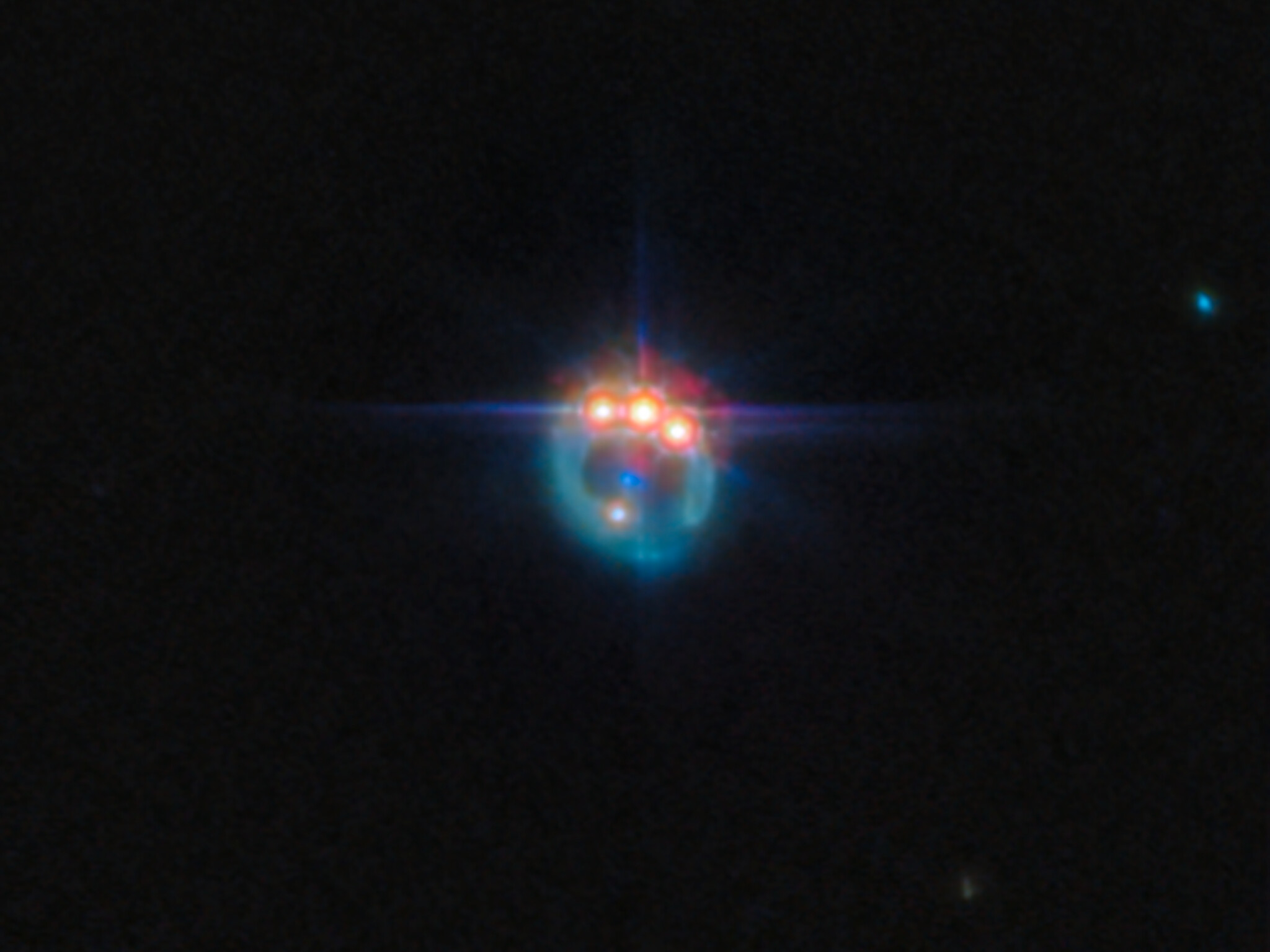
A small image of a galaxy distorted by gravitational lensing into a dim
ring. At the top of the ring are three very bright spots with
diffraction spikes coming off them, right next to each other: these are
copies of a single quasar in the lensed galaxy, duplicated by the
gravitational lens. In the centre of the ring, the elliptical galaxy
doing the lensing appears as a small blue dot. The background is black
and empty. Credit: ESA/Webb, NASA & CSA, A. Nierenberg
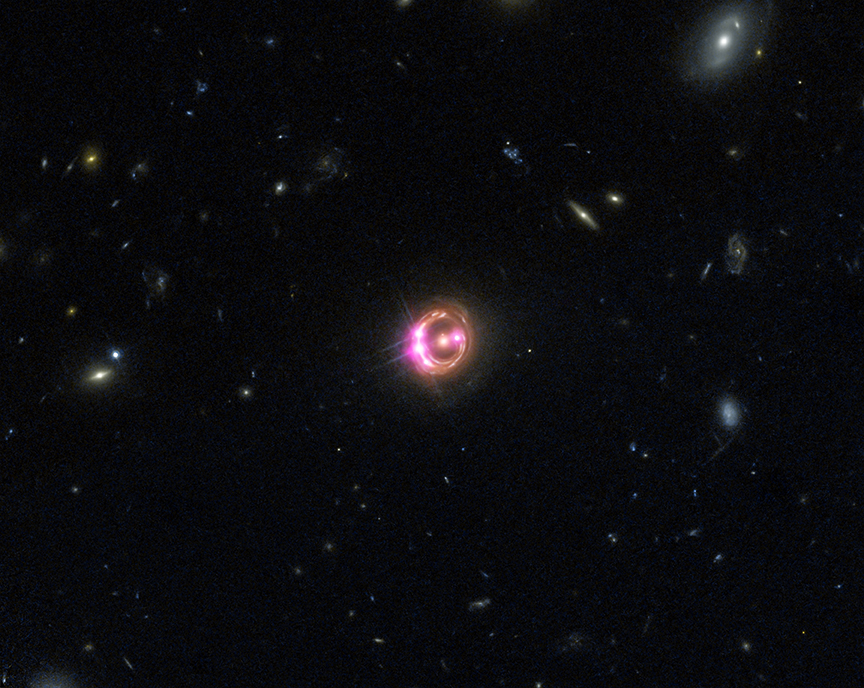
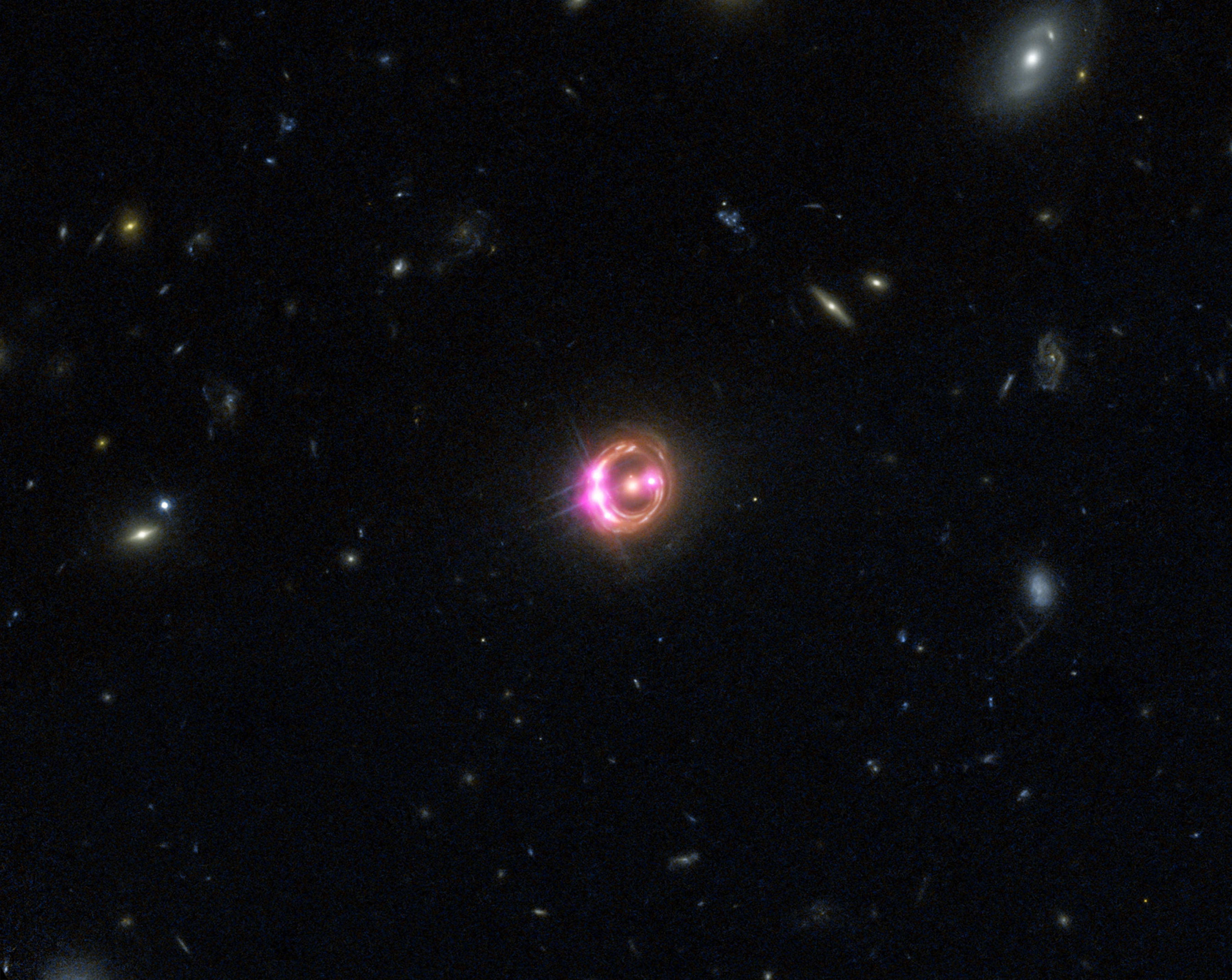
This new ESA/Webb Picture of the Month features the gravitational lensing of the quasar known as RX J1131-1231, located roughly 6 billion light-years from Earth in the constellation Crater. It is considered one of the best lensed quasars discovered to date, as the foreground galaxy smears the image of the background quasar into a bright arc and creates four images of the object.
Gravitational lensing, first predicted by Einstein, offers a rare opportunity to study regions close to the black hole in distant quasars, by acting as a natural telescope and magnifying the light from these sources. All matter in the Universe warps the space around itself, with larger masses producing a more pronounced effect. Around very massive objects, such as galaxies, light that passes close by follows this warped space, appearing to bend away from its original path by a clearly visible amount. One of the consequential effects of gravitational lensing is that it can magnify distant astronomical objects, letting astronomers study objects that would otherwise be too faint or far away.
Measurements of the X-ray emission from quasars can provide an indication of how fast the central black hole is spinning, which can provide researchers important clues about how black holes grow over time. For example, if a black hole grows primarily from collisions and mergers between galaxies, it should accumulate material in a stable disc, and the steady supply of new material from the disc should lead to a rapidly spinning black hole. On the other hand, if the black hole grew through many small accretion episodes, it would accumulate material from random directions. Observations have indicated that the black hole in this particular quasar is spinning at over half the speed of light, which suggests that this black hole has grown via mergers, rather than pulling material in from different directions.
This image was captured with Webb’s MIRI (Mid-Infrared Instrument) as part of an observation programme to study dark matter. Dark matter is an invisible form of matter that accounts for most of the Universe's mass. Webb’s observations of quasars are allowing astronomers to probe the nature of dark matter at smaller scales than ever before.