Showing posts with label IGR J18245-2452. Show all posts

Thursday, September 26, 2013

IGR J18245-2452: Neutron Star Undergoes Wild Behavior Changes

Credit: X-ray: NASA/CXC/ICE/A.Papitto et al


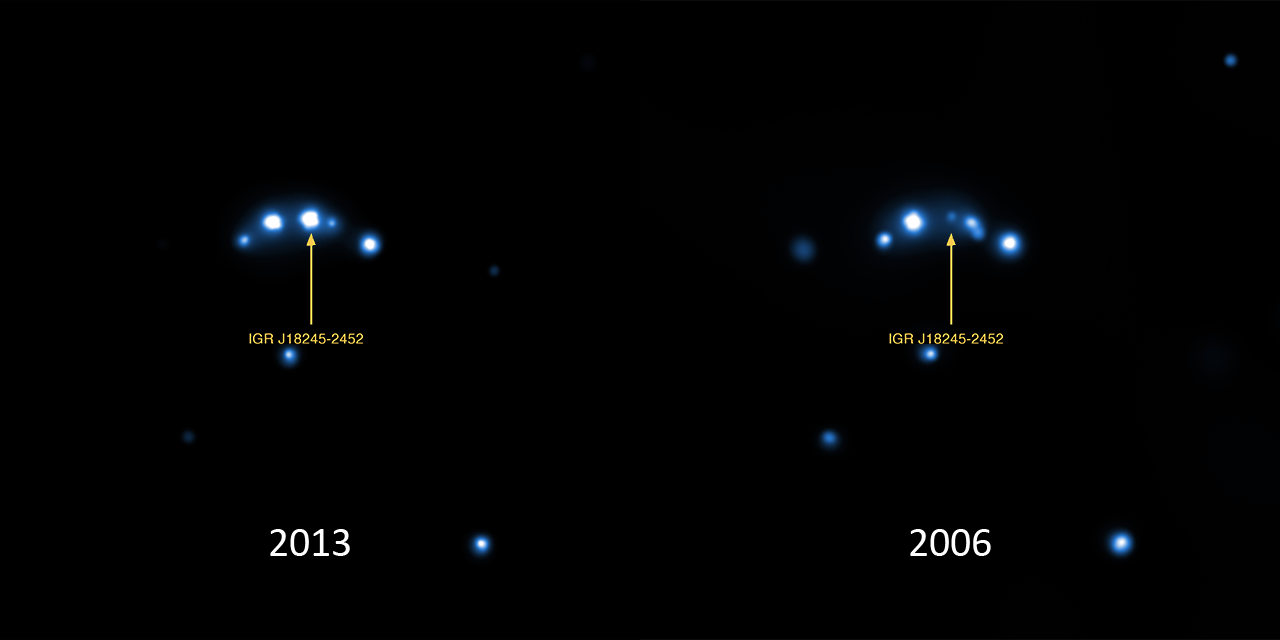
These two images from NASA's Chandra X-ray Observatory show a large change in X-ray brightness of a rapidly rotating neutron star, or pulsar, between 2006 and 2013. The neutron star - the extremely dense remnant left behind by a supernova - is in a tight orbit around a low mass star. This binary star system, IGR J18245-2452 (mouse over the image for its location) is a member of the globular cluster M28.

As described in a press release from the European Space Agency, IGR J18245-2452 provides important information about the evolution of pulsars in binary systems. Pulses of radio waves have been observed from the neutron star as it makes a complete rotation every 3.93 milliseconds (an astonishing rate of 254 times every second), identifying it as a "millisecond pulsar."

Credit: X-ray: NASA/CXC/ICE/A.Papitto et al 

The widely accepted model for the evolution of these objects is that matter is pulled from the companion star onto the surface of the neutron star via a disk surrounding it. During this so-called accretion phase, the system is described as a low-mass X-ray binary because bright X-ray emission from the disk is observed. Spinning material in the disk falls onto the neutron star, increasing its rotation rate. The transfer of matter eventually slows down and the remaining material is swept away by the whirling magnetic field of the neutron star as a millisecond radio pulsar forms.

The complete evolution of a low-mass X-ray binary into a millisecond pulsar should happen over several billion years, but in the course of this evolution, the system might switch rapidly between these two states. The source IGR J18245-2452 provides the first direct evidence for such drastic changes in behavior. In observations from July 2002 to May 2013 there are periods when it acts like an X-ray binary and the radio pulses disappear, and there are times when it switches off as an X-ray binary and the radio pulses turn on.

The latest observations with both X-ray and radio telescopes show that the transitions between an X-ray binary and a radio pulsar can take place in both directions and on a time scale that is shorter than expected, maybe only a few days. They also provide powerful evidence for an evolutionary link between X-ray binaries and radio millisecond pulsars.

The X-ray observations contained data from Chandra, ESA's XMM-Newton, the International Gamma-Ray Astrophysics Laboratory (INTEGRAL) and NASA's Swift/XRT and the radio observations used the Australia Telescope Compact Array, the Green Bank Telescope, Parkes radio telescope and the Westerbok Synthesis Radio Telescope.

The observations of IGR J18245-2452 and their implications are described in a paper published in the September 26th, 2013 issue of Nature. The first author is Alessandro Papitto from the Institute of Space Sciences in Barcelona, Spain. The co-authors are C. Ferrigno and E. Bozzo from Université de Genève, Versoix, Switzerland; N. Rea from the Institute of Space Sciences in Barcelona, Spain; L. Pavan from Université de Genève, Versoix, Switzerland; L. Burderi from Universit´a di Cagliari, Monserrato, Italy; M. Burgay from INAF-Osservatorio Astronomico di Cagliari, Capoterra, Italy; S. Campana from INAF-Osservatorio Astronomico di Brera, Lecco, Italy; T. Di Salvo from Universit´a di Palermo, Palermo, Italy; M. Falanga from International Space Science Institute, Bern, Switzerland; M. Filipovi´c from University of Western Sydney, Penrith, Australia; P. Freire from Max-Planck-Institut f´ur Radioastronomie, Bonn, Germany; J. Hessels from Netherlands Institute for Radio Astronomy, Dwingeloo, The Netherlands; A. Possenti from INAF-Osservatorio Astronomico di Cagliari, Capoterra, Italy; S. Ransom from National Radio Astronomy Observatory, Charlottesville, VA; A. Riggio from Universit´a di Cagliari, Monserrato, Italy; P. Romano from INAF-Istituto di Astrosica Spaziale e Fisica Cosmica, Palermo, Italy; J. Sarkissian from CSIRO Astronomy and Space Science, Epping, Australia; I. Stairs from University of British Columbia, Vancouver, Canada; L. Stella from INAF-Osservatorio Astronomico di Roma, Roma, Italy; D. Torres from the Institute of Space Sciences in Barcelona, Spain; M. Wieringa from CSIRO Astronomy and Space Science, Narrabri, Australia and G. Wong from University of Western Sydney, Penrith, Australia.

NASA's Marshall Space Flight Center in Huntsville, Ala., manages the Chandra Program for NASA's Science Mission Directorate in Washington. The Smithsonian Astrophysical Observatory controls Chandra's science and flight operations from Cambridge, Mass.


Fast Facts for IGR J18245-2452: 

Scale: Each panel is 1.2 arcmin across (About 6 light years) 
Category: Neutron Stars/X-ray Binaries
Coordinates (J2000): RA 18h 24m 32.00s | Dec -24° 52' 10.70" 
Constellation: Sagittarius
Observation Date: 30 May 2006 and 29 Apr 2013 
Observation Time: 26 (1 day, 2 hours). 
Obs. ID: 6769, 15645 I
Instrument: ACIS
References: Papitto, A. et al, 2013, Nature (accepted); arXiv:1305.3884 
Color Code: X-ray: Blue  
Distance Estimate: 18,000 light years

Missing link found between X-ray and Radio Pulsars

Pulsar caught in evolutionary change
Access the video

Astronomers using ESA’s Integral and XMM-Newton space observatories have caught a fast-spinning ‘millisecond pulsar’ in a crucial evolutionary phase for the first time, as it swings between emitting pulses of X-rays and radio waves. 

Pulsars are spinning, magnetised neutron stars, the dead cores of massive stars that exploded as a dramatic supernova after having burned up their fuel. As they spin, they sweep out pulses of electromagnetic radiation hundreds of times per second, like beams from a lighthouse. This tells us that the spin period of the neutron stars can be as short as a few milliseconds. 

Pulsars are classified according to how their emission is generated. For example, radio pulsars are powered by the rotation of their magnetic field, while X-ray pulsars are fuelled by the accretion of material siphoned off from a companion star. 

Theory holds that initially slowly rotating neutron stars with a low-mass companion are spun up as matter accretes onto them from a surrounding disc fed by the companion. X-rays are emitted as the accreting material heats up as it falls onto the neutron star. 

After a billion years or so, the rate of accretion drops and the pulsars are thought to switch on again as a radio-emitting millisecond pulsar. 

There is thought to be an intermediate phase during which they swing back and forth between the two states several times, but until now, there has been no direct and conclusive evidence for this transitional phase.
  
Thanks to the combined forces of ESA’s Integral and XMM-Newton space observatories, along with follow-up observations by NASA’s Swift and Chandra satellites and by ground-based radio telescopes, scientists have finally caught a pulsar in the act of changing between the two evolutionary steps. 

“The search is finally over: with our discovery of a millisecond pulsar that, within only a few weeks, switched from being accretion-powered and X-ray-bright to rotation-powered and bright in radio waves, we finally have the missing link in pulsar evolution,” says Alessandro Papitto from the Institute of Space Sciences in Barcelona, Spain, who led the research published this week in  Nature

The object, identified as IGR J18245-2452, was first detected in X-rays on 28 March 2013 by Integral in the globular cluster M28, which lies in the constellation Sagittarius. 

Observations by XMM-Newton determined the pulsar’s spin period to be 3.9 milliseconds, meaning that it rotates on its axis more than 250 times every second, clearly identifying it as an X-ray-bright millisecond pulsar. 

But comparing its spin period and other key characteristics with those of other known pulsars in M28 showed it matched perfectly those of another pulsar that had been observed in 2006 – but only at radio wavelengths.

“At that time, it appeared to be just another millisecond radio pulsar, but now here it was shining in X-rays – this is clearly no ordinary pulsar,” adds Dr Papitto. 

The astronomers kept monitoring the object with X-ray telescopes, but also started a series of radio observations, on the lookout for hints that it might change personalities again. 

What the astronomers didn’t expect was that the change in behaviour would happen within just a few weeks.
“We used to think the change would occur only once over the billion-year evolution of these systems, yet within a month, the neutron star swung back and forth between an X-ray and a radio pulsar state, showing the switch can be made even on extremely short timescales,” says co-author Enrico Bozzo of the University of Geneva, Switzerland. 

Despite occurring on a far quicker timescale than previously imagined, the characteristics of the transformation, which is thought to lie in the interplay between the pulsar’s magnetic field and the pressure of material falling onto it from its low-mass companion star, still fits current theory. 

When the inflow of material from the neighbouring star is more intense, the high density of matter shuts off the radio emission, and the pulsar is only visible through the X-rays emitted by the accreting matter as it heats up while falling onto the pulsar. 

Conversely, when the accretion rate decreases, the magnetic field of the pulsar expands and pushes any remaining matter away from the pulsar, allowing the radio emission to switch back on. 

Looking back through archival data for this particular pulsar, the astronomers have shown that these cycles may repeat on timescales of just a few years. 

“The discovery of this transitional pulsar completes a decades-long quest for such an object and will help us to understand better the evolution of pulsars,” says Erik Kuulkers, Integral Project Scientist at ESA.
“Although it took a long time to make this first detection, we believe that pulsars in such binary systems are fairly common, so we’re looking forward to finding more,” adds Norbert Schartel, XMM-Newton Project Scientist at ESA. 

Read an in-depth version of this story on ESA SciTech: Swinging between X-rays and radio waves: the missing-link pulsar
 
Swings between rotation and accretion power in a millisecond binary pulsar by A. Papitto et al. is published in Nature 26 September 2013. 

The study is based on data from a number of space-based high-energy observatories and ground-based radio telescopes: ESA’s Integral and XMM-Newton and NASA’s Swift and Chandra space telescopes, and CSIRO's Australia Telescope Compact Array and Parkes radio telescope, NRAO's Robert C. Byrd Green Bank Telescope, and ASTRON's Westerbork Synthesis Radio Telescope. 


For further information, please contact:
 
Markus Bauer
ESA Science and Robotic Exploration Communication Officer

Tel: +31 71 565 6799

Mob: +31 61 594 3 954

Email:
markus.bauer@esa.int

Alessandro Papitto Institut de Ciències de l’Espai (ICE), CSIC-IEEC (Spanish National Research Council - Institute for Space Studies of Catalonia)
Barcelona, Spain
Tel: +34 935 868355
Email:
papitto@ice.csic.es

Enrico Bozzo
ISDC Data Centre for Astrophysics
University of Geneva, Switzerland
Tel: +41 79 3129209
Email:
Enrico.Bozzo@unige.ch

Erik Kuulkers
ESA Integral Project Scientist
Tel: +34 918131358
Email:
Erik.Kuulkers@esa.int

Norbert Schartel
ESA XMM-Newton Project Scientist
Tel: +34 91 8131 184
Email:
Norbert.Schartel@esa.int


Source: ESA