Showing posts with label CID-42. Show all posts

Monday, January 26, 2015

A Recoiling, Supermassive Black Hole

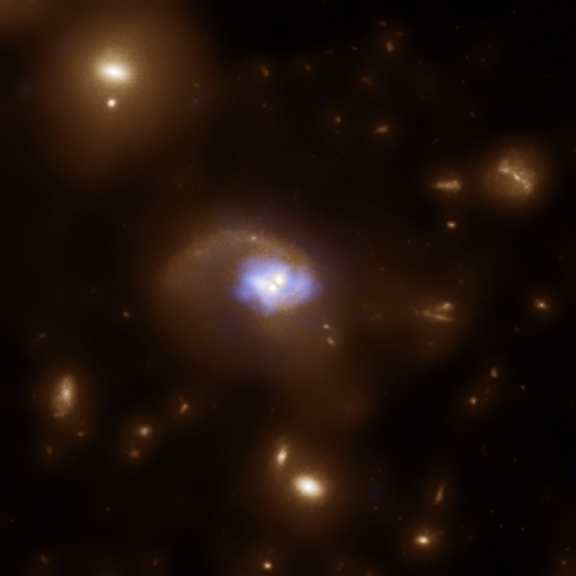
The galaxy at the center of this image from the Hubble Space Telescope contains an X-ray source, CID-42, which is suspected of being the merged remnant of a pair of supermassive black holes and of being ejected from the host galaxy at a speed of several million miles per hour. Credit: X-ray: NASA/CXC/SAO/F.Civano et al; Optical: NASA/STScI; Optical (wide field): CFHT, NASA/STScI 


When galaxies collide, the central supermassive black holes that reside at their cores will end up orbiting one another in a binary pair, at least according to current simulations. Einstein's general theory of relativity predicts that masses in a binary system should radiate gravitational waves, analogous to the way that accelerating electrical charges radiate electromagnetic waves but very much weaker.

As they radiate away their energy in these waves, orbiting black holes will gradually come closer together until eventually they merge in a coalescence event that is expected to emit a strong burst of gravitational waves. Relativity predicts that the gravitational radiation from black hole coalescence will be preferentially emitted in one direction that depends on the spin- and mass-ratios of the two black holes. In order to conserve momentum, therefore, the newly formed single supermassive black hole will recoil. Indeed, recoiling supermassive black holes are predicted to be one of the key observable signatures of such binary mergers. As they speed away from the center of the galaxy, they are expected to carry along with them their local environments (the discs and hot gas regions).

Amazingly, a few of these bizarre, recoiling candidates have apparently been serendipitously spotted (they are so far only candidates because their character is not yet confirmed). One of them is an X-ray source known as CID-42, which the Hubble Space Telescope resolves into two bright components only a few thousand light-years apart (a relatively small distance in galactic terms). CfA astronomers Francesca Civano, Xiawei Wang, Avi Loeb, and Martin Elvis, together with their colleagues, used the Very Large Array radio facility to study the radio emission emitted by charged particles accelerated by the black holes in CID-42, and analyzed their data together with that from other facilities in an effort to confirm it as a recoil object. They find that all of the radio emission can be attributed to one of the two bright components, which also is the source of the X-ray emission. This source, their analysis concludes (although still not unequivocally), could indeed be a long-sought example of a recoiling black hole. The new research is a major step towards confirming the existence of these exotic objects, but further observations are still needed.

Reference(s): 

 "New Insights from Deep VLA Data on the Potentially Recoiling Black Hole CID-42 in the COSMOS Field," Mladen Novak, Vernesa Smolcic, Francesca Civano, Marco Bondi, Paolo Ciliegi, Xiawei Wang, Abraham Loeb, Julie Banfield, Stephen Bourke, Martin Elvis, Gregg Hallinan, Huib T. Intema, Hans-Rainer Klockner, Kunal Mooley and Felipe Navarrete, MNRAS, 447, 2282, 2015.


Monday, June 04, 2012

CID 42: Giant Black Hole Kicked Out of Home Galaxy

CID-42
Credit: X-ray: NASA/CXC/SAO/F.Civano et al;
Optical: NASA/STScI;
Optical (wide field): CFHT, NASA/STScI


JPEG (297.2 kb) - Tiff (37.1 MB) - More Images

Download Desktop - Press Room: CID 42

View on the Sky (WWT)


The galaxy at the center of this image contains an X-ray source, CID-42, with exceptional properties. After combining data from several telescopes - including NASA's Chandra X-ray Observatory - researchers think that CID-42 contains a massive black hole being ejected from its host galaxy at several million miles per hour.

The main panel is a wide-field image of CID-42 and its surroundings taken by the Canada-French-Hawaii Telescope and the Hubble Space Telescope in optical light. The galaxy is located nearly 4 billion light years from Earth. The outlined box on the main panel represents the more localized view of CID-42 that is shown in the three separate boxes on the right-hand side of the graphic. At the top is an image from the Chandra X-ray Observatory. The X-ray emission is concentrated in a single source, corresponding to one of the two sources seen in deep observations by Hubble, which is shown in the middle inset box. The bottom inset shows how the X-rays align with the optical data in the two insets above.

The precise location of this source was recently obtained using Chandra's High Resolution Camera, giving an important clue in telling astronomers what is happening within this galaxy. Previous Chandra observations had detected a bright X-ray source likely caused by super-heated material around one or more supermassive black holes. However, they could not distinguish if the X-rays came from one or both of the optical sources because Chandra was not pointed directly at CID-42, giving an X-ray source that was less sharp than usual.


Simulation of Black Hole Ejection
The new data help to clarify the situation. Researchers think that CID-42 is the byproduct of two galaxies that have collided, producing the distinctive tail seen in the upper part of the optical image inset. A simulation by co-author Laura Blecha shows more details of how this spectacular event was thought to unfold.

When this galaxy collision occurred, the supermassive black holes in the center of each galaxy also collided. The two black holes then merged to form a single black hole, that recoiled from gravitational waves produced by the collision, giving the newly merged black hole a sufficiently large kick for it to eventually escape from the galaxy. In this scenario, the source with the X-rays is the black hole being ejected from the galaxy. The other optical source is thought to be the bright star cluster that was left behind at the center of the galaxy.

With the higher resolution Chandra data a new feature was discovered in CID-42, a small extension to the lower right of the source. This could be a jet from the black hole or stars forming near it.

There are two other possible, but less likely, explanations for the optical data detected in CID-42. Both would involve the presence of a second supermassive black hole in CID-42, requiring X-ray emission from a second source to be heavily obscured.

Fast Facts for CID 42:

Credit: X-ray: NASA/CXC/SAO/F.Civano et al; Optical: NASA/STScI; Optical (wide field): CFHT, NASA/STScI

Scale: Wide field image is 1 arcmin (1 million light years), Zoom image is 3.7 arcsec across (70,000 light years)
Category: Quasars & Active Galaxies, Black Holes
Coordinates: (J2000) RA 10h 00m 29.06s | Dec +02° 05' 31.33"
Constellation: Sextans
Observation Dates: 2011 Jan 26
Observation Time: 22 hours 2 min
Obs. IDs: 12810
Instrument: ACIS
References: Civano, F. et al, 2012 ApJ 752:49; arXiv:1205.0815
Distance Estimate: About 3.92 billion light years

Wednesday, June 30, 2010

CID-42: A Black Hole Slingshot?

CID-42
Credit X-ray: NASA/CXC/SAO/F.Civano et al. Optical: NASA/STScI


Evidence for a recoiling black hole has been found using data from the Chandra X-ray Observatory, XMM-Newton, the Hubble Space Telescope (HST), and several ground-based telescopes. This black hole kickback was caused either by a slingshot effect produced in a triple black hole system, or from the effects of gravitational waves produced after two supermassive black holes merged a few million years earlier.

The discovery of this object, located in this composite image, comes from a large, multi-wavelength survey, known as the Cosmic Evolution Survey (COSMOS). This survey includes data from Chandra, HST, XMM- Newton, as well as ground-based observatories. Of the 2,600 X-ray sources found in COSMOS, only one -- named CID-42 and located in a galaxy about 3.9 billion light years away -- coincides with two very close, compact optical sources (The two sources are seen in the HST data, but they are too close for Chandra to resolve separately.) In this image, the X-ray source detected by Chandra is colored blue, while the Hubble data are seen in gold.

The galaxy's long tail suggests that a merger between galaxies has occurred relatively recently, only a few million years earlier. Data from the Very Large Telescope and the Magellan telescope give evidence that the difference in speed of the two optical sources is at least three million miles an hour.

The X-ray spectra from Chandra and XMM-Newton provide extra information about CID-42. Absorption from iron-rich gas shows that gas is moving rapidly away from us in the rest frame of the galaxy. This could be gas in the galaxy between us and one of the black holes that is falling into the black hole, or it could be gas on the far side of the black hole that is blowing away.

Taken together, these pieces of information allow for two different scenarios for what is happening in this system. In the first scenario, the researchers surmise that a triple black hole encounter was produced by a two-step process. First, a collision between two galaxies created a galaxy with a pair of black holes in a close orbit. Before these black holes could merge, another galaxy collision occurred, and another supermassive black hole spiraled toward the existing black hole pair.

The interaction among the three black holes resulted in the lightest one being ejected. In this case, the optical source in the lower left of the image is an active galactic nucleus (AGN) powered by material being pulled along by, and falling onto, the escaping supermassive black hole. The source in the upper right is an AGN containing the black hole that resulted from a merger between the two remaining black holes.

In this slingshot scenario, the high-speed X-ray absorption can be explained as a high-speed wind blowing away from the AGN in the upper right that absorbs light from the AGN in the lower left. Based on its optical spectrum, the AGN in the upper right is thought to be obscured by a torus of dust and gas. In nearly all cases a wind from such an AGN would be undetectable, but here it is illuminated by the other AGN, giving the first evidence that fast winds exist in obscured AGN.

An alternative explanation posits a merger between two supermassive black holes in the center of the galaxy. The asymmetry of the gravitational waves emitted in this process caused the merged black hole to be kicked away from the center of the galaxy. In this scenario, the ejected black hole is the point source in the lower left and a cluster of stars left behind in the center of the galaxy is in the upper right. The observed X-ray absorption would be caused by gas falling onto the recoiling black hole.

Future observations may help eliminate or further support one of these scenarios. A team of researchers led by Francesca Civano and Martin Elvis of the Harvard-Smithsonian Center for Astrophysics (CfA) will publish their work on CID-42 in the July 1st edition of The Astrophysical Journal.

The second scenario, concerning the recoil of a supermassive black hole caused by a gravitational wave kick, has recently been proposed by Peter Jonker from the Netherlands Institute for Space Research in Utrecht as a possible explanation for a source in a different galaxy. In this study, led by Peter Jonker from the Netherlands Institute for Space Research in Utrecht, a Chandra X-ray source was discovered about ten thousand light years, in projection, away from the center of a galaxy. Three possible explanations for this object are that it is an unusual type of supernova, or an ultraluminous X- ray source with a very bright optical counterpart or a recoiling supermassive black hole resulting from a gravitational wave kick.

Fast Facts for CID-42:

Scale Image is 0.5 arcmin across (about 570,000 light years).
Category:
Quasars & Active Galaxies, Black Holes
Coordinates: (J2000) RA 10h 00m 29.06s | Dec +02° 05' 31.33"
Constellation: Sextans
Observation Date: Jan 4, 2007
Observation Time: 14 hours
Obs. ID: 8012
Color Code: X-ray (Blue); Optical (Yellow, White)
Instrument:
ACIS
References: Civano, F. et al, 2010, ApJ 717:209-222
Distance Estimate: About 3.92 billion light years