Wednesday, April 22, 2009

Most distant detection of water in the Universe

Astronomers have found the most distant signs of water in the Universe to date. Dr John McKean of the Netherlands Institute for Radio Astronomy (ASTRON) will be presenting the discovery at the European Week of Astronomy and Space Science in Hatfield on Wednesday 22nd April.

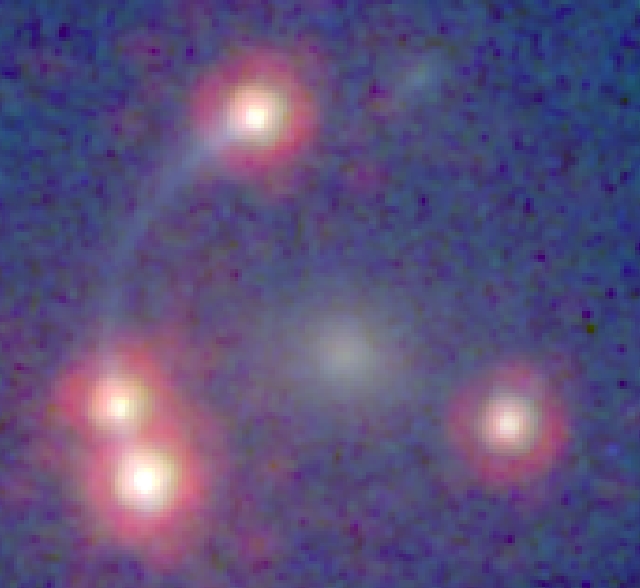
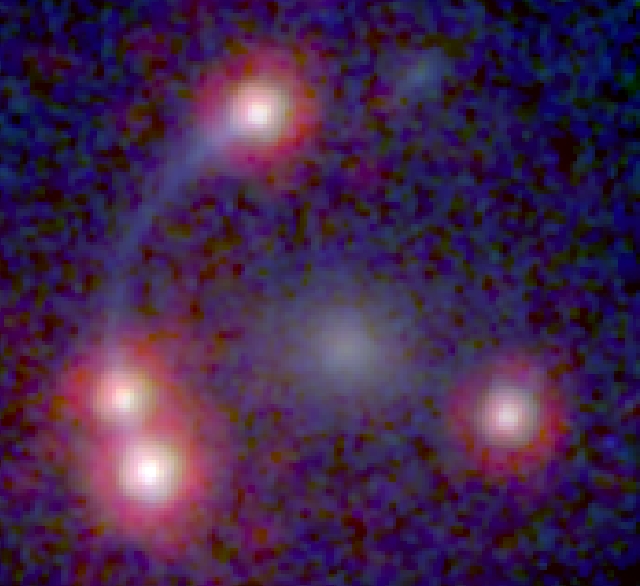
The water vapour is thought to be contained in a jet ejected from a supermassive black hole at the centre of a galaxy, named MG J0414+0534. The water emission is seen as a maser, where molecules in the gas amplify and emit beams of microwave radiation in much the same way as a laser emits beams of light. The faint signal is only detectable by using a technique called gravitational lensing, where the gravity of a massive galaxy in the foreground acts as a cosmic telescope, bending and magnifying light from the distant galaxy to make a clover-leaf pattern of four images of MG J0414+0534. The water maser was only detectable in the brightest two of these images.

Written by Anita Heward

Images

An image of the gravitationally lensed images of MG J0414+0534 can be found at:


(The two versions are the same image but with the contrast adjusted slightly)

Caption: The image is made from HST data and shows the four lensed images of the dusty red quasar, connected by a gravitational arc of the quasar host galaxy. The lensing galaxy is seen in the centre, between the four lensed images. Credit: John McKean/HST Archive data

Contacts

Dr. John McKean

Netherlands Institute for Radio Astronomy (ASTRON)

Tel: +31 521 595 780 (Office)

Tel: +31 6 243 28991 (mobile)


Dr. Violette Impellizzeri

National Radio Astronomy Observatory (NRAO)

Tel: +1 434 244 6811


Dr McKean said, "We have been observing the water maser every month since the detection and seen a steady signal with no apparent change in the velocity of the water vapour in the data we've obtained so far. This backs up our prediction that the water is found in the jet from the supermassive black hole, rather than the rotating disc of gas that surrounds it."

The radiation from the water maser was emitted when the Universe was only about 2.5 billion years old, a fifth of its current age.

"The radiation that we detected has taken 11.1 billion years to reach the Earth. However, because the Universe has expanded like an inflating balloon in that time, stretching out the distances between points, the galaxy in which the water was detected is about 19.8 billion light years away," explained Dr McKean.

Although since the initial discovery the team has looked at five more systems that have not had water masers, they believe that it is likely that there are many more similar systems in the early Universe. Surveys of nearby galaxies have found that only about 5% have powerful water masers associated with active galactic nuclei. In addition, studies show that very powerful water masers are extremely rare compared to their less luminous counterparts. The water maser in MG J0414+0534 is about 10 000 times the luminosity of the Sun, which means that if water masers were equally rare in the early Universe, the chances of making this discovery would be improbably slight.

"We found a signal from a really powerful water maser in the first system that we looked at using the gravitational lensing technique. From what we know about the abundance of water masers locally, we could calculate the probability of finding a water maser as powerful as the one in MG J0414+0534 to be one in a million from a single observation. This means that the abundance of powerful water masers must be much higher in the distant Universe than found locally because I’m sure we are just not that lucky!" said Dr McKean.

The discovery of the water maser was made by a team led by Dr Violette Impellizzeri using the 100-metre Effelsberg radio telescope in Germany during July to September 2007. The discovery was confirmed by observations with the Expanded Very Large Array in the USA in September and October 2007. The team included Alan Roy, Christian Henkel and Andreas Brunthaler, from the Max Planck Institute for Radio Astronomy, Paola Castangia from Cagliari Observatory and Olaf Wucknitz from the Argelander Institute for Astronomy at Bonn University. The findings were published in Nature in December 2008.

The team is now analysing high-resolution data to find out how close the water maser lies to the supermassive black hole, which will give them new insights into the structure at the centre of active galaxies in the early Universe.

"This detection of water in the early Universe may mean that there is a higher abundance of dust and gas around the super-massive black hole at these epochs, or it may be because the black holes are more active, leading to the emission of more powerful jets that can stimulate the emission of water masers. We certainly know that the water vapour must be very hot and dense for us to observe a maser, so right now we are trying to establish what mechanism caused the gas to be so dense," said Dr McKean.

Notes for Editors

The Effelsberg radio telescope is operated by the Max Planck Institute for Radio Astronomy (MPIfR) and has played an important role in finding water masers and using them to study the properties of black holes in nearby galaxies. The first extragalactic water maser was found using Effelsberg in 1977 (in the nearby galaxy M33).


The Very Large Array is operated by the National Radio Astronomy Observatory and consists of twenty-seven 25 m radio telescopes that are linked to form an interferometer. It is currently undergoing an upgrade to become the Expanded Very Large Array (EVLA) which opens up new frequency ranges for radio astronomers to use. The new 4 GHz to 8 GHz receiver on nine EVLA radio telescopes were used for this work.

The Mightiest Monsters of the Universe

Brightest ultrafast jets in active galaxies found to be powerful gamma-ray beacons

New observations reveal further details on the functioning of the most violent and energetic objects known: the jets produced by supermassive black holes in active galaxies. An international team of astronomers, including scientists at the Max Planck Institute for Radio Astronomy in Bonn, has combined data from some of the world's most advanced astronomical instruments, including the U.S. Very Long Baseline Array (VLBA) and the Fermi Gamma-ray Space Telescope, to study how supermassive black holes manage to produce copious quantities of the most energetic form of light: gamma-rays.

The international team has combined observations of the bright gamma-ray sky by NASA's orbiting Fermi Gamma-ray Space Telescope with those from the ground-based Very Long Baseline Array radio telescope to observe the material expelled with enormous speeds away from the black holes in the heart of very remote galaxies. These ejections take the form of narrow jets in radio telescope images, and appear to be producing the gamma-rays detected by Fermi. Their findings are being reported in two publications in the 2009 May 1 issue of the Astrophysical Journal Letters. Yuri Kovalev, Humboldt Fellow and scientist at the Max Planck Institute for Radio Astronomy, is enthusiastic: "These objects are amazing: finally we know for sure that the fastest, most compact, and brightest jets that we see with radio telescopes are the ones which are able to kick the light up to the highest energies". 

Figure 1: The Gamma-ray Sky as seen by Fermi (background). The inserts show radio images of the jets of selected active galactic nuclei observed by the VLBA in the framework of the MOJAVE project, showing how the VLBA works as magnifier to see the finest details in the radio jets. The VLBA images have an angular resolution of about one thousandth of a second or arc - about a million times better resolution than the gamma-ray observations and more than a factor of fifty better than any optical telescope such as the Hubble Space Telescope. Collage: Matthias Kadler and NASA/DOE/Fermi LAT Team and NRAO/AUI/MOJAVE team. Higher Resolution


Distant galaxies host deep in their nucleus spinning supermassive black holes, which are billions of times heavier than our Sun but are confined to a region no larger than our solar system. These rapidly rotating black holes attract stars, gas and dust, creating huge magnetic fields. The magnetic forces can trap some of the infalling gas and focus it into narrow jets that flow away from the core of the galaxy at velocities approaching the speed of light. The jets, when they happen to be pointed directly at Earth, display one of the most spectacular phenomena in the Universe, since a quirk of Einstein's theory of special relativity can make their speeds appear faster than the speed of light. Theoreticians and observers alike have been asking themselves for decades about the nature and composition of these energetic radio-emitting jets, and if they also radiate in other parts of the electromagnetic spectrum. And this is indeed the case! Some hints were provided by the EGRET instrument on the Compton Gamma Ray Observatory telescope in the late 1990s and more recent discoveries of X-ray emission made by the Chandra Observatory. But now, the prediction of the link between radio and gamma-ray mission has been confirmed by the several of world's most advanced astronomical instruments, such as the VLBA and Fermi. "The marriage of a prime instrument such as the VLBA with a new gamma-ray telescope is generating exciting insights into the acceleration and emission mechanisms of these mysterious black hole phenomena", says Anton Zensus, director at the Max Planck Institute for Radio Astronomy and Fermi Affiliated Scientist. "The gamma-ray bright sources are now proven to be brighter, more compact and faster at light year scales than the gamma-ray quiet sources."

The gamma-ray observations have been performed with NASA's Fermi Gamma-ray Space Telescope, which has been operational since the summer of 2008. The Fermi Large Area Telescope records an image of the whole sky every few hours to explore the most extreme environments in the universe, including pulsars and gamma-ray bursts, as well as black holes in galactic nuclei. Gamma-ray observations alone are not enough to discern the exact location of the radiation, however. The VLBA serves as a magnifying glass under which the details of the most energetic processes in the distant universe appear as if they were happening in our own Galactic backyard. Interestingly, many objects found by Fermi to be extreme in gamma-rays are emitting strong bursts of radio emission at the same time.

The Very Long Baseline Array of the U.S. National Science Foundation is a continent-wide system of ten radio telescope antennas, ranging from Hawaii in the west to the U.S. Virgin Islands in the east. Dedicated in 1993, the VLBA is operated by the NRAO and is designed to monitor the brightest objects in the Universe at the highest available resolution in astronomy. Matthew Lister, Physics Professor in Purdue University and guest investigator on the Fermi project, says: "For more than a decade, we have collected images of the brightest galaxies in the radio sky to study the changing structures of their jets. We have waited a long time to compare our measurements with the findings in the gamma-ray sky, and now we finally have it!"

The work for astronomers does not stop here: the team has concluded that the region of the jet closest to the black hole is undoubtedly the place where the gamma-ray and the radio bursts of light originate in about the same time. However, some parts of the puzzle have yet to be resolved: some bright gamma-ray sources in the sky appear to have no radio or optical counterpart - their nature is still completely unknown. With this new joint eye on the universe provided by Fermi and the VLBA, astronomers look forward to investigating these intriguing mysteries, and anticipate many new exciting discoveries to come.

The National Radio Astronomy Observatory is a facility of the National Science Foundation, operated under cooperative agreement by Associated Universities, Inc.

NASA's Fermi Gamma-ray Space Telescope is an astrophysics and particle physics partnership mission, developed in collaboration with the U.S. Department of Energy and important contributions from academic institutions and partners in France, Germany, Italy, Japan, Sweden, and the U.S. 


Additional graphical material:

Labeled Version (source names) and Labeled Version (source names, image title, and logos) of Figure 1 (Collage: Matthias Kadler and NASA/DOE/Fermi LAT Team and NRAO/AUI/MOJAVE team.)
3C 84. High-resolution VLBA image of the radio galaxy 3C 84, central galaxy of the Perseus cluster in a distance of approx. 230 million light years. (Image: Yuri Kovalev and NRAO/AUI/MOJAVE team.)
3C 454.3. High-resolution VLBA image of the quasar 3C 454.3 at a distance of approx. 7 billion light years. This quasar was found by Fermi to be the brightest on the gamma-ray sky in August-October 2008 (Figure 1). (Image: Yuri Kovalev and NRAO/AUI/MOJAVE team.) 

Original Publications:

The Relation Between AGN Gamma-Ray Emission and Parsec-Scale Radio Jets , Y. Y. Kovalev, H. D. Aller, M. F. Aller, D. C. Homan, M. Kadler, K. I. Kellermann, Yu. A. Kovalev, M. L. Lister, M. J. McCormick, A. B. Pushkarev, E. Ros and J. A. Zensus, The Astrophysical Journal Letters, 696, L17-L21 (2009).
A Connection Between Apparent VLBA Jet Speeds and Initial AGN Detections Made by the Fermi Gamma-ray Observatory , M. L. Lister, D. C. Homan, M. Kadler, K. I. Kellermann, Y. Y. Kovalev, E. Ros, T. Savolainen and J. A. Zensus, The Astrophysical Journal Letters, 696, L22-L26 (2009). 


Further Information:

Max Planck Institute for Radio Astronomy (MPIfR) and its Very Long Baseline Interferometry (VLBI) research group.
Alexander von Humboldt Foundation (AvH).
Monitoring Of Jets in Active galactic nuclei with VLBA Experiments (MOJAVE).
Very Long Baseline Array (VLBA).
Fermi Gamma-ray Space Telescope (formerly GLAST). 


Parallel and earlier press releases:

Continent-sized radio telescope takes close-ups of Fermi active galaxies, NASA Web Feature at the Fermi Mission Area, April 22, 2009.
Fermi's Best-Ever Look at the Gamma-Ray Sky, NASA Press Release, March 11, 2009.
VLBA Movies Reveal New Details of Cosmic Jets, NRAO Press Release, January 08, 2008.
Fifty Times sharper than Hubble, MPIfR Press Release, October 05, 2007.
NRAO Teams With NASA Gamma-Ray Satellite, NRAO Press Release, June 05, 2007. 


Contact:

Dr. Yuri Kovalev
Max-Planck-Institut für Radioastronomie, Bonn.
Fon: +49-228-525-395
Fon: +7 915 1546281
E-mail:
 ykovalev@mpifr.de


Prof. Dr. Eduardo Ros

Max-Planck-Institut für Radioastronomie, Bonn.
Fon: +49-228-525-292
E-mail:
 ros@mpifr.de


Dr. Norbert Junkes,
Public Outreach,
Max-Planck-Institut für Radioastronomie, Bonn.
Fon: +49-228-525-399
E-mail:
 njunkes@mpifr.de

Astronomers Discover Youngest and Lowest Mass Dwarfs

IC 348, the star-forming region where the brown dwarfs were discovered. 
Image credit: Adam Block and Tim Puckett

Astronomers have found three brown dwarfs with estimated masses of less than 10 times that of Jupiter, making them among the youngest and lowest mass sub-stellar objects detected in the solar neighbourhood to date.

The observations were made by a team of astronomers working at the Laboratoire d'Astrophysique de l'Observatoire de Grenoble (LAOG), France, using the Canada-France-Hawaii Telescope (CFHT). Andrew Burgess will be presenting the discovery at the European Week of Astronomy and Space Science at the University of Hertfordshire, Hatfield, on Wednesday 22nd April.

The dwarfs were found in a star forming region named IC 348, which lies almost 1000 light years from the Solar System towards the constellation of Perseus. This cluster is approximately 3 million years old – extremely young compared to our 4.5 billion year old Sun – which makes it a good location in order to search for the lowest mass brown dwarfs. The dwarfs are isolated in space, which means that they are not orbiting a star, although they are gravitationally bound to IC 348. Their atmospheres all show evidence of methane absorption which was used to select and identify these young objects. 

"There has been some controversy about identifying young, low mass brown dwarfs in this region. An object of a similar mass was discovered in 2002, but some groups have argued that it is an older, cooler brown dwarf in the foreground coinciding with the line of sight. The fact that we have detected three candidate low-mass dwarfs towards IC 348 supports the finding that these really are very young objects," said Burgess.

The team set out to find a population of these brown dwarfs in order to help theoreticians develop more accurate models for the distribution of mass in a newly-formed population, from high mass stars to brown dwarfs, which is needed to test current star formation theories. The discovery of the dwarfs in IC 348 has allowed them to set new limits on the lowest mass objects.

”Finding three candidate low-mass dwarfs towards IC 348 backs up predictions for how many low-mass objects develop in a new population of stars. Brown dwarfs cool with age and current models estimate that their surfaces are approximately 900-1000 degrees Kelvin (about 600-700 degrees Celsius). That’s extremely cool for objects that have just formed, which implies that they have the lowest masses of any of this type of object that we’ve seen to date,” said Burgess.

Written by Anita Heward 

NOTES FOR EDITORS:

The study was carried out by Andrew Burgess, Estelle Moraux and Jerome Bouvier of the Formation Stellaire et Planétaire, Naines Brunes group at the Laboratoire d'Astrophysique de l'Observatoire de Grenoble (LAOG), France.

The observations were obtained with WIRCam, a joint project of CFHT, Taiwan, Korea, Canada, France, at the Canada-France-Hawaii Telescope (CFHT) which is operated by the National Research Council (NRC) of Canada, the Institute National des Sciences de l'Univers of the Centre National de la Recherche Scientifique of France, and the University of Hawaii. This work was supported in part by the European Commission Sixth Framework Programme Marie Curie Research Training Network CONSTELLATION (MCRTN-2006-035890).

CONTACTS:
Andrew Burgess
Laboratoire d'Astrophysique
Observatoire de Grenoble
Grenoble, France
Tel : +33 4 76 63 58 40

E-mail : aburgess@obs.ujf-grenoble.fr   

Tuesday, April 21, 2009

Hubble Celebrates Its 19th Anniversary with a "Fountain of Youth"

Credit: NASA, ESA, and the Hubble Heritage Team (STScI/AURA)

Introduction

Over the past 19 years Hubble has taken dozens of exotic pictures of galaxies going "bump in the night" as they collide with each other and have a variety of close encounters of the galactic kind. Just when you thought these interactions couldn't look any stranger, this image of a trio of galaxies, called Arp 194, looks like one of the galaxies has sprung a leak. The bright blue streamer is really a stretched spiral arm full of newborn blue stars. This typically happens when two galaxies interact and gravitationally tug at each other.


Resembling a pair of owl eyes, the two nuclei of the colliding galaxies can be seen in the process of merging at the upper left. The blue bridge looks like it connects to a third galaxy. In reality the galaxy is in the background and not connected at all. Hubble's sharp view allows astronomers to try and visually sort out what are foreground and background objects when galaxies, superficially, appear to overlap. This picture was issued to celebrate the 19th anniversary of the launch of the Hubble Space Telescope aboard the space shuttle Discovery in 1990. During the past 19 years Hubble has made more than 880,000 observations and snapped over 570,000 images of 29,000 celestial objects.

Compass and Scale Image of Arp 194
Illustration Credit: NASA, ESA, and Z. Levay (STScI)

Credit: NASA, ESA, and the Hubble Heritage Team (STScI/AURA)


Constellation Region Near Arp 194
Illustration Credit: NASA, ESA, and Z. Levay (STScI)
Image Credit: A. Fujii for STScI

To commemorate the Hubble Space Telescope's 19 years of historic, trailblazing science, the orbiting telescope has photographed a peculiar system of galaxies known as Arp 194. This interacting group contains several galaxies, along with a "cosmic fountain" of stars, gas, and dust that stretches over 100,000 light-years.

The northern (upper) component of Arp 194 appears as a haphazard collection of dusty spiral arms, bright blue star-forming regions, and at least two galaxy nuclei that appear to be connected and in the early stages of merging. A third, relatively normal, spiral galaxy appears off to the right. The southern (lower) component of the galaxy group contains a single large spiral galaxy with its own blue star-forming regions.

However, the most striking feature of this galaxy troupe is the impressive blue stream of material extending from the northern component. This "fountain" contains complexes of super star clusters, each one of which may contain dozens of individual young star clusters. The blue color is produced by the hot, massive stars which dominate the light in each cluster. Overall, the "fountain" contains many millions of stars.

These young star clusters probably formed as a result of the interactions between the galaxies in the northern component of Arp 194. The compression of gas involved in galaxy interactions can enhance the star-formation rate and give rise to brilliant bursts of star formation in merging systems.

Hubble's resolution shows clearly that the stream of material lies in front of the southern component of Arp 194, as evidenced by the dust that is silhouetted around the star-cluster complexes. It is therefore not entirely clear whether the southern component actually interacts with the northern pair.

The details of the interactions among the multiple galaxies that make up Arp 194 are complex. The shapes of all the galaxies involved appear to have been distorted, possibly by their gravitational interactions with one another.

Arp 194, located in the constellation Cepheus, resides approximately 600 million light-years away from Earth. It contains some of the many interacting and merging galaxies known in our relatively nearby universe. These observations were taken in January of 2009 with the Wide Field Planetary Camera 2. Images taken through blue, green, and red filters were combined to form this picturesque image of galaxy interaction.

For additional information, contact:

Ray Villard
Space Telescope Science Institute, Baltimore, Md.
410-338-4514
villard@stsci.edu

Keith Noll
Space Telescope Science Institute, Baltimore, Md.
410-338-1828
noll@stsci.edu

Lightest Exoplanet Yet Discovered

Artist's impression of the newly discovered planetary system Gliese 581

After more than four years of observations using the most successful low-mass-exoplanet hunter in the world, the HARPS spectrograph attached to the 3.6-metre ESO telescope at La Silla, Chile, astronomers have discovered in this system the lightest exoplanet found so far: Gliese 581 e (foreground) is only about twice the mass of our Earth. The Gliese 581 planetary system now has four known planets, with masses of about 1.9 (planet e, left in the foreground), 16 (planet b, nearest to the star), 5 (planet c, centre), and 7 Earth-masses (planet d, with the bluish colour). The planet furthest out, Gliese 581 d, orbits its host star in 66.8 days, while Gliese 581 e completes its orbit in 3.15 days.

A planet in the habitable zone

By refining the orbit of the planet Gliese 581 d, first discovered in 2007, a team of astronomers has shown that it lies well within the habitable zone, where liquid water oceans could exist. This diagram shows the distances of the planets in the Solar System (upper row) and in the Gliese 581 system (lower row), from their respective stars (left). The habitable zone is indicated as the blue area, showing that Gliese 581 d is located inside the habitable zone around its low-mass red star.
Based on a diagram by Franck Selsis, Univ. of Bordeaux.

ESO PR Video 15a/09
ESOcast 6

ESO PR Video 15b/09
VNR A-roll

ESO PR Video 15c/09
Zoom-in on Gliese 581 e

ESO PR Video 15d/09
Artist's impression of Gliese 581 e

ESO PR Video 15e/09
Artist's impression of Gliese 581 d

ESO PR Video 15f/09
Artist's impression of Gliese 581 system

ESO PR Video 15g/09
The radial velocity method


Well-known exoplanet researcher Michel Mayor today announced the discovery of the lightest exoplanet found so far. The planet, “e”, in the famous system Gliese 581, is only about twice the mass of our Earth. The team also refined the orbit of the planet Gliese 581 d, first discovered in 2007, placing it well within the habitable zone, where liquid water oceans could exist. These amazing discoveries are the outcome of more than four years of observations using the most successful low-mass-exoplanet hunter in the world, the HARPS spectrograph attached to the 3.6-metre ESO telescope at La Silla, Chile.

“The holy grail of current exoplanet research is the detection of a rocky, Earth-like planet in the ‘habitable zone’ — a region around the host star with the right conditions for water to be liquid on a planet’s surface”, says Michel Mayor from the Geneva Observatory, who led the European team to this stunning breakthrough.

Planet Gliese 581 e orbits its host star – located only 20.5 light-years away in the constellation Libra (“the Scales”) — in just 3.15 days. “With only 1.9 Earth-masses, it is the least massive exoplanet ever detected and is, very likely, a rocky planet”, says co-author Xavier Bonfils from Grenoble Observatory.

Being so close to its host star, the planet is not in the habitable zone. But another planet in this system appears to be. From previous observations — also obtained with the HARPS spectrograph at ESO’s La Silla Observatory and announced two years ago — this star was known to harbour a system with a Neptune-sized planet (ESO 30/05) and two super-Earths (ESO 22/07). With the discovery of Gliese 581 e, the planetary system now has four known planets, with masses of about 1.9 (planet e), 16 (planet b), 5 (planet c), and 7 Earth-masses (planet d). The planet furthest out, Gliese 581 d, orbits its host star in 66.8 days. “Gliese 581 d is probably too massive to be made only of rocky material, but we can speculate that it is an icy planet that has migrated closer to the star,” says team member Stephane Udry. The new observations have revealed that this planet is in the habitable zone, where liquid water could exist. “‘d’ could even be covered by a large and deep ocean — it is the first serious 'water world' candidate,” continued Udry.

The gentle pull of an exoplanet as it orbits the host star introduces a tiny wobble in the star’s motion — only about 7 km/hour, corresponding to brisk walking speed — that can just be detected on Earth with today’s most sophisticated technology. Low-mass red dwarf stars such as Gliese 581 are potentially fruitful hunting grounds for low-mass exoplanets in the habitable zone. Such cool stars are relatively faint and their habitable zones lie close in, where the gravitational tug of any orbiting planet found there would be stronger, making the telltale wobble more pronounced. Even so, detecting these tiny signals is still a challenge, and the discovery of Gliese 581 e and the refinement of Gliese 581 d’s orbit were only possible due to HARPS’s unique precision and stability.

“It is amazing to see how far we have come since we discovered the first exoplanet around a normal star in 1995 — the one around 51 Pegasi,” says Mayor. “The mass of Gliese 581 e is 80 times less than that of 51 Pegasi b. This is tremendous progress in just 14 years.”

The astronomers are confident that they can still do better. “With similar observing conditions an Earth-like planet located in the middle of the habitable zone of a red dwarf star could be detectable,” says Bonfils. “The hunt continues.”

Notes
This discovery was announced today at the JENAM conference during the European Week of Astronomy & Space Science, which is taking place at the University of Hertfordshire, UK. The results have also been submitted for publication in the research journal Astronomy & Astrophysics (“The HARPS search for southern extra-solar planets: XVIII. An Earth-mass planet in the GJ 581 planetary system”, by Mayor et al., 2009).

The team is composed of M. Mayor, S. Udry, C. Lovis, F. Pepe and D. Queloz (Geneva Observatory, Switzerland), X. Bonfils, T. Forveille , X. Delfosse, H. Beust and C. Perrier (LAOG, France), N. C. Santos (Centro de Astrofisica,Universidade de Porto), F. Bouchy (IAP, Paris, France) and J.-L. Bertaux (Service d’Aéronomie du CNRS, Verrières-le-Buisson, France).

ESO, the European Southern Observatory, is the foremost intergovernmental astronomy organisation in Europe. It is supported by 14 countries: Austria, Belgium, the Czech Republic, Denmark, France, Finland, Germany, Italy, the Netherlands, Portugal, Spain, Sweden, Switzerland and the United Kingdom. ESO carries out an ambitious programme focused on the design, construction and operation of powerful ground-based observing facilities enabling astronomers to make important scientific discoveries. ESO also plays a leading role in promoting and organising cooperation in astronomical research. ESO operates three unique world-class observing sites in the Atacama Desert region of Chile: La Silla, Paranal and Chajnantor.


Contacts:

Michel Mayor
Geneva University, Switzerland
E-mail: michel.mayor@unige.ch
Prof. Mayor will attend the JENAM conference from 20 to 21 April and can be reached by phone through the JENAM press centre.

Xavier Bonfils, Thierry Forveille
Grenoble Observatory, France
Phone: +33 476 63 55 27, +33 4 76 51 42 06
E-mail: xavier.bonfils@obs.ujf-grenoble.fr, thierry.forveille@obs.ujf-grenoble.fr

Stephane Udry
Geneva University, Switzerland
Phone: +41 22 379 2467
E-mail: stephane.udry@unige.ch

Links:

Source: ESO

Monday, April 20, 2009

Rocky Planets Around 'Dead' Stars

Emission from the White Dwarf System GD 16
NASA / JPL-Caltech / University of Leicester
This chart shows the brightness and wavelength of the radiation coming from white dwarf GD 16 and its associated disk of closely orbiting rocky material. The data was obtained with NASA's Spitzer Space Telescope. The colored data points indicate hot emission from the white dwarf (left of the graph) and cool emission from the surrounding material (right hand side).

White dwarfs are the remnants of relatively low-mass stars that have passed through their red giant stage. A white dwarf may be the size of the Earth, but contain the same mass as the Sun. This star remnant is so dense, in fact, that one teaspoon of white dwarf material would weigh several tons. Over 90% of all stars -- including our Sun -- will end their lives as white dwarfs.

Asteroid 'Bites the Dust' Around Dead Star
Credit: NASA/JPL-Caltech
NASA's Spitzer Space Telescope set its infrared eyes upon the dusty remains of shredded asteroids around several dead stars. This artist's concept illustrates one such dead star, or "white dwarf," surrounded by the bits and pieces of a disintegrating asteroid. These observations help astronomers better understand what rocky planets are made of around other stars.

Asteroids are leftover scraps of planetary material. They form early on in a star's history when planets are forming out of collisions between rocky bodies. When a star like our sun dies, shrinking down to a skeleton of its former self called a white dwarf, its asteroids get jostled about. If one of these asteroids gets too close to the white dwarf, the white dwarf's gravity will chew the asteroid up, leaving a cloud of dust.

Spitzer's infrared detectors can see these dusty clouds and their various constituents. So far, the telescope has identified silicate minerals in the clouds polluting eight white dwarfs. Because silicates are common in our Earth's crust, the results suggest that planets similar to ours might be common around other stars.

Using the infrared detectors on NASA's Spitzer Space Telescope, a team of researchers based in the U.K. and in the United States have placed new constraints on how often rocky planets like Earth may exist around stars other than our Sun.

The team of researchers, including Jay Farihi, from the University of Leicester; and Michael Jura and Ben Zuckerman, both from UCLA, looked at the environments surrounding a number of "dead" stars known as a "white dwarfs". Using Spitzer's sensitive infrared eyes, they found that at least 1-3% of all white dwarf stars of a certain age are surrounded by dust and rocky debris.

"The infrared glow from dust around these white dwarfs is a road sign that tells us there were — or are — unseen rocky planets in these systems," said Farihi.

The team believes that the dust was produced when asteroids - the building blocks of rocky planets - surrounding the star were pushed and pulled apart by the force of the star's gravity. The dust then formed a glowing disk of orbiting, rocky material that Spitzer detected.

Just how common are rocky bodies around white dwarfs? In a previous study by this team, a sample of eight white dwarfs were shown to have the dusty remnants of shredded asteroids. In this study Farihi and his team systematically searched around metal-rich white dwarfs and placed statistical constraints on the frequency of inferred rocky planets.

"We now know of 14 white dwarfs circled by dusty debris. This suggests that at least 1-3% of main-sequence A and F stars — stars slightly hotter and larger than the Sun — have rocky planets, like Earth," said Farihi.

For the rocky bodies to be destroyed by the gravitational effects of the white dwarf, they would have to be knocked out of their orbits, towards the star. Farihi and his team believe that, although in principle this kick could come from a terrestrial planet, a large gas giant planet like Jupiter would do the job much more efficiently. Therefore, the small percentage of white dwarfs that might possess rocky planets probably have larger, gas-giant-like planets as well.

White dwarfs are the remnants of relatively low-mass stars that have passed through their red giant stage. Stars are composed mostly of hydrogen, and, during their lives, they burn more and more of the hydrogen, converting hydrogen into helium, until very little hydrogen is left. Then, the star begins to burn helium to create even heavier elements. When the supply of helium runs out, the star burns heavier and heavier elements, until it produces iron, which cannot be burned.

At this point, the star's contraction — due to its gravity — and its expansion — due to the energy produced by its thermonuclear reactions — become unbalanced, and the outer layers of the star puff out. Over time, the layers blow out into space, leaving behind a small core, which, because of the extreme gravity, compresses until it is extraordinarily dense. This core is called a "white dwarf."

A white dwarf may be the size of the Earth, but contain the same mass as the Sun. This star remnant is so dense, in fact, that one teaspoon of white dwarf material would weigh several tons. Over 90% of all stars — including our Sun — will end their lives as white dwarfs.

According to Farihi and his team, studying white dwarf stars is a good way to study planetary systems outside of our own Solar System. First, a white dwarf star is relatively dim and small -so its heat won't outshine the heat emitted by giant planets or dust orbiting it. Second, white dwarf stars do not contain significant amounts of heavy elements, like metals, so if metals are detected in a white dwarf, one can assume that the white dwarf has been absorbing those elements from surrounding debris. This permits an indirect way of studying the composition of distant planets.

This research paper was written by Jay Farihi, at the University of Leicester, UK; and Michael Jura and Ben Zuckerman, both at UCLA.

This research was supported by NASA, through an award issued by JPL/Caltech to UCLA, and has also been partly supported by the National Science Foundation.

Team member Professor Jay Farihi of the University of Leicester presents this discovery on Monday 20th April at the European Week of Astronomy and Space Science conference at the University of Hertfordshire. Visit http://www.ras.org.uk for an associated press release from the Royal Astronomical Society.

Written by Raphael Rosen

Glorious Orion: UKIRT Helps Reveal Chaotic and Overcrowded Stellar Nursery

This spectacular image combines observations from the United Kingdom Infrared Telescope and the Spitzer Space Telescope. It shows just a small portion of the region surveyed. In this figure, parts of the Orion Molecular cloud are illuminated by nearby stars and therefore glow an eerie green colour. The jets punch through the cloud and can be seen as a multitude of tiny pink-purple arcs, knots and filaments. The young stars that drive the jets are usually found along each jet and are coloured golden orange. Credit: UKIRT/JAC, Spitzer Telescope.
Full size image (JPG, 4.1 MB)

A close-up view of a spectacular jet (seen in red) popping out of a busy region of star formation in Orion. All of the red wisps, knots and filaments are in fact associated with jets from young stars, which in this figure are coloured orange. These data were acquired with the Wide Field Camera (WFCAM) at the United Kingdom Infrared Telescope. Credit: UKIRT/JAC.
Full size image (JPG, 430 KB)

Astronomers using the United Kingdom Infrared Telescope (UKIRT) in Hawaii, the IRAM Millimeter-wave Telescope in Spain, and the Spitzer Space Telescope in orbit above the Earth, have completed the most wide-ranging census ever produced of dynamical star formation in and around the well-known Great Nebula of Orion. They have found this stellar nursery to be a lively and somewhat overcrowded place, with young stars emitting gas jets in all directions, creating quite a chaotic picture. There is much more going on in Orion than previously thought.

The research team comprises more than a dozen astronomers from the US, the UK and a number of other European countries. The project thus has a truly international flavour, representing a collaboration of minds from across the globe. A number of them are in Hertfordshire in the UK this week to share their discoveries with colleagues at this year's annual National Astronomy Meeting of the UK (NAM 2009).

Take a look at the constellation of Orion at night. With the naked eye you see only the brightest stars, like Betelgeuse and Rigel at the shoulder and knee of the constellation, or perhaps the Orion Nebula as a vaguely fuzzy patch around the sword. What your eye does not see is an enormous cloud of molecules and dust particles that hide a vast region where young stars are currently being born. On the sky, the region – known to astronomers as the Orion Molecular Cloud -- is more than 20 times the angular size of the full moon, spanning from far above the hunter’s head to far below his feet. It is one of the most intense regions of star formation in the local Milky Way and has been the subject of many small-scale studies over the years. However, the current work is the first to present such a complete study of the young stars, the cloud of gas and dust from which they are being born, and the spectacular supersonic jets of hydrogen molecules being launched from the poles of each star.

Most of the "action" is hidden from view in visible light, because the molecular cloud is very thick and opaque. Only the Orion nebula, which is really just a blister on the surface of the cloud, gives an indication of what is really happening within. To see through the cloud, we need to observe at wavelengths beyond the reach of the human eye. The longer (or "redder") the wavelength, the better! Thus, the team have used UKIRT on Mauna Kea, the Spitzer Space Telescope, which works at even longer "mid-infrared" wavelengths, and the IRAM radio telescope, which operates beyond the infrared at short radio wavelengths.

The key to the success of this project was the combination of data from all three facilities. Inspired by the richness of his images from UKIRT, Chris Davis contacted colleagues in Europe and on the U.S. Mainland. Tom Megeath, an astronomer from the University of Toledo, provided a catalogue of the positions of the very youngest stars – sources revealed only recently by the Spitzer Space Telescope. Thomas Stanke, a researcher based at the European Southern Observatory in Garching, Germany, then provided extensive IRAM maps of the molecular gas and dust across the Orion cloud. Dirk Froebrich, a lecturer at the University of Kent, later used archival images from the Calar Alto Observatory in Spain (data acquired by Stanke some 10 years ago) to measure the speeds and directions of a large number of jets by comparing them with their positions in the new images. Armed with these data, Davis was able to match the jets up to the young stars that drive them, as well as to density peaks within the cloud – the natal cores from which each star is being created.

Dr Davis says, "regions like this are usually referred to as stellar nurseries, but we have shown that this one is not being well run: it is chaotic and seriously overcrowded. Using UKIRT’s wide field camera (WFCAM), we now know of more than 110 individual jets from this one region of the Milky Way. Each jet is traveling at tens or even hundreds of miles per second; the jets extend across many trillions of miles of interstellar space. Even so, we have been able to pinpoint the young stars that drive most of them."

Dr Froebrich mentions that, "measuring the speeds and directions of the jets is essential to pinpoint the driving sources, especially in such crowded regions as M42 in Orion."

Dr Megeath adds, "with such a large number of young stars, we can study the "demographics" of star birth. This study will give us an idea of how long it takes baby stars to bulk up by pulling in gas from the surrounding cloud, what ultimately stops a star from growing bigger, and how a star's birth is influenced by other stars in the stellar nursery."

Dr Stanke notes, "star formation research is fundamental to our understanding of how our own sun, and the planets that orbit it, were created. Many of the stars currently being born in Orion will evolve to be just like the sun. Some may even have earth-like planets associated with them."

Dr Andy Adamson, Associate Director at the UKIRT, says, "this spectacular dataset demonstrates the power of survey telescopes like UKIRT. With on-line access to data from other telescopes around the world, and the ease with which one can communicate with collaborators across the globe, massive projects like the Orion study are very much the future of astronomy."

Professor Gary Davis, Director UKIRT, and Dr Adamson will present this and other UKIRT science results at the European Week of Astronomy and Space Science (NAM 2009) at the University of Hertfordshire today.

Issued by: Dr. Robert Massey, Press Officer
Royal Astronomical Society
Email: rm@ras.org.uk
Desk: +44 (0)20 7734 3307 / 4582
Cell: +44 (0)794 124 8035

Issued by: Inge Heyer, Science Outreach Specialist
Joint Astronomy Centre
Email: outreach@jach.hawaii.edu
Desk: +1 808 969 6524

Thursday, April 16, 2009

NASA's Kepler Captures First Views of Planet-Hunting Territory

This image from NASA's Kepler mission shows the telescope's full field of view -- an expansive star-rich patch of sky in the constellations Cygnus and Lyra stretching across 100 square degrees, or the equivalent of two side-by-side dips of the Big Dipper.
Image credit: NASA/Ames/JPL-Caltech

Kepler Eyes Cluster and Known Planet Image
Credit: NASA/Ames/JPL-Caltech

Full image and caption

Cluster of Stars in Kepler's Sight
This image zooms into a small portion of Kepler's full field of view -- an expansive, 100-square-degree patch of sky in our Milky Way galaxy. An eight-billion-year-old cluster of stars 13,000 light-years from Earth, called NGC 6791, can be seen in the image. Clusters are families of stars that form together out of the same gas cloud. This particular cluster is called an open cluster, because the stars are loosely bound and have started to spread out from each other.
Image credit: NASA/JPL-Caltech

Host to 'Hot Jupiter' (labeled)
This image zooms into a small portion of Kepler's full field of view -- an expansive, 100-square-degree patch of sky in our Milky Way galaxy. At the center of the field is a star with a known "hot Jupiter" planet, named "TrES-2," zipping closely around it every 2.5 days. Kepler will observe TrES-2 and other known planets as a test to demonstrate that it is working properly, and to obtain new information about those planets. Image credit: NASA/JPL-Caltech
Full image and caption

NASA's Kepler mission has taken its first images of the star-rich sky where it will soon begin hunting for planets like Earth.

The new "first light" images show the mission's target patch of sky, a vast starry field in the Cygnus-Lyra region of our Milky Way galaxy. One image shows millions of stars in Kepler's full field of view, while two others zoom in on portions of the larger region. The images can be seen online at: http://www.nasa.gov/mission_pages/kepler/multimedia/20090416.html

"Kepler's first glimpse of the sky is awe-inspiring," said Lia LaPiana, Kepler's program executive at NASA Headquarters in Washington. "To be able to see millions of stars in a single snapshot is simply breathtaking."

One new image from Kepler shows its entire field of view -- a 100-square-degree portion of the sky, equivalent to two side-by-side dips of the Big Dipper. The regions contain an estimated 14 millions stars, more than 100,000 of which were selected as ideal candidates for planet hunting.
Two other views focus on just one-thousandth of the full field of view. In one image, a cluster of stars located about 13,000 light-years from Earth, called NGC 6791, can be seen in the lower left corner. The other image zooms in on a region containing a star, called Tres-2, with a known Jupiter-like planet orbiting every 2.5 days.

"It's thrilling to see this treasure trove of stars," said William Borucki, science principal investigator for Kepler at NASA's Ames Research Center at Moffett Field, Calif. "We expect to find hundreds of planets circling those stars, and for the first time, we can look for Earth-size planets in the habitable zones around other stars like the sun."

Kepler will spend the next three-and-a-half years searching more than 100,000 pre-selected stars for signs of planets. It is expected to find a variety of worlds, from large, gaseous ones, to rocky ones as small as Earth. The mission is the first with the ability to find planets like ours -- small, rocky planets orbiting sun-like stars in the habitable zone, where temperatures are right for possible lakes and oceans of water.

To find the planets, Kepler will stare at one large expanse of sky for the duration of its lifetime, looking for periodic dips in starlight that occur as planets circle in front of their stars and partially block the light. Its 95-megapixel camera, the largest ever launched into space, can detect tiny changes in a star's brightness of only 20 parts per million. Images from the camera are intentionally blurred to minimize the number of bright stars that saturate the detectors. While some of the slightly saturated stars are candidates for planet searches, heavily saturated stars are not.

"Everything about Kepler has been optimized to find Earth-size planets," said James Fanson, Kepler's project manager at NASA's Jet Propulsion Laboratory in Pasadena, Calif. "Our images are road maps that will allow us, in a few years, to point to a star and say a world like ours is there."
Scientists and engineers will spend the next few weeks calibrating Kepler's science instrument, the photometer, and adjusting the telescope's alignment to achieve the best focus. Once these steps are complete, the planet hunt will begin.

"We've spent years designing this mission, so actually being able to see through its eyes is tremendously exciting," said Eric Bachtell, the lead Kepler systems engineer at Ball Aerospace & Technology Corp. in Boulder, Colo. Bachtell has been working on the design, development and testing of Kepler for nine years.

Kepler is a NASA Discovery mission. Ames is responsible for the ground system development, mission operations and science data analysis. JPL manages the Kepler mission development. Ball Aerospace & Technologies Corp. is responsible for developing the Kepler flight system and supporting mission operations.

For images, animations and more information about the Kepler mission, visit:

Whitney Clavin 818-354-4673
Jet Propulsion Laboratory, Pasadena, Calif.
whitney.clavin@jpl.nasa.gov

J.D. Harrington 202-358-5241
Headquarters, Washington
j.d.harrington@nasa.gov

Michael Mewhinney 650-604-3937
Ames Research Center, Moffett Field, Calif.

MACSJ0717.5+3745: Cosmic Heavyweights in Free-For-All

Credit: X-ray (NASA/CXC/IfA/C. Ma et al.);
Optical (NASA/STScI/IfA/C. Ma et al.)
Press Image and Caption

This composite image shows the massive galaxy cluster MACSJ0717.5+3745 (MACSJ0717, for short), where four separate galaxy clusters have been involved in a collision, the first time such a phenomenon has been documented.

Labeled X-ray & Optical Image of MACSJ0717.5+3745
Credit: X-ray (NASA/CXC/IfA/C. Ma et al.);
Optical (NASA/STScI/IfA/C. Ma et al.)
View Animation

A labeled version of the MACSJ0717 image shows the galaxies in the four different clusters involved in the collision, plus the direction of motion for the three fastest moving clusters. The length of the arrow shows the approximate speed in a direction perpendicular to the line of sight. Note that the direction of motion of the clusters is roughly parallel to the direction of the filament. Data from Keck Observatory was used to derive the speed of the clusters along the line of sight, allowing the three-dimensional geometry and dynamics of MACSJ0717 to be derived.


A Larger Scale Chandra View of MACSJ0717
Credit: X-ray (NASA/CXC/IfA/C. Ma et al.)

This Chandra image shows a larger scale view of the galaxy cluster MACSJ0717, where the white box shows the field-of-view of the Chandra/HST composite image. The green line shows the approximate position of the large-scale filament leading into MACSJ0717, based on analysis of the positions of galaxies using optical data (not shown here). Material flows along the filament into MACSJ0717. Faint X-ray emission is seen along the filament, showing that it contains hot gas as well as galaxies.

The most crowded collision of galaxy clusters has been identified by combining information from three different telescopes. This result gives scientists a chance to learn what happens when some of the largest objects in the Universe go at each other in a cosmic free-for-all.

Using data from NASA's Chandra X-ray Observatory, Hubble Space Telescope and the Keck Observatory on Mauna Kea, Hawaii, astronomers were able to determine the three-dimensional geometry and motion in the system MACSJ0717.5+3745 (or MACSJ0717 for short) located about 5.4 billion light years from Earth.

The researchers found that four separate galaxy clusters are involved in a triple merger, the first time such a phenomenon has been documented. Galaxy clusters are the largest objects bound by gravity in the Universe.

In MACSJ0717, a 13-million-light-year-long stream of galaxies, gas and dark matter - known as a filament - is pouring into a region already full of matter. Like a freeway of cars emptying into a full parking lot, this flow of galaxies has caused one collision after another.

"In addition to this enormous pileup, MACSJ0717 is also remarkable because of its temperature," said Cheng-Jiun Ma of the University of Hawaii and lead author of the study. "Since each of these collisions releases energy in the form of heat, MACS0717 has one of the highest temperatures ever seen in such a system."

While the filament leading into MACJ0717 had been previously discovered, these results show for the first time that it was the source of this galactic pummeling. The evidence is two-fold. First, by comparing the position of the gas and clusters of galaxies, the researchers tracked the direction of clusters' motions, which matched the orientation of the filament in most cases. Secondly, the largest hot region in MACSJ0717 is where the filament intersects the cluster, suggesting ongoing impacts.

MACSJ0717 shows how giant galaxy clusters interact with their environment on scales of many millions of light years," said team member Harald Ebeling, also from University of Hawaii. "This is a wonderful system for studying how clusters grow as material falls into them along filaments."

Computer simulations show that the most massive galaxy clusters should grow in regions where large-scale filaments of intergalactic gas, galaxies, and dark matter intersect, and material falls inward along the filaments.

"It's exciting that the data we get from MACSJ0717 appear to beautifully match the scenario depicted in the simulations," said Ma.

Multiwavelength data were crucial for this work. The optical data from Hubble and Keck give information about the motion and density of galaxies along the line of sight, but not about their course perpendicular to that direction. By combining the X-ray and optical data, scientists were able to determine the three-dimensional geometry and motion in the system.

In the future, Ma and his team hope to use even deeper X-ray data to measure the temperature of gas over the full 13-million-light-year extent of the filament. Much remains to be learned about the properties of hot gas in filaments and whether its infall along these structures can significantly heat the gas in clusters over large scales.

"This is the most spectacular and most disturbed cluster I have ever seen," says Ma, "and we think that we can learn a whole lot more from it about how structure in our Universe grows and evolves."

The paper describing these results appeared in the March 10th issue of the Astrophysical Journal Letters. NASA's Marshall Space Flight Center in Huntsville, Ala., manages the Chandra program for NASA's Science Mission Directorate in Washington. The Smithsonian Astrophysical Observatory controls Chandra's science and flight operations from Cambridge, Mass.

Media contacts:

Kimberly Newton
Marshall Space Flight Center, Huntsville, Ala.
256-544-0371
kimberly.d.newton@nasa.gov

Megan Watzke
Chandra X-ray Center, Cambridge, Mass.
617-496-7998
cxcpress@cfa.harvard.edu

Additional information and images are available at:
http://chandra.harvard.edu/ and http://chandra.nasa.gov

 
Fast Facts for MACSJ0717.5+3745:
 
Scale: Image is 4.5 arcmin across
Category: Groups & Clusters of Galaxies
Coordinates: (J2000) RA 07h 17m 31.00s | Dec +37° 45' 39.60
Constellation: Aurigae
Observation Date: January 10, 2003
Observation Time: 16 hours 40 minutes
Obs. ID: 4200
Color Code: X-ray (Blue, Violet); Optical (Cyan, Yellow)
Instrument: ACIS
References: Ma C. et al 2009
Distance Estimate: About 5.4 billion light years