Wednesday, July 11, 2012

Dark Galaxies of the Early Universe Spotted for the First Time

Dark galaxies spotted for the first time

Dark galaxies spotted for the first time (annotated)

PR Image eso1228c
The location of the quasar HE 0109-3518

PR Image eso1228d
Wide-field view of the sky around the quasar HE0109-3518

PR Image eso1228e
Dark galaxies of the early Universe (cutouts)

Video


Zooming in on HE 0109-3518

For the first time, dark galaxies — an early phase of galaxy formation, predicted by theory but unobserved until now — may have been spotted. These objects are essentially gas-rich galaxies without stars. Using ESO’s Very Large Telescope, an international team thinks they have detected these elusive objects by observing them glowing as they are illuminated by a quasar.


Dark galaxies are small, gas-rich galaxies in the early Universe that are very inefficient at forming stars. They are predicted by theories of galaxy formation and are thought to be the building blocks of today’s bright, star-filled galaxies. Astronomers think that they may have fed large galaxies with much of the gas that later formed into the stars that exist today.

Because they are essentially devoid of stars, these dark galaxies don’t emit much light, making them very hard to detect. For years astronomers have been trying to develop new techniques that could confirm the existence of these galaxies. Small absorption dips in the spectra of background sources of light have hinted at their existence. However, this new study marks the first time that such objects have been seen directly.

“Our approach to the problem of detecting a dark galaxy was simply to shine a bright light on it.” explains Simon Lilly (ETH Zurich, Switzerland), co-author of the paper. “We searched for the fluorescent glow of the gas in dark galaxies when they are illuminated by the ultraviolet light from a nearby and very bright quasar. The light from the quasar makes the dark galaxies light up in a process similar to how white clothes are illuminated by ultraviolet lamps in a night club.” [1]

The team took advantage of the large collecting area and sensitivity of the Very Large Telescope (VLT), and a series of very long exposures, to detect the extremely faint fluorescent glow of the dark galaxies. They used the FORS2 instrument to map a region of the sky around the bright quasar [2] HE 0109-3518, looking for the ultraviolet light that is emitted by hydrogen gas when it is subjected to intense radiation. Because of the expansion of the Universe, this light is actually observed as a shade of violet by the time it reaches the VLT. [3]

“After several years of attempts to detect fluorescent emission from dark galaxies, our results demonstrate the potential of our method to discover and study these fascinating and previously invisible objects,” says Sebastiano Cantalupo (University of California, Santa Cruz), lead author of the study.

The team detected almost 100 gaseous objects which lie within a few million light-years of the quasar. After a careful analysis designed to exclude objects where the emission might be powered by internal star-formation in the galaxies, rather than the light from the quasar, they finally narrowed down their search to 12 objects. These are the most convincing identifications of dark galaxies in the early Universe to date.

The astronomers were also able to determine some of the properties of the dark galaxies. They estimate that the mass of the gas in them is about 1 billion times that of the Sun, typical for gas-rich, low-mass galaxies in the early Universe. They were also able to estimate that the star formation efficiency is suppressed by a factor of more than 100 relative to typical star-forming galaxies found at similar stage in cosmic history. [4]

“Our observations with the VLT have provided evidence for the existence of compact and isolated dark clouds. With this study, we’ve made a crucial step towards revealing and understanding the obscure early stages of galaxy formation and how galaxies acquired their gas”, concludes Sebastiano Cantalupo.

The MUSE integral field spectrograph, which will be commissioned on the VLT in 2013, will be an extremely powerful tool for the study of these objects.

Notes

[1] Fluorescence is the emission of light by a substance illuminated by a light source. In most cases, the emitted light has longer wavelength than the source light. For instance, fluorescent lamps transform ultraviolet radiation — invisible to us — into optical light. Fluorescence appears naturally in some compounds, such as rocks or minerals but can be also added intentionally as in detergents that contain fluorescent chemicals to make white clothes appear brighter under normal light.

[2] Quasars are very bright, distant galaxies that are believed to be powered by supermassive black holes at their centres. Their brightness makes them powerful beacons that can help to illuminate the surrounding area, probing the era when the first stars and galaxies were forming out of primordial gas.

[3] This emission from hydrogen is known as Lyman-alpha radiation, and is produced when electrons in hydrogen atoms drop from the second-lowest to the lowest energy level. It is a type of ultraviolet light. Because the Universe is expanding, the wavelength of light from objects gets stretched as it passes through space. The further light has to travel, the more its wavelength is stretched. As red is the longest wavelength visible to our eyes, this process is literally a shift in wavelength towards the red end of the spectrum — hence the name ‘redshift’. The quasar HE 0109-3518 is located at a redshift of z = 2.4, and the ultraviolet light from the dark galaxies is shifted into the visible spectrum. A narrow-band filter was specially designed to isolate the specific wavelength of light that the fluorescent emission is redshifted to. The filter was centered at around 414.5 nanometres in order to capture Lyman-alpha emission redshifted by z=2.4 (this corresponds to a shade of violet) and has a bandpass of only 4 nanometres.

[4] The star formation efficiency is the mass of newly formed stars over the mass of gas available to form stars. They found these objects would need more than 100 billion years to convert their gas into stars. This result is in accordance with recent theoretical studies that have suggested that gas-rich low-mass haloes at high redshift may have very low star formation efficiency as a consequence of lower metal content.
More information

This research was presented in a paper entitled "Detection of dark galaxies and circum-galactic filaments fluorescently illuminated by a quasar at z=2.4", by Cantalupo et al. to appear in Monthly Notices of the Royal Astronomical Society.

The team is composed of Sebastiano Cantalupo (University of California, Santa Cruz, USA), Simon J. Lilly (ETH Zurich, Switzerland) and Martin G. Haehnelt (Kavli Institute for Cosmology, Cambridge, United Kingdom).

The year 2012 marks the 50th anniversary of the founding of the European Southern Observatory (ESO). ESO is the foremost intergovernmental astronomy organisation in Europe and the world’s most productive astronomical observatory. It is supported by 15 countries: Austria, Belgium, Brazil, the Czech Republic, Denmark, France, Finland, Germany, Italy, the Netherlands, Portugal, Spain, Sweden, Switzerland and the United Kingdom. ESO carries out an ambitious programme focused on the design, construction and operation of powerful ground-based observing facilities enabling astronomers to make important scientific discoveries. ESO also plays a leading role in promoting and organising cooperation in astronomical research. ESO operates three unique world-class observing sites in Chile: La Silla, Paranal and Chajnantor. At Paranal, ESO operates the Very Large Telescope, the world’s most advanced visible-light astronomical observatory and two survey telescopes. VISTA works in the infrared and is the world’s largest survey telescope and the VLT Survey Telescope is the largest telescope designed to exclusively survey the skies in visible light. ESO is the European partner of a revolutionary astronomical telescope ALMA, the largest astronomical project in existence. ESO is currently planning a 40-metre-class European Extremely Large optical/near-infrared Telescope, the E-ELT, which will become “the world’s biggest eye on the sky”.

Links
Research paper
Photos of the VLT
Other images taken with the VLT

Contacts

Sebastiano Cantalupo
University of California
Santa Cruz, USA
Tel: +1 831 459 5891
Email: cantal@ucolick.org

Simon J. Lilly
Institute for Astronomy, ETH Zurich
Zurich, Switzerland
Tel: +41 44 633 3828
Email: simon.lilly@phys.ethz.ch

Richard Hook
ESO, La Silla, Paranal, E-ELT & Survey Telescopes Press Officer
Garching bei München, Germany
Tel: +49 89 3200 6655
Cell: +49 151 1537 3591
Email: rhook@eso.org

The Titanian Seasons Turn, Turn, Turn

This true color image captured by NASA'S Cassini spacecraft before a distant flyby of Saturn's moon Titan on June 27, 2012, shows a south polar vortex, or a mass of swirling gas around the pole in the atmosphere of the moon. Image credit: NASA/JPL-Caltech/Space Science Institute. Full image and caption


Titan's South Polar Vortex in Motion

This movie captured by NASA'S Cassini spacecraft shows a south polar vortex, or a swirling mass of gas around the pole in the atmosphere, at Saturn’s moon Titan. The swirling mass appears to execute one full rotation in about nine hours – much faster than the moon's 16-day rotation period. The images were taken before and after a distant flyby of Titan on June 27, 2012.

False-color images from NASA's Cassini spacecraft show the development of a hood of high-altitude haze - which appears orange in this image -- forming over the south pole of Saturn's moon Titan. Image credit: NASA/JPL-Caltech/University of Arizona/LPGNantes. Full image and caption-enlarge image

PASADENA, Calif. - Images from NASA's Cassini spacecraft show a concentration of high-altitude haze and a vortex materializing at the south pole of Saturn's moon Titan, signs that the seasons are turning on Saturn's largest moon. "The structure inside the vortex is reminiscent of the open cellular convection that is often seen over Earth's oceans," said Tony Del Genio, a Cassini team member at NASA's Goddard Institute for Space Studies, N.Y. "But unlike on Earth, where such layers are just above the surface, this one is at very high altitude, maybe a response of Titan's stratosphere to seasonal cooling as southern winter approaches. But so soon in the game, we're not sure."

Cassini first saw a "hood" of high-altitude haze and a vortex, which is a mass of swirling gas around the pole in the moon's atmosphere, at Titan's north pole when the spacecraft first arrived in the Saturn system in 2004. At the time, it was northern winter. Multiple instruments have been keeping an eye on the Titan atmosphere above the south pole for signs of the coming southern winter.

While the northern hood has remained, the circulation in the upper atmosphere has been moving from the illuminated north pole to the cooling south pole. This movement appears to be causing downwellings over the south pole and the formation of high-altitude haze and a vortex.

Cassini's visible light cameras saw the first signs of hazes starting to concentrate over Titan's south pole in March, and the spacecraft's visual and infrared mapping spectrometer (VIMS) obtained false-color images on May 22 and June 7.

"VIMS has seen a concentration of aerosols forming about 200 miles [300 kilometers] above the surface of Titan's south pole," said Christophe Sotin, a VIMS team member at NASA's Jet Propulsion Laboratory, Pasadena, Calif. "We've never seen aerosols here at this level before, so we know this is something new."

During a June 27 distant flyby, Cassini's imaging cameras captured a crow's-eye view of the south polar vortex in visible light. These new images show this detached, high-altitude haze layer in stunning new detail.

"Future observations of this feature will provide good tests of dynamical models of the Titan circulation, chemistry, cloud and aerosol processes in the upper atmosphere," said Bob West, deputy imaging team lead at JPL. The Cassini-Huygens mission is a cooperative project of NASA, the European Space Agency and the Italian Space Agency. The Jet Propulsion Laboratory, a division of the California Institute of Technology in Pasadena, manages the Cassini-Huygens mission for NASA's Science Mission Directorate, Washington. The Cassini orbiter and its two onboard cameras were designed, developed and assembled at JPL. The imaging team is based at the Space Science Institute in Boulder, Colo.

For more information about the mission visit http://www.nasa.gov/cassini and http://saturn.jpl.nasa.gov . The Cassini imaging team homepage is at http://ciclops.org


Jia-Rui C. Cook 818-354-0850
Jet Propulsion Laboratory, Pasadena, Calif.
jccook@jpl.nasa.gov

Tuesday, July 10, 2012

Hubble Unmasks Ghost Galaxies

Ultra-Faint Dwarf Galaxy Leo IV
Credit: NASA, ESA, and T. Brown (STScI)
More Images

Astronomers have puzzled over why some puny, extremely faint dwarf galaxies spotted in our Milky Way galaxy's back yard contain so few stars.

These ghost-like galaxies are thought to be some of the tiniest, oldest, and most pristine galaxies in the universe. They have been discovered over the past decade by astronomers using automated computer techniques to search through the images of the Sloan Digital Sky Survey. But astronomers needed NASA's Hubble Space Telescope to help solve the mystery of these star-starved galaxies.

Hubble views of three of the small-fry galaxies reveal that their stars share the same birth date. The galaxies all started forming stars more than 13 billion years ago — and then abruptly stopped — all in the first billion years after the universe was born in the big bang.

The relic galaxies are evidence for a transitional phase in the early universe that shut down star-making factories in tiny galaxies. During this time, the first stars burned off a fog of cold hydrogen in a process called reionization.

"These galaxies are all ancient and they're all the same age, so you know something came down like a guillotine and turned off the star formation at the same time in these galaxies," said Tom Brown of the Space Telescope Science Institute in Baltimore, Md., the study's leader. "The most likely explanation is reionization."

The reionization of the universe began in the first billion years after the big bang. During this epoch, radiation from the first stars knocked electrons off primeval hydrogen atoms, ionizing the cool hydrogen gas. This process allowed the hydrogen gas to become transparent to ultraviolet light.

Ironically, the same radiation that sparked universal reionization appears to have squelched star-making activities in dwarf galaxies, such as those in Brown's study. The small irregular galaxies were born about 100 million years before reionization began and had just started to churn out stars. Roughly 2,000 light-years wide, the galaxies are the smaller cousins of the more luminous star-making dwarf galaxies near our Milky Way. Unlike their larger relatives, the puny galaxies were not massive enough to shield themselves from the harsh ultraviolet light. What little gas they had was stripped away as the flood of ultraviolet light rushed through them. Their gas supply depleted, the galaxies could not make new stars.

The discovery could help explain the so-called "missing satellite problem," where only a few dozen dwarf galaxies have been observed around the Milky Way while computer simulations predict that thousands should exist. One possible explanation is that there has been very little, or even no star formation in the smallest of these dwarf galaxies, making them difficult to detect.

The Sloan survey recently uncovered more than a dozen of these star-starved galaxies in our Milky Way's neighborhood while scanning just a quarter of the sky. Astronomers think the rest of the sky should contain dozens more of these objects, dubbed ultra-faint dwarf galaxies. The evidence for squelched star formation in some of the smallest of these dwarfs suggests that there may be thousands more where essentially no stars formed at all.

"By measuring the star formation histories of the observed dwarfs, Hubble has confirmed earlier theoretical predictions that star formation in the smallest clumps would be shut down by reionization," said Jason Tumlinson of the Space Telescope Science Institute, a member of the research team.

Brown's results appeared in the July 1 issue of The Astrophysical Journal Letters.

"These are the fossils of the earliest galaxies in the universe," Brown said. "They haven't changed in billions of years. These galaxies are unlike most nearby galaxies, which have long star-formation histories."

The stellar populations in these fossil galaxies range from a few hundred to a few thousand stars both fainter and brighter than our Sun. The galaxies may be star-deprived, but they have an abundance of dark matter, the underlying scaffolding upon which galaxies are built.

Normal dwarf galaxies near the Milky Way contain 10 times more dark matter than the ordinary matter that makes up gas and stars. In ultra-faint dwarf galaxies, dark matter outweighs ordinary matter by at least a factor of 100. "The small galaxies in our study are made up mostly of dark matter because their hydrogen gas was ionized and the stars got turned off," Brown explained.

These mostly dark-matter islands coexisted unseen with our Milky Way for billions of years, until astronomers began finding them in the Sloan survey.

When these galaxies were uncovered, astronomers began proposing many reasons for their shortage of stars. Some believed that internal dynamics, such as a supernova blast, blew out the gas needed to create more stars. Others suggested that the galaxies simply used up what little gas they had. And a few thought that the galaxies were born during the early universe and reionization had turned off their star formation.

Then, ground-based observations of two of the newly discovered galaxies revealed tantalizing evidence that the stars were indeed ancient. So Brown decided to use Hubble's Advanced Camera for Surveys to look deep inside six of the galaxies to study the population of stars and determine when they were born. So far, Brown and his team have finished analyzing the Hubble data of three of the galaxies, named Hercules, Leo IV, and Ursa Major. The galaxies' distance from Earth ranges from 330,000 light-years to 490,000 light-years.

"Astronomers have said before that certain galaxies should be ancient, and then someone studies them hard enough and finds younger stars," Brown said. "Some of us expected to uncover younger stars and prove that the galaxies are not relics from the early universe. We were surprised to find that all the stars were ancient."

Brown measured the stars' ages by analyzing their brightness and colors. For reference, Brown compared the galaxies' stars with the stars in the ancient globular cluster M92, located 26,000 light-years away. M92 is more than 13 billion years old, one of the oldest objects in the universe. The analysis revealed that the galaxies' stars are as old as those in M92.

"The stars in the ultra-faint dwarf galaxies are very sparse," Brown said. "This is one reason why no one went after them with Hubble. However, we thought they were good targets for Hubble, given Hubble's ability to measure precise ages. You look at the Hubble images and there are almost no stars, but the ones we have are enough to give us the ages of these galaxies."

The science team that did the investigation is led by Principal Investigator T.M. Brown (STScI) and further consists of J. Tumlinson (STScI), M. Geha (Yale University), E.N. Kirby (California Institute of Technology), D.A. VandenBerg (University of Victoria), R.R. Munoz (Universidad de Chile), J.S. Kalirai (STScI), J.D. Simon (Observatories of the Carnegie Institute of Washington), R.J. Avila (STScI), P. Guhathakurta (UCO/Lick Observatory), A. Renzini (Osservatorio Astronomico), and H.C. Ferguson (STScI).

CONTACT

Donna Weaver
Space Telescope Science Institute, Baltimore, Md.
410-338-4493
dweaver@stsci.edu

Tom Brown
Space Telescope Science Institute, Baltimore, Md.
410-338-4902
tbrown@stsci.edu

New Instrument Sifts Starlight for New Worlds

These two images show HD 157728, a nearby star 1.5 times larger than the sun. The star is centered in both images, and its light has been mostly removed by an adaptive optics system and coronagraph belonging to Project 1640, which uses new technology on the Palomar Observatory's 200-inch Hale telescope near San Diego, Calif., to spot planets. Image credit: Project 1640 . Full image and caption

An advanced telescope imaging system that started taking data in June 2012 is the first of its kind capable of spotting planets orbiting suns outside of our solar system. The collaborative set of high-tech instrumentation and software, called Project 1640, is now operating on the Hale telescope at the Palomar Observatory near San Diego, after more than six years of development.

Researchers and engineers behind the project come from the American Museum of Natural History in New York, N.Y., the California Institute of Technology in Pasadena, and NASA's Jet Propulsion Laboratory, also in Pasadena.

The project's first images demonstrate a new technique that creates extremely precise "dark holes" around stars of interest. These dark holes allow researchers to spot planets.

"The more we learn about them, the more we realize how vastly different planetary systems can be from our own," said Gautam Vasisht of JPL. "All indications point to a tremendous diversity of planetary systems, far beyond what was imagined just 10 years ago. We are on the verge of an incredibly rich new field."

Funding for Project 1640 is from NASA, the National Science Foundation, JPL and Caltech Optical Observatories internal development funds, the Defense University Research Instrumentation Program, The Plymouth Foundation, Ron and Glo Helin, and Hilary and Ethel Lipsitz.

Read the full news release from the American Museum of Natural History at http://www.amnh.org/science/papers/starlight.php .

JPL is managed by Caltech for NASA. More information about exoplanets and NASA's planet-finding program is at http://planetquest.jpl.nasa.gov .

Whitney Clavin 818-354-4673
Jet Propulsion Laboratory, Pasadena, Calif.
whitney.clavin@jpl.nasa.gov

Monday, July 09, 2012

The Cat's Paw Remastered

Cat’s Paw Nebula - NGC 6334
Credit: ESO/R. Gendler & R.M. Hannahoe

The Cat’s Paw Nebula is revisited in a combination of exposures from the MPG/ESO 2.2-metre telescope and expert amateur astronomers Robert Gendler and Ryan M. Hannahoe. The distinctive shape of the nebula is revealed in reddish puffy clouds of glowing gas against a dark sky dotted with stars.

The image was made by combining existing observations from the 2.2-metre MPG/ESO telescope of the La Silla Observatory in Chile (see ESO Photo Release eso1003) with 60 hours of exposures on a 0.4-metre telescope taken by Gendler and Hannahoe.

The resolution of the existing 2.2-metre MPG/ESO telescope observations was combined (by using their “luminance” or brightness) with the colour information from Gendler and Hannahoe’s observations to produce a beautiful combination of data from amateur and professional telescopes. For example, the additional colour information brings out the faint blue nebulosity in the central region, which is not seen in the original ESO image, while the ESO data contribute their finer detail. The result is an image that is much more than the sum of its parts.

The well-named Cat’s Paw Nebula (also known as NGC 6334) lies in the constellation of Scorpius (The Scorpion). Although it appears close to the centre of the Milky Way on the sky, it is relatively near to Earth, at a distance of about 5500 light-years. It is about 50 light-years across and is one of the most active star formation regions in our galaxy, containing massive, young brilliant blue stars, which have formed in the last few million years. It is host to possibly tens of thousands of stars in total, some of them visible and others still hidden in the clouds of gas and dust.

Links
Robert Gendler’s website

Flying along the Vela ridge

The Vela C region, part of the Vela complex, by ESA’s Herschel space observatory. The image demonstrates Herschel’s ability to trace both high- and low-mass star formation at a range of evolutionary stages, from cool filaments, pre-stellar cores and protostars to more evolved regions containing dust that has been gently heated by hot stars.

The image was mapped using Herschel instruments PACS and SPIRE at wavelengths of 70, 160, and 250 microns, corresponding to the blue, green and red channels, respectively. North is to the right and east is up.

Credits: ESA/PACS & SPIRE Consortia, T. Hill, F. Motte, Laboratoire AIM Paris-Saclay, CEA/IRFU – CNRS/INSU – Uni. Paris Diderot, HOBYS Key Programme Consortium

HI-RES JPEG (Size: 337 kb)
HI-RES TIFF (Size: 20 678 kb)

A beautiful blue butterfly flutters towards a nest of warm dust and gas, above an intricate network of cool filaments in this image of the Vela C region by ESA’s Herschel space observatory.

Vela C is the most massive of the four parts of the Vela complex, a massive star nursery just 2300 light-years from the Sun. It is an ideal natural laboratory for us to study the birth of stars.

Herschel’s far-infrared detectors can spot regions where young high- and low-mass stars have heated dense clumps of gas and dust, where new generations of stars may be born.

The eye is immediately drawn to two prominent features in this image: a delicate blue and yellow butterfly shape just right of centre that appears to be flying towards a nest of coiled blue material in the lower right.

These regions stand out from their surroundings because their dust has been heated by young hot stars. A cluster of very hot, massive stars are strung out along the butterfly’s ‘body’, their radiation heating up the surrounding dust seen as yellow in this scene.

These heavy stars will follow ‘live fast, die young’, burning brightly for only a short time in cosmic terms. Those with more than eight times the mass of our own Sun will explode as cataclysmic supernovas within 10 million years of forming.

A particularly dense trunk of cool gas and dust weaves its way through the centre of the image, surrounded by a complex network of wispy red filaments.

Deeply embedded inside the filaments are numerous point-like sources, particularly evident towards the left of the scene: these are protostars, the seeds of new stars that will soon also light up the Vela region of the sky.

For further information, please contact:

Markus Bauer
ESA Science and Robotic Exploration Communication Officer
Tel: +31 71 565 6799
Mob: +31 61 594 3 954
Email: markus.bauer@esa.int

Göran Pilbratt
ESA Herschel Project Scientist
Research and Scientific Support Department
Science and Robotic Exploration Directorate
ESA, The Netherlands
Tel: +31 71 565 3621
Email: gpilbratt@rssd.esa.int

Saturday, July 07, 2012

Red Giant Blows a Bubble

Credit: ESA/Hubble, NASA and H. Olofsson (Onsala Space Observatory)

A bright star is surrounded by a tenuous shell of gas in this unusual image from the NASA/ESA Hubble Space Telescope. U Camelopardalis, or U Cam for short, is a star nearing the end of its life. As it begins to run low on fuel, it is becoming unstable. Every few thousand years, it coughs out a nearly spherical shell of gas as a layer of helium around its core begins to fuse. The gas ejected in the star’s latest eruption is clearly visible in this picture as a faint bubble of gas surrounding the star.

U Cam is an example of a carbon star. This is a rare type of star whose atmosphere contains more carbon than oxygen. Due to its low surface gravity, typically as much as half of the total mass of a carbon star may be lost by way of powerful stellar winds.

Located in the constellation of Camelopardalis (The Giraffe), near the North Celestial Pole, U Cam itself is actually much smaller than it appears in Hubble’s picture. In fact, the star would easily fit within a single pixel at the centre of the image. Its brightness, however, is enough to overwhelm the capability of Hubble’s Advanced Camera for Surveys making the star look much bigger than it really is.

The shell of gas, which is both much larger and much fainter than its parent star, is visible in intricate detail in Hubble’s portrait. While phenomena that occur at the ends of stars’ lives are often quite irregular and unstable (see for example Hubble’s images of Eta Carinae, potw1208a), the shell of gas expelled from U Cam is almost perfectly spherical.

The image was produced with the High Resolution Channel of the Advanced Camera for Surveys.

Source: ESA/Hubble - Space Telescope


Friday, July 06, 2012

Going Out Business: Planet-Formig Disk Turns Off Lights, Lock Doors

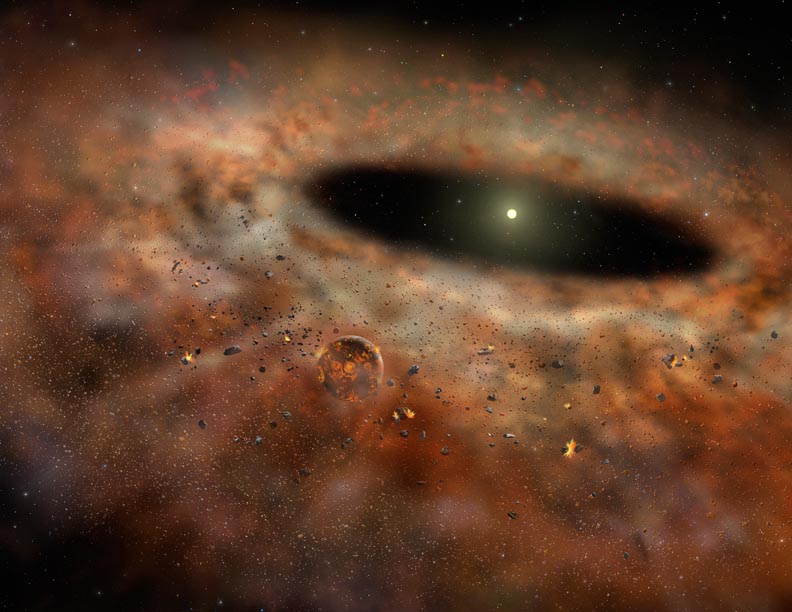
Animation showing the disappearance of dust from the TYC 8241 2652 system. Credit: Gemini Observatory/AURA artwork by Lynette Cook.


Figure 1: Artist's conceptualization of the dusty TYC 8241 2652 system as it might have appeared several years ago when it was emitting large amounts of excess infrared radiation. Credit: Gemini Observatory/AURA artwork by Lynette Cook.


Figure 2: Artist's conceptualization of the TYC 8241 2652 system as it might appear now after most of the surrounding dust has disappeared -- based on observations by the Gemini Observatory and other ground and space-based observatories. Credit: Gemini Observatory/AURA artwork by Lynette Cook.


Figure 3: A hypothetical view of Saturn (with its moon Titan) with and without rings illustrating co-PI Ben Zuckerman's statement about an imaginary analogue to the TYC 8241 2652 system: "It's as if you took a conventional picture of the planet Saturn today and then came back two years later and found that its rings had disappeared." Gemini image obtained using the Near-Infrared Imager (NIRI) on Gemini North with the Altair adaptive optics system. Image alteration by Joy Pollard/Gemini Observatory/AURA.

That surprise you feel when your favorite store turns off its lights, locks up its doors, and suddenly, for no apparent reason, goes out of business? That's just how astronomers felt recently when a dusty disk of rocky debris around a nearby star abruptly shut down and by all appearances went out of business.

The star -- designated TYC 8241 2652 and a young analog of our Sun -- only a few years ago displayed all of the characteristics of hosting a solar system in the making. Now, it has transformed completely: very little of the warm dusty material thought to originate from collisions of rocky planets is apparent - it's a mystery that has astronomers baffled.

Carl Melis of the University of California, San Diego, led the discovery team, whose report is published in the July 5th issue of the journal Nature. He said, "It's like the classic magician's trick: now you see it, now you don't. Only in this case we're talking about enough dust to fill an inner solar system and it really is gone!"

Co-author Ben Zuckerman of the University of California Los Angeles, observed, "It's as if you took a conventional picture of the planet Saturn today and then came back two years later and found that its rings had disappeared."

The dusty disk at TYC 8241 2652 was first seen by the NASA Infrared Astronomical Satellite (IRAS) in 1983, and remained brightly glowing for 25 years. Like Earth, warm dust absorbs the energy of visible starlight (sunlight) and reradiates that heat energy as infrared radiation. An infrared image obtained at the Gemini telescope in Chile on May 1, 2012 - just as the paper was being accepted by Nature - confirmed that the warm dust has now been gone for 2.5 years.

"A perplexing thing about this discovery is that we don't have a really satisfactory explanation to address what happened around this star. The disappearing act appears to be independent of the star itself, as there is no evidence to suggest that the star zapped the dust with some sort of mega-flare or any other violent event," said Melis.

Zuckerman, who has been investigating circumstellar disks (debris disks around stars) since the 1980s, noted that "the dust disappearance at TYC 8241 2652 was so bizarre and so quick, initially I figured that our observations must simply be in error in some strange way."

Norm Murray, Director of the Canadian Institute for Theoretical Astrophysics, who was not part of the research group, said, "The history of astronomy has shown that events that are not predicted and hard to explain can be game-changers".

The lack of an existing model for what is going on around this star is forcing astronomers to rethink what happens within young solar systems in the making.

"Although we've identified a couple of mechanisms that are potentially viable, none are really compelling," said Melis. "In one case, gas produced in the impact that released the dust helps to quickly drag the dust particles into the star and thus to their doom. In another possibility, collisions of large rocks left over from an original major impact provide a fresh infusion of dust particles into the disk which then instigate a runaway process where small grains chip into oblivion both themselves and also larger grains."

Major dusty regions such as the asteroid belt and another located out beyond the orbit of Neptune are known to exist in our own solar system. Nearly 30 years ago, NASA's Infrared Astronomical Satellite (IRAS) first discovered similar regions orbiting other stars. Now hundreds of stars similar to our Sun are known to emit an excess of infrared radiation that is usually attributed to dusty materials orbiting the star in what are called debris disks. It is believed that this material results from planetary system formation and is due to collisions and reprocessing of objects like the comets and asteroids that are part of our own solar system. But nothing like the disappearing dust disk at TYC 8241 2652 had ever been seen during these three decades.

The result is based upon multiple sets of observations of TYC 8241 2652 obtained with the Thermal-Region Camera Spectrograph (T-ReCS) on the Gemini South telescope in Chile, the IRAS satellite, the Wide-field Infrared Survey Explorer (WISE) satellite, NASA's Infrared Telescope on Mauna Kea in Hawai`i, the Herschel Space Telescope of the European Space Agency, and AKARI (a Japanese/ESA infrared satellite).

TYC 8241 2652 lies in the direction of the constellation of Centaurus. Observations by Australian co-authors Simon Murphy and Michael Bessell with the Australian National University's 2.3-meter telescope established that the star is roughly 10 million years old and 450 light years distant.

Support for this work was provided by the Lawrence Livermore National Labs, the US National Science Foundation, and NASA.

Media Contacts:

Peter Michaud
Gemini Observatory, Hilo, HI
Email: pmichaud@gemini.edu
Cell: (808) 936-6643
Desk: (808) 974-2510

Antonieta Garcia
Gemini Observatory, La Serena, Chile
Email: agarcia@gemini.edu
Phone: 56-51-205628

Science Contacts:

Carl Melis
University of California San Diego
Email: cmelis@ucsd.edu
Phone: 858-534-6627

Ben Zuckerman
University of California Los Angeles
Email: ben@astro.ucla.edu
Phone: 310-825-9338

Gemini's mission is to advance our knowledge of the Universe by providing the international Gemini Community with forefront access to the entire sky.

The Gemini Observatory is an international collaboration with two identical 8-meter telescopes. The Frederick C. Gillett Gemini Telescope is located on Mauna Kea, Hawai'i (Gemini North) and the other telescope on Cerro Pachón in central Chile (Gemini South); together the twin telescopes provide full coverage over both hemispheres of the sky. The telescopes incorporate technologies that allow large, relatively thin mirrors, under active control, to collect and focus both visible and infrared radiation from space.

The Gemini Observatory provides the astronomical communities in seven partner countries with state-of-the-art astronomical facilities that allocate observing time in proportion to each country's contribution. In addition to financial support, each country also contributes significant scientific and technical resources. The national research agencies that form the Gemini partnership include: the US National Science Foundation (NSF), the UK Science and Technology Facilities Council (STFC), the Canadian National Research Council (NRC), the Chilean Comisión Nacional de Investigación Cientifica y Tecnológica (CONICYT), the Australian Research Council (ARC), the Argentinean Consejo Nacional de Investigaciones Científicas y Técnicas (CONICET) and the Brazilian Conselho Nacional de Desenvolvimento Científico e Tecnológico CNPq). The observatory is managed by the Association of Universities for Research in Astronomy, Inc. (AURA) under a cooperative agreement with the NSF. The NSF also serves as the executive agency for the international partnership.

Thursday, July 05, 2012

UKIRT discovers 'impossible' binary stars

This artist's impression shows the tightest of the new record breaking binary systems. Two active M4 type red dwarfs orbit each other every 2.5 hours, as they continue to spiral inwards. Eventually they will coalesce into a single star. Credit: J. Pinfield, for the RoPACS network.

A team of astronomers have used the United Kingdom Infrared Telescope (UKIRT) on Hawaii to discover four pairs of stars that orbit each other in less than 4 hours. Until now it was thought that such close-in binary stars could not exist. The new discoveries come from the telescope's Wide Field Camera (WFCAM) Transit Survey, and appear in the journal Monthly Notices of the Royal Astronomical Society.

About half of the stars in our Milky Way galaxy are, unlike our Sun, part of a binary system in which two stars orbit each other. Most likely, the stars in these systems were formed close together and have been in orbit around each other from birth onwards. It was always thought that if binary stars form too close to each other, they would quickly merge into one single, bigger star. This was in line with many observations taken over the last three decades showing the abundant population of stellar binaries, but none with orbital periods shorter than 5 hours.

For the first time, the team have investigated binaries of red dwarfs, stars up to ten times smaller and a thousand times less luminous than the Sun. Although they form the most common type of star in the Milky Way, red dwarfs do not show up in normal surveys because of their dimness in visible light.

For the last five years, UKIRT has been monitoring the brightness of hundreds of thousands of stars, including thousands of red dwarfs, in near-infrared light, using its state-of-the-art Wide-Field Camera (WFC). This study of cool stars in the time domain has been a focus of the European (FP7) Initial Training Network 'Rocky Planets Around Cool Stars' (RoPACS) which studies planets and cool stars.

"To our complete surprise, we found several red dwarf binaries with orbital periods significantly shorter than the 5 hour cut-off found for Sun-like stars, something previously thought to be impossible", said Bas Nefs from Leiden Observatory in the Netherlands, lead author of the paper. "It means that we have to rethink how these close-in binaries form and evolve."

Since stars shrink in size early in their lifetime, the fact that these very tight binaries exist means that their orbits must also have shrunk as well since their birth, otherwise the stars would have been in contact early on and have merged. However, it is not at all clear how these orbits could have shrunk by so much.

One possible answer to this riddle is that cool stars in binary systems are much more active and violent than previously thought.

It is possible that the magnetic field lines radiating out from the cool star companions get twisted and deformed as they spiral in towards each other, generating the extra activity through stellar wind, explosive flaring and star spots. Powerful magnetic activity could apply the brakes to these spinning stars, slowing them down so that they move closer together.

"Without UKIRT's superb sensitivity, it wouldn't have been possible to find these extraordinary pairs of red dwarfs", said David Pinfield. He adds: "The active nature of these stars and their apparently powerful magnetic fields has profound implications for the environments around red dwarfs throughout our Galaxy."


Image and caption

An image accompanying the release can be downloaded from http://star-www.herts.ac.uk/~dpi/close_mdwarfs.png


Media contact

Dr Robert Massey
Royal Astronomical Society
Tel: +44 (0)20 7734 3307 / 4582 x214
Mob: +44 (0)794 124 8035
rm@ras.org.uk


Science contacts

Bas Nefs
Leiden Observatory
Tel: +31 (0)71 527 8439
nefs@strw.leidenuniv.nl

Dr Jayne Birkby
Leiden Observatory
Tel: +31 (0)71527 5832
birkby@strw.leidenuniv.nl

Dr David Pinfield
University of Hertfordshire
Leads the European ROPACS network: http://star.herts.ac.uk/RoPACS/ and is co-PI of the WFCAM Transit Survey (WTS).
Tel: +44 (0)1707 284171
d.j.pinfield@herts.ac.uk

Dr Simon Hodgkin
Institute of Astronomy
University of Cambridge
(Co-PI of WTS)
Tel: +44 (0)1223 766657
sth@ast.cam.ac.uk
(http://www.ast.cam.ac.uk/)


Further information

The team publish their work in the paper, "Four ultra-short period eclipsing M-dwarf binaries in the WFCAM Transit Survey", S. V. Nefs et al, Monthly Notices of the Royal Astronomical Society, in press. A preprint of the paper can be downloaded from http://arxiv.org/abs/1206.1200


Notes for editors

With a 3.8 metre diameter mirror, the UK Infrared Telescope (UKIRT: http://www.jach.hawaii.edu/UKIRT/) is the second largest dedicated infrared telescope in the world. Sited at an altitude of 4200 m on the top of the volcano Mauna Kea on the island of Hawaii, it began operations in 1979. UKIRT is carrying out the UKIRT Deep Sky Survey (UKIDSS: http://www.ukidss.org/) searching for objects from nearby brown dwarfs to distant quasars. In 2012 the UKIDSS team received the RAS Group Award.

The Royal Astronomical Society (RAS, www.ras.org.uk), founded in 1820, encourages and promotes the study of astronomy, solar-system science, geophysics and closely related branches of science. The RAS organizes scientific meetings, publishes international research and review journals, recognizes outstanding achievements by the award of medals and prizes, maintains an extensive library, supports education through grants and outreach activities and represents UK astronomy nationally and internationally. Its more than 3500 members (Fellows), a third based overseas, include scientific researchers in universities, observatories and laboratories as well as historians of astronomy and others.

Follow the RAS on Twitter via @royalastrosoc


Solar Fireworks on July 2

The Solar Dynamics Observatory (SDO) captured this video of the M5.6 class solar flare that occurred on July 2, 2012. Credit: NASA/SDO. Play/Download video

On July 2, 2012, an M5.6 class solar flare erupted in the sun's southern hemisphere from large sunspot AR1515, peaking at 6:52 AM EDT.

From a different spot, but on that same day, the sun unleashed a coronal mass ejection (CME) that began at 4:36 AM EDT. Models from the NASA's Space Weather Center at Goddard Space Flight Center in Greenbelt, Md, describe the CME at traveling at nearly 700 miles per second, but do not show it heading toward Earth.

This view of the July 2, 2012 M5.6 class solar flare was captured by the Solar Dynamic Observatory (SDO) satellite. Credit: NASA/SDO. View larger

What is a solar flare? What is a coronal mass ejection?

For answers to these and other space weather questions, please visit the Spaceweather Frequently Asked Questions page.

Karen C. Fox
NASA Goddard Space Flight Center, Greenbelt, MD

Wednesday, July 04, 2012

X-raying the beating heart of a newborn star


Animation depicting V1647 Ori
Credit: ESA/C. Carreau
(Click here for further details.)

An international team of scientists has used the world's most powerful X-ray observatories - including ESA's XMM-Newton orbiter - to probe the dusty surroundings of a newborn star and discover some of its innermost secrets. These findings shed new light on one of the most fundamental processes in the Universe, the creation of stars.


Our Galaxy contains numerous clouds of gas and dust - stellar nurseries where stars are born as the result of gravitational collapse and gradually grow in size until hydrogen fusion begins, enabling them to blaze forth in all their glory. Although the basic outline of the story is fairly well understood, there are still many questions that need to be answered.

It is generally believed that infant stars – known as 'protostars' – grow as the result of mass accretion. Large amounts of matter fall onto them from the innermost part of a surrounding disc, which is created by the gravitational collapse of a molecular cloud.

Fast-moving jets of material have been observed flowing outward from many protostars, suggesting the influence of powerful magnetic fields and highly energetic processes in the innermost regions of protostellar discs. However, the presence of the cocoon of gas and dust makes it extremely difficult to discover what is happening to the fledgling star in the centre.

In order to learn more about the growth of protostars, the team decided to use data from three orbiting X-ray observatories - XMM-Newton, Chandra and Suzaku - to study a young, low-mass star, known as V1647 Ori, which is located at the apex of McNeil's Nebula.

Soaring temperatures and X-ray spots

Writing in The Astrophysical Journal, an international team of scientists has now re-examined X-ray data obtained during two optical outbursts that are associated with mass accretion on V1647 Ori – one that occurred during the period 2003-2006 and another that has been under way since 2008.

Previous studies had shown that the protostar's X-ray output increased 100 times when the optical outbursts occurred, whilst the temperature of the plasma soared to about 50 million Kelvin. However, the cause of these soaring temperatures was unclear. Acceleration of this material due to the influence of gravity alone is insufficient to raise the temperature of the plasma above a few million degrees.

"In some ways it's like a huge waterfall, cascading down under gravity,"
said Kenji Hamaguchi from NASA's Goddard Space Flight Center, lead author of the paper. "We found that the 50 million degree plasma produced by mass accretion activity is located at the bottom of the accretion flow".

"In order to explain the sizzling temperature, the plasma stream must be hitting the star's surface at a speed of around 2000 km/s. The most likely explanation is that magnetic reconnection – a sudden reconfiguration of the magnetic field lines close to the young star - is accelerating the material."

The team also identified a regular, short period, variation in the protostar's powerful X-ray emissions.

"During the two outbursts, we identified strong similarities in 11 separate X-ray light curve observations of V1647 Ori, obtained with three different space observatories," said Hamaguchi.

The light curve with the longest duration, obtained with XMM-Newton in 2005, shows that the X-ray flux stays constant for about 5½ hours, rises by a factor of 5 over the next four hours, remains at an elevated level for more than 8 hours and then falls gradually to the original flux level.

"Subsequent observations with Suzaku enabled us to identify a similar light curve, indicating a periodic variation in the X-ray emission that lasts about one day," said Nicolas Grosso, a CNRS researcher at Strasbourg Astronomical Observatory in France, and a co-author of the paper.

"Since V1647 Ori has an estimated mass of 0.8 solar masses and a radius about five times larger than the Sun, this periodicity indicates that the star is rotating so quickly that it is close to breaking apart."

What is causing the periodic changes in X-ray output? According to the team, the most likely interpretation is that localised 'hot spot' regions of X-ray plasma are moving in and out of our line of sight as the star rotates. Rises and falls in the light curves would then correspond to appearances and disappearances of X-ray bright spots.

"The phases of low and high flux in the light curve cannot be reproduced by a single spot," said Hamaguchi. "We, therefore, assume two spots with identical shapes, located on opposite sides of the star."

X-ray lightcurve of V1647 Ori
Credit: Hamaguchi et al.

Modelling of the X-ray light curve indicates that the extremely hot plasma resides in large, pancake-shaped magnetic footprints, where the material from the disc is colliding with the surface of the newborn star.

The sustained X-ray periodicity of V1647 Ori demonstrates that such protostellar accretion can be stable over timescales of years. The duration of the rises and falls in the flux suggests that the spots cover a large area of the protostar's surface.

"The footprint of the infall is comparable to the size of the Sun's disc" said Hamaguchi. "Our calculations suggest that the bright spot is about five times more luminous than the faint spot. The brighter spot is located at a stellar latitude of about 49 degrees, whereas the star's inclination - the tilt of its polar axis toward our line of sight - is about 68 degrees. This alignment enables us to detect the accretion footprint."

"How stars are created is one of the fundamental questions in modern astrophysics, so studies such as this, which reveal the physical processes at work, are extremely important," said Norbert Schartel, ESA's Project Scientist for XMM-Newton.

Notes for editors


The study described in this article was carried out using data from ESA's XMM-Newton, NASA's Chandra and the Japan/US Suzaku observatories.

V1647 Ori, a young stellar object located at the apex of McNeil's Nebula, has erupted in optical outbursts on two occasions in recent times: once during 2003-2006 and again in 2008 - the latter outburst is still ongoing.

McNeil's Nebula, which lies in the constellation Orion, about 1300 light years from Earth, was discovered by amateur astronomer Jay McNeil in January 2004. The nebula became visible after a sudden brightening of the infant star in October-November 2003 illuminated the material around it. This outburst was caused by a dramatic increase in the rate of mass accretion from the surrounding disc.

Contacts

Kenji Hamaguchi
X-ray Astrophysics Laboratory and CRESST
NASA/Goddard Space Flight Center
and Department of Astronomy
University of Maryland, MD, U.S.A.
Email: kenji.hamaguchi@nasa.gov
Phone: +1-301-286-4970

Nicolas Grosso
Observatoire Astronomique de Strasbourg
Université de Strasbourg, France
Email: nicolas.grosso@astro.unistra.fr
Phone: +33-3-68-85-24-85

Norbert Schartel
ESA XMM-Newton Project Scientist
Directorate of Science and Robotic Exploration
European Space Agency
Email: Norbert.Schartel@esa.int
Phone: +34-91-8131-184


Tuesday, July 03, 2012

NASA's Hubble Views a Cosmic Skyrocket

HH 11o
Credit: NASA, ESA, and the Hubble Heritage Team (STScI/AURA)
Highest-quality download options

Resembling a Fourth of July skyrocket, Herbig-Haro 110 is a geyser of hot gas from a newborn star that splashes up against and ricochets off the dense core of a cloud of molecular hydrogen. Although the plumes of gas look like whiffs of smoke, they are actually billions of times less dense than the smoke from a July 4 firework. This Hubble Space Telescope photo shows the integrated light from plumes, which are light-years across.

Herbig-Haro (HH) objects come in a wide array of shapes, but the basic configuration stays the same. Twin jets of heated gas, ejected in opposite directions away from a forming star, stream through interstellar space. Astronomers suspect that these outflows are fueled by gas accreting onto a young star surrounded by a disk of dust and gas. The disk is the "fuel tank," the star is the gravitational engine, and the jets are the exhaust.

When these energetic jets slam into colder gas, the collision plays out like a traffic jam on the interstate. Gas within the shock front slows to a crawl, but more gas continues to pile up as the jet keeps slamming into the shock from behind. Temperatures climb sharply, and this curving, flared region starts to glow. These "bow shocks" are so named because they resemble the waves that form at the front of a boat.

In the case of the single HH 110 jet, astronomers observe a spectacular and unusual permutation on this basic model. Careful study has repeatedly failed to find the source star driving HH 110, and there may be good reason for this: perhaps the HH 110 outflow is itself generated by another jet.

Astronomers now believe that the nearby HH 270 jet grazes an immovable obstacle — a much denser, colder cloud core — and gets diverted off at about a 60-degree angle. The jet goes dark and then reemerges, having reinvented itself as HH 110.

The jet shows that these energetic flows are like the erratic outbursts from a Roman candle. As fast-moving blobs of gas catch up and collide with slower blobs, new shocks arise along the jet's interior. The light emitted from excited gas in these hot blue ridges marks the boundaries of these interior collisions. By measuring the current velocity and positions of different blobs and hot ridges along the chain within the jet, astronomers can effectively "rewind" the outflow, extrapolating the blobs back to the moment when they were emitted. This technique can be used to gain insight into the source star's history of mass accretion.

This image is a composite of data taken with Hubble's Advanced Camera for Surveys in 2004 and 2005 and the Wide Field Camera 3 in April 2011.

For additional information, contact:

Ray Villard
Space Telescope Science Institute, Baltimore, Md.
410-338-4514
villard@stsci.edu

Zolt Levay
Space Telescope Science Institute, Baltimore, Md.
410-338-4907
levay@stsci.edu

The 'Flame' Burns Bright in New WISE Image

The Flame Nebula sits on the eastern hip of Orion the Hunter, a constellation most easily visible in the northern hemisphere during winter evenings. Image Credit: NASA/JPL-Caltech . Full image and caption

A new image from NASA's Wide-field Infrared Survey Explorer, or WISE, shows the candle-like Flame nebula lighting up a cavern of dust. The Flame nebula is part of the Orion complex, a turbulent star-forming area located near the constellation's star-studded belt.

The image is being released today along with a new batch of data from the mission. Last March, WISE released its all-sky catalog and atlas containing infrared images and data on more than a half billion objects, including everything from asteroids to stars and galaxies. Now, the mission is offering up additional data from its second scan of the sky.

"If you're an astronomer, then you'll probably be in hog heaven when it comes to infrared data," said Edward (Ned) Wright of UCLA, the principal investigator of the WISE mission. "Data from the second sky scan are useful for studying stars that vary or move over time, and for improving and checking data from the first scan."

The new WISE view of the Flame nebula, in which colors are assigned to different channels of infrared light, looks like what appears to be a flaming candle sending off billows of smoke. In fact, the wispy tendrils in the image are part of the larger Orion star-forming complex, a huge dust cloud churning out new stars. In the Flame nebula, massive stars are carving a cavity in this dust. Intense ultraviolet light from a central massive star 20 times heavier than our sun, and buried in the blanketing dust, is causing the cloud to glow in infrared light. This star would be almost as bright to our eyes as the three stars in Orion's belt, but the dust makes the star appear 4 billion times fainter than it really is.

Other features in this view include the nebula NGC 2023, seen as a bright circle in the lower half of the image, and the famous Horsehead nebula, which is hard to see but located to the right of one of the lower, vertical ridges. The bright red arc at lower right is a bow shock, where material in front of the speeding multiple-star system Sigma Orionis is piling up.

The data released today cover about one-third of the mission's second full scan of the sky. They were taken from August to September 2010 as the telescope began to deplete its coolant, operating with three of its four infrared detectors. The coolant kept the telescope chilled to prevent its heat, or infrared radiation, from interfering with the observations. As the telescope warmed during this period, one of the four channels on WISE was overwhelmed by the infrared radiation.

An introduction and quick guide to accessing the WISE all-sky archive for astronomers is online at: http://wise2.ipac.caltech.edu/docs/release/allsky/ .

NASA's Jet Propulsion Laboratory, Pasadena, Calif., manages, and operated, WISE for NASA's Science Mission Directorate. The spacecraft was put into hibernation mode in 2011 after it scanned the entire sky twice, completing its main objectives. Edward Wright is the principal investigator and is at UCLA. The mission was selected competitively under NASA's Explorers Program managed by the agency's Goddard Space Flight Center in Greenbelt, Md. The science instrument was built by the Space Dynamics Laboratory in Logan, Utah. The spacecraft was built by Ball Aerospace & Technologies Corp. in Boulder, Colo. Science operations and data processing take place at the Infrared Processing and Analysis Center at the California Institute of Technology in Pasadena. Caltech manages JPL for NASA.

More information is online at http://www.nasa.gov/wise, http://wise.astro.ucla.edu and http://www.jpl.nasa.gov/wise .

Whitney Clavin 818-354-4673
Jet Propulsion Laboratory, Pasadena, Calif.
whitney.clavin@jpl.nasa.gov


Monday, July 02, 2012

Small Exoplanets May Abound

This artist's illustration shows the 63 hot Jupiter systems (planetary systems with Jupiter-size planet candidates) in three-day orbits, with simulated stellar colors, and disks and transiting planet silhouettes shown at the same relative scale. Credit: Fermilab Center for Particle Astrophysics/J Steffen.

Not all stars are created equal. Although all of them are born mostly with hydrogen, the trace amounts of other elements present can vary by at least a factor of ten, depending on the particular conditions of the star's birth cloud. Since planets condense out of the material in disks around young stars, astronomers wonder whether stars with relatively large amounts of these other elements will make rocky planets more easily.

Spectral observations of the star's light can reveal its original elemental composition, while the dramatic new methods for detecting exoplanets can identify, at least approximately, which stars host rocky planets (like the Earth) and which ones host primarily gaseous planets (like Jupiter). Recent observations have concluded that heavy-element-rich stars are much more likely to harbor gas giant planets like Jupiter, but the relationship for the smaller, Earth-sized planets has been unknown.

In the latest issue of the journal, Nature, CfA astronomers Dave Latham, Guillermo Torres, Gilbert Esquerdo, John Geary, Bob Stefanik, and Samuel Quinn, and their colleagues report on their spectroscopic studies of 152 stars hosting exoplanets, a subset of the 1235 candidate stars identified by the Kepler satellite as host stars.

The scientists find that planets with radii less than four Earth radii form around host stars with a wide range of elemental abundances (but on average, they look like the Sun), whereas large planets like Jupiter preferentially form around stars that have a higher abundances of elements than does the Sun. The wide variety of conditions in stars that host Earth-like planets prompts the team to conclude that terrestrial planets may be widespread in the disk of the Galaxy, with no special requirement of enhanced element abundances needed for their formation.