Image Comparisons
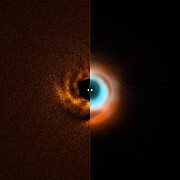
A disc and a planet candidate around the star HD 135344B
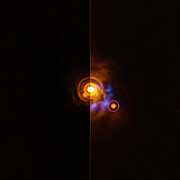
A disc and a possible companion around the star V960 Mon
A disc and a planet candidate around the star HD 135344B
A disc and a possible companion around the star V960 Mon
Astronomers may have caught a
still-forming planet in action, carving out an intricate pattern in the
gas and dust that surrounds its young host star. Using ESO’s Very Large
Telescope (VLT), they observed a planetary disc with prominent spiral
arms, finding clear signs of a planet nestled in its inner regions. This
is the first time astronomers have detected a planet candidate embedded
inside a disc spiral.
“We will never witness the formation of Earth, but here, around a young star 440 light-years away, we may be watching a planet come into existence in real time,” says Francesco Maio, a doctoral researcher at the University of Florence, Italy, and lead author of this study, published today in Astronomy & Astrophysics.
The potential planet-in-the-making was detected around the star HD 135344B, within a disc of gas and dust around it called a protoplanetary disc. The budding planet is estimated to be twice the size of Jupiter and as far from its host star as Neptune is from the Sun. It has been observed shaping its surroundings within the protoplanetary disc as it grows into a fully formed planet.
Protoplanetary discs have been observed around other young stars, and they often display intricate patterns, such as rings, gaps or spirals. Astronomers have long predicted that these structures are caused by baby planets, which sweep up material as they orbit around their parent star. But, until now, they had not caught one of these planetary sculptors in the act.
In the case of HD 135344B’s disc, swirling spiral arms had previously been detected by another team of astronomers using SPHERE (Spectro-Polarimetric High-contrast Exoplanet REsearch), an instrument on ESO’s VLT. However, none of the previous observations of this system found proof of a planet forming within the disc.
Now, with observations from the new VLT’s Enhanced Resolution Imager and Spectrograph (ERIS) instrument, the researchers say they may have found their prime suspect. The team spotted the planet candidate right at the base of one of the disc’s spiral arms, exactly where theory had predicted they might find the planet responsible for carving such a pattern.
“What makes this detection potentially a turning point is that, unlike many previous observations, we are able to directly detect the signal of the protoplanet, which is still highly embedded in the disc,” says Maio, who is based at the Arcetri Astrophysical Observatory, a centre of Italy’s National Institute for Astrophysics (INAF). “This gives us a much higher level of confidence in the planet’s existence, as we’re observing the planet’s own light.”
“We will never witness the formation of Earth, but here, around a young star 440 light-years away, we may be watching a planet come into existence in real time,” says Francesco Maio, a doctoral researcher at the University of Florence, Italy, and lead author of this study, published today in Astronomy & Astrophysics.
The potential planet-in-the-making was detected around the star HD 135344B, within a disc of gas and dust around it called a protoplanetary disc. The budding planet is estimated to be twice the size of Jupiter and as far from its host star as Neptune is from the Sun. It has been observed shaping its surroundings within the protoplanetary disc as it grows into a fully formed planet.
Protoplanetary discs have been observed around other young stars, and they often display intricate patterns, such as rings, gaps or spirals. Astronomers have long predicted that these structures are caused by baby planets, which sweep up material as they orbit around their parent star. But, until now, they had not caught one of these planetary sculptors in the act.
In the case of HD 135344B’s disc, swirling spiral arms had previously been detected by another team of astronomers using SPHERE (Spectro-Polarimetric High-contrast Exoplanet REsearch), an instrument on ESO’s VLT. However, none of the previous observations of this system found proof of a planet forming within the disc.
Now, with observations from the new VLT’s Enhanced Resolution Imager and Spectrograph (ERIS) instrument, the researchers say they may have found their prime suspect. The team spotted the planet candidate right at the base of one of the disc’s spiral arms, exactly where theory had predicted they might find the planet responsible for carving such a pattern.
“What makes this detection potentially a turning point is that, unlike many previous observations, we are able to directly detect the signal of the protoplanet, which is still highly embedded in the disc,” says Maio, who is based at the Arcetri Astrophysical Observatory, a centre of Italy’s National Institute for Astrophysics (INAF). “This gives us a much higher level of confidence in the planet’s existence, as we’re observing the planet’s own light.”
Source: ESO/News
A star’s companion is born
A different team of astronomers have also recently used the ERIS
instrument to observe another star, V960 Mon, one that is still in the
very early stages of its life. In a study published on 18 July in The Astrophysical Journal Letters,
the team report that they have found a companion object to this young
star. The exact nature of this object remains a mystery.
The new study, led by Anuroop Dasgupta, a doctoral researcher at ESO and at the Diego Portales University in Chile, follows up observations of V960 Mon made a couple of years ago. Those observations, made with both SPHERE and the Atacama Large Millimeter/submillimeter Array (ALMA), revealed that the material orbiting V960 Mon is shaped into a series of intricate spiral arms. They also showed that the material is fragmenting, in a process known as ‘gravitational instability’, when large clumps of the material around a star contract and collapse, each with the potential to form a planet or a larger object.
“That work revealed unstable material but left open the question of what happens next. With ERIS, we set out to find any compact, luminous fragments signalling the presence of a companion in the disc — and we did,” says Dasgupta. The team found a potential companion object very near to one of the spiral arms observed with SPHERE and ALMA. The team say that this object could either be a planet in formation, or a ‘brown dwarf’ — an object bigger than a planet that didn’t gain enough mass to shine as a star.
If confirmed, this companion object may be the first clear detection of a planet or brown dwarf forming by gravitational instability.
The new study, led by Anuroop Dasgupta, a doctoral researcher at ESO and at the Diego Portales University in Chile, follows up observations of V960 Mon made a couple of years ago. Those observations, made with both SPHERE and the Atacama Large Millimeter/submillimeter Array (ALMA), revealed that the material orbiting V960 Mon is shaped into a series of intricate spiral arms. They also showed that the material is fragmenting, in a process known as ‘gravitational instability’, when large clumps of the material around a star contract and collapse, each with the potential to form a planet or a larger object.
“That work revealed unstable material but left open the question of what happens next. With ERIS, we set out to find any compact, luminous fragments signalling the presence of a companion in the disc — and we did,” says Dasgupta. The team found a potential companion object very near to one of the spiral arms observed with SPHERE and ALMA. The team say that this object could either be a planet in formation, or a ‘brown dwarf’ — an object bigger than a planet that didn’t gain enough mass to shine as a star.
If confirmed, this companion object may be the first clear detection of a planet or brown dwarf forming by gravitational instability.
More information
This research highlighted in the first part
of this release was presented in the paper “Unveiling a protoplanet
candidate embedded in the HD 135344B disk with VLT/ERIS” to appear in Astronomy & Astrophysics (doi: 10.1051/0004-6361/202554472). The second part of the release highlights the study "VLT/ERIS observations of the V960 Mon system: a dust-embedded substellar object formed by gravitational instability?” published in The Astrophysical Journal Letters (doi: 10.3847/2041-8213/ade996).
The team who conducted the first study (on HD 135344B) is composed of F. Maio (University of Firenze, Italy, and INAF-Osservatorio Astrofisico Arcetri, Firenze, Italy [OAA]), D. Fedele (OAA), V. Roccatagliata (University of Bologna, Italy [UBologna] and OAA), S. Facchini (University of Milan, Italy [UNIMI]), G. Lodato (UNIMI), S. Desidera (INAF-Osservatorio Astronomico di Padova, Italy [OAP]), A. Garufi (INAF - Istituto di Radioastronomia, Bologna, Italy [INAP-Bologna], and Max-Planck-Institut für Astronomie, Heidelberg, Germany [MPA]), D. Mesa (OAP), A. Ruzza (UNIMI), C. Toci (European Southern Observatory [ESO], Garching bei Munchen, Germany, and OAA), L. Testi (OAA, and UBologna), A. Zurlo (Diego Portales University [UDP], Santiago, Chile, and Millennium Nucleus on Young Exoplanets and their Moons [YEMS], Santiago, Chile), and G. Rosotti (UNIMI).
The team behind the second study (on V960 Mon) is primarily composed of members of the Millennium Nucleus on Young Exoplanets and their Moons (YEMS), a collaborative research initiative based in Chile. Core YEMS contributors include A. Dasgupta (ESO, Santiago, Chile, UDP, and YEMS), A. Zurlo (UDP and YEMS), P. Weber (University of Santiago [Usach], Chile, and YEMS, and Center for Interdisciplinary Research in Astrophysics and Space Exploration [CIRAS], Santiago, Chile), F. Maio (OAA, and University of Firenze, Italy), Lucas A. Cieza (UDP and YEMS), D. Fedele (OAA), A. Garufi (INAF Bologna and MPA), J. Miley (Usach, YEMS, and CIRAS), P. Pathak (Indian Institute of Technology, Kanpur, India), S. Pérez (Usach and YEMS, and CIRAS), and V. Roccatagliata (UBologna and OAA).
The Atacama Large Millimeter/submillimeter Array (ALMA), an international astronomy facility, is a partnership of ESO, the U.S. National Science Foundation (NSF) and the National Institutes of Natural Sciences (NINS) of Japan in cooperation with the Republic of Chile. ALMA is funded by ESO on behalf of its Member States, by NSF in cooperation with the National Research Council of Canada (NRC) and the National Science and Technology Council (NSTC) in Taiwan and by NINS in cooperation with the Academia Sinica (AS) in Taiwan and the Korea Astronomy and Space Science Institute (KASI). ALMA construction and operations are led by ESO on behalf of its Member States; by the National Radio Astronomy Observatory (NRAO), managed by Associated Universities, Inc. (AUI), on behalf of North America; and by the National Astronomical Observatory of Japan (NAOJ) on behalf of East Asia. The Joint ALMA Observatory (JAO) provides the unified leadership and management of the construction, commissioning and operation of ALMA.
The European Southern Observatory (ESO) enables scientists worldwide to discover the secrets of the Universe for the benefit of all. We design, build and operate world-class observatories on the ground — which astronomers use to tackle exciting questions and spread the fascination of astronomy — and promote international collaboration for astronomy. Established as an intergovernmental organisation in 1962, today ESO is supported by 16 Member States (Austria, Belgium, Czechia, Denmark, France, Finland, Germany, Ireland, Italy, the Netherlands, Poland, Portugal, Spain, Sweden, Switzerland and the United Kingdom), along with the host state of Chile and with Australia as a Strategic Partner. ESO’s headquarters and its visitor centre and planetarium, the ESO Supernova, are located close to Munich in Germany, while the Chilean Atacama Desert, a marvellous place with unique conditions to observe the sky, hosts our telescopes. ESO operates three observing sites: La Silla, Paranal and Chajnantor. At Paranal, ESO operates the Very Large Telescope and its Very Large Telescope Interferometer, as well as survey telescopes such as VISTA. Also at Paranal ESO will host and operate the Cherenkov Telescope Array South, the world’s largest and most sensitive gamma-ray observatory. Together with international partners, ESO operates ALMA on Chajnantor, a facility that observes the skies in the millimetre and submillimetre range. At Cerro Armazones, near Paranal, we are building “the world’s biggest eye on the sky” — ESO’s Extremely Large Telescope. From our offices in Santiago, Chile we support our operations in the country and engage with Chilean partners and society.
The team who conducted the first study (on HD 135344B) is composed of F. Maio (University of Firenze, Italy, and INAF-Osservatorio Astrofisico Arcetri, Firenze, Italy [OAA]), D. Fedele (OAA), V. Roccatagliata (University of Bologna, Italy [UBologna] and OAA), S. Facchini (University of Milan, Italy [UNIMI]), G. Lodato (UNIMI), S. Desidera (INAF-Osservatorio Astronomico di Padova, Italy [OAP]), A. Garufi (INAF - Istituto di Radioastronomia, Bologna, Italy [INAP-Bologna], and Max-Planck-Institut für Astronomie, Heidelberg, Germany [MPA]), D. Mesa (OAP), A. Ruzza (UNIMI), C. Toci (European Southern Observatory [ESO], Garching bei Munchen, Germany, and OAA), L. Testi (OAA, and UBologna), A. Zurlo (Diego Portales University [UDP], Santiago, Chile, and Millennium Nucleus on Young Exoplanets and their Moons [YEMS], Santiago, Chile), and G. Rosotti (UNIMI).
The team behind the second study (on V960 Mon) is primarily composed of members of the Millennium Nucleus on Young Exoplanets and their Moons (YEMS), a collaborative research initiative based in Chile. Core YEMS contributors include A. Dasgupta (ESO, Santiago, Chile, UDP, and YEMS), A. Zurlo (UDP and YEMS), P. Weber (University of Santiago [Usach], Chile, and YEMS, and Center for Interdisciplinary Research in Astrophysics and Space Exploration [CIRAS], Santiago, Chile), F. Maio (OAA, and University of Firenze, Italy), Lucas A. Cieza (UDP and YEMS), D. Fedele (OAA), A. Garufi (INAF Bologna and MPA), J. Miley (Usach, YEMS, and CIRAS), P. Pathak (Indian Institute of Technology, Kanpur, India), S. Pérez (Usach and YEMS, and CIRAS), and V. Roccatagliata (UBologna and OAA).
The Atacama Large Millimeter/submillimeter Array (ALMA), an international astronomy facility, is a partnership of ESO, the U.S. National Science Foundation (NSF) and the National Institutes of Natural Sciences (NINS) of Japan in cooperation with the Republic of Chile. ALMA is funded by ESO on behalf of its Member States, by NSF in cooperation with the National Research Council of Canada (NRC) and the National Science and Technology Council (NSTC) in Taiwan and by NINS in cooperation with the Academia Sinica (AS) in Taiwan and the Korea Astronomy and Space Science Institute (KASI). ALMA construction and operations are led by ESO on behalf of its Member States; by the National Radio Astronomy Observatory (NRAO), managed by Associated Universities, Inc. (AUI), on behalf of North America; and by the National Astronomical Observatory of Japan (NAOJ) on behalf of East Asia. The Joint ALMA Observatory (JAO) provides the unified leadership and management of the construction, commissioning and operation of ALMA.
The European Southern Observatory (ESO) enables scientists worldwide to discover the secrets of the Universe for the benefit of all. We design, build and operate world-class observatories on the ground — which astronomers use to tackle exciting questions and spread the fascination of astronomy — and promote international collaboration for astronomy. Established as an intergovernmental organisation in 1962, today ESO is supported by 16 Member States (Austria, Belgium, Czechia, Denmark, France, Finland, Germany, Ireland, Italy, the Netherlands, Poland, Portugal, Spain, Sweden, Switzerland and the United Kingdom), along with the host state of Chile and with Australia as a Strategic Partner. ESO’s headquarters and its visitor centre and planetarium, the ESO Supernova, are located close to Munich in Germany, while the Chilean Atacama Desert, a marvellous place with unique conditions to observe the sky, hosts our telescopes. ESO operates three observing sites: La Silla, Paranal and Chajnantor. At Paranal, ESO operates the Very Large Telescope and its Very Large Telescope Interferometer, as well as survey telescopes such as VISTA. Also at Paranal ESO will host and operate the Cherenkov Telescope Array South, the world’s largest and most sensitive gamma-ray observatory. Together with international partners, ESO operates ALMA on Chajnantor, a facility that observes the skies in the millimetre and submillimetre range. At Cerro Armazones, near Paranal, we are building “the world’s biggest eye on the sky” — ESO’s Extremely Large Telescope. From our offices in Santiago, Chile we support our operations in the country and engage with Chilean partners and society.
Links
- Research paper (Maio et al., on HD 135344B)
- Research paper (Dasgupta et al., on V960 Mon)
- Photos of the VLT
- For journalists: subscribe to receive our releases under embargo in your language
- For scientists: got a story? Pitch your research
- New ESO analysis confirms severe damage from industrial complex planned near Paranal
Contacts:
Francesco Maio (for questions on the HD 135344B study)
INAF Osservatorio Astrofisico di Arcetri
Florence, Italy
Email: francesco.maio@inaf.it
Davide Fedele (for questions on the HD 135344B study)
INAF Osservatorio Astrofisico di Arcetri
Florence, Italy
Tel: (+39) 055-2752-242
Email: davide.fedele@inaf.it
Anuroop Dasgupta (for questions on the V960 Mon study)
European Southern Observatory
Santiago, Chile
Email: Anuroop.Dasgupta@eso.org
Bárbara Ferreira
ESO Media Manager
Garching bei München, Germany
Tel: +49 89 3200 6670
Cell: +49 151 241 664 00
Email: press@eso.org