Showing posts with label CSIRO. Show all posts

Thursday, September 21, 2023

Astronomers reveal cosmic ribbon around rare galaxy

NGC 4632
Image Credit: J. English (U.Manitoba), with support of N. Deg (Queen’s U.) and the WALLABY team; CSIRO/ASKAP radio telescope, NAOJ/Subaru Telescope

CSIRO’s ASKAP radio telescope on Wajarri Yamaji Country in Western Australia.
Credit: CSIRO/A.Cherney


Associate Professor Barbara Catinella


International astronomers using a telescope owned and operated by CSIRO, Australia’s national science agency, have revealed a galaxy wrapped in a cosmic ‘ribbon’.

The research, led by Dr Nathan Deg and Dr Kristine Spekkens from Queen’s University Canada and co- authored by CSIRO’s Professor Bärbel Koribalski, presents a stunning image of a galaxy called NGC 4632 that is 56 million light years from Earth.

It’s been identified as a potential polar ring galaxy, which are some of the most spectacular types of galaxies in the Universe, and among the most mysterious.

Detected using CSIRO’s ASKAP radio telescope on Wajarri Yamaji Country in Western Australia, the galaxy features a ring of gas that can only be seen at radio wavelengths. The ring is orbiting the galaxy at right angles to its spiral disk, like a parcel wrapped in a ribbon of cosmic gas, dust and stars. Dr Nathan Deg co-authored the paper published today in Monthly Notices of the Royal Astronomical Society.

“The findings suggest that one to three per cent of nearby galaxies may have gaseous polar rings, which is much higher than suggested by optical telescopes. Polar ring galaxies might be more common than previously thought,” Dr Deg said.

“While this is not the first time astronomers have observed polar ring galaxies, NGC 4632 is the first observed with ASKAP and there may be many more to come,”

Professor Koribalski said the WALLABY survey aims to observe the whole southern sky using ASKAP to detect and visualise the gas distribution in hundreds of thousands of galaxies.

“NGC 4632 is one of two polar ring galaxies we’ve identified from 600 galaxies that were mapped in our first small WALLABY survey.

“Using ASKAP over coming years we expect to reveal more than 200,000 hydrogen-rich galaxies, among them many more unusual galaxies like these ones with polar rings,” Professor Koribalski said.

Why polar rings exist is still a puzzle to astronomers. One possible explanation is that their stellar rings, which appear blended with gas clouds, are shredded material from a passing galaxy.

Another possibility is that hydrogen gas flows along the filaments of the cosmic web and accretes into a ring around a galaxy, possibly forming stars during this process

Associate Professor Barbara Catinella, from ICRAR’s UWA node, is WALLABY Co-Principal Investigator and co-author on the paper.

“One of the most exciting outcomes of a large survey such as WALLABY, which will scan most of the Southern sky to carry out the largest census of neutral atomic hydrogen ever done, is discovering the unexpected,” she says.

“These unusual galaxies with beautiful gas rings are perfect examples of this.”

In the future, polar ring galaxies can also be used to deepen our understanding of the universe, with potential applications in dark matter research. It is possible to use polar rings to probe the shape of dark matter of the host galaxy, which could lead to new clues about the mysterious properties of the elusive substance.

Over 25 global collaborators from Canada, Australia, South Africa, Ecuador, Burkina Faso, Germany, China, and beyond worked together to analyse data from the first WALLABY survey collected using ASKAP and processed by the Pawsey Supercomputing Research Centre in Western Australia.

ASKAP is part of CSIRO’s Australia Telescope National Facility. It is also a precursor to the international SKA telescopes currently being built in Australia and South Africa.

Thursday, February 25, 2016

New Fast Radio Burst Discovery Finds 'Missing Matter' in the Universe

An international team of scientists using a combination of radio and optical telescopes identified the distant location of a fast radio burst (FRB) for the first time. This discovery has allowed them to confirm the current cosmological model of the distribution of matter in the universe.

The fast radio burst was detected on April 18, 2015 by the Commonwealth Scientific and Industrial Research Organisation (CSIRO)'s 64-meter Parkes radio telescope in Australia. That observation triggered an international alert to other telescopes to follow up with their observations. Within a few hours, CSIRO's Australian Telescope Compact Array (ATCA), as well as other facilities around the world were looking for the signal.

FRBs are mysterious bright radio flashes generally lasting only a few milliseconds. Their cause is still unknown and there is a long list of phenomena potentially associated with them. FRBs are very difficult to detect; before this discovery only 16 had been observed.

"In the past, FRBs have been found by sifting through data months or even years later. By that time it is too late to do follow up observations," said Dr. Evan Keane, Project Scientist at the Square Kilometre Array Organisation (SKAO) and the lead scientist behind the study. To remedy this, the team developed its own observing system at Swinburne University of Technology in Australia to detect FRBs within seconds, and to immediately alert other telescopes while there is still time to search for more evidence in the aftermath of the initial flash (Figure 1).

Figure 1: This image shows the field of view of the Parkes radio telescope on the left. On the right are successive zoom-ins in on the area where the signal came from (cyan circular region). The image at the bottom right shows the Subaru Telescope's image of the FRB galaxy, with the superimposed elliptical regions showing the location of the fading 6-day afterglow seen with ATCA. Image Credit: D. Kaplan (UWM), E. F. Keane (SKAO).

Catching a Flash


Thanks to the ATCA's six 22-meter dishes and their combined resolution, the team was able to pinpoint the location of the signal with much greater accuracy than has been possible in the past. The observations revealed a radio afterglow that lasted for around six days before fading away. This afterglow enabled astronomers to pinpoint the location of the FRB about a thousand times more precisely than for previous observed events (Figure 1).

The team members from the University of Tokyo (UTokyo), the National Astronomical Observatory of Japan (NAOJ), and Konan University next examined an optical image of the FRB taken a day after the first flash by the NAOJ's 8.2-meter Subaru Telescope in Hawaii. The image revealed a possible source: an elliptical galaxy some 6 billion light-years away. Follow-up spectroscopic observations by the Subaru Telescope yielded a redshift measurement for the source, which allowed astronomers to calculate its distance. (Redshift is the speed at which the galaxy is moving away from us due to the expansion of the universe). "For the first time, we have identified the host galaxy and measured the distance to a fast radio burst," said Dr. Tomonori Totani, professor at the UTokyo Department of Astronomy, who led the optical observation effort.

Doing Cosmology with an FRB


FRBs show a frequency-dependent dispersion (Figure 2), a delay in the radio signal caused by how much material it has gone through. "Until now, the dispersion measure is all we had. By also having a distance we can now measure how dense the material is between the point of origin and Earth, and compare that with the current model of the distribution of matter in the universe" explained Dr. Simon Johnston, of CSIRO's Astronomy and Space Science division. "Essentially, this lets us weigh the universe, or at least the normal matter it contains."

In the current model, the universe is believed to be made of 70% dark energy, 25% dark matter and 5% 'ordinary' matter, the matter that makes up everything we see. However, through observations of stars, galaxies and hydrogen, astronomers have only been able to account for about half of the ordinary matter, the rest cannot be seen directly and so has been referred to as 'missing.'

"The good news is our observations and the model match. We have found the missing matter" explained Dr. Keane. "It's the first time a fast radio burst has been used to conduct a cosmological measurement." 

Finding the Cause of FRBs


Still, the origin of FRBs is a mystery. The fact that the host galaxy is an elliptical galaxy, which is not actively forming young stars, implies that it takes a long time for a stellar system to evolve into an FRB. This favors scenarios like compact binary star mergers, but there is no direct evidence yet.

Future observations of FRBs in a variety of wavebands may well reveal more details about this enigmatic astronomical phenomenon. Optical observations are essential as demonstrated by the present study. Instruments such as the Subaru Telescope and the upcoming Thirty Meter Telescope (TMT) in future will play major roles as FRBs occur.

Even more tantalizing is the idea that FRBs could also be sources of gravitational waves, leading to collaboration between FRB search projects and gravitational wave observations. These could make valuable contributions to the new era of gravitational wave astronomy begun by the recent discovery of a black hole binary merger by the LIGO Observatory.

Figure 2: This image shows the increased delay in the arrival time of the Fast Radio Burst as a function of the frequency. The delay in the signal is caused by the material it goes through between its point of origin and Earth. Image Credit: E. F. Keane (SKAO).

The study was published in Nature on February 24, 2016, titled "The host galaxy of a fast radio burst" by Keane et al. This research is supported in part by a Grant-in-Aid for the Scientific Research (No. 15K05018) by the Japan Society for the Promotion of Science.  


Monday, January 25, 2016

Dark 'noodles' may lurk in the Milky Way


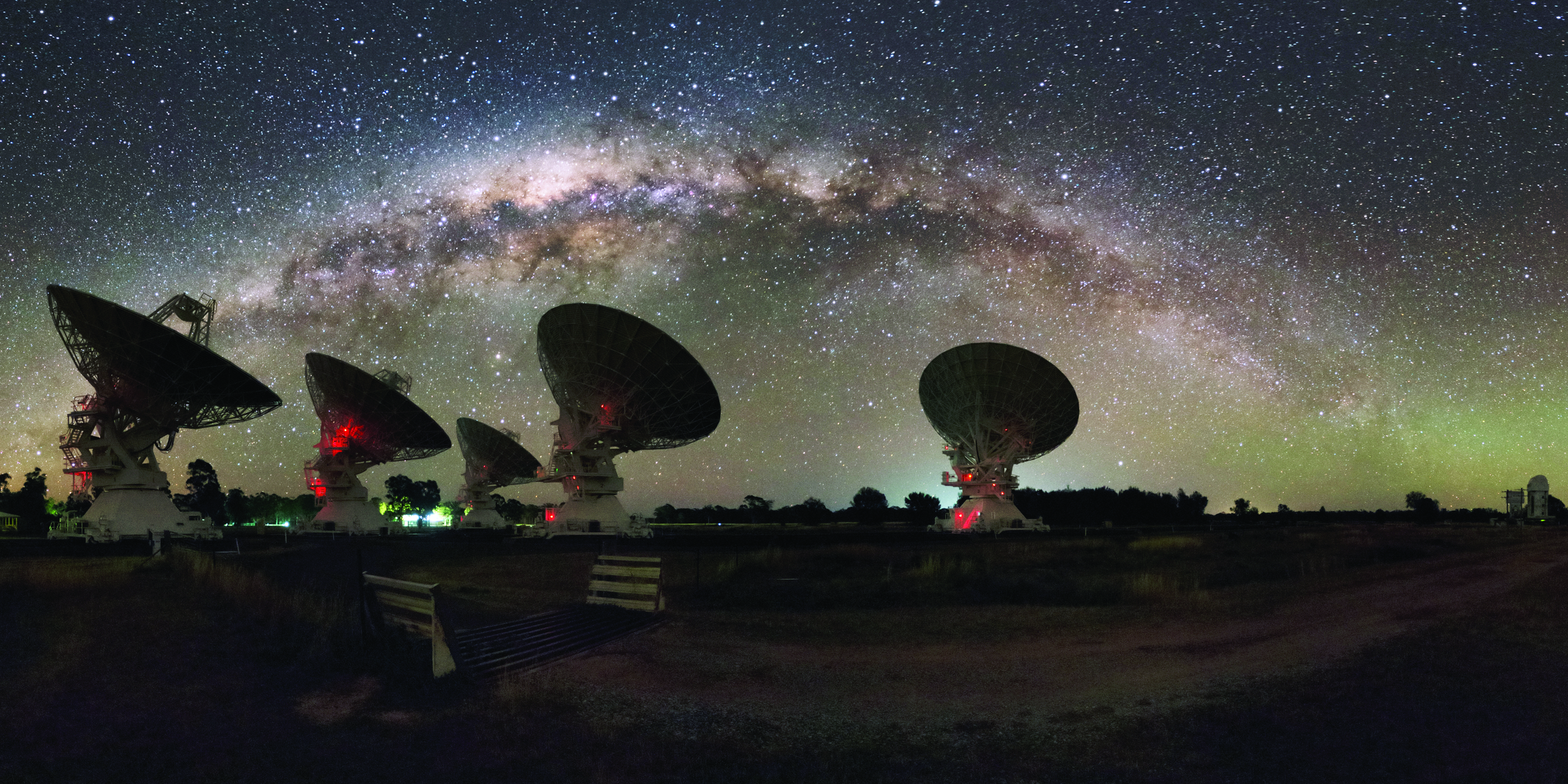
CSIRO's Compact Array in Australia under the night lights of the Milky Way


Invisible structures shaped like noodles, lasagne sheets or hazelnuts could be floating around in our Galaxy radically challenging our understanding of gas conditions in the Milky Way.

CSIRO astronomer and first author of a paper released in Science Dr Keith Bannister said the structures appear to be ‘lumps’ in the thin gas that lies between the stars in our Galaxy.

“They could radically change ideas about this interstellar gas, which is the Galaxy’s star recycling depot, housing material from old stars that will be refashioned into new ones,” Dr Bannister said.

Dr Bannister and his colleagues described breakthrough observations of one of these ‘lumps’ that have allowed them to make the first estimate of its shape.

The observations were made possible by an innovative new technique the scientists employed using CSIRO’s Compact Array telescope in eastern Australia.

Astronomers got the first hints of the mysterious objects 30 years ago when they saw radio waves from a bright, distant galaxy called a quasar varying wildly in strength.

They figured out this behaviour was the work of our Galaxy’s invisible ‘atmosphere’, a thin gas of electrically charged particles which fills the space between the stars. 

“Lumps in this gas work like lenses, focusing and defocusing the radio waves, making them appear to strengthen and weaken over a period of days, weeks or months,” Dr Bannister said.

These episodes were so hard to find that researchers had given up looking for them.

But Dr Bannister and his colleagues realised they could do it with CSIRO’s Compact Array.

Pointing the telescope at a quasar called PKS 1939–315 in the constellation of Sagittarius, they saw a lensing event that went on for a year.

Astronomers think the lenses are about the size of the Earth’s orbit around the Sun and lie approximately 3000 light-years away – 1000 times further than the nearest star, Proxima Centauri.

Until now they knew nothing about their shape, however, the team has shown this lens could not be a solid lump or shaped like a bent sheet.

“We could be looking at a flat sheet, edge on,” CSIRO team member Dr Cormac Reynolds said.

“Or we might be looking down the barrel of a hollow cylinder like a noodle, or at a spherical shell like a hazelnut.”

Getting more observations will “definitely sort out the geometry,” he said.

While the lensing event went on, Dr Bannister’s team observed it with other radio and optical telescopes.

The optical light from the quasar didn’t vary while the radio lensing was taking place. This is important, Dr Bannister said, because it means earlier optical surveys that looked for dark lumps in space couldn’t have found the one his team has detected.

So what can these lenses be? One suggestion is cold clouds of gas that stay pulled together by the force of their own gravity. That model, worked through in detail, implies the clouds must make up a substantial fraction of the mass of our Galaxy.

Nobody knows how the invisible lenses could form. “But these structures are real, and our observations are a big step forward in determining their size and shape,” Dr Bannister said.


News release contact

Mr Eamonn Bermingham
Communication Advisor · Communications 
Phone: +61 7 3833 5601  +61 477 317 235 (Mobile) 
Email: Eamonn.Bermingham@csiro.au

Dr Keith Bannister
Principal Research Engineer · Astronomy and Space Science
Phone: +61 2 9372 4295
Email: Keith.Bannister@csiro.au


Wednesday, June 26, 2013

Astronomers spy on galaxies in the raw

The Spiderweb, imaged by the Hubble Space Telescope – a central galaxy (MRC 1138-262) surrounded by hundreds of other star-forming 'clumps'. Credit: NASA, ESA, George Miley and Roderik Overzier (Leiden Observatory). Hi-res

In blue, the carbon monoxide gas detected in and around the Spiderweb
Credit: B. Emonts et al (CSIRO/ATCA). Hi-Res

Antennas of CSIRO's Compact Array telescope
Photo: David Smyth . Hi-Res

 The Spiderweb
Zooming into the Spiderweb, as imaged by NASA/ESA's Hubble Space Telescope. Credit: Akira Fujii, Digitized Sky Survey 2 and ESA/Hubble.  Download (mp4). Transcript: Stars and galaxies seen from far away then the camera zooms in closer to focus on a conglomerate of star-forming 'clumps' or 'proto-galaxies' that are in the process of coming together as a single massive galaxy.
  
A CSIRO radio telescope has detected the raw material for making the first stars in galaxies that formed when the Universe was just three billion years old — less than a quarter of its current age. This opens the way to studying how these early galaxies make their first stars.

The telescope is CSIRO's Australia Telescope Compact Array telescope near Narrabri, NSW. "It one of very few telescopes in the world that can do such difficult work, because it is both extremely sensitive and can receive radio waves of the right wavelengths," says CSIRO astronomer Professor Ron Ekers. 

The raw material for making stars is cold molecular hydrogen gas, H2. It can't be detected directly but its presence is revealed by a 'tracer' gas, carbon monoxide (CO), which emits radio waves.

In one project, astronomer Dr Bjorn Emonts (CSIRO Astronomy and Space Science) and his colleagues used the Compact Array to study a massive, distant conglomerate of star-forming 'clumps' or 'proto-galaxies' that are in the process of coming together as a single massive galaxy. This structure, called the Spiderweb, lies more than ten thousand million light-years away [at a redshift of 2.16]. 

Dr Emonts' team found that the Spiderweb contains at least sixty thousand million [6 x 10¹⁰] times the mass of the Sun in molecular hydrogen gas, spread over a distance of almost a quarter of a million light-years. This must be the fuel for the star-formation that has been seen across the Spiderweb. "Indeed, it is enough to keep stars forming for at least another 40 million years," says Emonts.

In a second set of studies, Dr Manuel Aravena (European Southern Observatory) and colleagues measured CO, and therefore H2, in two very distant galaxies [at a redshift of 2.7]. 

The faint radio waves from these galaxies were amplified by the gravitational fields of other galaxies — ones that lie between us and the distant galaxies. This process, called gravitational lensing, "acts like a magnifying lens and allows us to see even more distant objects than the Spiderweb," says Dr Aravena.

Dr Aravena's team was able to measure the amount of H2 in both galaxies they studied. For one (called SPT-S 053816-5030.8), they could also use the radio emission to make an estimate of how rapidly the galaxy is forming stars — an estimate independent of the other ways astronomers measure this rate.

The Compact Array's ability to detect CO is due to an upgrade that has boosted its bandwidth — the amount of radio spectrum it can see at any one time — sixteen-fold [from 256 MHz to 4 GHz], and made it far more sensitive.

"The Compact Array complements the new ALMA telescope in Chile, which looks for the higher-frequency transitions of CO," says Ron Ekers.

Read more media releases in our Media section.

Publications


Emonts BHC and 15 co-authors. CO(1-0) detection of molecular gas in the massive Spiderweb Galaxy (z=2). Monthly Notices of the Royal Astronomical Society 430, 3465 (2013). Online at http://arxiv.org/abs/1301.6012


Aravena M and 28 co-authors. Large gas reservoirs and free-free emission in two lensed star-forming galaxies at z = 2.7. Accepted for publication in Monthly Notices of the Royal Astronomical Society. Online at http://arxiv.org/abs/1305.0614.

More information


Professor Ron Ekers, CSIRO Astronomy and Space Science [in Sydney, Australia]
Mob: +61 419 146 313

Dr Bjorn Emonts, CSIRO Astronomy and Space Science [currently in Spain]
bjornemonts@gmail.com

Mob: +34 692 744 507

Dr Manuel Aravena, European Southern Observatory [in Santiago, Chile]
maravena@eso.org
Office: +56 22 463 3256
 

Contact Information


Ms Helen Sim

Media and Public Relations
Astronomy and Space Science
Phone: +61 2 9372 4251
Alt Phone: +61 419 635 905
Email: Helen.Sim@csiro.au

Dr Ron Ekers
Fellow
CSIRO Astronomy and Space Science
Phone: +61 41914 6313
Email: Ron.Ekers@csiro.au


Wednesday, November 24, 2010

Black Hole True Power Revealed

A composite image showing the position of the 'miniature galaxy' S26 in the galaxy NGC 7793. The image of S26 is a radio image, made with a CSIRO telescope while the image of the galaxy is made from combined X-ray and optical data. Image credit - Soria et al / CSIRO / ATCA; NGC 7793 - NASA, ESO and NOAO.

Following a study of what is in effect a miniature galaxy buried inside a normal-sized one - like a Russian doll - astronomers using a CSIRO telescope have concluded that massive black holes are more powerful than we thought.

An international team of astronomers led by Dr Manfred Pakull at the University of Strasbourg in France has discovered a 'microquasar' - a small black hole, weighing only as much as a star, that shoots jets of radio-emitting particles into space.

Called S26, the black hole sits inside a regular galaxy called NGC 7793, which is 13M light-years away in the Southern constellation of Sculptor.

Earlier this year Pakull and colleagues observed S26 with optical and X-ray telescopes (the European Southern Observatory's Very Large Telescope and NASA's Chandra space telescope).

Now they have made new observations with CSIRO's Compact Array radio telescope near Narrabri, NSW. These show that S26 is a near-perfect analogue of the much larger 'radio galaxies' and 'radio quasars'. Called S26, the black hole sits inside a regular galaxy called NGC 7793, which is 13M light-years away in the Southern constellation of Sculptor.

Powerful radio galaxies and quasars are almost extinct today, but they dominated the early Universe, billions of years ago, like cosmic dinosaurs. They contain big black holes, billions of times more massive than the Sun, and shoot out huge radio jets that can stretch millions of light-years into space.

Astronomers have been working for decades to understand how these black holes form their giant jets, and how much of the black hole's energy those jets transmit to the gas they travel through. That gas is the raw material for forming stars, and the effects of jets on star-formation have been hotly debated.

"Measuring the power of black hole jets, and therefore their heating effect, is usually very difficult," said co-author Roberto Soria (University College London), who carried out the radio observations.

"With this unusual object, a bonsai radio quasar in our own backyard, we have a unique opportunity to study the energetics of the jets."

Using their combined optical, X-ray and radio data, the scientists were able to determine how much of the jet's energy went into heating the gas around it, and how much went into making the jet glow at radio wavelengths.

They concluded that only about a thousandth of the energy went into creating the radio glow.

"This suggests that in bigger galaxies too the jets are about a thousand times more powerful than we'd estimate from their radio glow alone," said Dr Tasso Tzioumis of CSIRO Astronomy and Space Science.

"That means that black hole jets can be both more powerful and more efficient than we thought, and that their heating effect on the galaxies they live in can be stronger."

The study was made possible by a recent upgrade to the Compact Array, which can now do work of this kind five times faster than before.

Publication: Roberto Soria, Manfred W. Pakull, Jess W. Broderick, Stephane Corbel, and Christian Motch. "Radio lobes and X-ray hotspots in the microquasar S26." In press in Monthly Notices of the Royal Astronomical Society. Available online on the MNRAS website and at http://arxiv.org/abs/1008.0394.