Showing posts with label Zwicky Transient Facility (ZTF). Show all posts

Wednesday, April 22, 2026

Collaboration led by the German Center for Astrophysics (DZA) joins the ZTF partnership

ZTF image of the Orion nebula
Credit: Caltech Optical Observatories


Small screen size [600 x 600, 50 KB] - Big screen size [1000 x 1000, 160 KB] - Original size [1024 x 1024, 210 KB]


April 16, 2026 // A collaboration consisting of the German Center for Astrophysics in Goerlitz, the Leibniz-Institute for Astrophysics (AIP), Potsdam and the German Electron Synchrotron DESY is officially joining the Zwicky Transient Facility (ZTF) partnership, expanding our scientific collaborative network in Europe and growing the team of world-class researchers and students.

The Zwicky Transient Facility (ZTF) is designed to scan the night sky rapidly and repeatedly to detect transient astronomical events — things that change or appear suddenly, like supernovae, variable stars, asteroids, and other cosmic phenomena. It operates at the Palomar Observatory in California, using a wide-field camera mounted on the Samuel Oschin Telescope. ZTF helps astronomers catch time variable events in the universe in near real-time, enabling quick follow-up observations and advancing our understanding of dynamic cosmic processes.

“This is exciting news. DZA is quickly attracting exceptional talent from around the world and developing cutting-edge scientific and research infrastructure. I am convinced we will build a solid and long-term partnership that will benefit astrophysics both in the USA and Europe”, says Mansi Kasliwal, a professor of astronomy at Caltech and the principal investigator of ZTF.

The German Center for Astrophysics, currently under construction, is envisioned as a new hub for scientific innovation in Lusatia, a growing region in Eastern Germany. The center aims to become a global leader in developing cutting-edge and sustainable infrastructure for scientific research in astrophysics with an initial focus on radio and multi-messenger astronomy.

Prof. Stefan Wagner from the University of Heidelberg and DZA, Prof. Matthias Steinmetz from the Leibniz Institute for Astrophysics Potsdam (AIP), and Prof. Samaya Nissanke, lead scientist at DESY who is also a long-standing collaborator with members of the ZTF multi-messenger science group, are heading different research areas in DZA and have joined ZTF as co-investigators.

“After working closely with ZTF colleagues since 2009, in the early days of its precursor the Palomar Transient Factory, I am thrilled to be joining ZTF as an official partner. ZTF has been extraordinary across a wide range of discoveries and has quite literally led the way in the optical follow up of gravitational wave mergers over the past seven years,” says Samaya Nissanke, whose research focus is on studying black holes and neutron star mergers with gravitational waves.

”With ZTF and our well established collaboration with DZA, AIP can now expand its portfolio mainly focussed on spectroscopic surveys with a new dimension - time domain astrophysics,” adds Matthias Steinmetz of AIP.

Stefan Wagner is also interested in employing big data methods and technology to advance survey science. As partners in ZTF, he and Matthias Steinmetz will lead the transfer of the real-time pipeline from Caltech IPAC to Germany, employing the computational facilities at the TUD University of Dresden.

“Exploring the dynamic universe currently requires constant innovations in data science to enable astronomers to analyze large data streams from multiple telescopes quickly. I am looking forward to working with our colleagues at DZA to provide excellent survey data from ZTF to the astronomical community around the world”, says Matthew Graham, a co-PI of ZTF.

The DZA led collaboration is joining ZTF as a major partner with full access to ZTF's proprietary partnership data.


Media contact:

Tilo Bergemann
Phone: +49 331 7499 803
presse@aip.de


Further information

www.deutscheszentrumastrophysik.de


The Leibniz Institute for Astrophysics Potsdam (AIP) is dedicated to astrophysical questions ranging from the study of our sun to the evolution of the cosmos. The key areas of research focus on stellar, solar and exoplanetary physics as well as extragalactic astrophysics. A considerable part of the institute's efforts aims at the development of research technology in the fields of spectroscopy, robotic telescopes, and e-science. The AIP is the successor of the Berlin Observatory founded in 1700 and of the Astrophysical Observatory of Potsdam founded in 1874. The latter was the world’s first observatory to emphasize explicitly the research area of astrophysics. The AIP has been a member of the Leibniz Association since 1992.


Monday, November 10, 2025

Black Hole Flare is Biggest and Most Distant Seen

This artist's concept depicts a supermassive black hole in the process of shredding a massive star—at least 30 times the mass of our Sun—to pieces. Scientists propose this is what happened around the distant black hole referred to as J2245+3743, which in 2018, brightened dramatically to create the brightest black hole flare ever recorded, shining with the light of 10 trillion suns. This is likely the most massive star-shredding event (formally called a tidal disruption event or TDE) ever observed and one of only a few to have occurred in an active galactic nucleus (AGN), which is an active supermassive black hole "feeding" off material in a surrounding disk. The stunning flare was discovered by the Zwicky Transient Facility (ZTF), based at Caltech's Palomar Observatory, and the Caltech-led Catalina Real-Time Transient Survey. Credit: Caltech/R. Hurt (IPAC)

The 48-inch Samuel Oschin Telescope at Palomar Observatory, where ZTF resides.
Credit: Palomar/Caltech

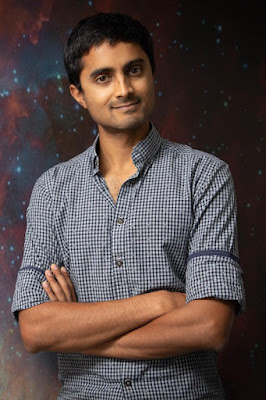
Matthew Graham
Credit: Nick Macdonald


The flare, co-discovered by the Zwicky Transient Facility, may be the result of a mega black-hole meal

The most massive stars in the universe are destined to explode as brilliant supernova before collapsing into black holes. Yet one huge star appears to have never fulfilled its destiny; in a twist of irony, the star wandered too close to a gargantuan black hole, which gobbled it up, shredding the star to bits and pieces.

That is the most likely explanation to come from authors of a new Nature Astronomy report describing the most powerful and most distant flare of energy ever recorded from a supermassive black hole. The cosmic object was first observed in 2018 by the US National Science Foundation (NSF)-funded Zwicky Transient Facility (ZTF), based at Caltech's Palomar Observatory, and the Caltech-led Catalina Real-Time Transient Survey, which is also funded by NSF. The flare rapidly brightened by a factor of 40 over a period of months, and, at its peak, was 30 times more luminous than any previous black hole flare seen to date. At its brightest, the flare shined with the light of 10 trillion suns.

The supermassive black hole behind the flare is a type of accreting, or feeding, black hole called an active galactic nucleus (AGN). Referred to as J2245+3743, this AGN is estimated to be 500 million times more massive than our Sun. It resides 10 billion light-years away in the remote universe. Because light has a finite speed and takes time to reach us, astronomers observe distant events like this one in the past, when the universe was young.

"The energetics show this object is very far away and very bright," says study lead author Matthew Graham, research professor of astronomy at Caltech, as well as the project scientist for ZTF, and a co-principal investigator of the project. "This is unlike any AGN we've ever seen."

Astronomers are continuing to monitor the black hole flare though it is fading over time. In fact, in addition to witnessing the object in the past, time itself runs slower at the remote site of the black hole compared to our own experience of time. "It's a phenomenon called cosmological time dilation due to stretching of space and time. As the light travels across expanding space to reach us, its wavelength stretches as does time itself," Graham explains, noting that long-lived surveys like ZTF and Catalina are important to fully witness events in the past because, in this case, "seven years here is two years there. We are watching the event play back at quarter speed."

To determine what could cause such a dramatic burst of light in the cosmos, the researchers thoroughly examined a list of possibilities, concluding that the most likely culprit is a tidal disruption event (TDE). This phenomenon occurs when a supermassive black hole's gravity shears a star that comes too close, slowly consuming the star over time as it spirals into the black hole. The fact that the black hole flare J2245+3743 is still going indicates that we are witnessing a star not yet fully devoured but rather like "a fish only halfway down the whale's gullet," Graham says.

If the flare is from a TDE, the scientists estimate that the supermassive black hole gobbled a star with a mass at least 30 times greater than that of our Sun. The previous record holder for the largest candidate TDE, an event nicknamed Scary Barbie after its initial ZTF classification as ZTF20abrbeie, was not nearly as intense. That TDE, which is also thought to have originated from an AGN, was 30 times weaker than that of J2245+3743, and its doomed star is estimated to have been between three and 10 solar masses.

Stellar Snack Within a Black Hole's Disk

Most of the roughly 100 TDEs seen to date do not take place around AGN—massive structures that consist of supermassive black holes surrounded by large, swirling disks of material that feed the central black hole. The AGN burble along, flaring up with their own feeding activity, which can mask TDE bursts and makes them harder to find. The recent jumbo flare J2245+3743, on the other hand, was so large that it was easier to see.

However, at first, J2245+3743 did not seem to be anything special. In 2018, after the object was first spotted, the researchers used the 200-inch Hale Telescope at Caltech's Palomar Observatory to obtain a spectrum of the object's light, but it did not reveal anything unusual. In 2023, the team noticed the flare was decaying slower than expected, so they obtained another spectrum from the W. M. Keck Observatory in Hawai‘i, which indicated the extreme brightness of this particular AGN.

"At first, it was important to establish that this extreme object was truly this bright," explains co-author K. E. Saavik Ford, a professor at the City University of New York (CUNY) Graduate Center and Borough of Manhattan Community College and American Museum of Natural History (AMNH). It was possible, she says, that the object could have been beaming the light toward us rather than glowing in all directions, but data from NASA's former Wide-field Infrared Survey Explorer (WISE) mission helped rule that out. In the end, after other scenarios were also ruled out, the researchers concluded that J2245+3743 was indeed the brightest black hole flare ever recorded.

"If you convert our entire Sun to energy, using Albert Einstein's famous formula E = mc2, that's how much energy has been pouring out from this flare since we began observing it," Ford says.

Once the team established the unprecedented brightness of the event, they looked at what could possibly have caused it. "Supernovae are not bright enough to account for this," Ford says, referring to one possibility. Instead, the team's favored explanation is a supermassive black hole slowly ripping a huge star to death.

"Stars this massive are rare," Ford says, "but we think stars within the disk of an AGN can grow larger. The matter from the disk is dumped onto stars, causing them to grow in mass."

Finding a black hole meal with such mega proportions indicates that other events like this are likely taking place across the cosmos. The researchers hope to mine through more ZTF data to find others, and the NSF and Department of Energy's Vera C. Rubin Observatory may likewise find unusually large TDEs.

"We never would have found this rare event in the first place if it weren't for ZTF," Graham says. "We've been observing the sky with ZTF for seven years now, so when we see anything flare or change, we can see what it has done in the past and how it will evolve."

The Nature Astronomy study titled "An Extremely Luminous Flare Recorded from a Supermassive Black Hole" was funded by the NSF, the Simons Foundation, NASA, and the German Research Foundation. Other Caltech authors include Andrew Drake, Yuanze Ding (MS '25), Mansi Kasliwal (PhD '11), Sam Rose, Jean Somalwar (now a postdoc at UC Berkeley), George Djorgovski, Shri Kulkarni, and Ashish Mahabal; Tracy Chen and Steven Groom of Caltech's IPAC astronomy center; and Daniel Stern of NASA's Jet Propulsion Laboratory (which is managed by Caltech). Additional authors are Barry McKernan of CUNY Graduate Center and Borough of Manhattan Community Collegeand AMNH; Matteo Cantiello of the Simons Foundation's Flatiron Institute and Princeton University; Mike Koss of Eureka Scientific; Raffaella Margutti of UC Berkeley; Phil Wiseman of University of Southampton, UK; Patrik Veres of Ruhr University in Bochum, Germany; and Eric Bellm of the University of Washington.

Caltech's ZTF is funded by the NSF and an international collaboration of partners. Additional support comes from the Heising-Simons Foundation and from Caltech. ZTF data are processed and archived by Caltech's IPAC. NASA supports ZTF's search for near-Earth objects through the Near-Earth Object Observations program.

Written by Whitney Clavin

Source: Caltech/News


Contact:

Whitney Clavin
(626) 395‑1944

wclavin@caltech.edu


Sunday, January 05, 2025

Two luminous flares detected from a nearby tidal disruption event

Broad-band (0.3-10.0 keV) merged Swift XRT observations of ASASSN-22ci during the second flare. The green circle marks the location of ASASSN-22ci. Credit: arXiv (2024). DOI: 10.48550/arxiv.2412.15326


Two luminous flares detected from a nearby tidal disruption event

A group of astronomers from numerous institutions have investigated a recently discovered nearby tidal disruption event known as ASASSN-22ci. They detected two luminous flares from this event. The finding was reported in a paper published Dec. 19 on the preprint server arXiv.

Tidal disruption events (TDEs) are astronomical phenomena that occur when a star passes close enough to a supermassive black hole and is pulled apart by the black hole's tidal forces, causing the process of disruption.

Such tidally disrupted stellar debris starts raining down on the black hole and radiation emerges from the innermost region of accreting debris, which is an indicator of the presence of a TDE. All in all, the debris stream–stream collision causes an energy dissipation, which may lead to the formation of an accretion disk.

Therefore, TDEs are perceived by astronomers as potentially important probes of strong gravity and accretion physics, providing answers about the formation and evolution of supermassive black holes.

ASASSN-22ci (also known as AT2022dbl) is a TDE discovered by the All-Sky Automated Survey for Supernovae (ASAS-SN) in February 2022. It occurred in the nucleus of a galaxy designated WISEA J122045.05+493304.7, at a redshift of approximately 0.0284.

Shortly after the discovery, a team of astronomers led by University of Hawaii's Jason T. Hinkle commenced spectroscopic and photometric follow-up observations of ASASSN-22ci with the Zwicky Transient Facility (ZTF), Asteroid Terrestrial Impact Last Alert System (ATLAS), and ASAS-SN. This resulted in the detection of two flares from the source.

According to the paper, each of the two flares has a temperature of about 30,000 K, a rising time of approximately 30 days, and a peak bolometric luminosity at a level of 200–1,000 tredecillion erg/s. They also showcase a blue optical spectrum with broad hydrogen, helium, and nitrogen lines. The second flare occurred some 720 days after the first one. The astronomers noted that pre-discovery survey observations of ASASSN-22ci rule out the existence of earlier flares within the past 6,000 days, which suggests that the discovery of this TDE likely coincides with the first flare. They predict that the next flare of ASASSN-22ci should occur near February 4, 2026.

The discovery made by Hinkle's team makes ASASSN-22ci one of only five TDEs that have been reported to experience multiple flares. The researchers added that its two flares have good coverage with multiwavelength photometry and high signal-to-noise optical spectroscopy, when compared to other multiple-flaring TDEs.

"We have now observed five optically-selected TDEs that exhibit multiple flares, some of which are likely to be repeating partial tidal disruptions. Although small, this sample is nevertheless sufficient to begin exploring the theoretical implications of the observed trends among these events," the authors of the paper concluded.

By Tomasz Nowakowski , Phys.org


More information: Jason T. Hinkle et al, On the Double: Two Luminous Flares from the Nearby Tidal Disruption Event ASASSN-22ci (AT2022dbl) and Connections to Repeating TDE Candidates, arXiv (2024). DOI: 10.48550/arxiv.2412.15326

Journal information: arXiv

© 2025 Science X Network


Explore further


Thursday, July 20, 2023

Two-Faced Star Exposed: Unusual White Dwarf Star is Made of Hydrogen on One Side and Helium on the Other


Artist’s rendition of janus, the blue-tinted dead cinder of a star that is composed primarily of hydrogen on one side and helium on the other (the hydrogen side appears brighter). the peculiar double-faced nature of this white dwarf star might be due to the interplay of magnetic fields and convection, or a mixing of materials. on the helium side, which appears bubbly, convection has destroyed the thin hydrogen layer on the surface and brought up the helium underneath. Image credit: K. Miller, Caltech/IPAC


Maunakea, Hawaiʻi – In a first for white dwarfs, the burnt-out cores of dead stars, astronomers have discovered that at least one member of this cosmic family is two-faced. One side of the white dwarf is composed of hydrogen, while the other is made up of helium.

The findings, which include data from the Zwicky Transient Facility at Caltech’s Palomar Observatory in San Diego, California and W. M. Keck Observatory on Maunakea, Hawaiʻi Island, are published in today’s online edition of the journal Nature.

“The surface of the white dwarf completely changes from one side to the other,” says Ilaria Caiazzo, a postdoctoral scholar at Caltech and lead author of the study. “When I show the observations to people, they are blown away.”

White dwarfs are the scalding remains of stars that were once like our Sun. As the stars age, they puff up into red giants, but eventually their outer fluffy material is blown away and their cores contract into dense, fiery-hot white dwarfs. Our Sun will evolve into a white dwarf in about 5 billion years.

The newfound white dwarf, nicknamed Janus after the two-faced Roman god of transition, was initially discovered by the ZTF, an instrument that scans the skies every night. Caiazzo had been searching for highly magnetized white dwarfs, such as the object known as ZTF J1901+1458, which she and her team found previously using ZTF. One candidate object stood out for its rapid changes in brightness, so Caiazzo decided to investigate further with the CHIMERA (Caltech HIgh-speed Multi-color camERA) instrument at Palomar, as well as with the camera HiPERCAM on the Gran Telescopio Canarias in Spain’s Canary Islands. Those data confirmed that the object, Janus, is rotating on its axis every 15 minutes.


Scientists think that magnetic fields may explain the unusual two-face appearance of the white dwarf nicknamed Janus. One side of the dead star’s surface is composed primarily of hydrogen, while the other side is helium, as seen in this artist’s animation. One theory states that asymmetric magnetic fields (seen as looping lines) may have influenced the mixing of materials in the white dwarf in such a way to have caused the uneven distribution. The white dwarf’s rotation has been sped up in this animation; normally, it rotates around its axis every 15 minutes. Credit: K. Miller, Caltech/IPAC


Subsequent observations made with Keck Observatory revealed the dramatic double-faced nature of the white dwarf. The team used the Low Resolution Imaging Spectrometer (LRIS) on the Keck I Telescope to view Janus in optical wavelengths (light that our eyes can see) as well as the Near-Infrared Echellette Spectrograph (NIRES) on the Keck II Telescope to observe the white dwarf in infrared wavelengths. The data revealed the white dwarf’s chemical fingerprints, which showed the presence of hydrogen when one side of the object was in view (with no signs of helium), and only helium when the other side swung into view.

What would cause a white dwarf floating alone in space to have such drastically different faces? The team acknowledges they are baffled but have come up with some possible theories. One idea is that we may be witnessing Janus undergoing a rare phase of white dwarf evolution.

“Not all, but some white dwarfs transition from being hydrogen- to helium-dominated on their surface,” Caiazzo explains. “We might have possibly caught one such white dwarf in the act.”

After white dwarfs are formed, their heavier elements sink to their cores and their lighter elements—hydrogen being the lightest of all—float to the top. Over time, as the white dwarfs cool, the materials are thought to mix together. In some cases, the hydrogen is mixed into the interior and diluted such that helium becomes more prevalent. Janus may embody this transition phase, but one pressing question is: Why is the transition happening in such a disjointed way, with one side evolving before the other?

The answer, according to the science team, may lie in magnetic fields.

“Magnetic fields around cosmic bodies tend to be asymmetric, or stronger on one side,” Caiazzo explains. “Magnetic fields can prevent the mixing of materials. So, if the magnetic field is stronger on one side, then that side would have less mixing and thus more hydrogen.”

Another theory proposed by the team to explain the two faces also depends on magnetic fields. But in this scenario, the fields are thought to change the pressure and density of the atmospheric gasses.

“The magnetic fields may lead to lower gas pressures in the atmosphere, and this may allow a hydrogen ‘ocean’ to form where the magnetic fields are strongest,” says co-author James Fuller, professor of theoretical astrophysics at Caltech. “We don’t know which of these theories are correct, but we can’t think of any other way to explain the asymmetric sides without magnetic fields.”

To help solve the mystery, the team hopes to find more Janus-like white dwarfs with ZTF’s sky survey. “ZTF is very good at finding strange objects,” Caiazzo says. Future surveys, such as those to be performed by the Vera C. Rubin Observatory in Chile, she says, should make finding variable white dwarfs even easier.


About LRIS

The Low Resolution Imaging Spectrometer (LRIS) is a very versatile and ultra-sensitive visible-wavelength imager and spectrograph built at the California Institute of Technology by a team led by Prof. Bev Oke and Prof. Judy Cohen and commissioned in 1993. Since then it has seen two major upgrades to further enhance its capabilities: the addition of a second, blue arm optimized for shorter wavelengths of light and the installation of detectors that are much more sensitive at the longest (red) wavelengths. Each arm is optimized for the wavelengths it covers. This large range of wavelength coverage, combined with the instrument’s high sensitivity, allows the study of everything from comets (which have interesting features in the ultraviolet part of the spectrum), to the blue light from star formation, to the red light of very distant objects. LRIS also records the spectra of up to 50 objects simultaneously, especially useful for studies of clusters of galaxies in the most distant reaches, and earliest times, of the universe. LRIS was used in observing distant supernovae by astronomers who received the Nobel Prize in Physics in 2011 for research determining that the universe was speeding up in its expansion.

About NIRES

The Near-Infrared Echellette Spectrograph (NIRES) is a prism cross-dispersed near-infrared spectrograph built at the California Institute of Technology by a team led by Chief Instrument Scientist Keith Matthews and Prof. Tom Soifer. Commissioned in 2018, NIRES covers a large wavelength range at moderate spectral resolution for use on the Keck II telescope and observes extremely faint red objects found with the Spitzer and WISE infrared space telescopes, as well as brown dwarfs, high-redshift galaxies, and quasars. Support for this technology was generously provided by the Mt. Cuba Astronomical Foundation.

About W. M. Keck Observatory

The W. M. Keck Observatory telescopes are among the most scientifically productive on Earth. The two 10-meter optical/infrared telescopes atop Maunakea on the Island of Hawaii feature a suite of advanced instruments including imagers, multi-object spectrographs, high-resolution spectrographs, integral-field spectrometers, and world-leading laser guide star adaptive optics systems. Some of the data presented herein were obtained at Keck Observatory, which is a private 501(c) 3 non-profit organization operated as a scientific partnership among the California Institute of Technology, the University of California, and the National Aeronautics and Space Administration. The Observatory was made possible by the generous financial support of the W. M. Keck Foundation. The authors wish to recognize and acknowledge the very significant cultural role and reverence that the summit of Maunakea has always had within the Native Hawaiian community. We are most fortunate to have the opportunity to conduct observations from this mountain.


Friday, January 14, 2022

Black Hole Devours a Star Decades Ago, Goes Unnoticed Until Now


Artist's conception of a tidal disruption event (TDE), a star being shredded by the powerful gravity of a supermassive black hole. Material from the star spirals into a disk rotating around the black hole, and a jet of particles is ejected. Credit: Sophia Dagnello, NRAO/AUI/NSF

Vikram Ravi
Credit: Caltech

Jean Somalwar
Credit: Caltech


Every galaxy, including our own Milky Way, has at its center a massive black hole whose gravity influences the stars around it. Generally, the stars orbit around the black hole without incident, but sometimes a star will wander a little too close, and the black hole will "make a meal" of the star in a process astrophysicists have termed spaghettification.

"Gravity around the black hole will shred these unlucky stars, causing them to be squeezed into thin streams and fall into the black hole," says Vikram Ravi, assistant professor of astronomy at Caltech. "This is a really messy process. The stars don't go quietly!"

As the stars are devoured, their remains swirl around the black hole and glow with light of different frequencies, which telescopes can detect. In some cases, the stellar remains are expelled in powerful jets that shine with radio-frequency light waves.

Ravi and his team, including two graduate students at Caltech, have now discovered what appears to be one of these black-hole-eating-a-star events—also known as tidal disruption events, or TDEs—using archival observations made by radio telescopes. Of the roughly 100 TDEs that have been discovered to date, this is only the second candidate to be found using radio waves. The first was discovered in 2020 by Marin Anderson (MS '14, PhD '19), a postdoctoral scholar at JPL, which is managed by Caltech for NASA.

"TDEs are primarily discovered in optical and X-ray light, but these methods may be missing some TDEs, such as those buried in dust," says Ravi, who is lead author of a new report on the findings accepted for publication in The Astrophysical Journal. "This study demonstrates the power of radio surveys to discover TDEs."

The same newfound TDE was also uncovered by astronomers at the University of Toronto, so the scientists teamed up to jointly publish their findings.

"An unprecedented amount of radio observations are now becoming available, positioning us to discover many more sources like this one," says co-author Hannah Dykaar of the University of Toronto. "Interestingly, neither of the radio-discovered candidates were found in the type of galaxy most popular for TDEs. Finding more of these radio TDEs could help us to illuminate ongoing mysteries about what types of galaxies they occur in and just how many there are in the universe."

The new TDE event, called J1533+2727, was first noticed by Ravi's team after two high school interns from Cambridge, Massachusetts—Ginevra Zaccagnini and Jackson Codd— scanned through decades of radio data captured by the National Radio Astronomy Observatory's (NRAO's) Karl G. Jansky Very Large Array (VLA) in New Mexico. The students worked with Ravi from 2018 to 2019 while he was a postdoctoral fellow at Harvard University. By comparing radio observations taken years apart, they found that one object, J1533+2727, was fairly bright in the mid-1990s but had dramatically faded by 2017.

Like detectives uncovering new clues in a historical case, they then searched the archives of the NRAO's Green Bank 300-foot telescope and learned that the same object was even brighter in 1986 and 1987 (the Green Bank telescope collapsed in 1988). Since its peak of brightness in the mid-1980s, J1533+2727 has faded by a factor of 500.

Adding up all the evidence, including brand-new VLA observations, the scientists think that the new TDE occurred when a supermassive black hole at the heart of a galaxy 500 million light-years away crushed a star and then expelled a radio jet traveling at near the speed of light. Three other TDEs have been associated with these so-called relativistic jets so far, but those were found in galaxies over 10 times farther away.

"This is the first discovery of a relativistic TDE candidate in the relatively nearby universe, showing that these radio-bright TDEs may be more common than we thought before," says Ravi.

TDEs have become a valuable tool for studying massive black holes. They were first theorized in the 1980s and then finally detected for the first time in the 1990s. Now that more than 100 have been found, the events have become a new means to study the hidden happenings of black holes.

Caltech graduate student Jean Somalwar, a new member in Ravi's group who is not an author on the current study, is hoping to capture more radio-bright TDEs with the VLA. She and her team have recently published one such candidate, which is either a TDE or a mysterious flare from an active supermassive black hole. Additionally, she is using data from the Zwicky Transient Facility, or ZTF, at Caltech's Palomar Observatory to uncover more optically bright TDEs (ZTF, which scans the night sky every two nights in visible light, has already discovered more than 15 of these events).

"TDEs basically turn flashlights onto these extreme regions at the centers of galaxies that we would not otherwise be able to see," says Somalwar. "They have become very powerful tools in recent years."

Somalwar and Ravi presented these results virtually on January 10, 2022, at the 239th meeting of the American Astronomical Society.

The Astrophysical Journal paper, titled "FIRST J153350.8+272729: the radio afterglow of a decades-old tidal disruption event," was funded by Harvard, the National Science Foundation (NSF), the City of Cambridge, the John G. Wolbach Library, and the Cambridge Rotary. Other Caltech authors include graduate student Dillon Dong (MS '18), Professor of Astronomy Gregg Hallinan, and staff scientist Casey Law. Bryan Gaensler of University of Toronto is also an author.

Written by Whitney Clavin
 
Contact:
 
Whitney Clavin
(626) 395‑1944
wclavin@caltech.edu