Showing posts with label Seyfert galaxies. Show all posts

Tuesday, December 19, 2023

Sighting forbidden light

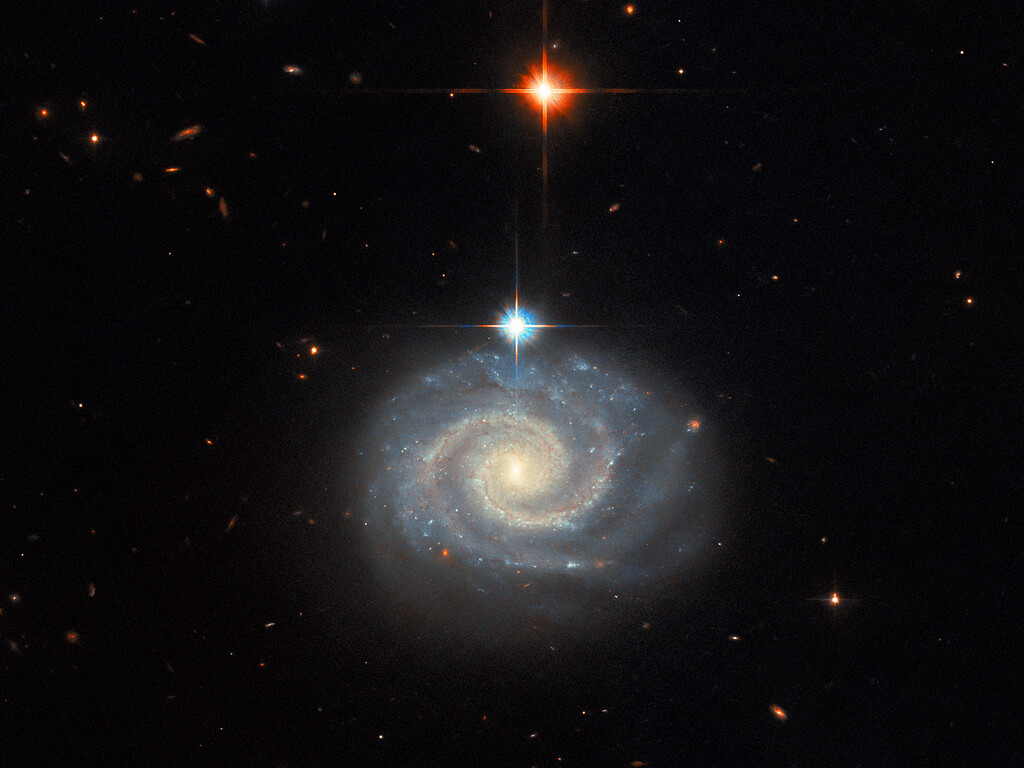
A spiral galaxy. It appears to be almost circular and seen face-on, with two prominent spiral arms winding out from a glowing core. It is centred in the frame as if a portrait. Most of the background is black, with only tiny, distant galaxies, but there are two large bright stars in the foreground, one blue and one red, directly above the galaxy. Credit: ESA/Hubble & NASA, C. Kilpatrick

This whirling image features a bright spiral galaxy known as MCG-01-24-014, which is located about 275 million light-years from Earth. In addition to being a well-defined spiral galaxy, MCG-01-24-014 has an extremely energetic core, known as an active galactic nucleus (AGN), so it is referred to as an active galaxy. Even more specifically, it is categorised as a Type-2 Seyfert galaxy. Seyfert galaxies host one of the most common subclasses of AGN, alongside quasars. Whilst the precise categorisation of AGNs is nuanced, Seyfert galaxies tend to be relatively nearby ones where the host galaxy remains plainly detectable alongside its central AGN, while quasars are invariably very distant AGNs whose incredible luminosities outshine their host galaxies.

There are further subclasses of both Seyfert galaxies and quasars. In the case of Seyfert galaxies, the predominant subcategories are Type-1 and Type-2. These are differentiated from one another by their spectra — the pattern that results when light is split into its constituent wavelengths — where the spectral lines that Type-2 Seyfert galaxies emit are particularly associated with specific so-called ‘forbidden’ emission. To understand why emitted light from a galaxy could be considered forbidden, it helps to understand why spectra exist in the first place. Spectra look the way they do because certain atoms and molecules will absorb and emit light very reliably at very specific wavelengths. The reason for this is quantum physics: electrons (the tiny particles that orbit the nuclei of atoms and molecules) can only exist at very specific energies, and therefore electrons can only lose or gain very specific amounts of energy. These very specific amounts of energy correspond to certain light wavelengths being absorbed or emitted.

Forbidden emission lines, therefore, are spectral emission lines that should not exist according to certain rules of quantum physics. But quantum physics is complex, and some of the rules used to predict it use assumptions that suit laboratory conditions here on Earth. Under those rules, this emission is ‘forbidden’ — so improbable that it’s disregarded. But in space, in the midst of an incredibly energetic galactic core, those assumptions don’t hold anymore, and the ‘forbidden’ light gets a chance to shine out towards us.

Wednesday, September 29, 2021

Classifying Seyfert galaxies with deep learning

NGC 2992 (right) and NGC 2993 (left)
Credit Line and Copyright Adam Block/ Mount Lemmon SkyCenter/University of Arizona.

Scientist uses deep learning to identify low luminous Seyfert 1.9 galaxies that are usually missed by human inspection among ten thousands of spectra. These results are published in the Astrophysical Journal Supplement Series on 28 September 2021 by a PhD student, Yen Chen Chen, in the department of physics at Sapienza University of Rome and the International Center for Relativistic Astrophysics Network (ICRANet).

Seyfert 1 and Seyfert 2 galaxies have distinct features on their spectra and the difference is explained by different viewing angles in the unification model of active galactic nuclei. However, a few Seyfert galaxies called intermediate Seyfert (Seyfert 1.2, 1.5, 1.8, 1.9) share spectral features from Seyfert 1 and Seyfert 2 and these two-component sources are hard to be explained by the unification model. At early time, these sources were picked out by vision inspection and hard to be picked out from amount observation data. Recently, astronomers usually fit candidate spectra to find these two-component sources. However, the fitting process usually spends a lot of time and the classification results are dependent on fitting results. Now, this classification process can be done by deep learning. Scientist builds a convolution neural network (CNN) model and feeds the model with a known sample of Seyfert 1.9 galaxies. The result shows that the trained CNN model has a high ability to recognize Seyfert 1.9 galaxies and the trained model finds new Seyfert 1.9 sources. The novel point is that this method only needs a few known sources for training model and the training process is fast. Besides, the trained model can obtain more new sources in a faster way ever.

This work shows a practical method in identifying sources and can be applied in the future. These new Seyfert 1.9 sources have obscure characteristic on its spectra and are usually missed in classification process by visual inspection. Scientist finds this machine-selected Seyfert 1.9 sample is fainter than the humanselected one. This work provides astronomers more Seyfert 1.9 sources to low luminous end and will help astronomers understand the origin of the two components on its emission lines with multiple wavelength follow-up observation.

Contact:

Yen Chen Chen
1 ICRA and Dipartimento di Fisica, Sapienza Università di Roma, Rome, Italy
2 ICRANet, Pescara, Italy
Email:
yen-chen.chen@icranet.org

Source: ICRANET (Press Release)


Friday, September 16, 2016

Starving Black Hole Returns Brilliant Galaxy to the Shadows

The active galaxy Markarian 1018

PR Image eso1631b
The sky around the active galaxy Markarian 1018

The location of the galaxy Markarian 1018 in the constellation of Cetus


Videos 

Zooming in on the unusual active galaxy Markarian 1018
Zooming in on the unusual active galaxy Markarian 1018 


The mystery of a rare change in the behaviour of a supermassive black hole at the centre of a distant galaxy has been solved by an international team of astronomers using ESO’s Very Large Telescope along with the NASA/ESA Hubble Space Telescope and NASA’s Chandra X-ray Observatory. It seems that the black hole has fallen on hard times and is no longer being fed enough fuel to make its surroundings shine.

Many galaxies are found to have an extremely bright core powered by a supermassive black hole. These cores make “active galaxies” some of the brightest objects in the Universe. They are thought to shine so brightly because hot material is glowing fiercely as it falls into the black hole, a process known as accretion. This brilliant light can vary hugely between different active galaxies, so astronomers classify them into several types based on the properties of the light they emit [1].

Some of these galaxies have been observed to change dramatically over the course of only 10 years; a blink of an eye in astronomical terms. However, the active galaxy in this new study, Markarian 1018 stands out by having changed type a second time, reverting back to its initial classification within the last five years. A handful of galaxies have been observed to make this full-cycle change, but never before has one been studied in such detail.

The discovery of Markarian 1018’s fickle nature was a chance by-product of the Close AGN Reference Survey (CARS), a collaborative project between ESO and other organisations to gather information on 40 nearby galaxies with active cores. Routine observations of Markarian 1018 with the Multi-Unit Spectroscopic Explorer (MUSE) installed on ESO’s Very Large Telescope revealed the surprising change in the light output of the galaxy.

“We were stunned to see such a rare and dramatic change in Markarian 1018”, said Rebecca McElroy, lead author of the discovery paper and a PhD student at the University of Sydney and the ARC Centre of Excellence for All Sky Astrophysics (CAASTRO).

The chance observation of the galaxy so soon after it began to fade was an unexpected opportunity to learn what makes these galaxies tick, as Bernd Husemann, CARS project leader and lead author of one of two papers associated with the discovery, explained: “We were lucky that we detected the event just 3-4 years after the decline started so we could begin monitoring campaigns to study details of the accretion physics of active galaxies that cannot be studied otherwise.”

The research team made the most of this opportunity, making it their first priority to pinpoint the process causing Markarian 1018’s brightness to change so wildly. This could have been caused by any one of a number of astrophysical events, but they could rule out the black hole pulling in and consuming a single star [2] and cast doubt on the possibility of obscuration by intervening gas [3]. But the true mechanism responsible for Markarian 1018’s surprising variation remained a mystery after the first round of observations.

However, the team were able to gather extra data after they were awarded observing time to use the NASA/ESA Hubble Space Telescope, and NASA’s Chandra X-ray Observatory. With the new data from this suite of instruments they were able to solve the mystery — the black hole was slowly fading because it was being starved of accretion material.

“It’s possible that this starvation is because the inflow of fuel is being disrupted”, said Rebecca McElroy. “An intriguing possibility is that this could be due to interactions with a second supermassive black hole”. Such a black hole binary system is a distinct possibility in Markarian 1018, as the galaxy is the product of a major merger of two galaxies — each of which likely contained a supermassive black hole in its centre.

Research continues into the mechanisms at work in active galaxies such as Markarian 1018 that change their appearance. “The team had to work fast to determine what was causing Markarian 1018’s return to the shadows,” comments Bernd Husemann. “Ongoing monitoring campaigns with ESO telescopes and other facilities will allow us to explore the exciting world of starving black holes and changing active galaxies in more detail.”


Notes

[1] The brightest of the active galaxies are quasars, where the brilliant nucleus outshines the rest of the galaxy. Another, less extreme, class are known as Seyfert galaxies. Originally a method was developed that used brightness and the emission spectrum — the plot of the strength of radiation emitted at different wavelength — to distinguish between just two types of Seyfert galaxies, Type 1 and Type 2, but extra classifications such as Type 1.9 Seyferts have since been introduced.

[2] Such a tidal disruption event occurs when a star strays too close to a supermassive black hole and is torn apart by the extreme gravitational tidal force. This results in a sharp rise in the brightness of the central region that slowly declines over a period of years. The observed brightness variations of Markarian 1018 were found not to match the profile of such an event.

[3] Gas obscuration can affect the classification of an active galaxy by blocking the line of sight, drifting in front of the galaxy’s bright core like fog in front of a car’s headlights, and dimming the light passing through. This also affects the spectrum of galaxy, perhaps changing its classification.


More Information 

This research was presented in two papers entitled “Mrk 1018 returns to the shadows after 30 years as a Seyfert 1”, and “What is causing Mrk 1018’s return to the shadows after 30 years?”, both to appear as Letters in the journal Astronomy & Astrophysics.


The team is composed of B. Husemann (ESO, Garching, Germany), T. Urrutia (Leibniz-Institut für Astrophysik Potsdam, Potsdam, Germany), G. R. Tremblay (Yale Center for Astronomy and Astrophysics, New Haven, USA), M. Krumpe (Leibniz-Institut für Astrophysik Potsdam, Potsdam, Germany), J. Dexter (Max-Planck-Institut für extraterrestrische Physik, Garching, Germany), V. N. Bennert (Physics Department, California Polytechnic State University, USA), G. Busch (I. Physikalisches Institut, Universität zu Köln, Germany), F. Combes (LERMA, Observatoire de Paris, France), S. M. Croom (Sydney Institute for Astronomy, Sydney, Australia & ARC Centre of Excellence for All-sky Astrophysics), T. A. Davis (School of Physics & Astronomy, Cardiff University, UK), A. Eckart (I. Physikalisches Institut Universität zu Köln, Germany; Max-Planck-Institut für Radioastronomie, Bonn, Germany), R. E. McElroy (Sydney Institute for Astronomy, Sydney, Australia & ARC Centre of Excellence for All-sky Astrophysics), M. Pérez-Torres (Instituto de Astrofísica de Andalucía, Granada, Spain), M. Powell (Yale Center for Astronomy and Astrophysics, New Haven, USA) and J. Scharwächter (Gemini Observatory, Northern Operations Center, Hawaii, USA).


ESO is the foremost intergovernmental astronomy organisation in Europe and the world’s most productive ground-based astronomical observatory by far. It is supported by 16 countries: Austria, Belgium, Brazil, the Czech Republic, Denmark, France, Finland, Germany, Italy, the Netherlands, Poland, Portugal, Spain, Sweden, Switzerland and the United Kingdom, along with the host state of Chile. ESO carries out an ambitious programme focused on the design, construction and operation of powerful ground-based observing facilities enabling astronomers to make important scientific discoveries. ESO also plays a leading role in promoting and organising cooperation in astronomical research. ESO operates three unique world-class observing sites in Chile: La Silla, Paranal and Chajnantor. At Paranal, ESO operates the Very Large Telescope, the world’s most advanced visible-light astronomical observatory and two survey telescopes. VISTA works in the infrared and is the world’s largest survey telescope and the VLT Survey Telescope is the largest telescope designed to exclusively survey the skies in visible light. ESO is a major partner in ALMA, the largest astronomical project in existence. And on Cerro Armazones, close to Paranal, ESO is building the 39-metre European Extremely Large Telescope, the E-ELT, which will become “the world’s biggest eye on the sky”.

Bernd Husemann
European Southern Observatory
Garching bei München, Germany
Tel: +49 89 3200 6750
Email:
bhuseman@eso.org

Rebecca McElroy
University of Sydney
Sydney, Australia
Tel: +61 421 882 513
Email:
rebecca.mcelroy@sydney.edu.au

Richard Hook
ESO Public Information Officer
Garching bei München, Germany
Tel: +49 89 3200 6655
Cell: +49 151 1537 3591
Email:
rhook@eso.org


Source: ESO