Showing posts with label SXP 1062. Show all posts

Tuesday, June 03, 2014

Pulsar encased in supernova bubble

Pulsar encased in supernova bubble
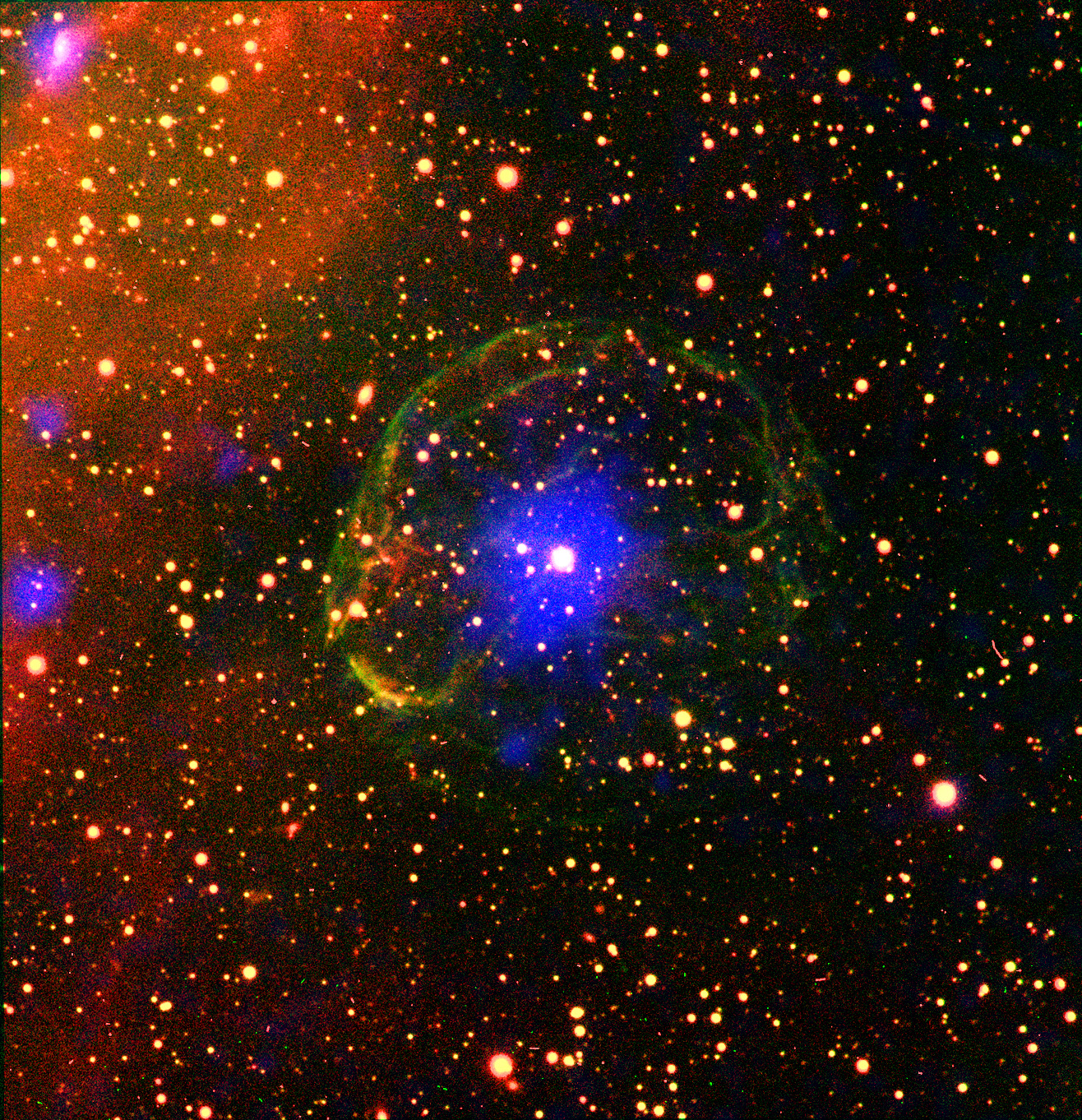
Copyright: ESA/XMM-Newton/ L. Oskinova/M. Guerrero; CTIO/R. Gruendl/Y.H. Chu
 
Massive stars end their lives with a bang: exploding as spectacular supernovas, they release huge amounts of mass and energy into space. These explosions sweep up any surrounding material, creating bubble remnants that expand into interstellar space. At the heart of bubbles like these are small, dense neutron stars or black holes, the remains of what once shone brightly as a star.

Since supernova-carved bubbles shine for only a few tens of thousands of years before dissolving, it is rare to come across neutron stars or black holes that are still enclosed within their expanding shell. This image captures such an unusual scene, featuring both a strongly magnetised, rotating neutron star – known as a pulsar – and its cosmic cloak, the remains of the explosion that generated it.

This pulsar, named SXP 1062, lies in the outskirts of the Small Magellanic Cloud, one of the satellite galaxies of our Milky Way galaxy. It is an object known as an X-ray pulsar: it hungrily gobbles up material from a nearby companion star and burps off X-rays as it does so. In the future, this scene may become even more dramatic, as SXP 1062 has a massive companion star that has not yet exploded as a supernova.

Most pulsars whirl around incredibly quickly, spinning many times per second. However, by exploring the expanding bubble around this pulsar and estimating its age, astronomers have noticed something intriguing: SXP 1062 seems to be rotating far too slowly for its age. It is actually one of the slowest pulsars known.

While the cause of this weird sluggishness is still a mystery, one explanation may be that the pulsar has an unusually strong magnetic field, which would slow the rotation.

The diffuse blue glow at the centre of the bubble in this image represents X-ray emission from both the pulsar and the hot gas that fills the expanding bubble. The other fuzzy blue objects visible in the background are extragalactic X-ray sources.

This image combines X-ray data from ESA’s XMM-Newton (shown in blue) with optical observations from the Cerro Tololo Inter-American Observatory in Chile. The optical data were obtained using two special filters that reveal the glow of oxygen (shown in green) and hydrogen (shown in red). The size of the image is equivalent to a distance of 457 light-years on a side.

This image was first published on ESA’s Science and Technology website in 2011. It is based on data from the paper “Discovery of a Be/X-ray pulsar binary and associated supernova remnant in the Wing of the Small Magellanic Cloud” by V. Hénault-Brunet, et al. 2012.

Source: ESA

Tuesday, December 20, 2011

SXP 1062: Celestial Bauble Intrigues Astronomers

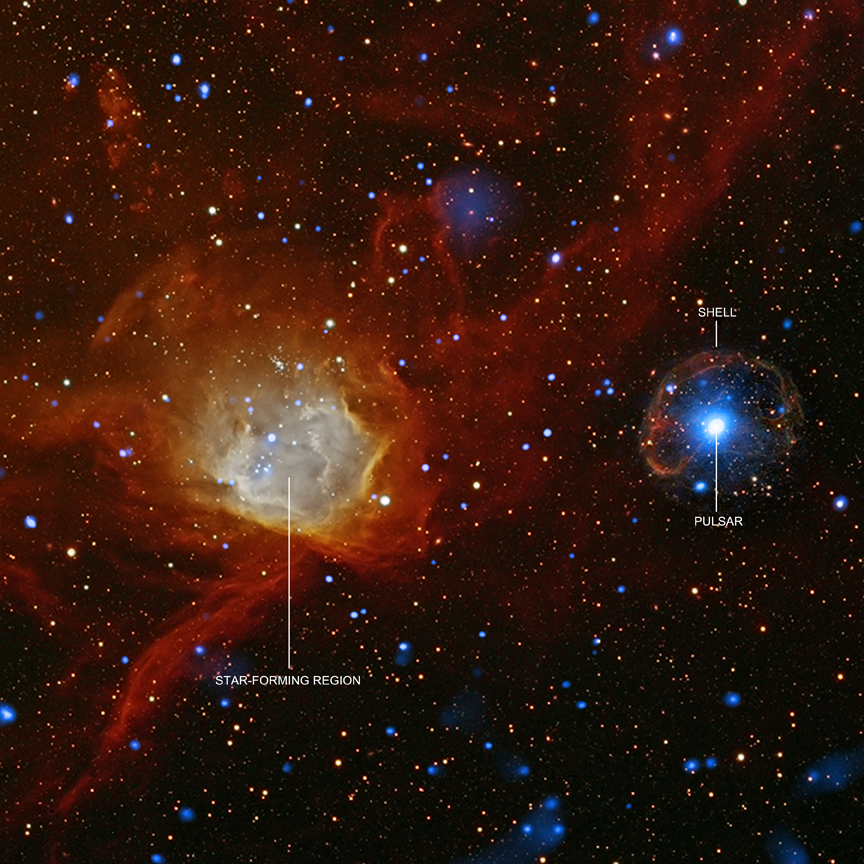
Credit X-ray & Optical: NASA/CXC/Univ.Potsdam/L.Oskinova et al


With the holiday season in full swing, a new image from an assembly of telescopes has revealed an unusual cosmic ornament. Data from NASA's Chandra X-ray Observatory and ESA's XMM-Newton have been combined to discover a young pulsar in the remains of a supernova located in the Small Magellanic Cloud, or SMC. This would be the first definite time a pulsar, a spinning, ultra-dense star, has been found in a supernova remnant in the SMC, a small satellite galaxy to the Milky Way.

In this composite image, X-rays from Chandra and XMM-Newton have been colored blue and optical data from the Cerro Tololo Inter-American Observatory in Chile are colored red and green. The pulsar, known as SXP 1062, is the bright white source located on the right-hand side of the image in the middle of the diffuse blue emission inside a red shell. The diffuse X-rays and optical shell are both evidence for a supernova remnant surrounding the pulsar. The optical data also displays spectacular formations of gas and dust in a star-forming region on the left side of the image. A comparison of the Chandra image with optical images shows that the pulsar has a hot, massive companion.

Astronomers are interested in SXP 1062 because the Chandra and XMM-Newton data show that it is rotating unusually slowly - about once every 18 minutes. (In contrast, some pulsars are found to revolve multiple times per second, including most newly born pulsars.) This relatively leisurely pace of SXP 1062 makes it one of the slowest rotating X-ray pulsars in the SMC.

Two different teams of scientists have estimated that the supernova remnant around SXP 1062 is between 10,000 and 40,000 years old, as it appears in the image. This means that the pulsar is very young, from an astronomical perspective, since it was presumably formed in the same explosion that produced the supernova remnant. Therefore, assuming that it was born with rapid spin, it is a mystery why SXP 1062 has been able to slow down by so much, so quickly. Work has already begun on theoretical models to understand the evolution of this unusual object.

Fast Facts for SXP 1062:

Credit X-ray & Optical: NASA/CXC/Univ.Potsdam/L.Oskinova et al
Scale: Image is 14 arcmin across (744 light years)
Category: Supernovas & Supernova Remnants
Coordinates: (J2000) RA 01h 29m 12.40s | Dec -73° 32' 01.70"
Constellation: Tucana
Observation Date: 11 pointings between 03/31/2010 and 04/29/2010
Observation Time: 80 hours 45 min (3 days 8 hours 45 min).
Obs. ID: 10985-10986, 11978-11979, 11988-11989, 12130-12131, 12134, 12136, 12207
Color Code: X-ray (Blue); Optical (Red, Green)
Instrument: ACIS
References: Henault-Brunet, V. et al, MNRAS 2011
Distance Estimate: 180,000 light years