Showing posts with label NASA’s Juno spacecraft. Show all posts

Friday, June 08, 2018

Juno Solves 39-Year Old Mystery of Jupiter Lightning

This artist's concept of lightning distribution in Jupiter's northern hemisphere incorporates a JunoCam image with artistic embellishments. Data from NASA's Juno mission indicates that most of the lightning activity on Jupiter is near its poles. Image credit: NASA/JPL-Caltech/SwRI/JunoCam.  › Full image and caption


Ever since NASA's Voyager 1 spacecraft flew past Jupiter in March, 1979, scientists have wondered about the origin of Jupiter's lightning. That encounter confirmed the existence of Jovian lightning, which had been theorized for centuries. But when the venerable explorer hurtled by, the data showed that the lightning-associated radio signals didn't match the details of the radio signals produced by lightning here at Earth. 

In a new paper published in Nature today, scientists from NASA's Juno mission describe the ways in which lightning on Jupiter is actually analogous to Earth's lightning. Although, in some ways, the two types of lightning are polar opposites.

"No matter what planet you're on, lightning bolts act like radio transmitters -- sending out radio waves when they flash across a sky," said Shannon Brown of NASA's Jet Propulsion Laboratory in Pasadena, California, a Juno scientist and lead author of the paper. "But until Juno, all the lightning signals recorded by spacecraft [Voyagers 1 and 2, Galileo, Cassini] were limited to either visual detections or from the kilohertz range of the radio spectrum, despite a search for signals in the megahertz range. Many theories were offered up to explain it, but no one theory could ever get traction as the answer."

Enter Juno, which has been orbiting Jupiter since July 4, 2016. Among its suite of highly sensitive instruments is the Microwave Radiometer Instrument (MWR), which records emissions from the gas giant across a wide spectrum of frequencies. 

"In the data from our first eight flybys, Juno's MWR detected 377 lightning discharges," said Brown. "They were recorded in the megahertz as well as gigahertz range, which is what you can find with terrestrial lightning emissions. We think the reason we are the only ones who can see it is because Juno is flying closer to the lighting than ever before, and we are searching at a radio frequency that passes easily through Jupiter's ionosphere." 

While the revelation showed how Jupiter lightning is similar to Earth's, the new paper also notes that where these lightning bolts flash on each planet is actually quite different.

"Jupiter lightning distribution is inside out relative to Earth," said Brown. "There is a lot of activity near Jupiter's poles but none near the equator. You can ask anybody who lives in the tropics -- this doesn't hold true for our planet."

Why do lightning bolts congregate near the equator on Earth and near the poles on Jupiter? Follow the heat. 

Earth's derives the vast majority of its heat externally from solar radiation, courtesy of our Sun. 

Because our equator bears the brunt of this sunshine, warm moist air rises (through convection) more freely there, which fuels towering thunderstorms that produce lightning. 

Jupiter's orbit is five times farther from the Sun than Earth's orbit, which means that the giant planet receives 25 times less sunlight than Earth. But even though Jupiter's atmosphere derives the majority of its heat from within the planet itself, this doesn't render the Sun's rays irrelevant. They do provide some warmth, heating up Jupiter's equator more than the poles -- just as they heat up Earth. Scientists believe that this heating at Jupiter's equator is just enough to create stability in the upper atmosphere, inhibiting the rise of warm air from within. The poles, which do not have this upper-level warmth and therefore no atmospheric stability, allow warm gases from Jupiter's interior to rise, driving convection and therefore creating the ingredients for lightning. 

"These findings could help to improve our understanding of the composition, circulation and energy flows on Jupiter," said Brown. But another question looms. "Even though we see lightning near both poles, why is it mostly recorded at Jupiter's north pole?" 

In a second Juno lightning paper published today in Nature Astronomy, Ivana Kolmašová of the Czech Academy of Sciences, Prague, and colleagues, present the largest database of lightning-generated low-frequency radio emissions around Jupiter (whistlers) to date. The data set of more than 1,600 signals, collected by Juno's Waves instrument, is almost 10 times the number recorded by Voyager 1. Juno detected peak rates of four lightning strikes per second (similar to the rates observed in thunderstorms on Earth) which is six times higher than the peak values detected by Voyager 1.

"These discoveries could only happen with Juno," said Scott Bolton, principal investigator of Juno from the Southwest Research Institute, San Antonio. "Our unique orbit allows our spacecraft to fly closer to Jupiter than any other spacecraft in history, so the signal strength of what the planet is radiating out is a thousand times stronger. Also, our microwave and plasma wave instruments are state-of-the-art, allowing us to pick out even weak lightning signals from the cacophony of radio emissions from Jupiter. "

NASA's Juno spacecraft will make its 13th science flyby over Jupiter's mysterious cloud tops on July 16. 

NASA's Jet Propulsion Laboratory, Pasadena, California, manages the Juno mission for the principal investigator, Scott Bolton, of the Southwest Research Institute in San Antonio. Juno is part of NASA's New Frontiers Program, which is managed at NASA's Marshall Space Flight Center in Huntsville, Alabama, for NASA's Science Mission Directorate. The Microwave Radiometer instrument (MWR) was built by JPL. The Juno Waves instrument was provided by the University of Iowa. Lockheed Martin Space, Denver, built the spacecraft.

More information on Juno can be found at:  https://www.nasa.gov/juno - https://www.missionjuno.swri.edu

More information about Jupiter can be found at:  https://www.nasa.gov/jupiter

The public can follow the mission on Facebook and Twitter at:  https://www.facebook.com/NASAJuno - https://www.twitter.com/NASAJuno


News Media Contact

DC Agle
Jet Propulsion Laboratory, Pasadena, Calif.
818-393-9011
agle@jpl.nasa.gov

JoAnna Wendel
NASA Headquarters, Washington
202-358-1003
joanna.r.wendel@nasa.gov

Richard Lewis
University of Iowa, Iowa City
319-384-0012
richard-c-lewis@uiowa.edu

Deb Schmid
Southwest Research Institute, San Antonio
210-522-2254
dschmid@swri.org


Wednesday, July 05, 2017

Striking Gemini Images Point Juno Spacecraft Toward Discovery

Figure 1. A composite color infrared image of Jupiter reveals haze particles over a range of altitudes, as seen in reflected sunlight. The image was taken using the Gemini North telescope with the Near-InfraRed Imager (NIRI) on May 18, 2017, one day before the Juno mission’s sixth close passage (“perijove”) of the planet. The color filters cover wavelengths between 1.69 to 2.275 microns and are sensitive to pressures of 10 millibars to 2 bars. The Great Red Spot (GRS) appears as the brightest (white) region at these wavelengths, which are primarily sensitive to high-altitude clouds and hazes near and above the top of Jupiter’s convective region – revealing that the GRS is one of the highest-altitude features in Jupiter’s atmosphere. The features that appear yellow/orange at Jupiter’s poles arise from the reflection of sunlight from high-altitude hazes that are the products of auroral-related chemistry in the planet’s upper stratosphere.

Narrow spiral streaks that appear to lead into it or out of it from surrounding regions probably represent atmospheric features being stretched by the intense winds within the GRS, such as the hook-like structure on its western edge (left side). Some are being swept off its eastern edge (right side) and into an extensive wave-like flow pattern; and there is even a trace of flow from its north. Other features near the GRS include the dark block and dark oval to the south and the north of the eastern flow pattern, respectively, indicating a lower density of cloud and haze particles in those locations. Both are long-lived cyclonic circulations, rotating clockwise - in the opposite direction as the counterclockwise rotation of the GRS. A prominent wave pattern is evident north of the equator, along with two bright ovals; these are anticyclones that appeared in January. Both the wave pattern and the ovals may be associated with an impressive upsurge in stormy activity that has been observed in these latitudes this year. Another bright anticyclonic oval is seen further north. Juno may pass over these ovals during its July 11 closest approach. High hazes are evident over both polar regions with much spatial structure that has never been seen quite so clearly in ground-based images, with substantial variability in their spatial structure. The central wavelengths and colors assigned to the filters are:1.69 microns (blue), 2.045 microns (cyan), 2.169 microns (green), 2.124 microns (yellow), and 2.275 microns (red).   Credit: Gemini Observatory/AURA/NSF/JPL-Caltech/NASA. Full resolution JPEG | TIFF

Figure 2. Close up images of the Great Red Spot from Gemini Near-InfraRed Imager (NIRI) images showing differences in the interior structure of this giant vortex with altitude. The top image was taken with a filter at 2.275 microns that is sensitive to particles at, and above, pressures of about 10 millibars (about 1% of the pressure at sea level on the Earth) in Jupiter’s lower stratosphere. It shows that particles at this level tend to increase toward the center of this gigantic vortex. The middle image was taken with a filter at 1.58 microns, sensitive to virtually no gaseous absorption, and is sensitive to the brightness of clouds, very similar to visible red light. Subtle oval-shaped banded structure going from the outside to the interior can be spotted in the image. The difference between these two images illustrates major differences in the dynamics of this vortex with altitude. The bottom image was taken with a filter at 4.68 microns, and shows bright thermal emission from the deeper atmosphere wherever there is “clear sky” (low cloud opacity in the 0.5-3 bar range). Top two panels show data from May 18, 2017, while the bottom panel shows data from January 11, 2017.   Credit: Gemini Observatory/AURA/NSF/JPL-Caltech/NASA/UC Berkeley.  Image in JPEG

Figure 3. At longer infrared wavelengths, Jupiter glows with thermal (heat) emission. In dark areas of this 4.8-micron image, thick clouds block the emission from the deeper atmosphere. The Great Red Spot is visible just below center. This image, obtained with the Gemini North telescope’s Near-InfraRed Imager (NIRI), was obtained on January 11, 2017, so the relative positions of discrete features have changed with respect to the near-infrared image in Figure 1.   Credit: Gemini Observatory/AURA/NSF/UC Berkeley.  Full resolution JPEG


Very detailed Gemini Observatory images peel back Jupiter’s atmospheric layers to support the NASA/JPL Juno spacecraft in its quest to understand the giant planet’s atmosphere. 
 
High-resolution imaging of Jupiter by the Gemini North telescope on Maunakea is informing the Juno mission of compelling events in Jupiter’s atmosphere. “The Gemini observations, spanning most of the first half of this year, have already revealed a treasure-trove of fascinating events in Jupiter’s atmosphere,” said Glenn Orton, PI for this Gemini adaptive optics investigation and coordinator for Earth-based observations supporting the Juno project at Caltech’s Jet Propulsion Laboratory. 

“Back in May, Gemini zoomed in on intriguing features in and around Jupiter’s Great Red Spot: including a swirling structure on the inside of the spot, a curious hook-like cloud feature on its western side and a lengthy, fine-structured wave extending off from its eastern side,” adds Orton. “Events like this show that there’s still much to learn about Jupiter’s atmosphere – the combination of Earth-based and spacecraft observations is a powerful one-two punch in exploring Jupiter.” 

Juno has now made five close-up passes of Jupiter’s atmosphere, the first of which was on August 27, 2016, and the latest (the sixth) on May 19th of this year. Each of these close passes has provided Juno’s science team with surprises, and the Juno science return has benefited from a coordinated campaign of Earth-based support – including observations from spacecraft orbiting the Earth (covering X-ray through visible wavelengths) and ground-based observatories (covering near-infrared through radio wavelengths). 

Next up: Juno’s close passages to Jupiter on July 11, 2017. “Gemini observations, which are already underway for the July flyby, are helping to guide our plans for this passage,” said Orton. He adds that the types of light Gemini captures provide a powerful glimpse into the layers of Jupiter’s atmosphere and provides a 3-dimensional view into Jupiter’s clouds. Among the questions Juno is investigating include poorly understood planetary-scale atmospheric waves south of the equator. “We aren’t sure if these waves might be seen at higher latitudes,” said Orton. “If so it might help us understand phenomena in Jupiter’s circulation that are quite puzzling.” 

“Wow – more remarkable images from the adaptive optics system at Gemini!” said Chris Davis, Program Officer for Gemini at the National Science Foundation (NSF), one of five agencies that operate the observatory. “It’s great to see this powerful combination of ground and space-based observations, and the two agencies, NSF and NASA, working together on such scientifically important discoveries.” 

The Gemini observations use special filters that focus on specific colors of light that can penetrate the upper atmosphere and clouds of Jupiter. These images are sensitive to increasing absorption by mixtures of methane and hydrogen gas in Jupiter’s atmosphere. “The Gemini images provide vertical sensitivity from Jupiter’s cloud tops up to the planet’s lower stratosphere,” according to Orton. 

The observations also employ adaptive optics technology to significantly remove distortions due to the turbulence in the Earth’s atmosphere and produce these extremely high-resolution images. Specifically, the detail visible in these images of Jupiter is comparable to being able to see a feature about the size of Ireland from Jupiter’s current distance of about 600 million kilometers (365 million miles) from Earth. 

In addition to images using adaptive-optics technology, a parallel Gemini program headed by Michael Wong of the University of California, Berkeley, used a longer-wavelength filter, for which adaptive optics is not needed. To obtain these data several images were made with short exposures, and the sharpest images were combined in processing - an approach commonly called “lucky imaging.” Images obtained with this filter are mainly sensitive to cloud opacity (blocks light) in the pressure range of 0.5 to 3 atmospheres. “These observations trace vertical flows that cannot be measured any other way, illuminating the weather, climate and general circulation in Jupiter’s atmosphere,” notes Wong. This image is shown in Figure 3. 

Subaru Telescope also supplied simultaneous mid-infrared imaging with its COMICS instrument – measuring the planet’s heat output in a spectral region not covered by Juno’s instrumentation, and producing data on composition and cloud structure that complement both the Juno and Gemini observations. For example, they show a very cold interior to the Great Red Spot that is surrounded by a warm region at its periphery, implying upwelling air in the center that is surrounded by subsidence. They also show a very turbulent region to the northwest of the Great Red Spot. The Subaru image is available at: http://subarutelescope.org/Topics/2017/06/30/index.html. 

The NASA Juno spacecraft was launched in August 2011 and began orbiting Jupiter in early July 2016. A primary goal of the mission is to improve our understanding of Jupiter – from its atmospheric properties to our understanding of how Jupiter and other planets in the outer Solar System formed. Juno’s payload of nine instruments can probe the atmospheric composition, temperature, cloud dynamics as well as the properties of Jupiter’s intense magnetic fields and aurora.
Gemini’s near-infrared images are particularly helpful to Juno’s Jupiter Infrared Auroral Mapper (JIRAM). JIRAM takes images at 3.5 and 4.8 microns and moderate-resolution spectra at 2–5 microns. The Gemini images provide a high-resolution spatial context for JIRAM’s spectroscopic observations and cover wavelengths and regions of the planet not observed by JIRAM. They also place an upper-atmospheric constraint on Jupiter’s circulation in the deep atmosphere determined by Juno’s Microwave Radiometer (MWR) experiment. 

Orton leads the observing team for the adaptive-optics imaging and Wong heads the observing team for the thermal imaging. Additional team members include Andrew Stephens (Gemini Observatory); Thomas Momary, James Sinclair (JPL); Kevin Baines (JPL, University of Wisconsin), Michael Wong, Imke de Pater (University of California, Berkeley); Patrick Irwin (University of Oxford); Leigh Fletcher (University of Leicester); Gordon Bjoraker (NASA Goddard Space Flight Center); and John Rogers (British Astronomical Association). 

In the full campaign of Earth-based support, the Gemini observations provide a key element that extends the spectral coverage of other facilities, as well as providing a strategic sampling to compare with the lower-resolution but more frequent imaging by NASA’s Infrared Telescope Facility (IRTF) that tracks the evolution of atmospheric features. These Gemini data are also a useful measure of cloud properties to compare with mid-infrared thermal imaging and spectroscopy of Jupiter’s atmosphere, such as that provided by Subaru’s COMICS experiment. The space platforms are involved in the Juno-support campaign include the XMM, Chandra and NuSTAR X-ray observatories and the Hisaki ultraviolet observatory, together with the Hubble Space Telescope. The many ground-based observatories include the Very Large Telescope (VLT), the Atacama Large Millimeter Array (ALMA), Calar Alto Observatory, and a suite of visible and radio observatories. Full details of the campaign can be found on: https://www.missionjuno.swri.edu/planned-observations.


Science Contacts:


Media Contacts:


Monday, July 04, 2016

NASA's Juno Peers Inside a Giant

Scientists will use the twin magnetometers aboard NASA's Juno spacecraft to gain a better understanding about how Jupiter's magnetic field is generated. Credit: NASA Goddard Space Flight Center.  › Larger view

Exploring Jupiter's Magnetic Field


NASA's Juno spacecraft will make its long anticipated arrival at Jupiter on July 4. Coming face-to-face with the gas giant, Juno will begin to unravel some of the greatest mysteries surrounding our solar system's largest planet, including the origin of its massive magnetosphere.

Magnetospheres are the result of a collision between a planet's intrinsic magnetic field and the supersonic solar wind. Jupiter's magnetosphere -- the volume carved out in the solar wind where the planet's magnetic field dominates --extends up to nearly 2 million miles (3 million kilometers). If it were visible in the night sky, Jupiter's magnetosphere would appear to be about the same size as Earth's full moon. By studying Jupiter's magnetosphere, scientists will gain a better understanding about how Jupiter's magnetic field is generated.

They also hope to determine whether the planet has a solid core, which will tell us how Jupiter formed during the earliest days of our solar system.

In order to look inside the planet, the science team equipped Juno with a pair of magnetometers. The magnetometers, which were designed and built by an in-house team of scientists and engineers at NASA's Goddard Space Flight Center in Greenbelt, Maryland, will allow scientists to map Jupiter's magnetic field with high accuracy and observe variations in the field over time.

"The best way to think of a magnetometer is like a compass," said Jack Connerney, deputy principal investigator and head of the magnetometer team at Goddard. "Compasses record the direction of a magnetic field. But magnetometers expand on that capability and record both the direction and magnitude of the magnetic field."

The magnetometer sensors rest on a boom attached to one of the solar arrays, placing them about 40 feet (12 meters) from the body of the spacecraft. This helps ensure that the rest of the spacecraft does not interfere with the magnetometer.

However, the sensor orientation changes in time with the mechanical distortion of the solar array and boom resulting from the extremely cold temperatures of deep space. This distortion would limit the accuracy of the magnetometer measurements if not measured.

To ensure that the magnetometers retain their high accuracy, the team paired the instruments with a set of four cameras. These cameras measure the distortion of the magnetometer sensors in reference to the stars to determine their orientation.

"This is our first opportunity to do very precise, high-accuracy mapping of the magnetic field of another planet," Connerney said. "We are going to be able to explore the entire three-dimensional space around Jupiter, wrapping Jupiter in a dense net of magnetic field observations completely covering the sphere."

One of the mysteries the team hopes to answer is how Jupiter's magnetic field is generated. Scientists expect to find similarities between Jupiter's magnetic field and that of Earth.

Magnetic fields are produced by what are known as dynamos -- convective motion of electrically conducting fluid inside planets. As a planet rotates, the electrically susceptible liquid swirls around and drives electric currents, inducing a magnetic field. Earth's magnetic field is generated by liquid iron in the planet's core.

"But with Jupiter, we don't know what material is producing the planet's magnetic field," said Jared Espley, Juno program scientist for NASA Headquarters, Washington. "What material is present and how deep down it lies is one of the questions Juno is designed to answer."

The observations made by Juno's magnetometers will also add to our understanding of Earth's dynamo, the source of our planet's magnetic field, which lies deep beneath a magnetized layer of rocks and iron.

Imagine Earth's crust strewn with refrigerator magnets as you try to peer beneath the surface to observe the dynamo. The magnetization of Earth's crust will skew your measurements of the magnetic field.

"One of the reasons that the Juno mission is so exciting is because we can map Jupiter's magnetic field without having to look through the crustal magnetic fields, which behave like a jumble of refrigerator magnets," Connerney said. "Jupiter has a gaseous envelope about it made of hydrogen and helium that gives us a clear and unobstructed view of the dynamo."

These observations will also add to the general understanding of how dynamos generate magnetic fields, including here on Earth.

"Any time we understand anything about another planet, we can take that knowledge and apply it to our knowledge about our own planet," Espley said. "We'll be looking at Juno's observations in a big-picture perspective."

NASA's Jet Propulsion Laboratory in Pasadena, California, manages the Juno mission for the principal investigator, Scott Bolton, of Southwest Research Institute in San Antonio. Juno is part of NASA's New Frontiers Program, which is managed at NASA's Marshall Space Flight Center in Huntsville, Alabama, for NASA's Science Mission Directorate. Lockheed Martin Space Systems, Denver, built the spacecraft.

For more information about the Juno mission, visit: www.nasa.gov/juno


News Media Contact 

DC Agle
Jet Propulsion Laboratory, Pasadena, Calif.
818-393-9011
agle@jpl.nasa.gov


Source:  JPL-Caltech/News

Friday, July 01, 2016

Hubble captures vivid auroras in Jupiter’s atmosphere

Auroras on Jupiter


Videos
 
Timelapse of Jupiter’s auroras

Timelapse of Jupiter’s auroras (2)


Astronomers are using the NASA/ESA Hubble Space Telescope to study auroras — stunning light shows in a planet’s atmosphere — on the poles of the largest planet in the Solar System, Jupiter. This observation programme is supported by measurements made by NASA’s Juno spacecraft, currently on its way to Jupiter.

Jupiter, the largest planet in the Solar System, is best known for its colourful storms, the most famous being the Great Red Spot. Now astronomers have focused on another beautiful feature of the planet, using the ultraviolet capabilities of the NASA/ESA Hubble Space Telescope.

The extraordinary vivid glows shown in the new observations are known as auroras [1]. They are created when high energy particles enter a planet’s atmosphere near its magnetic poles and collide with atoms of gas. As well as producing beautiful images, this programme aims to determine how various components of Jupiter’s auroras respond to different conditions in the solar wind, a stream of charged particles ejected from the Sun.

This observation programme is perfectly timed as NASA’s Juno spacecraft is currently in the solar wind near Jupiter and will enter the orbit of the planet in early July 2016. While Hubble is observing and measuring the auroras on Jupiter, Juno is measuring the properties of the solar wind itself; a perfect collaboration between a telescope and a space probe [2].

“These auroras are very dramatic and among the most active I have ever seen”, says Jonathan Nichols from the University of Leicester, UK, and principal investigator of the study. “It almost seems as if Jupiter is throwing a firework party for the imminent arrival of Juno.”

To highlight changes in the auroras Hubble is observing Jupiter daily for around one month. Using this series of images it is possible for scientists to create videos that demonstrate the movement of the vivid auroras, which cover areas bigger than the Earth.

Not only are the auroras huge, they are also hundreds of times more energetic than auroras on Earth. And, unlike those on Earth, they never cease. Whilst on Earth the most intense auroras are caused by solar storms — when charged particles rain down on the upper atmosphere, excite gases, and cause them to glow red, green and purple — Jupiter has an additional source for its auroras.

The strong magnetic field of the gas giant grabs charged particles from its surroundings. This includes not only the charged particles within the solar wind but also the particles thrown into space by its orbiting moon Io, known for its numerous and large volcanos.

The new observations and measurements made with Hubble and Juno will help to better understand how the Sun and other sources influence auroras. While the observations with Hubble are still ongoing and the analysis of the data will take several more months, the first images and videos are already available and show the auroras on Jupiter’s north pole in their full beauty.


Notes

[1] Jupiter’s auroras were first discovered by the Voyager 1 spacecraft in 1979. A thin ring of light on Jupiter's nightside looked like a stretched-out version of our own auroras on Earth. Only later on was it discovered that the auroras were best visible in the ultraviolet.

[2] This is not the first time astronomers have used Hubble to observe the auroras on Jupiter, nor is it the first time that Hubble has cooperated with space probes to do so. In 2000 the NASA/ESA/ASI Cassini spacecraft made its closest approach to Jupiter and scientists used this opportunity to gather data and images about the auroras simultaneously from Cassini and Hubble (heic0009). In 2007 Hubble obtained images in support of its sister NASA Mission New Horizons which used Jupiter's gravity for a manoeuvre on its way to Pluto (opo0714a).


More Information 

The Hubble Space Telescope is a project of international cooperation between ESA and NASA.

Image credit: NASA, ESA


Links


Contacts

Jonathan Nichols
University of Leicester
United Kingdom
Tel: +44 116 252 5049
Email: jdn4@leicester.ac.uk

Mathias Jäger
ESA/Hubble, Public Information Officer
Garching bei München, Germany
Cell: +49 176 62397500
Email: mjaeger@partner.eso.org


Monday, June 27, 2016

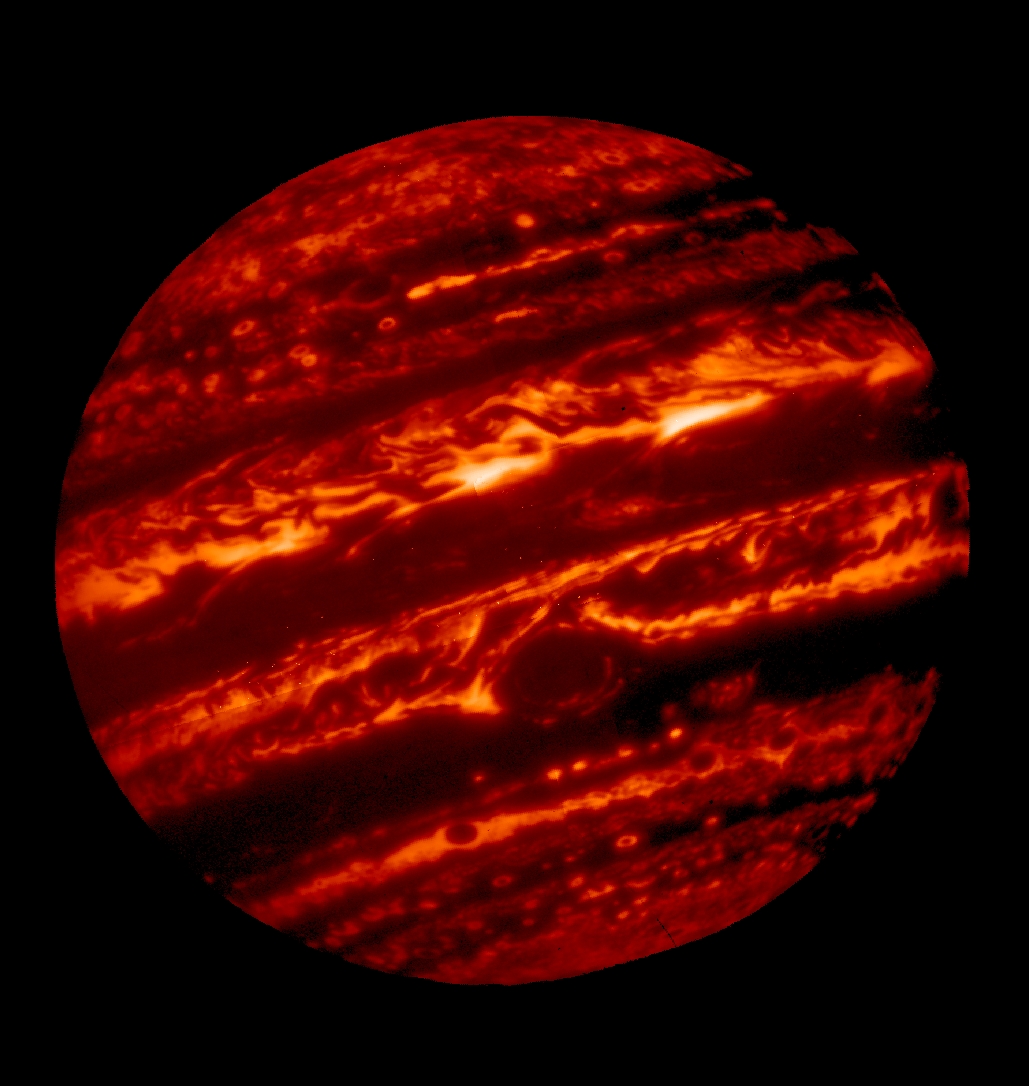
Jupiter Awaits Arrival of Juno

Jupiter imaged using the VISIR instrument on the VLT

Two faces of Jupiter

Comparison of VISIR and visible light views of Jupiter 


Videos
 
Jupiter imaged using the VISIR instrument on the VLT


Spectacular VLT images of Jupiter presented just days before the arrival of the Juno spacecraft

In preparation for the imminent arrival of NASA’s Juno spacecraft, astronomers have used ESO’s Very Large Telescope to obtain spectacular new infrared images of Jupiter. They are part of a campaign to create high-resolution maps of the giant planet. These observations will inform the work to be undertaken by Juno over the coming months, helping astronomers to better understand the gas giant ahead of Juno’s close encounter.

A team led by Leigh Fletcher of the University of Leicester in the United Kingdom are presenting new images of Jupiter at the UK’s Royal Astronomical Society’s National Astronomy Meeting in Nottingham. Obtained with the VISIR instrument on ESO’s Very Large Telescope, the new images are part of a focused effort to improve understanding of Jupiter’s atmosphere prior to the arrival of NASA’s Juno spacecraft [1] in July this year.

The campaign has involved the use of several telescopes based in Hawaii and Chile, as well as contributions from amateur astronomers around the world. The maps do not just give snapshots of the planet, they also reveal how Jupiter’s atmosphere has been shifting and changing in the months prior to Juno’s arrival.

The Juno spacecraft was launched in 2011, and has travelled nearly 3000 million kilometres to reach the Jovian system. Spacecraft can collect data free from the limitations affecting telescopes on Earth so with that in mind, it might seem surprising that this ground-based campaign was considered so important.

Leigh Fletcher describes the significance of this research in preparing for Juno’s arrival: “These maps will help set the scene for what Juno will witness in the coming months. Observations at different wavelengths across the infrared spectrum allow us to piece together a three-dimensional picture of how energy and material are transported upwards through the atmosphere.”

Capturing sharp images through the Earth’s constantly shifting atmosphere is one of the greatest challenges faced by ground-based telescopes. This glimpse of Jupiter’s own turbulent atmosphere, rippling with cooler gas clouds, was possible thanks to a technique known as lucky imaging. Sequences of very short exposures were taken of Jupiter by VISIR, producing thousands of individual frames. The lucky frames, where the image is least affected by the atmosphere’s turbulence, are selected and the rest discarded. Those selected frames are aligned and combined to produce remarkable final pictures like the ones shown here.

Glenn Orton, leader of the ground-based campaign in support of Juno’s mission, elaborates on why the preparatory observations from Earth are so valuable: “The combined efforts of an international team of amateur and professional astronomers have provided us with an incredibly rich dataset over the past eight months. Together with the new results from Juno, the VISIR dataset in particular will allow researchers to characterise Jupiter’s global thermal structure, cloud cover and distribution of gaseous species.”

Whilst the modern Juno’s mission to unveil the mighty Jupiter will bring new and highly anticipated results, its way has been paved by ground-based efforts here on Earth.

Notes

[1] The Juno spacecraft was named after the mythological wife of the god Jupiter. Just like his planetary counterpart, Jupiter veiled himself in clouds to hide his mischief, and only Juno was able to peer through them to see his true nature.

More Information

ESO is the foremost intergovernmental astronomy organisation in Europe and the world’s most productive ground-based astronomical observatory by far. It is supported by 16 countries: Austria, Belgium, Brazil, the Czech Republic, Denmark, France, Finland, Germany, Italy, the Netherlands, Poland, Portugal, Spain, Sweden, Switzerland and the United Kingdom, along with the host state of Chile. ESO carries out an ambitious programme focused on the design, construction and operation of powerful ground-based observing facilities enabling astronomers to make important scientific discoveries. ESO also plays a leading role in promoting and organising cooperation in astronomical research. ESO operates three unique world-class observing sites in Chile: La Silla, Paranal and Chajnantor. At Paranal, ESO operates the Very Large Telescope, the world’s most advanced visible-light astronomical observatory and two survey telescopes. VISTA works in the infrared and is the world’s largest survey telescope and the VLT Survey Telescope is the largest telescope designed to exclusively survey the skies in visible light. ESO is a major partner in ALMA, the largest astronomical project in existence. And on Cerro Armazones, close to Paranal, ESO is building the 39-metre European Extremely Large Telescope, the E-ELT, which will become “the world’s biggest eye on the sky”.


Links


Contacts

Leigh Fletcher
University of Leicester
United Kingdom
Tel: +44 116 252 3585
Email:
leigh.fletcher@leicester.ac.uk

Richard Hook
ESO Public Information Officer
Garching bei München, Germany
Tel: +49 89 3200 6655
Cell: +49 151 1537 3591
Email:
rhook@eso.org

Robert Massey
Deputy Executive Director, Royal Astronomical Society
United Kingdom
Tel: +44 (0)20 7292 3979
Email:
rm@ras.org.uk

Anita Heward
Royal Astronomical Society
Cell: +44 (0)7756 034 243
Email:
anitaheward@btinternet.com


Source: ESO