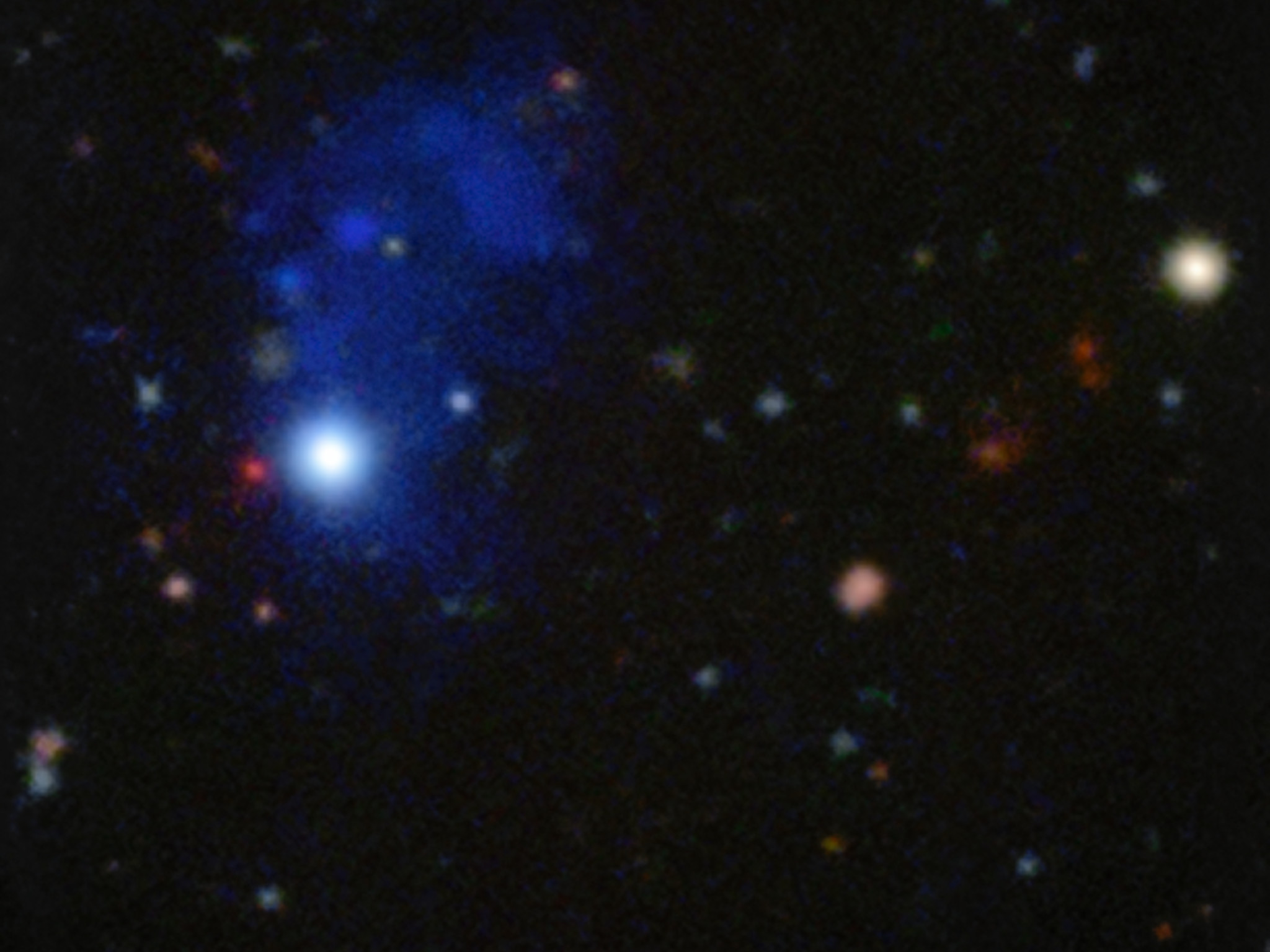
Glowing haloes around distant galaxies
Videos

ESOcast 140 Light: MUSE Dives into the Hubble Ultra Deep Field
Zooming into the MUSE view of the Hubble Ultra Deep Field
Panning across the MUSE view of the Hubble Ultra Deep Field
Flying through the MUSE view of the Hubble Ultra Deep Field
MUSE charts distances in the Hubble Ultra Dee Field
Deepest ever spectroscopic survey completed
Astronomers using the MUSE instrument on
ESO’s Very Large Telescope in Chile have conducted the deepest
spectroscopic survey ever. They focused on the Hubble Ultra Deep Field,
measuring distances and properties of 1600 very faint galaxies including
72 galaxies that have never been detected before, even by Hubble
itself. This groundbreaking dataset has already resulted in 10 science
papers that are being published in a special issue of Astronomy &
Astrophysics. This wealth of new information is giving astronomers
insight into star formation in the early Universe, and allows them to
study the motions and other properties of early galaxies — made possible
by MUSE’s unique spectroscopic capabilities.
The MUSE HUDF Survey team, led by Roland Bacon of the
Centre de recherche astrophysique de Lyon (CNRS/Université Claude
Bernard Lyon 1/ENS de Lyon), France, used MUSE (Multi Unit Spectroscopic Explorer) to observe the Hubble Ultra Deep Field (heic0406), a much-studied patch of the southern constellation of Fornax
(The Furnace). This resulted in the deepest spectroscopic observations
ever made; precise spectroscopic information was measured for 1600
galaxies, ten times as many galaxies as has been painstakingly obtained
in this field over the last decade by ground-based telescopes.
The original HUDF images were pioneering deep-field observations with the NASA/ESA Hubble Space Telescope
published in 2004. They probed more deeply than ever before and
revealed a menagerie of galaxies dating back to less than a billion
years after the Big Bang. The area was subsequently observed many times
by Hubble and other telescopes, resulting in the deepest view of the Universe to date [1].
Now, despite the depth of the Hubble observations, MUSE has — among
many other results — revealed 72 galaxies never seen before in this very
tiny area of the sky.
Roland Bacon takes up the story: “MUSE can do something
that Hubble can’t — it splits up the light from every point in the
image into its component colours to create a spectrum. This allows us to
measure the distance, colours and other properties of all the galaxies
we can see — including some that are invisible to Hubble itself.”
The MUSE data provides a new view of dim, very distant
galaxies, seen near the beginning of the Universe about 13 billion years
ago. It has detected galaxies 100 times fainter than in previous
surveys, adding to an already richly observed field and deepening our
understanding of galaxies across the ages.
The survey unearthed 72 candidate galaxies known as Lyman-alpha emitters that shine only in Lyman-alpha light [2].
Current understanding of star formation cannot fully explain these
galaxies, which just seem to shine brightly in this one colour. Because
MUSE disperses the light into its component colours these objects become
apparent, but they remain invisible in deep direct images such as those
from Hubble.
“MUSE has the unique ability to extract information
about some of the earliest galaxies in the Universe — even in a part of
the sky that is already very well studied,” explains Jarle
Brinchmann, lead author of one of the papers describing results from
this survey, from the University of Leiden in the Netherlands and the
Institute of Astrophysics and Space Sciences at CAUP in Porto, Portugal.
“We learn things about these galaxies that is only possible with
spectroscopy, such as chemical content and internal motions — not galaxy
by galaxy but all at once for all the galaxies!”
Another major finding of this study was the systematic
detection of luminous hydrogen halos around galaxies in the early
Universe, giving astronomers a new and promising way to study how
material flows in and out of early galaxies.
Many other potential applications of this dataset are
explored in the series of papers, and they include studying the role of
faint galaxies during cosmic reionisation (starting just 380 000 years after the Big Bang), galaxy merger rates when the Universe was young, galactic winds, star formation as well as mapping the motions of stars in the early Universe.
“Remarkably, these data were all taken without the use
of MUSE’s recent Adaptive Optics Facility upgrade. The activation of the
AOF after a decade of intensive work by ESO’s astronomers and engineers
promises yet more revolutionary data in the future,” concludes Roland Bacon [3].
Notes
[1] The Hubble Ultra Deep Field is one of the most
extensively studied areas of space. To date, 13 instruments on eight
telescopes, including the ESO-partnered ALMA (eso1633), have observed the field from X-ray to radio wavelengths.
[2] The negatively-charged
electrons that orbit the positively-charged nucleus in an atom have
quantised energy levels. That is, they can only exist in specific energy
states, and they can only transition between them by gaining or losing
precise amounts of energy. Lyman-alpha radiation is produced when
electrons in hydrogen atoms drop from the second-lowest to the lowest
energy level. The precise amount of energy lost is released as light
with a particular wavelength in the ultraviolet part of the spectrum,
which astronomers can detect with space telescopes or on Earth in the
case of redshifted objects. For this data, at redshift of z ~ 3–6.6, the
Lyman-alpha light is seen as visible or near-infrared light.
[3] The Adaptive Optics Facility with MUSE has already revealed previously unseen rings around the planetary nebula IC 4406 (eso1724).
More Information
This research was presented in a series of 10 papers to appear in the journal Astronomy & Astrophysics.
The teams are composed of Roland Bacon (CRAL - CNRS,
Université Claude Bernard Lyon 1, ENS de Lyon, Université de Lyon, Lyon,
France), Hanae Inami (CRAL - CNRS, Université Claude Bernard Lyon 1,
ENS de Lyon, Université de Lyon, Lyon, France), Jarle Brinchmann (Leiden
Observatory, Leiden, the Netherlands; Instituto de Astrofísica e
Ciências do Espaço, Porto, Portugal), Michael Maseda (Leiden
Observatory, Leiden, the Netherlands), Adrien Guerou (IRAP, CNRS,
Université Toulouse III – Paul Sabatier, CNES, Université de Toulouse,
France; ESO, Garching, Germany), A. B. Drake (CRAL - CNRS, Université
Claude Bernard Lyon 1, ENS de Lyon, Université de Lyon, Lyon, France),
H. Finley (IRAP, Université de Toulouse, Toulouse, France), F. Leclercq
(University of Lyon, Lyon, France), E. Ventou (IRAP, CNRS, Université
Toulouse III – Paul Sabatier, CNES Université de Toulouse, Toulouse,
France), T. Hashimoto (University of Lyon, Lyon, France), Simon Conseil
(CRAL - CNRS, Université Claude Bernard Lyon 1, ENS de Lyon Université
de Lyon, Lyon, France), David Mary (Laboratoire Lagrange, CNRS,
Observatoire de la Côte d’Azur, Université de Nice, Nice, France),
Martin Shepherd (University of Lyon, Lyon, France), Mohammad Akhlaghi
(CRAL - CNRS, Université Claude Bernard Lyon 1, ENS de Lyon Université
de Lyon, Lyon, France), Peter M. Weilbacher (Leibniz-Institut für
Astrophysik Postdam, Postdam, Germany), Laure Piqueras (CRAL - CNRS,
Université Claude Bernard Lyon 1, ENS de Lyon Université de Lyon, Lyon,
France), Lutz Wisotzki (Leibniz-Institut für Astrophysik Potsdam,
Potsdam, Germany), David Lagattuta (CRAL - CNRS, Université Claude
Bernard Lyon 1, ENS de Lyon Université de Lyon, Lyon, France), Benoit
Epinat (IRAP, CNRS, Université Toulouse III – Paul Sabatier, CNES,
Université de Toulouse, Toulouse, France; and LAM, CNRS / Aix Marseille
Université, Marseille, France), Sebastiano Cantalupo (ETH Zurich,
Zurich, Switzerland), Jean Baptiste Courbot (University of Lyon, Lyon,
France; ICube, Université de Strasbourg, Strasbourg, France), Thierry
Contini (IRAP, CNRS, Université Toulouse III – Paul Sabatier, CNES
Université de Toulouse, Toulouse, France), Johan Richard (CRAL - CNRS,
Université Claude Bernard Lyon 1, ENS de Lyon Université de Lyon, Lyon,
France), Rychard Bouwens (Leiden Observatory, Leiden, the Netherlands),
Nicolas Bouché (IRAP, CNRS, Université Toulouse III – Paul Sabatier,
CNES Université de Toulouse, Toulouse, France), Wolfram Kollatschny
(AIG, Universität Göttingen, Göttingen, Germany), Joop Schaye (Leiden
Observatory, Leiden, the Netherlands), Raffaella Anna Marino (ETH
Zurich, Zurich, Switzerland), Roser Pello (IRAP, CNRS, Université
Toulouse III – Paul Sabatier, CNES Université de Toulouse, Toulouse,
France), Bruno Guiderdoni (CRAL - CNRS, Université Claude Bernard Lyon
1, ENS de Lyon Université de Lyon, Lyon, France), Marcella Carollo (ETH
Zurich, Zurich, Switzerland), S. Hamer (University of Lyon, Lyon,
France), B. Clément (University of Lyon, Lyon, France), G. Desprez
(University of Lyon, Lyon, France), L. Michel-Dansac (CRAL - CNRS,
Université Claude Bernard Lyon 1, ENS de Lyon Université de Lyon, Lyon,
France), M. Paalvast (Leiden Observatory, Leiden, the Netherlands), L.
Tresse (CRAL - CNRS, Université Claude Bernard Lyon 1, ENS de Lyon
Université de Lyon, Lyon, France), L. A. Boogaard (Leiden Observatory,
Leiden, the Netherlands), J. Chevallard (Scientific Support Office,
ESA/ESTEC, Noordwijk, the Netherlands) S. Charlot (Sorbonne University,
Paris, France), J. Verhamme (University of Lyon, Lyon, France), Marijn
Franx (Leiden Observatory, Leiden, the Netherlands), Kasper B. Schmidt
(Leibniz-Institut für Astrophysik Potsdam, Potsdam, Germany), Anna
Feltre (CRAL - CNRS, Université Claude Bernard Lyon 1, ENS de Lyon
Université de Lyon, Lyon, France), Davor Krajnović (Leibniz-Institut für
Astrophysik Potsdam, Potsdam, Germany), Eric Emsellem (ESO, Garching,
Germany; University of Lyon, Lyon, France), Mark den Brok (ETH Zurich,
Zurich, Switzerland), Santiago Erroz-Ferrer (ETH Zurich, Zurich,
Switzerland), Peter Mitchell (CRAL - CNRS, Université Claude Bernard
Lyon 1, ENS de Lyon Université de Lyon, Lyon, France), Thibault Garel
(University of Lyon, Lyon, France), Jeremy Blaizot (CRAL - CNRS,
Université Claude Bernard Lyon 1, ENS de Lyon Université de Lyon, Lyon,
France), Edmund Christian Herenz (Department of Astronomy, Stockholm
University, Stockholm, Sweden), D. Lam (Leiden University, Leiden, the
Netherlands), M. Steinmetz (Leibniz-Institut für Astrophysik Potsdam,
Potsdam, Germany) and J. Lewis (University of Lyon, Lyon, France).
ESO is the foremost intergovernmental astronomy
organisation in Europe and the world’s most productive ground-based
astronomical observatory by far. It is supported by 16 countries:
Austria, Belgium, Brazil, the Czech Republic, Denmark, France, Finland,
Germany, Italy, the Netherlands, Poland, Portugal, Spain, Sweden,
Switzerland and the United Kingdom, along with the host state of Chile
and by Australia as a strategic partner. ESO carries out an ambitious
programme focused on the design, construction and operation of powerful
ground-based observing facilities enabling astronomers to make important
scientific discoveries. ESO also plays a leading role in promoting and
organising cooperation in astronomical research. ESO operates three
unique world-class observing sites in Chile: La Silla, Paranal and
Chajnantor. At Paranal, ESO operates the Very Large Telescope, the
world’s most advanced visible-light astronomical observatory and two
survey telescopes. VISTA works in the infrared and is the world’s
largest survey telescope and the VLT Survey Telescope is the largest
telescope designed to exclusively survey the skies in visible light. ESO
is a major partner in ALMA, the largest astronomical project in
existence. And on Cerro Armazones, close to Paranal, ESO is building the
39-metre Extremely Large Telescope, the ELT, which will become “the
world’s biggest eye on the sky”.
Links
- MUSE HUDF Special Issue in A&A
- “The MUSE Hubble Ultra Deep Field Survey: I. Survey description, data reduction and source detection” by R. Bacon et al.
- “The MUSE Hubble Ultra Deep Field Survey: II. Spectroscopic Redshift and Line Flux Catalog, and Comparisons to Color Selections of Galaxies at 3 < z < 7” by H. Inami et al.
- “The MUSE Hubble Ultra Deep Field Survey: III. Testing photometric redshifts to 30th magnitude” by J. Brinchmann et al.
- “The MUSE Hubble Ultra Deep Field Survey: IV. An Overview of C III] Emitters” by M. V. Maseda et al.
- “The MUSE Hubble Ultra Deep Field Survey: V. Spatially resolved stellar kinematics of galaxies at redshift 0.2 ≲ z ≲ 0.8” b A. Guérou
- “The MUSE Hubble Ultra Deep Field Survey: VI. The Faint-End of the Lyα Luminosity Function at 2.91 < z < 6.64 and Implications for Reionisation” by A. B. Drake et al.
- “The MUSE Hubble Ultra Deep Field Survey:VII. Fe II* Emission in Star-Forming Galaxies” by H. Finley et al.
- “The MUSE Hubble Ultra Deep Field Survey: VIII. Extended Lyman α haloes” by F. Leclercq et al.
- “The MUSE Hubble Ultra Deep Field Survey: IX. evolution of galaxy merger fraction up to z ≈ 6” by E. Ventou et al.
- “The MUSE Hubble Ultra Deep Field Survey: X. Lyα Equivalent Widths at 2.9 < z < 6.6” by T. Hashimoto et al.
- MUSE
- MUSE and the Adaptive Optics Facility (eso1724)
Contacts
Roland Bacon
Lyon Centre for Astrophysics Research (CRAL)
France
Cell: +33 6 08 9 14 27
Email: roland.bacon@univ-lyon1.fr
Lyon Centre for Astrophysics Research (CRAL)
France
Cell: +33 6 08 9 14 27
Email: roland.bacon@univ-lyon1.fr
Jarle Brinchmann
University of Leiden
Netherlands
Cell: +31 6 50 92 51 89
Email: jarle@strw.leidenuniv.nl
University of Leiden
Netherlands
Cell: +31 6 50 92 51 89
Email: jarle@strw.leidenuniv.nl
Davor Krajnovic
Leibniz Institute for Astrophysics Potsdam
Germany
Cell: +49 160 24 34 574
Email: dkrajnovic@aip.de
Leibniz Institute for Astrophysics Potsdam
Germany
Cell: +49 160 24 34 574
Email: dkrajnovic@aip.de
Thierry Contini
Institut de Recherche en Astrophysique et Planétologie
France
Cell: +33 6 62 64 12 68
Email: thierry.contini@irap.omp.eu
Institut de Recherche en Astrophysique et Planétologie
France
Cell: +33 6 62 64 12 68
Email: thierry.contini@irap.omp.eu
Richard Hook
ESO Public Information Officer
Garching bei München, Germany
Tel: +49 89 3200 6655
Cell: +49 151 1537 3591
Email: rhook@eso.org
ESO Public Information Officer
Garching bei München, Germany
Tel: +49 89 3200 6655
Cell: +49 151 1537 3591
Email: rhook@eso.org
Source: ESO