Showing posts with label K2 mission. Show all posts

Tuesday, July 19, 2016

Gemini Observatory Instrumental in Exoplanet Harvest

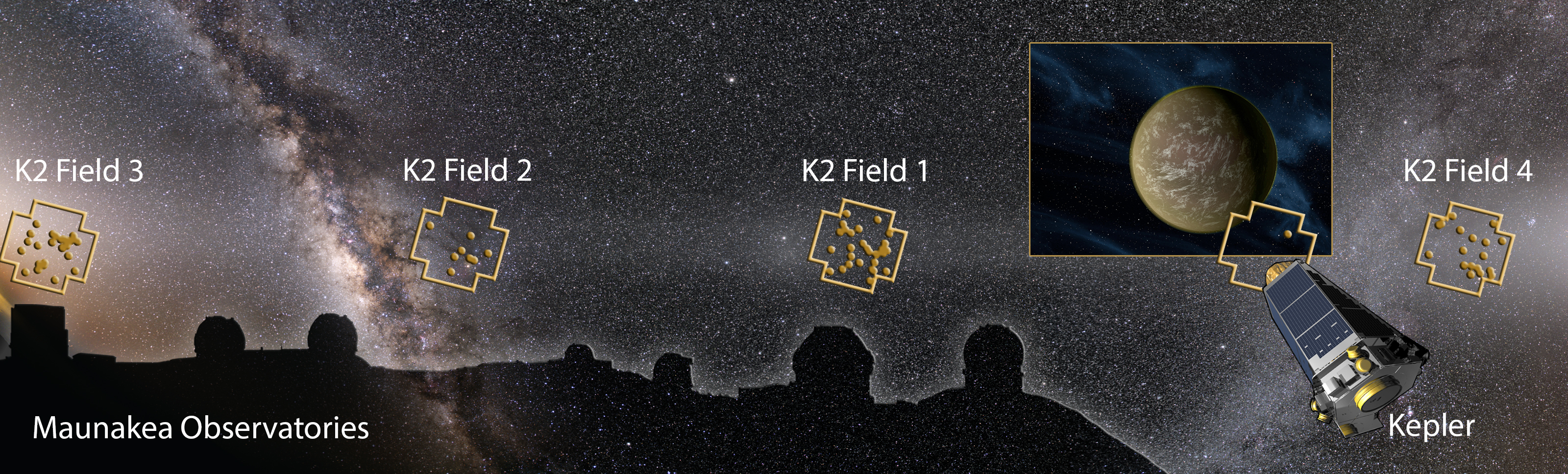
Image montage showing the Maunakea Observatories, Kepler Space Telescope, and night sky with K2 Fields and discovered planetary systems (dots) overlaid. An international team of scientists discovered more than 100 planets based on images from Kepler operating in the ‘K2 Mission’. The team confirmed and characterized the planets using a suite of telescopes worldwide, including four on Maunakea (the twin telescopes of Keck Observatory, the Gemini­North Telescope, and the Infrared Telescope Facility). The planet image on the right is an artist’s impression of a representative planet.  Image Credit: Art by Karen Teramura (UHIfA) based on night sky image of the ecliptic plane by Miloslav Druckmüller and Shadia Habbal, and Kepler Telescope and planet images by NASA. Full resolution JPEG


Gemini Observatory plays a key role in the latest harvest of over 100 confirmed exoplanets from NASA’s K2 mission, the repurposed Kepler spacecraft. Three instruments on the Gemini North telescope delivered precise images verifying many of the candidate stars as planetary system hosts. Researchers note that these systems could contain a considerable number of rocky, potentially earthlike exoplanets.

The Gemini North telescope on Hawaii’s Maunakea helped verify many of the over 100 new worlds announced in the initial crop of discoveries from the NASA K2 mission, according to Ian Crossfield of the University of Arizona. Crossfield led the international team of scientists who announced the findings, which are published online in The Astrophysical Journal Supplement Series. A preprint of the paper is available here.

“Gemini North was instrumental because it delivered extremely high-resolution images of over 70 of the almost 200 potential planetary systems that K2 uncovered,” says Crossfield. ”In total we used three instruments, or cameras, on Gemini to complete our studies – so you could say that Gemini was instrumental in that way too!”

Once K2’s data are analyzed to identify potential exoplanet candidates, many of the world’s most powerful telescopes, like Gemini, are set into motion. This is so astronomers can rule out other explanations that can produce the signature of a planet orbiting a star. “This is where the discovery happens,” says astronomer Christopher Davis of the US National Science Foundation, which funds over 70% of Gemini. “Once other possibilities are eliminated, like nearby background stars, the team can say with extreme certainty that we have a new exoplanet system.”

One of the instruments used at Gemini is a visiting instrument called the Differential Speckle Survey Instrument (DSSI) which is led by Steve Howell of NASA’s Ames Research Center. “These observations are a critical part of the exoplanet validation process,” says Howell. “It’s essentially the only way to validate small, earth-sized planets orbiting around other stars.” Howell’s DSSI instrument uses many extremely short (typically about 60 millisecond) exposures of a star to capture fine detail by combining the images and subtracting momentary distortions caused by the Earth’s atmosphere. With this technique astronomers can see details at, or very near, the theoretical limit of the 8-meter Gemini mirror which is like being able to resolve two automobile headlights at a distance of about 2000 miles.

In its initial mission, Kepler surveyed just one patch of sky in the northern hemisphere, measuring the frequency with which planets whose size and temperature are similar to Earth occur around stars like our Sun. But when the satellite lost its ability to precisely stare at its original target area in 2013, a brilliant fix created a second life for the telescope that is proving remarkably fruitful.

The new K2 mission provides fields of view within the ecliptic which presents greater opportunities for Earth-based observatories in both the northern and southern hemispheres. Additionally, the new mission opened up the observations to the entire scientific community, not just specific targets picked by science team members. K2 now looks at new types of populations, including a larger fraction of cooler, smaller, red dwarf-type stars, which are much more common in our Milky Way than Sun-like stars. The space observatory discovers new planets by measuring the subtle dip in a star's brightness caused by a planet passing in front of its star.

The Gemini followup observations were made as part of what is called a Large and Long program intended to provide access to Gemini for studies requiring more observing time, or extended periods of observations to yield high-impact results. In addition to observations with DSSI, Gemini’s Near-InfraRed Imager (NIRI) with the Altair adaptive optics system, and the Gemini Near-InfraRed Spectrograph (GNIRS) were used to make the verification observations.

In addition to Gemini, follow-up ground-based observations were made by W. M. Keck Observatory also on Maunakea in Hawai‘i, the Automated Planet Finder of the University of California Observatories, and the Large Binocular Telescope operated by the University of Arizona.


Institute for Astronomy, University of Hawaii press release.

W. M. Keck Observatory press release.


Media Contacts:

Peter Michaud
Public Information and Outreach
Gemini Observatory, Hilo, HI
Email:
pmichaud@gemini.edu
Cell: (808) 936-6643

 
Alexis-Ann Acohido
Public Information and Outreach
Gemini Observatory, Hilo, HI
Email:
aacohido@gemini.edu
Phone: (808) 974-2528

 
Doug Carroll
Director of Media Relations and Communications
University of Arizona
Email:
dougcarroll@email.arizona.edu
Phone: (520) 621-9017


Science Contacts:

Ian Crossfield
University of Arizona & UC Santa Cruz
Email:
ianc@ucsc.edu
Phone: (949) 923-0578

Steve Howell
Project Scientist, Kepler and K2 Mission
NASA Ames Research Center
Moffett Field, CA 94035
Email: steve.b.howell@nasa.gov
Desk: (650) 604-4238

Tuesday, May 17, 2016

Kepler-223 System: Clues to Planetary Migration

These animations show approximately 200,000 years of orbital evolution in the Kepler-223 planetary system. The planets’ interactions with the disk of gas and dust in which they formed caused their orbits to shrink toward their star over time at differing rates.YouTube version

Sean Mills (left) and Daniel Fabrycky (right), researchers at the University of Chicago, describe the complex orbital structure of the Kepler-223 system in a new study. Credits: Nancy Wong/University of Chicago


The four planets of the Kepler-223 star system appeared to have little in common with the planets of our own solar system today. But a new study using data from NASA's Kepler space telescope suggests a possible commonality in the distant past. The Kepler-223 planets orbit their star in the same configuration that Jupiter, Saturn, Uranus and Neptune may have had in the early history of our solar system, before migrating to their current locations.

"Exactly how and where planets form is an outstanding question in planetary science," said the study's lead author, Sean Mills, a graduate student in astronomy and astrophysics at the University of Chicago in Illinois. "Our work essentially tests a model for planet formation for a type of planet we don't have in our solar system."

The puffy, gaseous planets orbiting Kepler-223, all of which are far more massive than Earth, orbit close to their star. "That's why there's a big debate about how they formed, how they got there and why don't we have an analogous planet in our solar system," Mills said.

Mills and his collaborators used data from Kepler -- its mission is now known as K2 -- to analyze how the four planets block their stars' light and change each other's orbits. This information also gave researchers the planets' sizes and masses. The team performed numerical simulations of planetary migration that generate this system's current architecture, similar to the migration suspected for the solar system's gas giants. These calculations are described in the May 11 Advance Online edition of Nature.

The orbital configuration of our own solar system seems to have evolved since its birth 4.6 billion years ago. The four known planets of the much older Kepler-223 system, however, have maintained a single orbital configuration for far longer.

Astronomers call the planets of Kepler-223 "sub-Neptunes." They likely consist of a solid core and an envelope of gas, and they orbit their star in periods ranging from only seven to 19 days. They are the most common type of planets known in the galaxy, even though there is nothing quite like them around our sun.

Kepler-223's planets also are in resonance, meaning their gravitational influence on each other creates a periodic relationship between their orbits. Planets are in resonance when, for example, every time one of them orbits its sun once, the next one goes around twice. Three of Jupiter's largest moons, where the phenomenon was discovered, display resonances. Kepler-223 is the first time that four planets in an extrasolar system have been confirmed to be in resonance.

"This is the most extreme example of this phenomenon," said study co-author Daniel Fabrycky, an assistant professor of astronomy and astrophysics at the University of Chicago.


Formation scenarios

The Kepler-223 system provides alternative scenarios for how planets form and migrate in a planetary system that is different from our own, said study co-author Howard Isaacson, a research astronomer at the University of California, Berkeley, and member of the California Planet Search Team.

"Data from Kepler and the Keck Telescope were absolutely critical in this regard," Isaacson said. Thanks to observations of Kepler-223 and other exoplanetary systems, "We now know of systems that are unlike our sun's solar system, with hot Jupiters, planets closer than Mercury or in between the size of Earth and Neptune, none of which we see in our solar system. Other types of planets are very common."

Some stages of planet formation can involve violent processes. But during other stages, planets can evolve from gaseous disks in a smooth, gentle way, which is probably what the sub-Neptune planets of Kepler-223 did, Mills said.

"We think that two planets migrate through this disk, get stuck and then keep migrating together; find a third planet, get stuck, migrate together; find a fourth planet and get stuck," Mills explained.

That process differs completely from the one that scientists believe led to the formation of Mercury, Venus, Earth and Mars, which likely formed in their current orbital locations.

Earth formed from Mars-sized or moon-sized bodies smacking together, Mills said, in a violent and chaotic process. When planets form this way, their final orbital periods are not near a resonance.


Substantial movement

But scientists suspect that the solar system's larger, more distant planets of today -- Jupiter, Saturn, Uranus and Neptune -- moved around substantially during their formation. They may have been knocked out of resonances that once resembled those of Kepler-223, possibly after interacting with numerous asteroids and small planets (planetesimals).

"These resonances are extremely fragile," Fabrycky said. "If bodies were flying around and hitting each other, then they would have dislodged the planets from the resonance." But Kepler-223's planets somehow managed to dodge this scattering of cosmic bodies.

NASA's Ames Research Center in Moffett Field, California, manages the Kepler and K2 missions for NASA's Science Mission Directorate. NASA's Jet Propulsion Laboratory in Pasadena, California, managed Kepler mission development. Ball Aerospace & Technologies Corporation operates the flight system with support from the Laboratory for Atmospheric and Space Physics at the University of Colorado at Boulder.


For more information about the Kepler and K2 missions, visit:  http://www.nasa.gov/kepler
 

Elizabeth Landau
Jet Propulsion Laboratory, Pasadena, Calif.
818-354-6425

elizabeth.landau@jpl.nasa.gov

Michele Johnson
NASA Ames Research Center, Moffett Field, Calif.
650-604-6982

michele.johnson@nasa.gov

Written by Steve Koppes
University of Chicago
773-702-8366

skoppes@uchicago.edu

Editor: Tony Greicius


Thursday, May 21, 2015

News Center Supernova Hunting with Supercomputers

This computer simulation shows the debris of a Type Ia supernova (brown) slamming into its companion star (blue) at tens of millions of miles per hour. The interaction produces ultraviolet light that escapes as the supernova shell sweeps over the companion, a signal detected by Swift. Credits: UC Berkeley, Daniel Kasen
 
The graphic depicts a light curve of the newly discovered Type Ia supernova, KSN 2011b, from NASA's Kepler spacecraft. The light curve shows a star's brightness (vertical axis) as a function of time (horizontal axis) before, during and after the star exploded. The white diagram on the right represents 40 days of continuous observations by Kepler. In the red zoom box, the agua-colored region is the expected 'bump' in the data if a companion star is present during a supernova. The measurements remained constant (yellow line) concluding the cause to be the merger of two closely orbiting stars, most likely two white dwarfs. The finding provides the first direct measurements capable of informing scientists of the cause of the blast. Credits: NASA Ames/W. Stenzel

Animation showing a binary star system in which a white dwarf accretes matter from a normal companion star. Matter streaming from the red star accumulates on the white dwarf until the dwarf explodes. With its partner destroyed, the normal star careens into space. This scenario results in what astronomers refer to as a Type Ia supernova.Credits: NASA's Goddard Space Flight Center/Walt Feimer


Astronomers are going gaga over newborn supernova measurements taken by NASA’s Kepler and Swift spacecraft, poring over them in hopes of better understanding what sparks these world-shattering stellar explosions. Scientists are particularly fascinated with Type la supernovae, as they can serve as a lighthouse for measuring the vast distances across space.“Kepler’s unprecedented pre-event supernova observations and Swift’s agility in responding to supernova events have both produced important discoveries at the same time but at very different wavelengths,” says Paul Hertz, Director of Astrophysics. “Not only do we get insight into what triggers a Type Ia supernova, but these data allow us to better calibrate Type Ia supernovae as standard candles, and that has implications for our ability to eventually understand the mysteries of dark energy.”

Type Ia supernovae explode with similar brightness because the exploding object is always a white dwarf, the Earth-sized remnant of a star like the sun. A white dwarf can go supernova by merging with another white dwarf or by pulling too much matter from a nearby companion star, causing a thermonuclear reaction and blowing itself to smithereens.

In studies appearing in Nature on Thursday, Kepler and Swift have found supporting evidence for both star-pulverizing scenarios.

Researchers studying the Kepler data have caught three new and distant supernovae, and the dataset includes measurements taken before the violent explosions even happened. Known for its planet-hunting prowess and its unceasing gaze, the Kepler space telescope's exquisitely precise and frequent observations every 30 minutes have allowed astronomers to turn back the clock and dissect the initial moments of a supernova. The finding provides the first direct measurements capable of informing scientists of the cause of the blast.

"Our Kepler supernova discoveries strongly favor the white dwarf merger scenario, while the Swift study, led by Cao, proves that Type Ia supernovae can also arise from single white dwarfs," said Robert Olling, research associate at the University of Maryland and lead author of the study. "Just as many roads lead to Rome, nature may have several ways to explode white dwarf stars."

To capture the earliest moments of Type Ia explosions, the research team monitored 400 galaxies for two years using Kepler. The team discovered three events, designated KSN 2011b, KSN 2011c and KSN 2012a, with measurements taken before, during and after the explosions.

These early data provide a view into the physical processes that ignite these stellar bombs hundreds of millions of light years away. When a star goes supernova, the explosive burst of energy ejects the star's material at hypersonic velocity, emitting a shock wave in all directions. If a companion star is in the neighborhood, the disruption in the shock wave will be recorded in the data.

Scientists found no evidence of a companion star and concluded the cause to be the collision and merger of two closely orbiting stars, most likely two white dwarfs.

Knowing the distance to a galaxy in the Kepler survey was key to characterizing the Type of supernova uncovered by Olling and his colleagues. To determine the distance, the team turned to the powerful telescopes at the Gemini and the W. M. Keck Observatories atop Mauna Kea in Hawaii. These measurements were key for the researchers to conclude that the supernovae they had discovered were that of the Type Ia lighthouse variety.

“The Kepler spacecraft has delivered yet another surprise, playing an unexpected role in supernova science by providing the first well-sampled early time light curves of Type Ia supernovae," said Steve Howell, Kepler project scientist at NASA's Ames Research Center in Moffett Field, California. "Now in its new mission as K2, the spacecraft will search for more supernovae among many thousands of galaxies."

A separate group of astronomers have also found intriguing data on a different supernova. Led by California Institute of Technology (Caltech) graduate student Yi Cao, a team using Swift has detected an unprecedented flash of ultraviolet (UV) light in the first few days of a Type Ia supernova. Based on computer simulations of supernovae exploding in binary star systems, the researchers think the UV pulse was emitted when the supernova’s blast wave slammed into and engulfed a nearby companion star.

"If Swift had looked just a day or two later, we would have missed the prompt UV flash entirely," said Brad Cenko, a Swift team member at NASA's Goddard Space Flight Center in Greenbelt, Maryland. "Thanks to Swift's wavelength coverage and rapid scheduling capability, it is currently the only spacecraft that can regularly make these observations."

According to the analysis, the supernova debris slammed into and swept around its companion star, creating a region of UV emission. The peak temperature exceeded 19,000 degrees Fahrenheit (11,000 degrees Celsius) or about twice the surface temperature of the sun.

The explosion, designated iPTF14atg, was first seen on May 3, 2014, in the galaxy IC 831, located about 300 million light-years away in the constellation Coma Berenices. It was discovered through a wide-field robotic observing system known as the intermediate Palomar Transient Factory (iPTF), a multi-institute collaboration led by the Caltech Optical Observatories in California.

"We saw no evidence of this explosion in images taken the previous night, so we found iPTF14atg when it was only about one day old," Cao said. "Better yet, we confirmed it was a young Type Ia supernova, something we've worked hard designing our system to find."

The team immediately requested follow-up observations from other facilities, including ultraviolet and X-ray observations from NASA's Swift satellite. Although no X-rays were found, a fading spike of UV light was caught by Swift's Ultraviolet/Optical Telescope within a few days of the explosion, with no corresponding spike at visible wavelengths. After the flash faded, both UV and visible wavelengths rose together as the supernova brightened.

The UV pulse from iPTF14atg provides strong evidence for the presence of a companion star, but as white dwarfs crashing into each other can also produce supernovae, as demonstrated by the Kepler results, astronomers are working to determine the percentage of supernovae produced by each one.

The scientists add that a better understanding of the differences among Type Ia explosions will help astronomers improve their knowledge of dark energy, a mysterious force that appears to be accelerating cosmic expansion.

Ames manages the Kepler and K2 missions for NASA’s Science Mission Directorate. NASA's Jet Propulsion Laboratory in Pasadena, California, managed Kepler mission development. Ball Aerospace & Technologies Corp. operates the flight system with support from the Laboratory for Atmospheric and Space Physics at the University of Colorado in Boulder.

Swift blasted into orbit Nov. 20, 2004. Managed by Goddard, the mission is operated in collaboration with Penn State University in University Park, Pennsylvania, the Los Alamos National Laboratory in New Mexico and Orbital Sciences Corp. in Dulles, Virginia. Other partners include the University of Leicester and Mullard Space Science Laboratory in the United Kingdom, Brera Observatory and the Italian Space Agency in Italy, with additional collaborators in Germany and Japan.


Michele Johnson (Editor)
NASA’s Ames Research Center, Moffett Field, Calif.
650-604-6982

michele.johnson@nasa.gov

Lynn Chandler
NASA’s Goddard Space Flight Center, Greenbelt, Md.
301-286-2806

lynn.chandler-1@nasa.gov


Monday, May 18, 2015

Kepler Observes Neptune Dance with Its Moons NASA Ames Research Center

Seventy days worth of solar system observations from NASA's Kepler spacecraft, taken during its reinvented "K2" mission, are highlighted in this sped-up movie. The planet Neptune appears on day 15, followed by its moon Triton, which looks small and faint. Keen-eyed observers can also spot Neptune's tiny moon Nereid at day 24. Neptune is not moving backward but appears to do so because of the changing position of the Kepler spacecraft as it orbits around the sun. Credits: NASA Ames/SETI Institute/J. Rowe


NASA's Kepler spacecraft, known for its planet-hunting prowess of other stars, is also studying solar system objects. In its new K2 mission, Neptune and two of its moons, Triton and Nereid, have been imaged. The movie illustrates 70 days of uninterrupted observation making this one of the longer continuous studies of an outer solar system object.

The movie, based on 101,580 images taken from November 2014 through January 2015 during K2's Campaign 3, reveals the perpetual clockwork of our solar system. The 70-day timespan is compressed into 34 seconds with the number of days noted in the top right corner.

Neptune appears on day 15 but does not travel alone in the video. The small faint object closely orbiting is its large moon Triton, which circles Neptune every 5.8 days. Appearing from the left at day 24, keen-eyed observers can also spot the tiny moon Nereid in its slow 360-day orbit around the planet. A few fast-moving asteroids make cameo appearances in the movie, showing up as streaks across the K2 field of view. The red dots are a few of the stars K2 examines in its search for transiting planets outside of our solar system.

Neptune's atmosphere reflects sunlight creating a bright appearance. The reflected light floods a number of pixels of the spacecraft's on board camera, producing the bright spikes extending above and below the planet. The celestial bodies in the stitched-together images are colored red to represent the wavelength response of the spacecraft's camera. In reality, Neptune is deep blue in color and its moons and the speeding asteroids are light grey while the background stars appear white from a distance.

Relative orbit speeds explain the interesting motion of Neptune and its moons beginning at day 42. Inner planets like Earth orbit more quickly than outer planets like Neptune. In the movie, Neptune’s apparent motion relative to the stationary stars is mostly due to the circular 372-day orbit of the Kepler spacecraft around the sun. If you look at distant objects and move your head back and forth, you will notice that objects close to you will also appear to move back and forth, relative to objects far away. The same concept is producing the apparent motion of Neptune.

While NASA’s Kepler spacecraft is known for its discoveries of planets around other stars, an international team of astronomers plans to use these data to track Neptune’s weather and probe the planet’s internal structure by studying subtle brightness fluctuations that can only be observed with K2.

NASA's Ames Research Center in Moffett Field, California, manages the Kepler and K2 missions for NASA’s Science Mission Directorate. NASA's Jet Propulsion Laboratory in Pasadena, California, managed Kepler mission development. Ball Aerospace & Technologies Corp. operates the flight system with support from the Laboratory for Atmospheric and Space Physics at the University of Colorado in Boulder.


Editor: Michele Johnson


Tuesday, November 26, 2013

A Sunny Outlook for NASA Kepler's Second Light

 
NASA Kepler's Second Light. This image by NASA's Kepler spacecraft shows the telescope's full field of view taken in a new demonstration mode in late October. A new mission concept, dubbed K2, would continue Kepler's search for other worlds, and introduce new science observation opportunities. Image Credit: NASA Ames

This conception illustration depicts how solar pressure can be used to balance NASA's Kepler spacecraft, keeping the telescope stable enough to continue searching for transiting planets around distant stars.Image Credit:  NASA Ames/W Stenzel

You may have thought that NASA's Kepler spacecraft was finished. Well, think again. A repurposed Kepler Space telescope may soon start searching the sky again.

A new mission concept, dubbed K2, would continue Kepler's search for other worlds, and introduce new opportunities to observe star clusters, young and old stars, active galaxies and supernovae.

In May, the Kepler spacecraft lost the second of four gyroscope-like reaction wheels, which are used to precisely point the spacecraft, ending new data collection for the original mission. The spacecraft required three functioning wheels to maintain the precision pointing necessary to detect the signal of small Earth-sized exoplanets, which are planets outside our solar system, orbiting stars like our sun in what's known as the habitable zone -- the range of distances from a star where the surface temperature of a planet might be suitable for liquid water.

With the failure of a second reaction wheel, the spacecraft can no longer precisely point at the mission's original field of view. The culprit is none other than our own sun.

The very body that provides Kepler with its energy needs also pushes the spacecraft around by the pressure exerted when the photons of sunlight strike the spacecraft. Without a third wheel to help counteract the solar pressure, the spacecraft's ultra-precise pointing capability cannot be controlled in all directions.

However, Kepler mission and Ball Aerospace engineers have developed an innovative way of recovering pointing stability by maneuvering the spacecraft so that the solar pressure is evenly distributed across the surfaces of the spacecraft.

To achieve this level of stability, the orientation of the spacecraft must be nearly parallel to its orbital path around the sun, which is slightly offset from the ecliptic, the orbital plane of Earth. The ecliptic plane defines the band of sky in which lie the constellations of the zodiac.

This technique of using the sun as the 'third wheel' to control pointing is currently being tested on the spacecraft and early results are already coming in. During a pointing performance test in late October, a full frame image of the space telescope's full field of view was captured showing part of the constellation Sagittarius.

Photons of light from a distant star field were collected over a 30-minute period and produced an image quality within five percent of the primary mission image quality, which used four reaction wheels to control pointing stability. Additional testing is underway to demonstrate the ability to maintain this level of pointing control for days and weeks.

To capture the telltale signature of a distant planet as it crosses the face of its host star and temporarily blocks the amount of starlight collected by Kepler, the spacecraft must maintain pointing stability over these longer periods.

"This 'second light' image provides a successful first step in a process that may yet result in new observations and continued discoveries from the Kepler space telescope," said Charlie Sobeck, Kepler deputy project manager at NASA Ames Research Center in Moffett Field, CA.

The K2 mission concept has been presented to NASA Headquarters. A decision to proceed to the 2014 Senior Review – a biannual assessment of operating missions – and propose for budget to fly K2 is expected by the end of 2013.

Kepler's original mission, which is still in progress to fully process the wealth of data collected, is to determine what percentage of stars like the sun harbor small planets the approximate size and surface temperature of Earth. For four years, the space telescope simultaneously and continuously monitored the brightness of more than 150,000 stars, recording a measurement every 30 minutes.

More than a year of the data collected by Kepler remains to be fully reviewed and analyzed.

Michele Johnson, 650-604-6982
Ames Research Center, Moffett Field, Calif.

michele.johnson@nasa.gov