Showing posts with label Fomalhaut. Show all posts

Sunday, October 27, 2024

Searching Five Million Stars for Disks, Debris, and Dyson Spheres

This image combines data from the Hubble Space Telescope and the Spitzer Space Telescope to show the center of the Milky Way at infrared wavelengths. Credit: Hubble: NASA, ESA, and Q.D. Wang (University of Massachusetts, Amherst); Spitzer: NASA, Jet Propulsion Laboratory, and S. Stolovy (Spitzer Science Center/Caltech)

Main-sequence stars with brighter than expected mid-infrared emission can signal the presence of a debris disk, rubble from planetary collisions, or even a theorized sign of a technologically advanced civilization. New research demonstrates a data-driven method to identify mid-infrared excesses in main-sequence stars.

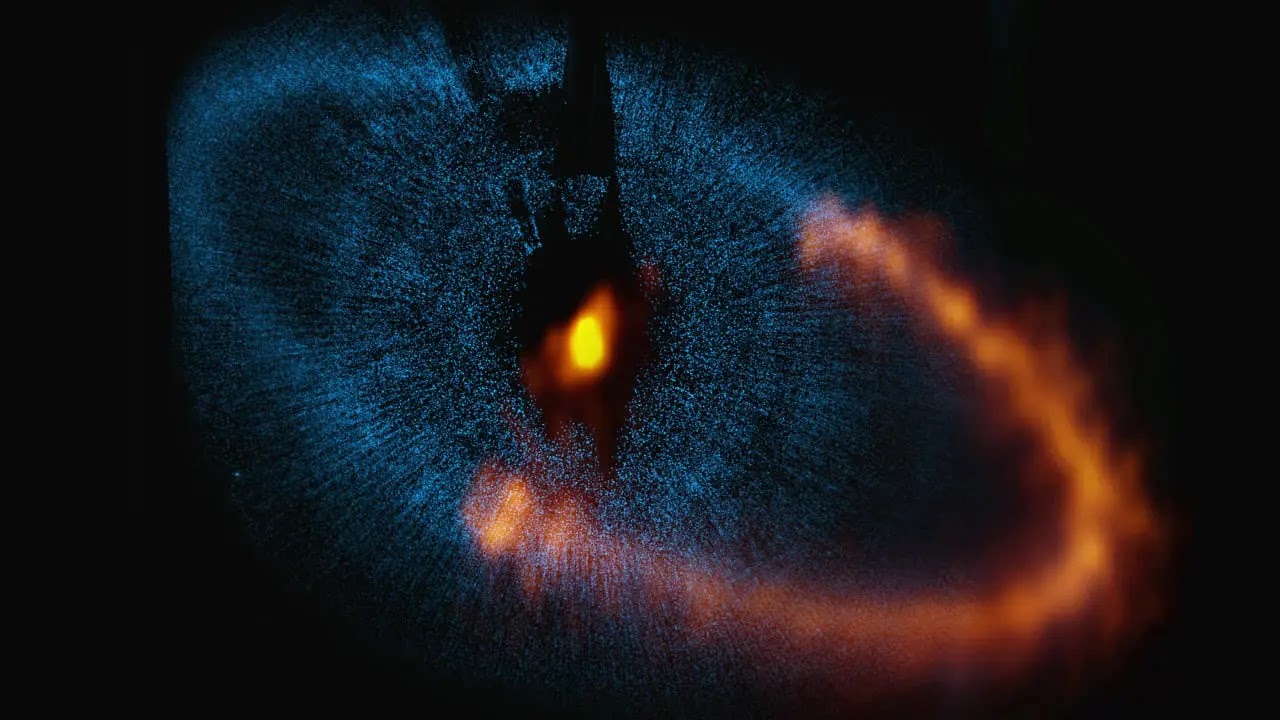
This image combines observations from the Hubble Space Telescope and the Atacama Large Millimeter/submillimeter Array to show the dusty debris disk surrounding the star Fomalhaut.  Credit:
ALMA (ESO/NAOJ/NRAO). Visible light image: the NASA/ESA Hubble Space Telescope A. Fujii/Digitized Sky Survey 2. Acknowledgment: Davide De Martin (ESA/Hubble); CC BY 4.0

An Excess of Emission

Young stars swaddled in gas and dust are known to shine extra brightly in the mid-infrared, but as stars age, this mid-infrared exuberance is expected to fade. When it doesn’t, that signals something interesting. Extreme debris disks resulting from collisions between planets or planetesimals provide one explanation for excess infrared light from mature stars; as rubble and dust billow from the collision, the dust captures and reprocesses the star’s light, re-emitting it in the mid-infrared and causing a potentially detectable excess. Only a handful of extreme debris disk candidates have been identified.

Mid-infrared excesses are hypothesized to signal something even wilder: the presence of a Dyson sphere — a hypothetical artificial structure created by an advanced civilization to harness the power of their home star. Similar to dust and rubble, the components of a Dyson sphere would collect starlight and re-emit it at infrared wavelengths, potentially producing a mid-infrared bump.

Regardless of the cause, excess mid-infrared emission from mature Sun-like stars is something to investigate. But how do we find stars with this feature?

Difference between observed and predicted magnitude in the WISE W1 and W2 bands (3.4 and 4.6 microns, respectively)
Adapted from Contardo & Hogg 2024

Taking Cues from Data

Gabriella Contardo (International School for Advanced Studies, Italy) and David Hogg (New York University; Flatiron Institute; Max Planck Institute for Astronomy) began their search for mid-infrared excesses with an expansive set of observations from the Gaia spacecraft, the Two Micron All Sky Survey, and the Wide-field Infrared Survey Explorer (WISE). After trimming these data sets down to include only main-sequence Sun-like stars, and to exclude objects that might be contaminated by close neighbors or are too dusty, they reduced the number of stars in their sample from 18,751,187 to 4,898,812.

To identify mid-infrared excesses in this sample, the team needed an estimate of what the mid-infrared fluxes of these stars should be. Rather than using models, which can be computationally intensive and require making assumptions about the objects, Contardo and Hogg let the data lead the way.

Their data-driven method involves splitting the five million stars into eight sub-samples, each of which is used to train a separate random forest algorithm. Each algorithm “learns” what the mid-infrared emission “should” be from the stars in its sample, then predicts the mid-infrared emission of the stars in the other seven sub-samples. When a star’s actual mid-infrared emission is brighter than predicted, it gets flagged.

Locations of the 53 stars in the final mid-infrared excess sample
Credit: Contardo & Hogg 202

To Be Continued

This analysis yielded a preliminary sample of 127 objects with mid-infrared excess. Ultimately, after applying additional cuts to remove crowded objects, duplicate sources, and other complications, Contardo and Hogg landed on a sample of 53 objects with interesting infrared behavior. These objects’ mid-infrared emission ranged from 0.5% to 10% higher than expected, spanning the values predicted for extreme debris disks and rubble left over from planetary collisions. In fact, one of the 53 objects has already been highlighted by previous work as an extreme debris disk candidate.

What happens now? To identify the stars that are the most promising hosts of extreme debris disks, Contardo and Hogg listed ways to pin down the ages of the stars in their sample, which may rule out stars whose mid-infrared excess is due to their youth. They also proposed to compare the mid-infrared behavior of their stellar sample to Dyson sphere models, exploring whether the observed stellar behavior matches the predictions for these hypothetical structures.

By Kerry Hensley

Citation

“A Data-Driven Search for Mid-infrared Excesses Among Five Million Main-Sequence FGK Stars,” Gabriella Contardo and David W. Hogg 2024 AJ 168 157. doi:10.3847/1538-3881/ad6b90


Saturday, October 27, 2012

New Study Brings a Doubted Exoplanet 'Back from the Dead'

A second look at data from NASA's Hubble Space Telescope is reanimating the claim that the nearby star Fomalhaut hosts a massive exoplanet. The study suggests that the planet, named Fomalhaut b, is a rare and possibly unique object that is completely shrouded by dust.

 Fomalhaut is the brightest star in the constellation Piscis Austrinus and lies 25 light-years away.

 In November 2008, Hubble astronomers announced the exoplanet, named Fomalhaut b, as the first one ever directly imaged in visible light around another star. The object was imaged just inside a vast ring of debris surrounding but offset from the host star. The planet's location and mass -- no more than three times Jupiter's -- seemed just right for its gravity to explain the ring's appearance.

 Recent studies have claimed that this planetary interpretation is incorrect. Based on the object's apparent motion and the lack of an infrared detection by NASA's Spitzer Space Telescope, they argue that the object is a short-lived dust cloud unrelated to any planet.

 A new analysis, however, brings the planet conclusion back to life.


In 2008, Hubble astronomers announced the detection of a giant planet around the bright star Fomalhaut. Recent studies have questioned this conclusion. Now, a reanalysis of Hubble data has revived the "deceased" exoplanet as a dust-shrouded world with less than twice the mass of Jupiter.  (Credit: NASA's Goddard Space Flight Center).

"Although our results seriously challenge the original discovery paper, they do so in a way that actually makes the object's interpretation much cleaner and leaves intact the core conclusion, that Fomalhaut b is indeed a massive planet," said Thayne Currie, an astronomer formerly at NASA's Goddard Space Flight Center in Greenbelt, Md., and now at the University of Toronto.

 The discovery study reported that Fomalhaut b's brightness varied by about a factor of two and cited this as evidence that the planet was accreting gas. Follow-up studies then interpreted this variability as evidence that the object actually was a transient dust cloud instead.

 In the new study, Currie and his team reanalyzed Hubble observations of the star from 2004 and 2006. They easily recovered the planet in observations taken at visible wavelengths near 600 and 800 nanometers, and made a new detection in violet light near 400 nanometers. In contrast to the earlier research, the team found that the planet remained at constant brightness.

 The team attempted to detect Fomalhaut b in the infrared using the Subaru Telescope in Hawaii, but was unable to do so. The non-detections with Subaru and Spitzer imply that Fomalhaut b must have less than twice the mass of Jupiter.

 Another contentious issue has been the object's orbit. If Fomalhaut b is responsible for the ring's offset and sharp interior edge, then it must follow an orbit aligned with the ring and must now be moving at its slowest speed. The speed implied by the original study appeared to be too fast. Additionally, some researchers argued that Fomalhaut b follows a tilted orbit that passes through the ring plane.

 Using the Hubble data, Currie's team established that Fomalhaut b is moving with a speed and direction consistent with the original idea that the planet's gravity is modifying the ring.

This visible-light image from the Hubble Space Telescope shows the vicinity of the star Fomalhaut, including the location of its dust ring and disputed planet, Fomalhaut b. A coronagraphic mask helped dim the star's brightness. This view combines two 2006 observations that were taken with masks of different sizes (1.8 and 3 arcseconds).  (Credit: NASA/ESA/T. Currie, U. Toronto).

This is an artist's impression of the exoplanet, Fomalhaut b, orbiting its sun, Fomalhaut.  (Credit: ESA; Hubble, M. Kornmesser; and ESO, L. Calçada and L. L. Christensen).   Larger image

"What we've seen from our analysis is that the object's minimum distance from the disk has hardly changed at all in two years, which is a good sign that it's in a nice ring-sculpting orbit," explained Timothy Rodigas, a graduate student in the University of Arizona and a member of the team.
Currie's team also addressed studies that interpret Fomalhaut b as a compact dust cloud not gravitationally bound to a planet. Near Fomalhaut's ring, orbital dynamics would spread out or completely dissipate such a cloud in as little as 60,000 years. The dust grains experience additional forces, which operate on much faster timescales, as they interact with the star's light.

Given what we know about the behavior of dust and the environment where the planet is located, we think that we're seeing a planetary object that is completely embedded in dust rather than a free-floating dust cloud," said team member John Debes, an astronomer at the Space Telescope Science Institute in Baltimore, Md.

A paper describing the findings has been accepted for publication in The Astrophysical Journal Letters.

Because astronomers detect Fomalhaut b by the light of surrounding dust and not by light or heat emitted by its atmosphere, it no longer ranks as a "directly imaged exoplanet." But because it's the right mass and in the right place to sculpt the ring, Currie's team thinks it should be considered a "planet identified from direct imaging."

Fomalhaut was targeted with Hubble most recently in May by another team. Those observations are currently under scientific analysis and are expected to be published soon.

Related Links

Francis Reddy
NASA's Goddard Space Flight Center, Greenbelt, Md.

Thursday, April 12, 2012

ALMA Reveals Workings of Nearby Planetary System

ALMA observes a ring around the bright star Fomalhaut

The bright star Fomalhaut in the constellation of Piscis Austrinus

Wide-field view of the sky around the bright star Fomalhaut

PR Image eso1216d
Planets shepherding material into a narrow ring around Fomalhaut

Video

PR Video eso1216a
Zooming in on Fomalhaut and its dusty disc

A new observatory still under construction has given astronomers a major breakthrough in understanding a nearby planetary system and provided valuable clues about how such systems form and evolve. Astronomers using the Atacama Large Millimeter/submillimeter Array (ALMA) have discovered that planets orbiting the star Fomalhaut must be much smaller than originally thought. This is the first published science result from ALMA in its first period of open observations for astronomers worldwide.

The discovery was made possible by exceptionally sharp ALMA images of a disc, or ring, of dust orbiting Fomalhaut, which lies about 25 light-years from Earth. It helps resolve a controversy among earlier observers of the system. The ALMA images show that both the inner and outer edges of the thin, dusty disc have very sharp edges. That fact, combined with computer simulations, led the scientists to conclude that the dust particles in the disc are kept within the disc by the gravitational effect of two planets — one closer to the star than the disc and one more distant [1].

Their calculations also indicated the probable size of the planets — larger than Mars but no larger than a few times the size of the Earth. This is much smaller than astronomers had previously thought. In 2008, a NASA/ESA Hubble Space Telescope image had revealed the inner planet, then thought to be larger than Saturn, the second largest planet in our Solar System. However, later observations with infrared telescopes failed to detect the planet.

That failure led some astronomers to doubt the existence of the planet in the Hubble image. Also, the Hubble visible-light image detected very small dust grains that are pushed outward by the star's radiation, thus blurring the structure of the dusty disc. The ALMA observations, at wavelengths longer than those of visible light, traced larger dust grains — about 1 millimetre in diameter — that are not moved by the star's radiation. They clearly reveal the disc's sharp edges and ringlike structure, which indicate the gravitational effect of two planets.

"Combining ALMA observations of the ring's shape with computer models, we can place very tight limits on the mass and orbit of any planet near the ring," said Aaron Boley (a Sagan Fellow at the University of Florida, USA) who was leader of the study. "The masses of these planets must be small; otherwise the planets would destroy the ring," he added. The small sizes of the planets explain why the earlier infrared observations failed to detect them, the scientists said.

The ALMA research shows that the ring's width is about 16 times the distance from the Sun to the Earth, and is only one-seventh as thick as it is wide. "The ring is even more narrow and thinner than previously thought," said Matthew Payne, also of the University of Florida.

The ring is about 140 times the Sun-Earth distance from the star. In our own Solar System, Pluto is about 40 times more distant from the Sun than the Earth. "Because of the small size of the planets near this ring and their large distance from their host star, they are among the coldest planets yet found orbiting a normal star," added Aaron Boley.

The scientists observed the Fomalhaut system in September and October of 2011, when only about a quarter of ALMA's planned 66 antennas were available. When construction is completed next year, the full system will be much more capable. Even in this Early Science phase, though, ALMA was powerful enough to reveal the telltale structure that had eluded earlier millimetre-wave observers.

"ALMA may be still under construction, but it is already the most powerful telescope of its kind. This is just the beginning of an exciting new era in the study of discs and planet formation around other stars", concludes ESO astronomer and team member Bill Dent (ALMA, Chile).

The Atacama Large Millimeter/submillimeter Array (ALMA), an international astronomy facility, is a partnership of Europe, North America and East Asia in cooperation with the Republic of Chile. ALMA is funded in Europe by the European Southern Observatory (ESO), in North America by the U.S. National Science Foundation (NSF) in cooperation with the National Research Council of Canada (NRC) and the National Science Council of Taiwan (NSC) and in East Asia by the National Institutes of Natural Sciences (NINS) of Japan in cooperation with the Academia Sinica (AS) in Taiwan. ALMA construction and operations are led on behalf of Europe by ESO, on behalf of North America by the National Radio Astronomy Observatory (NRAO), which is managed by Associated Universities, Inc. (AUI) and on behalf of East Asia by the National Astronomical Observatory of Japan (NAOJ). The Joint ALMA Observatory (JAO) provides the unified leadership and management of the construction, commissioning and operation of ALMA.

Notes

[1] The effect of planets or moons in keeping a dust ring's edges sharp was first seen when the Voyager spacecraft flew by Saturn and made detailed images of that planet's ring system. In another example in our Solar System, one ring of the planet Uranus is confined sharply by the moons Cordelia and Ophelia, in exactly the manner the ALMA observers propose for the ring around Fomalhaut. The moons confining those planets' rings are dubbed "shepherding moons".

The moons or planets confining such dust rings do so through gravitational effects. A planet on the inside of the ring is orbiting the star more rapidly than the dust particles in the ring. Its gravity adds energy to the particles, pushing them outward. A planet on the ring's outside is moving more slowly than the dust particles, and its gravity decreases the energy of the particles, making them fall slightly inward.
More information

This research was presented in a paper, “Constraining the Planetary System of Fomalhaut Using High-Resolution ALMA Observations” by A. Boley et al. to appear in Astrophysical Journal Letters.

The team is composed of A. C. Boley (University of Florida, Gainesville, USA), M. J. Payne (University of Florida), S. Corder (North American ALMA Science Center, Charlottesville, USA), W. Dent (ALMA, Santiago, Chile), E. B. Ford (University of Florida) and M. Shabram (University of Florida).

The year 2012 marks the 50th anniversary of the founding of the European Southern Observatory (ESO). ESO is the foremost intergovernmental astronomy organisation in Europe and the world’s most productive astronomical observatory. It is supported by 15 countries: Austria, Belgium, Brazil, the Czech Republic, Denmark, France, Finland, Germany, Italy, the Netherlands, Portugal, Spain, Sweden, Switzerland and the United Kingdom. ESO carries out an ambitious programme focused on the design, construction and operation of powerful ground-based observing facilities enabling astronomers to make important scientific discoveries. ESO also plays a leading role in promoting and organising cooperation in astronomical research. ESO operates three unique world-class observing sites in Chile: La Silla, Paranal and Chajnantor. At Paranal, ESO operates the Very Large Telescope, the world’s most advanced visible-light astronomical observatory and two survey telescopes. VISTA works in the infrared and is the world’s largest survey telescope and the VLT Survey Telescope is the largest telescope designed to exclusively survey the skies in visible light. ESO is the European partner of a revolutionary astronomical telescope ALMA, the largest astronomical project in existence. ESO is currently planning a 40-metre-class European Extremely Large optical/near-infrared Telescope, the E-ELT, which will become “the world’s biggest eye on the sky”.

Links
Research paper
ESO ALMA pages
Pictures of ALMA

Contacts

Aaron. C. Boley
University of Florida
Gainesville, USA
Tel: +1 352 294 1844
Email: aaron.boley@astro.ufl.edu

William Dent
Joint ALMA Observatory
Santiago, Chile
Tel: +56 2 467 6249
Cell: +56 9 827 9537
Email: wdent@alma.cl

Richard Hook
ESO Public Information Officer
Garching, Germany
Tel: +49 89 3200 6655
Email: rhook@eso.org

Dave Finley
Public Information Officer, National Radio Astronomy Observatory
Socorro, USA
Tel: +1 575 835 7302
Email: dfinley@nrao.edu

Masaaki Hiramatsu
Education & Public Outreach Officer, National Astronomical Observatory of Japan
Japan
Tel: +81 422 34 3900 ext.3150
Email: hiramatsu.masaaki@nao.ac.jp

William Garnier
Education and Public Outreach Officer, Joint ALMA Observatory
Santiago, Chile
Tel: +56 2 467 6119
Email: wgarnier@alma.cl

Wednesday, April 11, 2012

Herschel spots comet massacre around nearby star

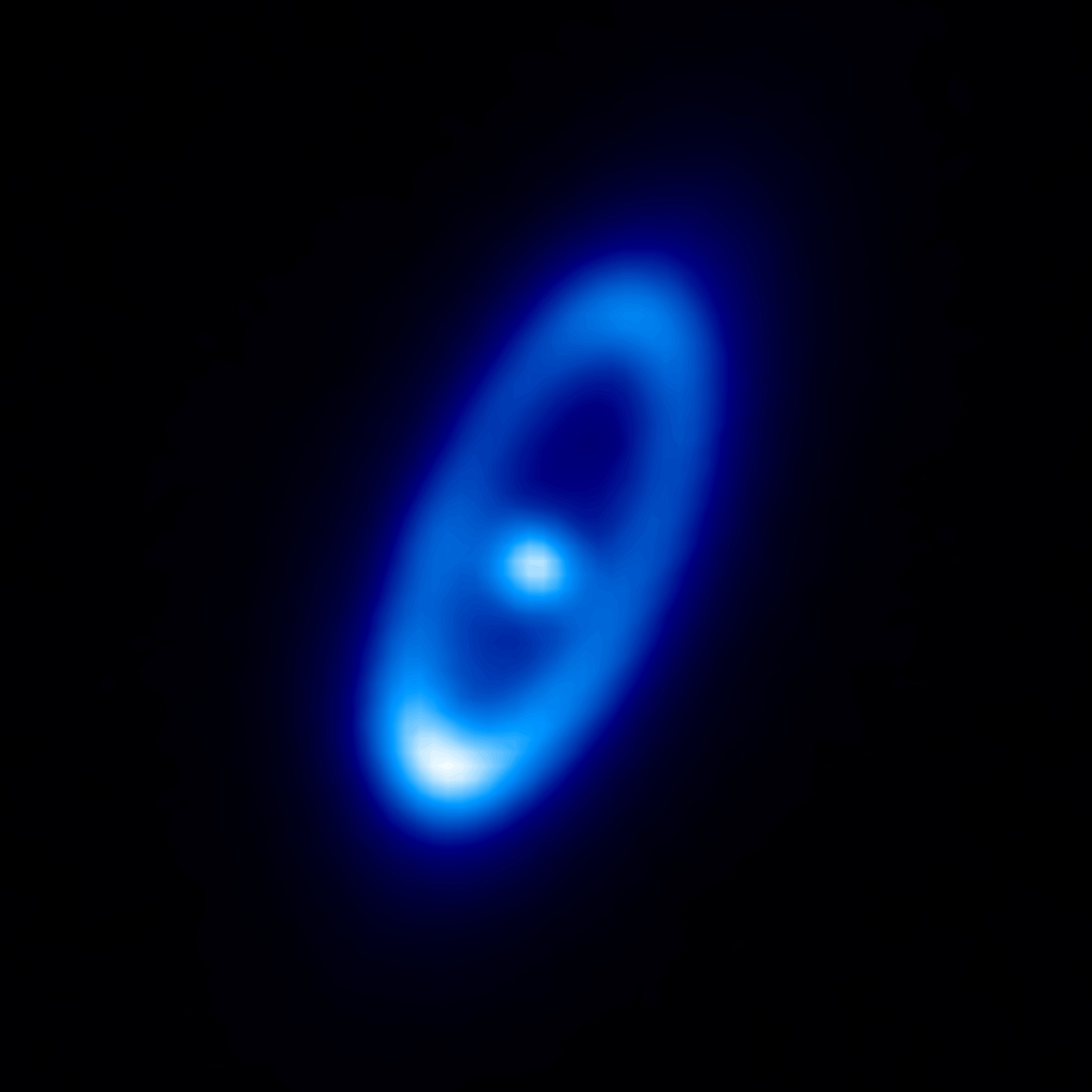
Herschel image of the star Fomalhaut and its debris disc.
Credit: ESA/Herschel/PACS/Bram Acke, KU Leuven, Belgium
HI-RES JPEG (Size: 185 kb)

ESA’s Herschel Space Observatory has studied the dusty belt around the nearby star Fomalhaut. The dust appears to be coming from collisions that destroy up to thousands of icy comets every day.

Fomalhaut is a young star, just a few hundred million years old, and twice as massive as the Sun. Its dust belt was discovered in the 1980s by the IRAS satellite, but Herschel’s new images of the belt show it in much more detail at far-infrared wavelengths than ever before.

Bram Acke, at the University of Leuven in Belgium, and colleagues analysed the Herschel observations and found the dust temperatures in the belt to be between –230 and –170ºC. However, because Fomalhaut is slightly off-centre and closer to the southern side of the belt, the southern side is warmer and brighter than the northern side.

Both the narrowness and asymmetry of the belt are thought to be due to the gravity of a possible planet in orbit around the star, as suggested by earlier Hubble Space Telescope images.

The Herschel data show that the dust in the belt has the thermal properties of small solid particles, with sizes of only a few millionths of a metre across.

But this created a paradox because the Hubble Space Telescope observations suggested solid grains more than ten times larger.

Those observations collected starlight scattering off the grains in the belt and showed it to be very faint at Hubble’s visible wavelengths, suggesting that the dust particles are relatively large. But that appears to be incompatible with the temperature of the belt as measured by Herschel in the far-infrared.

To resolve the paradox, Dr Acke and colleagues suggest that the dust grains must be large fluffy aggregates, similar to dust particles released from comets in our own Solar System.

These would have both the correct thermal and scattering properties. However, this leads to another problem.

The bright starlight from Fomalhaut should blow small dust particles out of the belt very rapidly, yet such grains appear to remain abundant there.

The only way to overcome this contradiction is to resupply the belt through continuous collisions between larger objects in orbit around Fomalhaut, creating new dust.

To sustain the belt, the rate of collisions must be impressive: each day, the equivalent of either two 10 km-sized comets or 2000 1 km-sized comets must be completely crushed into small fluffy, dust particles.

“I was really surprised,” says Dr Acke, “To me this was an extremely large number.”

To keep the collision rate so high, there must be between 260 billion and 83 trillion comets in the belt, depending on their size. Our own Solar System has a similar number of comets in its Oort Cloud, which formed from objects scattered from a disc surrounding the Sun when it was as young as Fomalhaut.

“These beautiful Herschel images have provided the crucial information needed to model the nature of the dust belt around Fomalhaut,” says Göran Pilbratt, ESA Herschel Project Scientist.

Further information

Notes for Editors:

“Herschel Images of Fomalhaut – An extrasolar Kuiper Belt at the height of its dynamical activity,” by B. Acke et al, Astronomy & Astrophysics 540, A125, published online on 11 April 2012. DOI: 10.1051/0004-6361/201118581

For further information, please contact:

Markus Bauer
ESA Science and Robotic Exploration Communication Officer
Tel: +31 71 565 6799
Mob: +31 61 594 3 954
Email: markus.bauer@esa.int

Bram Acke
University of Leuven
Tel: +32 16 327 939
Email: bram@ster.kuleuven.be

Göran Pilbratt
ESA Herschel Project Scientist
Tel: +31 71 565 3621
Email: gpilbratt@rssd.esa.int