Friday, July 27, 2007

Planets with four parents?

Planets with four parents?
SPITZER SCIENCE CENTER NEWS RELEASE
Posted: July 24, 2007

How many stars does it take to "raise" a planet? In our own solar system, it took only one -- our Sun. However, new research from NASA's Spitzer Space Telescope shows that planets might sometimes form in systems with as many as four stars.

This artist concept depicts a quadruple-star system called HD 98800.
The system is approximately 10 million years old, and is located 150 light-years away in the constellation TW Hydrae.

Credit: NASA/JPL-Caltech/T. Pyle (SSC)

Astronomers used Spitzer's infrared vision to study a dusty disk that swirls around a pair of stars in the quadruple-star system HD 98800. Such disks are thought to give rise to planets. Instead of a smooth, continuous disk, the telescope detected gaps that could be caused by a unique gravitational relationship between the system's four stars. Alternatively, the gaps could indicate planets have already begun to form, carving out lanes in the dust.

"Planets are like cosmic vacuums. They clear up all the dirt that is in their path around the central stars," said Dr. Elise Furlan, of the NASA Astrobiology Institute at the University of California at Los Angeles. Furlan is the lead author of a paper that has been accepted for publication in The Astrophysical Journal.

HD 98800 is approximately 10 million years old, and is located 150 light-years away in the constellation TW Hydrae.

Before Spitzer set its gaze on HD 98800, astronomers had a rough idea of the system's structure from observations with ground-based telescopes. They knew the system contains four stars, and that the stars are paired off into doublets, or binaries. The stars in the binary pairs orbit around each other, and the two pairs also circle each other like choreographed ballerinas. One of the stellar pairs, called HD 98800B, has a disk of dust around it, while the other pair has none.

Although the four stars are gravitationally bound, the distance separating the two binary pairs is about 50 astronomical units (AU) -- slightly more than the average distance between our Sun and Pluto. Until now, technological limitations have hindered astronomers' efforts to look at the dusty disk around HD 98800B more closely.

With Spitzer, scientists finally have a detailed view. Using the telescope's infrared spectrometer, Furlan's team sensed the presence of two belts in the disk made of large dust grains. One belt sits at approximately 5.9 AU away from the central binary, HD 98800B, or about the distance from the Sun to Jupiter. This belt is likely made up of asteroids or comets. The other belt sits at 1.5 to 2 AU, comparable to the area where Mars and the asteroid belt sit, and probably consists of fine grains.

"Typically, when astronomers see gaps like this in a debris disk, they suspect that a planet has cleared the path. However, given the presence of the diskless pair of stars sitting 50 AU away, the inward-migrating dust particles are likely subject to complex, time-varying forces, so at this point the existence of a planet is just speculation," said Furlan.

Astronomers believe that planets form like snowballs over millions of years, as small dust grains clump together to form larger bodies. Some of these cosmic rocks then smash together to form rocky planets, like Earth, or the cores of gas-giant planets like Jupiter. Large rocks that don't form planets often become asteroids and comets. As these rocky structures violently collide, bits of dust are released into space. Scientists can see these dust grains with Spitzer's supersensitive infrared eyes.

According to Furlan, the dust generated from the collision of rocky objects in the outer belt should eventually migrate toward the inner disk. However, in the case of HD 98800B, the dust particles do not evenly fill out the inner disk as expected, due to either planets or the diskless binary pair sitting 50 AU away and gravitationally influencing the movement of dust particles.

"Since many young stars form in multiple systems, we have to realize that the evolution of disks around them and the possible formation of planetary systems can be way more complicated and perturbed than in a simple case like our solar system," Furlan added.

Thursday, July 19, 2007

Astronomers Find Highly Elliptical Disk Around Young Star

Credit: NASA, ESA, and P. Kalas (University of California, Berkeley)

Astronomers Find Highly Elliptical Disk Around Young Star

This image taken by NASA's Hubble Space Telescope shows a lopsided debris disk around the young star HD 15115.

The disk, seen edge-on, is the dense blue line extending from the star to the upper right and lower left of the image. As seen from Earth, the edge-on disk resembles a needle sticking out from the star. The disk appears thicker and longer at upper right than at lower left, evidence of the disk's lopsided structure.

Astronomers think the disk's odd imbalanced look is caused by dust particles following a highly elliptical orbit around the star, which is slightly brighter than the Sun. The lopsidedness may have been caused by planets sweeping up debris in the disk or by the gravity of a nearby star.

Astronomers used an occulting mask on Hubble's Advanced Camera for Surveys to block out the bright starlight so they could see the dim disk. The occulting masks can be seen in the image as the dark circle in the center and the dark bar on the left. The star is behind the central mask.

HD 15115 is among nearly 30 stars that belong to the Beta Pictoris Moving Group. Moving groups are expanded clusters of stars believed to have a common birthplace and age, in this case about 12 million years, that are traveling together loosely through space. HD 15115 is 150 light-years from Earth.

Dusty disks are known to exist around at least 100 stars, but because of the difficulty in observing material close to the brightness of a star, less than a dozen have been studied closely.

Astronomers described the disk as one of the most peculiar debris disks that Hubble has ever imaged. They in fact made follow-up observations with the W.M. Keck Observatory in Hawaii to confirm the disk's presence.

Hubble's Advanced Camera for Surveys snapped the image on July 17, 2006.

Monday, June 25, 2007

An intriguing bright clump in Saturn's F ring

An Intriguing Bright Clump in Saturn's F ring

The Cassini spacecraft spies an intriguing bright clump in Saturn's F ring. Also of interest is the dark gash that appears to cut through the ring immediately below the clump. Scientists continue to monitor this ring for small, transient clumps of material, as well as the effects of the shepherd moon Prometheus.

This view looks toward the unilluminated side of the rings from about 28 degrees above the ringplane.

The image was taken in visible light with the Cassini spacecraft narrow-angle camera on May 5, 2007 at a distance of approximately 2.1 million kilometers (1.3 million miles) from Saturn. Image scale is 12 kilometers (8 miles) per pixel.

The Cassini-Huygens mission is a cooperative project of NASA, the European Space Agency and the Italian Space Agency. The Jet Propulsion Laboratory, a division of the California Institute of Technology in Pasadena, manages the mission for NASA's Science Mission Directorate, Washington, D.C. The Cassini orbiter and its two onboard cameras were designed, developed and assembled at JPL. The imaging operations center is based at the Space Science Institute in Boulder, Colo.

For more information about the Cassini-Huygens mission visit http://saturn.jpl.nasa.gov
The Cassini imaging team homepage is at http://ciclops.org
Credit: NASA/JPL/Space Science Institute

Thursday, June 14, 2007

Astronomers Measure Mass of Largest Dwarf Planet

Credit: NASA, ESA, and M. Brown (California Institute of Technology)

ASA's Hubble Space Telescope has teamed up with the W.M. Keck Observatory to precisely measure the mass of Eris, the largest member of a new class of dwarf planets in our solar system. Eris is 1.27 times the mass of Pluto, formerly the largest member of the Kuiper Belt of icy objects beyond Neptune.

Hubble observations in 2006 showed that Eris is slightly physically larger than Pluto. But the mass could only be calculated by observing the orbital motion of the moon Dysnomia around Eris. Multiple images of Dysnomia's movement along its orbit were taken by Hubble and Keck.

Astronomer Mike Brown of the California Institute of Technology in Pasadena, Calif. and colleagues also report in this week's Science Magazine that Dysnomia is in a nearly circular 16-day orbit. This favors the idea that Dysnomia was born out of a collision between Eris and another Kuiper Belt object (KBO). A gravitationally captured object would be expected to be in a more elliptical orbit.

The satellites of Pluto, as well as the Earth-Moon system are also believed to have been born out of a collision process where debris from the smashup goes into orbit and coalesces into a satellite.

By comparing the mass and diameter, Brown has calculated a density for Eris of 2.3 grams per cubic centimeter. This is very similar to the density of Pluto, the large Kuiper Belt object 2003 EL61, and Neptune's moon Triton which is likely a captured KBO. These higher densities imply that these bodies are not pure ice but must have a significant rocky composition.

The discovery of Eris in 2005 (originally nicknamed Xena, and officially cataloged 2003 UB313) prompted a debate over the planetary status of Pluto because astronomers realized they would have to call it the "10th" planet if Pluto retained its own planetary status, which was already under debate. This led the International Astronomical Union, in 2006, to make a new class of solar system object called dwarf planets. These are spherical bodies in hydrostatic equilibrium (objects that have sufficient gravity to overcome their own rigidity and form a spherical shape) like the planets, but unlike the major planets in the solar system, they have not gravitationally cleared out the neighborhood of particles and small debris along their orbits.

Tuesday, May 15, 2007

Dark Matter Ring in CI 0024+17

Credit: NASA, ESA, M.J. Jee and H. Ford (Johns Hopkins University)

This Hubble Space Telescope composite image shows a ghostly "ring" of dark matter in the galaxy cluster Cl 0024+17.

The ring-like structure is evident in the blue map of the cluster's dark matter distribution. The map is superimposed on a Hubble image of the cluster. The ring is one of the strongest pieces of evidence to date for the existence of dark matter, an unknown substance that pervades the universe.

The map was derived from Hubble observations of how the gravity of the cluster Cl 0024+17 distorts the light of more distant galaxies, an optical illusion called gravitational lensing. Although astronomers cannot see dark matter, they can infer its existence by mapping the distorted shapes of the background galaxies. The mapping also shows how dark matter is distributed in the cluster.

Astronomers suggest that the dark-matter ring was produced from a collision between two gigantic clusters.

Dark matter makes up the bulk of the universe's material and is believed to make up the underlying structure of the cosmos.

The Hubble observations were taken in November 2004 by the Advanced Camera for Surveys (ACS). Thanks to the exquisite resolution of the ACS, astronomers saw the detailed cobweb tracery of gravitational lensing in the cluster.

Tuesday, April 24, 2007

Star-Forming Region in the Carina Nebula

Credit for Hubble Image: NASA, ESA, N. Smith (University of California, Berkeley),
and The Hubble Heritage Team (STScI/AURA)

[Left] — A towering "mountain" of cold hydrogen gas laced with dust is the site of new star formation in the Carina Nebula. The great gas pillar is being eroded by the ultraviolet radiation from the hottest newborn stars in the nebula.

[Right] — A close-up look at the peak of one of these "pillars of creation" reveals unequivocal evidence that stars are being born inside the columns. A pencil-like streamer of gas shoots out in both directions from the pillar and plows into surrounding gas like a fire hose hitting a wall of sand. The jet is being launched from a newly forming star hidden inside the column. A similar jet appears near the bottom of the image. These stellar jets are a common signature of the birth of a new star.

Carina Nebula Details


Credit for Hubble Image: NASA, ESA, N. Smith (University of California, Berkeley),
and The Hubble Heritage Team (STScI/AURA)

This Hubble Space Telescope view of the central region of the Carina Nebula reveals a violent maelstrom of star birth. The fantasy-like landscape of the nebula is sculpted by the intense pressure of starlight from monster stars and their accompanying star clusters, as well as the hydrodynamics of their stellar winds of charged particles.

[Top] — An approximately one-light-year tall "pillar" of cold hydrogen towers above the wall of the molecular cloud. The 2.5-million-year-old star cluster called Trumpler 14 appears at the right side of the image. A small nugget of cold molecular hydrogen, called a Bok globule, is silhouetted against the star cluster.

[Center] — A Bok globule nicknamed the "caterpillar" appears at the right. Its glowing edge indicates that it is being photoionized by the hottest stars in the cluster. It has been hypothesized that stars may form inside such dusty cocoons. The top of the Keyhole Nebula, the most prominent feature embedded inside Carina, is on the left. Another Bok globule is in the foreground.

[Bottom] — These great clouds of cold hydrogen resemble summer afternoon thunderheads. They tower above the surface of a molecular cloud on the edge of the nebula. So-called "elephant trunk" pillars resist being heated and eaten away by blistering ultraviolet radiation from the nebula's brightest stars.

Carina Nebula


Credit for Hubble Image:NASA, ESA, N. Smith (University of California, Berkeley),
and The Hubble Heritage Team (STScI/AURA)

In celebration of the 17th anniversary of the launch and deployment of NASA's Hubble Space Telescope, a team of astronomers is releasing one of the largest panoramic images ever taken with Hubble's cameras. It is a 50-light-year-wide view of the central region of the Carina Nebula where a maelstrom of star birth - and death - is taking place.

Hubble's view of the nebula shows star birth in a new level of detail. The fantasy-like landscape of the nebula is sculpted by the action of outflowing winds and scorching ultraviolet radiation from the monster stars that inhabit this inferno. In the process, these stars are shredding the surrounding material that is the last vestige of the giant cloud from which the stars were born.

The immense nebula contains at least a dozen brilliant stars that are roughly estimated to be at least 50 to 100 times the mass of our Sun. The most unique and opulent inhabitant is the star Eta Carinae, at far left. Eta Carinae is in the final stages of its brief and eruptive lifespan, as evidenced by two billowing lobes of gas and dust that presage its upcoming explosion as a titanic supernova.

The fireworks in the Carina region started three million years ago when the nebula's first generation of newborn stars condensed and ignited in the middle of a huge cloud of cold molecular hydrogen. Radiation from these stars carved out an expanding bubble of hot gas. The island-like clumps of dark clouds scattered across the nebula are nodules of dust and gas that are resisting being eaten away by photoionization.

The hurricane blast of stellar winds and blistering ultraviolet radiation within the cavity is now compressing the surrounding walls of cold hydrogen. This is triggering a second stage of new star formation.

Our Sun and our solar system may have been born inside such a cosmic crucible 4.6 billion years ago. In looking at the Carina Nebula we are seeing the genesis of star making as it commonly occurs along the dense spiral arms of a galaxy.

The immense nebula is an estimated 7,500 light-years away in the southern constellation Carina the Keel (of the old southern constellation Argo Navis, the ship of Jason and the Argonauts, from Greek mythology).

This image is a mosaic of the Carina Nebula assembled from 48 frames taken with Hubble Space Telescope's Advanced Camera for Surveys. The Hubble images were taken in the light of neutral hydrogen. Color information was added with data taken at the Cerro Tololo Inter-American Observatory in Chile. Red corresponds to sulfur, green to hydrogen, and blue to oxygen emission.

Friday, March 02, 2007

Hubble Sees 'Comet Galaxy' Being Ripped Apart By Galaxy Cluster

Credit: NASA, ESA, and J. -P. Kneib (Laboratorie d'Astrophysique de Marseille)

NASA's Hubble Space Telescope, in collaboration with several other ground- and space- based telescopes, has captured a galaxy being ripped apart by a galaxy cluster's gravitational field and harsh environment.

The finding sheds light on the mysterious process by which gas-rich spiral-shaped galaxies might evolve into gas-poor irregular- or elliptical-shaped galaxies over billions of years. The new observations also reveal one mechanism for forming the millions of "homeless" stars seen scattered throughout galaxy clusters.

There are many galaxies of different shapes and sizes around us today. Roughly half are gas-poor elliptical-shaped galaxies with little new star formation activity, and half are gas- rich spiral and irregular galaxies with high star formation activity. Observations have shown that gas-poor galaxies are most often found near the centers of crowded galaxy clusters, whereas spirals spend most of their lifetimes in less crowded circumstances.

But deep observations of the universe show that when the universe was half its present age, only one in five galaxies was a gas-poor object. So where do all of today's gas-poor galaxies come from? Scientists suspect that some kind of transformative process must have taken place, but because galaxy evolution occurs over billions of years, they previously have not been able to see this transformation at work.

The new Hubble observations, made by an international team of astronomers led by Luca Cortese of Cardiff University, United Kingdom, provide one of the best examples to date of this metamorphosis. While looking at galaxy cluster Abell 2667, astronomers found an odd- looking spiral galaxy (shown in the upper left hand corner of the image) that plows through the cluster after being accelerated to at least 3.5 million km/h by the enormous combined gravity of the cluster's dark matter, hot gas and hundreds of galaxies. As it speeds through, it rams into the hot gas that permeates the cluster. Its gas and stars are pulled away by the gravitational tidal forces exerted by the cluster, just as the forces exerted by our moon and sun pull the Earth's oceans.

The unique galaxy is situated 3.2 billion light-years from the Earth. It has an extended stream of bright blue knots and diffuse wisps of young stars whose formation and evolution have been driven by both the cluster's tidal forces and a mechanism called "ram pressure stripping." Abell 2667's hot gas is composed of charged particles with a temperature of 10-100 million degrees. During the ram pressure stripping process, the charged particles strip and push away the infalling galaxy's gas, just as the solar wind of charged particles pushes ionized gas away from a comet to create a gas tail. For this reason the scientists have nicknamed the stretched spiral the "comet galaxy."

In the midst of the destruction a baby-boom of star formation in the center of the infalling galaxy has been triggered by the tidal effect of the cluster's gravity. Millions of stars have been ripped from their host galaxy. The spiral galaxy will inevitably lose all its gas and dust in the collision, and become a gas-poor galaxy with an old population of red stars.

Scientists estimate that the total duration of the transformation process is close to one billion years. What is seen now in the Hubble image is not yet half-way through the transformation (i.e. roughly 200 million years).

The strong gravitational pull exerted by the galaxy cluster's collective mass has bent the light of other, more distant galaxies and distorted their shapes - an effect called gravitational lensing. The giant bright banana-shaped arc seen just to the right of the center in the photo corresponds to the magnified and distorted image of a distant galaxy that lies behind the cluster's core.

The Hubble image was taken by the Wide Field Planetary Camera 2 in October 2001 and is a composite of three observations through blue, green, and near-infrared filters.

The astronomers combined the Hubble observations with various ground- and space-based telescopes: the European Southern Observatory's Very Large Telescope in Chile, NASA's Spitzer Space Telescope, NASA's Chandra X-Ray Observatory, and the twin Keck Telescopes in Hawaii.

The Very Large Telescope was used for optical spectroscopy and near-infrared photometry. Spitzer Space Telescope provided mid-infrared photometry. The Chandra X-Ray Observatory took X-ray observations, and the twin Keck Telescopes were used for optical spectroscopy. Optical spectroscopy is used to measure the temperature, composition, and radial motion of stars and galaxies. Infrared photometry measures the brightness, and any change in brightness, of an object glowing at infrared wavelengths.

Thursday, February 22, 2007

Supernova 1987A


This photo album of images from NASA's Hubble Space Telescope shows a ring of gas beginning to glow around an exploded star.

The stellar blast, called Supernova 1987A, was first spotted 20 years ago. The explosion is one of the brightest supernova blasts in more than 400 years. Hubble began watching the blast's aftermath shortly after it was launched in 1990.

The growing number of bright spots on the ring was produced by an onslaught of material unleashed by the blast. The shock wave of material is slamming into the ring's innermost regions, heating them up, and causing them to glow. The ring, about a light-year across, was probably shed by the star about 20,000 years before the star exploded.

Astronomers detected the first bright spot in 1997, but now they see dozens of spots around the ring. Only Hubble can see the individual bright spots. In the next few years, the entire ring will be ablaze as it absorbs the full force of the crash. The glowing ring is expected to become bright enough to illuminate the star's surroundings, providing astronomers with new information on how the star expelled material before the explosion.

The bright spot that appears to be on the ring at lower right is actually a foreground star. Supernova 1987A is 163,000 light-years away in the Large Magellanic Cloud.

The images were taken between 1994 and 2006 with Hubble's Wide Field Planetary Camera 2 and Advanced Camera for Surveys.

Credit: NASA, ESAP. Challis and R. Kirshner (Harvard-Smithsonian Center for Astrophysics)

Wednesday, January 10, 2007

Eagle Nebula (M16) Pillars

Credit: NASA/JPL-Caltech/N. Flagey (IAS/SSC) & A. Noriega-Crespo (SSC/Caltech)

Unwrapping the Pillars

This image composite highlights the pillars of the Eagle nebula, as seen in infrared light by NASA's Spitzer Space Telescope (bottom) and visible light by NASA's Hubble Space Telescope (top insets).

The top right inset focuses on the three famous pillars, dubbed the "Pillars of Creation," which were photographed by Hubble in 1995. Hubble's optical view shows the dusty towers in exquisite detail, while Spitzer's infrared eyes penetrate through the thick dust, revealing ghostly transparent structures. The same effect can be seen for the pillar outlined in the top left box.

In both cases, Spitzer's view exposes newborn stars that were hidden inside the cocoon-like pillars, invisible to Hubble. These stars were first uncovered by the European Space Agency's Infrared Satellite Observatory. In the Spitzer image, two embedded stars are visible at the tip and the base of the left pillar, while one star can be seen at the tip of the tallest pillar on the right.


Credit: NASA/JPL-Caltech/N. Flagey (IAS/SSC) & A. Noriega-Crespo (SSC/Caltech)

Eagle Nebula Flaunts Its Infrared Feathers

This set of images from NASA's Spitzer Space Telescope shows the Eagle nebula in different hues of infrared light. Each view tells a different tale. The left picture shows lots of stars and dusty structures with clarity. Dusty molecules found on Earth called polycyclic aromatic hydrocarbons produce most of the red; gas is green and stars are blue.

The middle view is packed with drama, because it tells astronomers that a star in this region violently erupted, or went supernova, heating surrounding dust (orange). This view also reveals that the hot dust is shell shaped, another indication that a star exploded.

The final picture highlights the contrast between the hot, supernova-heated dust (green) and the cooler dust making up the region's dusty star-forming clouds and towers (red, blue and purple).

The left image is a composite of infrared light with the following wavelengths: 3.6 microns (blue); 4.5 microns (green); 5.8 microns (orange); and 8 microns (red). The right image includes longer infrared wavelengths, and is a composite of light of 4.5 to 8.0 microns (blue); 24 microns (green); and 70 microns (red). The middle image is made up solely of 24-micron light.

Monday, December 11, 2006

Heavyweight Stars Light Up Nebula NGC 6357


The small open star cluster Pismis 24 lies in the core of the large emission nebula NGC 6357 in Sagittarius, about 8,000 light-years away from Earth. Some of the stars in this cluster are extremely massive and emit intense ultraviolet radiation.

The brightest object in the picture is designated Pismis 24-1. It was once thought to weigh as much as 200 to 300 solar masses. This would not only have made it by far the most massive known star in the galaxy, but would have put it considerably above the currently believed upper mass limit of about 150 solar masses for individual stars.

However, Hubble Space Telescope high-resolution images of the star show that it is really two stars orbiting one another (inset pictures at top right and bottom right). They are estimated to each be 100 solar masses.

In addition, spectroscopic observations with ground-based telescopes further reveal that one of the stars is actually a tight binary that is too compact to be resolved even by Hubble. This divides the estimated mass for Pismis 24-1 among the three stars. Although the stars are still among the heaviest known, the mass limit has not been broken thanks to the multiplicity of the system.

The observations were performed by a team of astronomers led by J. Maíz Apellániz of the Instituto de Astrofísica de Andalucía in Spain. The team imaged Pismis 24-1 with Hubble's Advanced Camera for Surveys in April 2006.

The images of NGC 6357 were taken with Hubble's Wide Field and Planetary Camera 2 in April 2002.

Credit: NASA, ESA, and J. Maíz Apellániz (Instituto de Astrofísica de Andalucía, Spain)

Thursday, November 16, 2006

Hubble Finds Evidence for Dark Energy in the Young Universe

Credit: NASA, ESA, and A. Riess (STScI)

Scientists using NASA's Hubble Space Telescope have discovered that dark energy is not a new constituent of space, but rather has been present for most of the universe's history.
Dark energy is a mysterious repulsive force that causes the universe to expand at an increasing rate. Investigators used Hubble to find that dark energy was already boosting the expansion rate of the universe as long as nine billion years ago.
This picture of dark energy is consistent with Albert Einstein's prediction of nearly a century ago that a repulsive form of gravity emanates from empty space.
Data from Hubble provides supporting evidence to help astrophysicists to understand the nature of dark energy.
This will allow them to begin ruling out some competing explanations that predict that the strength of dark energy changes over time.

Friday, November 10, 2006

Cassini stares into the eye of monster storm on Saturn

NASA NEWS RELEASE
Posted: November 9, 2006


NASA's Cassini spacecraft has seen something never before seen on another planet -- a hurricane-like storm at Saturn's South Pole with a well-developed eye, ringed by towering clouds.

Cassini stares deep into the swirling hurricane-like vortex at Saturn's south pole, where the vertical structure of the clouds is highlighted by shadows. Such a storm, with a well-developed eye ringed by towering clouds, is a phenomenon never before seen on another planet.
Credit: NASA/JPL/Space Science Institute

The "hurricane" spans a dark area inside a thick, brighter ring of clouds. It is approximately 5,000 miles across, or two thirds the diameter of Earth.

"It looks like a hurricane, but it doesn't behave like a hurricane," said Andrew Ingersoll, a member of Cassini's imaging team at the California Institute of Technology, Pasadena. "Whatever it is, we're going to focus on the eye of this storm and find out why it's there."

A movie taken by Cassini's camera over a three-hour period reveals winds around Saturn's South Pole blowing clockwise at 350 miles per hour. The camera also saw the shadow cast by a ring of towering clouds surrounding the pole, and two spiral arms of clouds extending from the central ring. These ring clouds, 20 to 45 miles above those in the center of the storm, are two to five times taller than the clouds of thunderstorms and hurricanes on Earth.

Eye-wall clouds are a distinguishing feature of hurricanes on Earth. They form where moist air flows inward across the ocean's surface, rising vertically and releasing a heavy rain around an interior circle of descending air that is the eye of the storm itself. Though it is uncertain whether such moist convection is driving Saturn's storm, the dark "eye" at the pole, the eye-wall clouds and the spiral arms together indicate a hurricane-like system.
These images of Saturn's south pole were taken by two different instruments on Cassini. The four monochrome images displayed here were acquired by the imaging science subsystem; the blue and red images in the bottom row were taken by the visual and infrared mapping spectrometer. The images are arranged in order of increasing wavelength in nanometers as follows: (top row) 460 nm, 752 nm, 728 nm; (bottom row) 890 nm, 2,800 nm, 5,000 nm.
Credit: NASA/JPL/Space Science Institute/University of Arizona

Distinctive eye-wall clouds have not been seen on any planet other than Earth. Even Jupiter's Great Red Spot, much larger than Saturn's polar storm, has no eye or eye-wall, and is relatively calm at the center.

This giant Saturnian storm is apparently different than hurricanes on Earth because it is locked to the pole and does not drift around like terrestrial hurricanes. Also, since Saturn is a gaseous planet, the storm forms without an ocean at its base.

In the Cassini imagery the eye looks dark at light wavelengths where methane gas absorbs the light and only the highest clouds are visible.

"The clear skies over the eye appear to extend down to a level about twice as deep as the usual cloud level observed on Saturn," said Kevin H. Baines, of Cassini's visual and infrared mapping spectrometer team at NASA's Jet Propulsion Laboratory, Pasadena, Calif. "This gives us the deepest view yet into Saturn over a wide range of wavelengths, and reveals a mysterious set of dark clouds at the bottom of the eye."
The Cassini data presented in this view appear to confirm a region of warm atmospheric descent into the eye of a hurricane-like storm locked to Saturn's south pole. The view shows temperature data from the Cassini spacecraft composite infrared spectrometer overlaid onto an image from the imaging science subsystem wide-angle camera.
Credit: NASA/JPL/Space Science Institute/GSFC

Infrared images taken by the Keck I telescope in Mauna Kea, Hawaii, had previously shown Saturn's South Pole to be warm. Cassini's composite infrared spectrometer has confirmed this with higher resolution temperature maps of the area. The spectrometer observed a temperature increase of about 4 degrees Fahrenheit at the pole. The instrument measured high temperatures in the upper troposphere and stratosphere, regions higher in the atmosphere than the clouds seen by the Cassini imaging instruments.

"The winds decrease with height, and the atmosphere is sinking, compressing and heating over the South Pole," said Richard Achterberg, a member of Cassini's composite infrared spectrometer team at NASA's Goddard Spaceflight Center, Greenbelt, Md.

Observations taken over the next few years, as the South Pole season changes from summer to fall, will help scientists understand the role seasons play in driving the dramatic meteorology at the south pole of Saturn.

The Cassini-Huygens mission is a cooperative project of NASA, the European Space Agency and the Italian Space Agency. The Jet Propulsion Laboratory manages the Cassini-Huygens mission for NASA's Science Mission Directorate, Washington.

Friday, October 27, 2006

Light Echo from Star V838 Monocerotis

Credit: NASA, ESA, and H. Bond (STScI)

These are the most recent NASA Hubble Space Telescope views of an unusual phenomenon in space called a light echo. Light from a star that erupted nearly five years ago continues propagating outward through a cloud of dust surrounding the star. The light reflects or "echoes" off the dust and then travels to Earth.

Because of the extra distance the scattered light travels, it reaches the Earth long after the light from the stellar outburst itself. Therefore, a light echo is an analog of a sound echo produced, for example, when sound from an Alpine yodeler echoes off of the surrounding mountainsides.

The echo comes from the unusual variable star V838 Monocerotis (V838 Mon), located 20,000 light-years away on the periphery of our Galaxy. In early 2002, V838 Mon increased in brightness temporarily to become 600,000 times brighter than our Sun. The reason for the eruption is still unclear.

Hubble has been observing the V838 Mon light echo since 2002. Each new observation of the light echo reveals a new and unique "thin-section" through the interstellar dust around the star. The new images of the light echo were taken with Hubble's Advanced Camera for Surveys in November 2005 (left) and September 2006 (right). Particularly noticeable in the images are numerous whorls and eddies in the interstellar dust, which are possibly produced by effects of magnetic fields.

Monday, October 16, 2006

In the Shadow of Saturn

Credit: SSI, JPL, ESA, NASA
In the shadow of Saturn, unexpected wonders appear. The robotic Cassini spacecraft now orbiting Saturn recently drifted in giant planet's shadow for about 12 hours and looked back toward the eclipsed Sun. Cassini saw a view unlike any other. First, the night side of Saturn is seen to be partly lit by light reflected from its own majestic ring system. Next, the rings themselves appear dark when silhouetted against Saturn, but quite bright when viewed away from Saturn and slightly scattering sunlight, in the above exaggerated color image. Saturn's rings light up so much that new rings were discovered, although they are hard to see in the above image. Visible in spectacular detail, however, is Saturn's E ring, the ring created by the newly discovered ice-fountains of the moon Enceladus, and the outermost ring visible above. Far in the distance, visible on the image left just above the bright main rings, is the almost ignorable pale blue dot of Earth.

Wednesday, October 11, 2006

Markarian's Chain of Galaxies

Across the heart of the Virgo Cluster of Galaxies lies a striking string of galaxies known as Markarian's Chain. The chain, pictured above, is highlighted on the lower right with two large but featureless lenticular galaxies, M84 and M86, and connects through several large spiral to the upper left, including M88. The home Virgo Cluster is the nearest cluster of galaxies, contains over 2,000 galaxies, and has a noticeable gravitational pull on the galaxies of the Local Group of Galaxies surrounding our Milky Way Galaxy. The center of the Virgo Cluster is located about 70 million light years away toward the constellation of Virgo. At least seven galaxies in the chain appear to move coherently, although others appear to be superposed by chance. The above image is just a small part of a mosaic dubbed the Big Picture taken by the Samuel Oschin Telescope at Palomar Observatory, in California, USA. A mural of the Big Picture will be displayed at the newly renovated Griffith Observatory near Los Angeles, California.

Credit & Copyright: The Palomar-Quest Survey Team, CalTech

Wednesday, October 04, 2006

Hubble Exoplanet Search Field in Sagittarius

This is an image of one-half of the Hubble Space Telescope field of view in the Sagittarius Window Eclipsing Extrasolar Planet Search (SWEEPS). The field contains approximately 150,000 stars, down to 30th magnitude. The stars in the Galactic disk and bulge have a mixture of colors and masses. The field is so crowded with stars because Hubble was looking across 26,000 light-years of space in the direction of the center of our galaxy.

Half of these stars are bright enough for Hubble to monitor for any small, brief and periodic dips in brightness caused by the passage of an exoplanet passing in front of the star, an event called a transit. Hubble took approximately 520 pictures of this field, at red and blue wavelengths, from Feb. 22-29, 2004. The green circles identify 9 stars that are orbited by planets with periods of a few days. Planets so close to their stars with such short orbital periods are called "hot Jupiters."

These are considered "candidate" exoplanets because most of them are too faint to allow for spectroscopic observations that would allow for a precise measure of the planet's mass. The Hubble observations allow for a robust statistical estimate of the possible "false positives," which suggests that at least 45 percent of the candidates must be genuine planets.

The bottom frame identifies one of two stars in the field where astronomers were able to spectroscopically measure the star's back-and-forth wobble due to the pull of the planet. The planet turns out to be less than 3.8 Jupiter masses.

The members of the SWEEPS science team are Kailash C. Sahu, Stefano Casertano, Howard E. Bond, Jeff Valenti, T. Ed Smith, Mario Livio, Nino Panagia, Thomas M. Brown, Will Clarkson and Stephen Lubow (Space Telescope Science Institute), Dante Minniti and Manuela Zoccali (Universidad Catolica de Chile), Nikolai Piskunov (Uppsala University), Timothy Brown (High Altitude Observatory), Alvio Renzini (INAF-Osservatorio Astronomico di Padova), and R. Michael Rich (University of California at Los Angeles).

Credit: NASA, ESA, K. Sahu (STScI) and the SWEEPS Science Team

Thursday, September 21, 2006

Distant Galaxies in the Hubble Ultra Deep Field

Credit: NASA, ESA,R. Bouwens and G. Illingworth (University of California, Santa Cruz)

This Hubble Space Telescope image shows 28 of the more than 500 young galaxies that existed when the universe was less than 1 billion years old. The galaxies were uncovered in a study of two of the most distant surveys of the cosmos, the Hubble Ultra Deep Field (HUDF), completed in 2004, and the Great Observatories Origins Deep Survey (GOODS), made in 2003.

Just a few years ago, astronomers had not spotted any galaxies that existed significantly less than 1 billion years after the Big Bang. The galaxies spied in the HUDF and GOODS surveys are blue galaxies brimming with star birth.

The large image at left shows the Hubble Ultra Deep Field, taken by the Hubble telescope. The numbers next to the small boxes correspond to close-up views of 28 of the newly found galaxies at right. The galaxies in the postage-stamp size images appear red because of their tremendous distance from Earth. The blue light from their young stars took nearly 13 billion years to arrive at Earth. During the journey, the blue light was shifted to red light due to the expansion of space.

Wednesday, August 23, 2006

Visible-Light and X-Ray Composite Image of Galaxy Cluster 1E 0657-556


Credit:
X-ray: NASA/CXC/M.Markevitch et al. Optical: NASA/STScI; Magellan/U.Arizona/D.Clowe et al. Lensing Map: NASA/STScI; ESO WFI; Magellan/U.Arizona/D.Clowe et al.

This composite image shows the galaxy cluster 1E 0657-556, also known as the "bullet cluster." This cluster was formed after the collision of two large clusters of galaxies, the most energetic event known in the universe since the Big Bang.

Hot gas detected by Chandra in X-rays is seen as two pink clumps in the image and contains most of the "normal," or baryonic, matter in the two clusters. The bullet-shaped clump on the right is the hot gas from one cluster, which passed through the hot gas from the other larger cluster during the collision. An optical image from Magellan and the Hubble Space Telescope shows the galaxies in orange and white. The blue areas in this image depict where astronomers find most of the mass in the clusters. The concentration of mass is determined by analyzing the effect of so-called gravitational lensing, where light from the distant objects is distorted by intervening matter. Most of the matter in the clusters (blue) is clearly separate from the normal matter (pink), giving direct evidence that nearly all of the matter in the clusters is dark.

The hot gas in each cluster was slowed by a drag force, similar to air resistance, during the collision. In contrast, the dark matter was not slowed by the impact because it does not interact directly with itself or the gas except through gravity. Therefore, during the collision the dark matter clumps from the two clusters moved ahead of the hot gas, producing the separation of the dark and normal matter seen in the image. If hot gas was the most massive component in the clusters, as proposed by alternative theories of gravity, such an effect would not be seen. Instead, this result shows that dark matter is required.

Comparing the optical image with the blue emission shows that the most of the galaxies in each cluster are located near the two dark matter clumps. This shows that the galaxies in each cluster did not slow down because of the collision, unlike the hot gas.

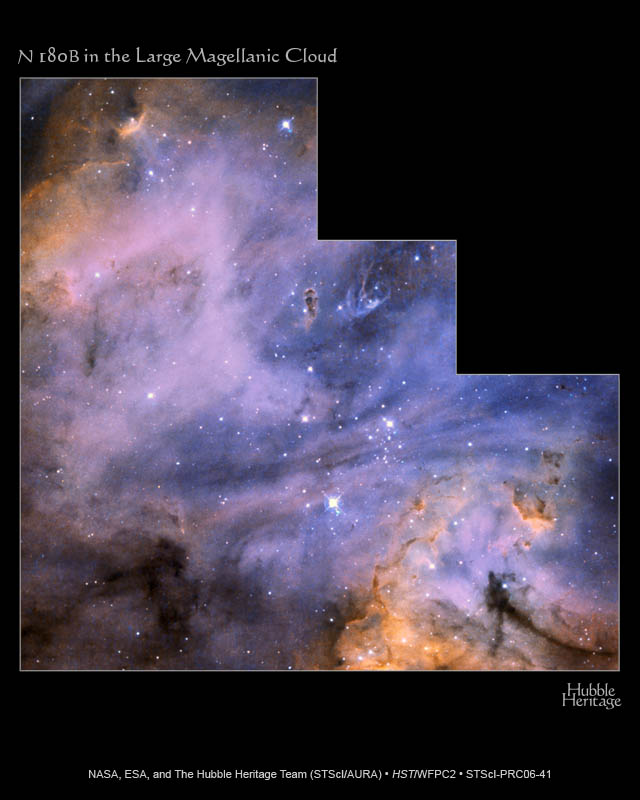
N 180B - Large Magellanic Cloud


Credit: NASA ESA, and the Hubble Heritag Team (STScI/AURA)

This active region of star formation in the Large Magellanic Cloud (LMC), as photographed by NASA's Hubble Space Telescope, unveils wispy clouds of hydrogen and oxygen that swirl and mix with dust on a canvas of astronomical size. The LMC is a satellite galaxy of the Milky Way.

This particular region within the LMC, referred to as N 180B, contains some of the brightest known star clusters. The hottest blue stars can be brighter than a million of our Suns. Their intense energy output generates not only harsh ultraviolet radiation but also incredibly strong stellar "winds" of high-speed, charged particles that blow into space. The ultraviolet radiation ionizes the interstellar gas and makes it glow, while the winds can disperse the interstellar gas across tens or hundreds of light-years. Both actions are evident in N 180B.

Also visible etched against the glowing hydrogen and oxygen gases are 100 light-year-long dust streamers that run the length of the nebula, intersecting the core of the cluster near the center of the image. Perpendicular to the direction of the dark streamers, bright orange rims of compact dust clouds appear near the bottom right of and top left corners of the image. These dark concentrations are on the order of a few light-years in size. Also visible among the dust clouds are so-called "elephant trunk" stalks of dust. If the pressure from the nearby stellar winds is great enough to compress this material and cause it to gravitationally contract, star formation might be triggered in these small dust clouds. These dust clouds are evidence that this is still a young star-formation region.

This image was taken with Hubble's Wide Field Planetary Camera 2 in 1998 using filters that isolate light emitted by hydrogen and oxygen gas. To create a color composite, the data from the hydrogen filter were colorized red, the oxygen filter were colorized blue, and a combination of the two filters averaged together was colorized green. The amalgamation yields pink and orange hydrogen clouds set amid a field of soft blue oxygen gas. Dense dust clouds block starlight and glowing gas from our view point.

Tuesday, August 15, 2006

Orion's Inner Beauty


Credit: NASA/JPL-Caltech/ T. Megeath (University of Toledo)
This infrared image from NASA's Spitzer Space Telescope shows the Orion nebula, our closest massive star-making factory, 1,450 light-years from Earth. The nebula is close enough to appear to the naked eye as a fuzzy star in the sword of the popular hunter constellation.

The nebula itself is located on the lower half of the image, surrounded by a ring of dust. It formed in a cold cloud of gas and dust and contains about 1,000 young stars. These stars illuminate the cloud, creating the beautiful nebulosity, or swirls of material, seen here in infrared.

This image shows infrared light captured by Spitzer's infrared array camera. Light with wavelengths of 8 and 5.8 microns (red and orange) comes mainly from dust that has been heated by starlight. Light of 4.5 microns (green) shows hot gas and dust; and light of 3.6 microns (blue) is from starlight.

Sunday, July 09, 2006

NGC 2392 - Eskimo Nebula

Credit: Andrew Fruchter (STScI) et al., WFPC2, HST, NASA

In 1787, astronomer William Herschel discovered the Eskimo Nebula. From the ground, NGC 2392 resembles a person's head surrounded by a parka hood. In 2000, the Hubble Space Telescope imaged the Eskimo Nebula. From space, the nebula displays gas clouds so complex they are not fully understood. The Eskimo Nebula is clearly a planetary nebula, and the gas seen above composed the outer layers of a Sun-like star only 10,000 years ago. The inner filaments visible above are being ejected by strong wind of particles from the central star. The outer disk contains unusual light-year long orange filaments.

Friday, June 23, 2006

Pluto and Its Moons: Charon, Nix, and Hydra


Credit: NASA, ESA,
H. Weaver (JHU/APL), A. Stern (SwRI), and the HST Pluto

A pair of small moons that NASA's Hubble Space Telescope discovered orbiting Pluto now have official names: Nix and Hydra. Photographed by Hubble in 2005, Nix and Hydra are roughly 5,000 times fainter than Pluto and are about two to three times farther from Pluto than its large moon, Charon, which was discovered in 1978.

Tuesday, June 06, 2006

The supernova remnant 1E0102.2-7219

Credit: NASA, JPL-Caltech, UC Berkeley

The supernova remnant 1E0102.2-7219 (inset) sits next to the emission-line nebula N76 in a bright, star-forming region of the Small Magellanic Cloud, which is located about 200,000 light years from Earth. Image on right shows glowing dust grains in three wavelengths of infrared radiation: 24 microns (red) measured by the Multiband Imaging Photometer (MIPS) aboard NASA's Spitzer Space Telescope; and 8.0 microns (green) and 3.6 micron (blue) measured by Spitzer's Infrared Array Camera (IRAC). The red bubble is the 120 Kelvin dust envelope around E0102 that is being heated by the shock wave created in the explosion of the 20-solar-mass progenitor star some 1,000 years ago. Most of the blue stars are in the SMC, though some are in our own galaxy, the Milky Way.

The closeup of E0102 on the left is a composite of the infrared observations by Spitzer (red), an optical image (0.5 micron oxygen emission line) captured by the Hubble Space Telescope (green), and X-ray measurements by NASA's Chandra X-ray Observatory satellite (blue). The X-ray ring is generated when the reverse shock slams into stellar material that was expelled during the explosion.

NGC 6164 - A Bipolar Emission Nebula

Credit & Copyright: Gemini Obs., AURA, NSF

How did a star form this beautiful nebula? In the middle of emission nebula NGC 6164-5 is an unusually massive star nearing the end of its life. The star, visible in the center of the above image and catalogued as HD 148937, is so hot that the ultraviolet light it emits heats up gas that surrounds it. That gas was likely thrown off from the star, possibly by its fast rotation, like a rotating lawn sprinkler. Expelled material might have been further channeled by the magnetic field of the star, creating the symmetric shape of the bipolar nebula. Several cometary knots of gas are also visible on the lower left. NGC 6164-5 spans about four light years and is located about 4,000 light years away toward the southern constellation Norma.

Friday, June 02, 2006

IC 443 - Supernova Remnant and Neutron Star

Credit: Chandra X-ray: NASA/CXC/B.Gaensler et al; ROSAT X-ray: NASA/ROSAT/Asaoka & Aschenbach; Radio Wide: NRC/DRAO/D.Leahy; Radio Detail: NRAO/VLA; Optical: DSS

IC 443 is typical of the aftermath of a stellar explosion, the ultimate fate of massive stars. Seen in this false-color composite image, the supernova remnant is still glowing, across the spectrum from radio (blue) to optical (red) to x-ray (green) energies -- even though light from the stellar explosion that created the expanding cosmic cloud first reached planet Earth thousands of years ago. The odd thing about IC 443 is the apparent motion of its dense neutron star, the collapsed remnant of the stellar core. The close-up inset shows the swept-back wake created as the neutron star hurtles through the hot gas, but that direction is not aligned with the direction toward the apparent center of the remnant. The misalignment suggests that the explosion site was offset from the center or that fast-moving gas in the nebula has influenced the wake. The wide view of IC 443, also known as the Jellyfish nebula, spans about 65 light-years at the supernova remnant's estimated distance of 5,000 light-years.


Tuesday, May 23, 2006

Gravitational Lens SDSS J1004+4112

Credit: ESA, NASA, K. Sharon (Tel Aviv University) and E. Ofek (Caltech)

NASA's Hubble Space Telescope has captured the first-ever picture of a group of five star-like images of a single distant quasar.

The multiple-image effect seen in the Hubble picture is produced by a process called gravitational lensing, in which the gravitational field of a massive object — in this case, a cluster of galaxies — bends and amplifies light from an object — in this case, a quasar — farther behind it.

Wednesday, May 10, 2006

Comet 73P /Schwassman-Wachmann 3

Credit: NASA/JPL-Caltech/W. Reach (SSC/Caltech)

This infrared image from NASA's Spitzer Space Telescope shows the broken Comet 73P/Schwassman-Wachmann 3 skimming along a trail of debris left during its multiple trips around the sun. The flame-like objects are the comet's fragments and their tails, while the dusty comet trail is the line bridging the fragments.

Comet 73P /Schwassman-Wachmann 3 began to splinter apart in 1995 during one of its voyages around the sweltering sun. Since then, the comet has continued to disintegrate into dozens of fragments, at least 36 of which can be seen here. Astronomers believe the icy comet cracked due the thermal stress from the sun.

The Spitzer image provides the best look yet at the trail of debris left in the comet's wake after its 1995 breakup. The observatory's infrared eyes were able to see the dusty comet bits and pieces, which are warmed by sunlight and glow at infrared wavelengths. This comet debris ranges in size from pebbles to large boulders. When Earth passes near this rocky trail every year, the comet rubble burns up in our atmosphere, lighting up the sky in meteor showers. In 2022, Earth is expected to cross close to the comet's trail, producing a noticeable meteor shower.

Astronomers are studying the Spitzer image for clues to the comet's composition and how it fell apart. Like NASA's Deep Impact experiment, in which a probe smashed into comet Tempel 1, the cracked Comet 73P/Schwassman-Wachmann 3 provides a perfect laboratory for studying the pristine interior of a comet.

This image was taken from May 4 to May 6 by Spitzer's Multiband Imaging Photometer, using its 24-micron wavelength channel.

Sunday, May 07, 2006

NGC 2440 - Cocoon of a New White Dwarf

Like a butterfly, a white dwarf star begins its life by casting off a cocoon that enclosed its former self. In this analogy, however, the Sun would be a catepillar and the ejected shell of gas would become the prettiest of all! In the above cocoon, the planetary nebula designated NGC 2440, contains one of the hottest white dwarf stars known. The white dwarf can be seen as the bright dot near the photo's center. Our Sun will eventually become a white dwarf butterfly, but not for another 5 billion years. The false color image was post-processed by Forrest Hamilton.

Credit: H. Bond (STScI), R. Ciardullo (PSU), WFPC2,HST,NASA

Saturday, May 06, 2006

Hubble Snaps Baby Pictures of Jupiter's "Red Spot Jr."

NASA's Hubble Space Telescope is giving astronomers their most detailed view yet of a second red spot emerging on Jupiter. For the first time in history, astronomers have witnessed the birth of a new red spot on the giant planet, which is located half a billion miles away. The storm is roughly one-half the diameter of its bigger and legendary cousin, the Great Red Spot. Researchers suggest that the new spot may be related to a possible major climate change in Jupiter's atmosphere.

Credit: NASA,ESA, A. Simon-Miller (NASA/GSFC), and I. de Pater (University of California Berkeley)

Wednesday, April 26, 2006

NGC 2207 and IC 2163

Eyes in the Sky
 Credit: NASA, ESA/JPL-Caltech/STScI/D. Elmegreen (Vassar)


These shape-shifting galaxies have taken on the form of a giant mask. The icy blue eyes are actually the cores of two merging galaxies, called NGC 2207 and IC 2163, and the mask is their spiral arms. The false-colored image consists of infrared data from NASA's Spitzer Space Telescope (red) and visible data from NASA's Hubble Space Telescope (blue/green). 

NGC 2207 and IC 2163 met and began a sort of gravitational tango about 40 million years ago. The two galaxies are tugging at each other, stimulating new stars to form. Eventually, this cosmic ball will come to an end, when the galaxies meld into one. The dancing duo is located 140 million light-years away in the Canis Major constellation. 

The infrared data from Spitzer highlight the galaxies' dusty regions, while the visible data from Hubble indicates starlight. In the Hubble-only image (not pictured here), the dusty regions appear as dark lanes. 

The Hubble data correspond to light with wavelengths of .44 and .55 microns (blue and green, respectively). The Spitzer data represent light of 8 microns.

Sunday, April 09, 2006

Molecular Cloud Barnard 68 - Credit: FORS Team, 8.2-meter VLT Antu, ESO

Where did all the stars go? What used to be considered a hole in the sky is now known to astronomers as a dark molecular cloud . Here, a high concentration of dust and molecular gas absorb practically all the visible light emitted from background stars. The eerily dark surroundings help make the interiors of molecular cloudssome of the coldest and most isolated places in the universe. One of the most notable of these dark absorption nebulae is a cloud toward the constellation Ophiucus known as Barnard 68. That no stars are visible in the center indicates that Barnard 68 is relatively nearby, with measurements placing it about 500 light-years away and half al igth-year across. It is not known exactly how molecular clouds like Barnard 68 form, but it is known that these clouds are themselves likely placesfor new stars to form. It is possible to look right through the cloud in infrared light.

Tuesday, March 14, 2006

CG4 - A Ruptured Cometary Globule - Credit & Copyright: T. A. Rector (U. Alaska), T. Abbott, NOAO, AURA, NSF

Can a gas cloud eat a galaxy? It's not even close. The odd looking "creature" in the center of the photo is a gas cloud known as a cometary globule . This globule, however, has ruptured. Cometary globules are typically characterized by dusty heads and elongated tails . These features cause cometary globules to have visual similarities to comets, but in reality they are very much different. Globules are frequently the birthplaces of stars, and many show very young stars in their heads. The reason for the rupture in the head of this object is not completely known. The galaxy to the left of center is huge, very far in the distance, and only placed near CG4 by chance superposition.

Saturday, March 04, 2006

Stephan’s Quintet Galaxy Cluster - Credit: NASA/JPL-Caltech/Max Planck Institute


Stephan’s Quintet Galaxy Cluster
Credit: NASA/JPL-Caltech/Max Planck Institute


This false-color composite image of the Stephan’s Quintet galaxy cluster clearly shows one of the largest shock waves ever seen (green arc). The wave was produced by one galaxy falling toward another at speeds of more than one million miles per hour. The image is made up of data from NASA's Spitzer Space Telescope and a ground-based telescope in Spain.

Four of the five galaxies in this picture are involved in a violent collision, which has already stripped most of the hydrogen gas from the interiors of the galaxies. The centers of the galaxies appear as bright yellow-pink knots inside a blue haze of stars, and the galaxy producing all the turmoil, NGC7318b, is the left of two small bright regions in the middle right of the image. One galaxy, the large spiral at the bottom left of the image, is a foreground object and is not associated with the cluster.

The titanic shock wave, larger than our own Milky Way galaxy, was detected by the ground-based telescope using visible-light wavelengths. It consists of hot hydrogen gas. As NGC7318b collides with gas spread throughout the cluster, atoms of hydrogen are heated in the shock wave, producing the green glow.

Stephan's Quintet is located 300 million light-years away in the Pegasus constellation.

Monday, February 27, 2006

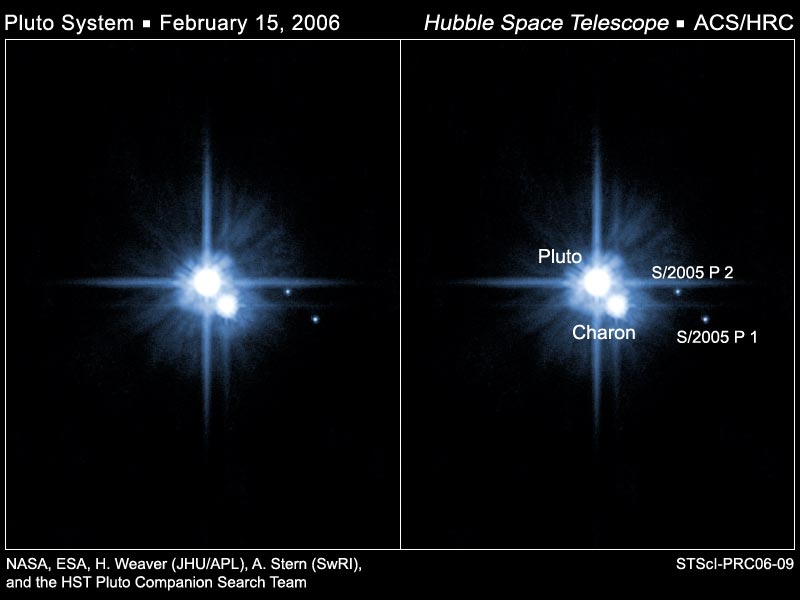
New Pluto's Moons - Credit Nasa/ESA

Astronomers using NASA's Hubble Space Telescope have confirmed the presence of two new moons around the distant planet Pluto. The moons were first discovered by Hubble in May 2005, but the Pluto Companion Search team probed even deeper into the Pluto system with Hubble on Feb. 15 to look for additional satellites and to characterize the orbits of the moons. In the image, Pluto is in the center and Charon is just below it. The moons, provisionally designated S/2005 P 1 and S/2005 P 2, are located to the right of Pluto and Charon.

Sunday, February 12, 2006

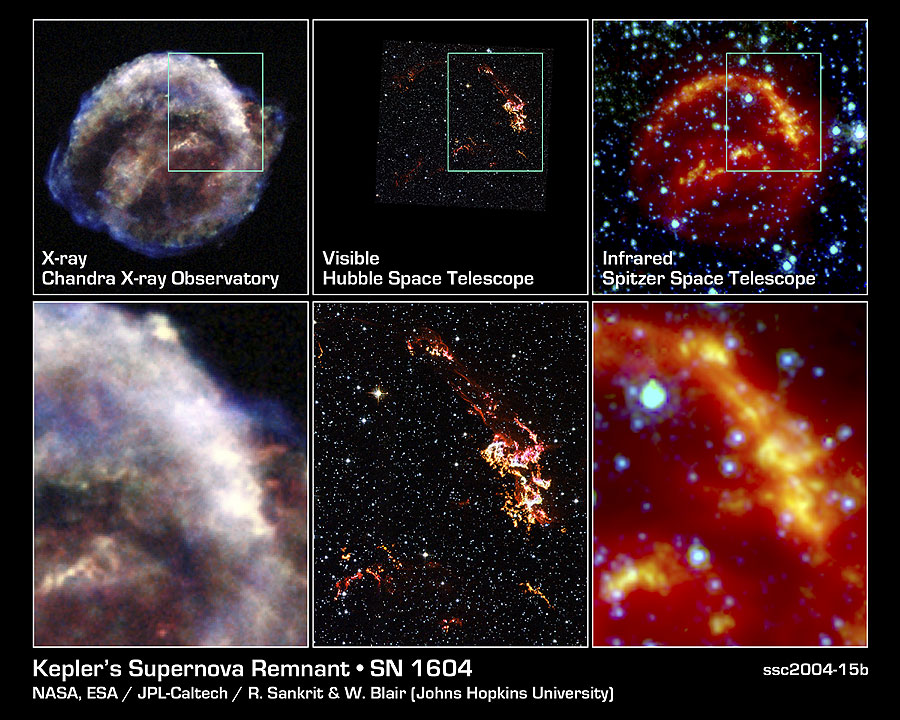
Kepler's Supernova Remnant - Credit Nasa/JPL-Caltech

Views from Chandra, Hubble and Spitzer

These images represent views of Kepler's supernova remnant taken in X-rays, visible light, and infrared radiation.

Each top panel shows the entire remnant. Each color in this image represents a different region of the electromagnetic spectrum, from X-rays to infrared light. The X-ray and infrared data cannot be seen with the human eye. Astronomers have color-coded those data so they can be seen in these images.

The bottom panels are close-up views of the remnant. In the bottom, center image, Hubble sees fine details in the brightest, densest areas of gas. The region seen in these images is outlined in the top, center panel.

View of Distant Galaxies - Courtesy Nasa/JPL-Caltech

The larger picture (top) depicts one-tenth of the Spitzer Wide-area Infrarede Extragalatic (SWIRE) survey field called ELAIS-N1. In this image, the bright blue sources are hot stars in our own Milky Way, which range anywhere from 3 to 60 times the mass of our Sun. The fainter green spots are cooler stars and galaxies beyond the Milky Way whose light is dominated by older stellar populations. The red dots are dusty galaxies that are undergoing intense star formation. The faintest specks of red-orange are galaxies billions of light-years away in the distant universe.

The three lower panels highlight several regions of interest within the ELAIS-N1 field.

The Tadpole galaxy (bottom left) is the result of a recent galactic interaction in the local universe. Although these galactic mergers are rare in the universe's recent history, astronomers believe that they were much more common in the early universe. Thus, SWIRE team members will use this detailed image of the Tadpole galaxy to help understand the nature of the "faint red-orange specks" of the early universe.

The middle panel features an unusual ring-like galaxy called CGCG 275-022. The red spiral arms indicate that this galaxy is very dusty and perhaps undergoing intense star formation. The star-forming activity could have been initiated by a near head-on collision with another galaxy.

The most distant galaxies that SWIRE is able to detect are revealed in a zoom of deep space (bottom right). The colors in this feature represent the same objects as those in the larger field image of ELAIS-N1.

Saturday, February 11, 2006

Fire Within the Antennae Galaxies - Courtesy Nasa/JPL - Caltech/Z

Interacting Antennae Galaxies
Credit: NASA/JPL-Caltech/Z.Wang (Harvard-Smithsonian CfA)


This false-color image from NASA's Spitzer Space Telescope reveals hidden populations of newborn stars at the heart of the colliding "Antennae" galaxies. These two galaxies, known individually as NGC 4038 and 4039, are located around 68 million light-years away and have been merging together for about the last 800 million years. The latest Spitzer observations provide a snapshot of the tremendous burst of star formation triggered in the process of this collision, particularly at the site where the two galaxies overlap.


Stellar Snowflake Cluster - Courtesy Nasa/JPL

Newborn stars, hidden behind thick dust, are revealed in this image of a section of the Christmas Tree Cluster from NASA's Spitzer Space Telescope, created in joint effort between Spitzer's Infrared Array Camera (IRAC) and Multiband Imaging Photometer (MIPS) instruments.

The newly revealed infant stars appear as pink and red specks toward the center of the combined IRAC-MIPS image (left panel). The stars appear to have formed in regularly spaced intervals along linear structures in a configuration that resembles the spokes of a wheel or the pattern of a snowflake. Hence, astronomers have nicknamed this the "Snowflake Cluster."

Star-forming clouds like this one are dynamic and evolving structures. Since the stars trace the straight line pattern of spokes of a wheel, scientists believe that these are newborn stars, or "protostars." At a mere 100,000 years old, these infant structures have yet to "crawl" away from their location of birth. Over time, the natural drifting motions of each star will break this order, and the snowflake design will be no more.