Releases from NASA, HubbleSite, Spitzer, ESO, ESA, NASA’s Chandra X-ray Observatory, Royal Astronomical Society, Harvard-Smithsonian Center For Astrophysics, Max Planck Institute, Gemini Observatory, Subaru Telescope, W. M. Keck Observatory, JPL-Caltech, ICRAR, Webb Space Telescope, etc
Sunday, July 09, 2006
NGC 2392 - Eskimo Nebula
Friday, June 23, 2006
Pluto and Its Moons: Charon, Nix, and Hydra
Tuesday, June 06, 2006
The supernova remnant 1E0102.2-7219
NGC 6164 - A Bipolar Emission Nebula
Friday, June 02, 2006
IC 443 - Supernova Remnant and Neutron Star
Credit: Chandra X-ray: NASA/CXC/B.Gaensler et al; ROSAT X-ray: NASA/ROSAT/Asaoka & Aschenbach; Radio Wide: NRC/DRAO/D.Leahy; Radio Detail: NRAO/VLA; Optical: DSS
Tuesday, May 23, 2006
Gravitational Lens SDSS J1004+4112
The multiple-image effect seen in the Hubble picture is produced by a process called gravitational lensing, in which the gravitational field of a massive object — in this case, a cluster of galaxies — bends and amplifies light from an object — in this case, a quasar — farther behind it.
Wednesday, May 10, 2006
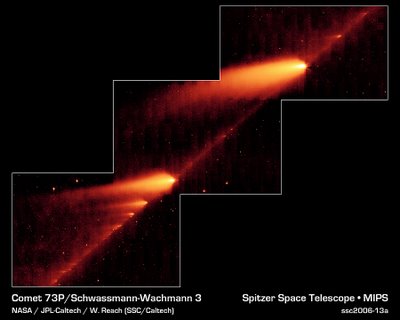
Comet 73P /Schwassman-Wachmann 3
Comet 73P /Schwassman-Wachmann 3 began to splinter apart in 1995 during one of its voyages around the sweltering sun. Since then, the comet has continued to disintegrate into dozens of fragments, at least 36 of which can be seen here. Astronomers believe the icy comet cracked due the thermal stress from the sun.
The Spitzer image provides the best look yet at the trail of debris left in the comet's wake after its 1995 breakup. The observatory's infrared eyes were able to see the dusty comet bits and pieces, which are warmed by sunlight and glow at infrared wavelengths. This comet debris ranges in size from pebbles to large boulders. When Earth passes near this rocky trail every year, the comet rubble burns up in our atmosphere, lighting up the sky in meteor showers. In 2022, Earth is expected to cross close to the comet's trail, producing a noticeable meteor shower.
Astronomers are studying the Spitzer image for clues to the comet's composition and how it fell apart. Like NASA's Deep Impact experiment, in which a probe smashed into comet Tempel 1, the cracked Comet 73P/Schwassman-Wachmann 3 provides a perfect laboratory for studying the pristine interior of a comet.
This image was taken from May 4 to May 6 by Spitzer's Multiband Imaging Photometer, using its 24-micron wavelength channel.
Sunday, May 07, 2006
NGC 2440 - Cocoon of a New White Dwarf
Like a butterfly, a white dwarf star begins its life by casting off a cocoon that enclosed its former self. In this analogy, however, the Sun would be a catepillar and the ejected shell of gas would become the prettiest of all! In the above cocoon, the planetary nebula designated NGC 2440, contains one of the hottest white dwarf stars known. The white dwarf can be seen as the bright dot near the photo's center. Our Sun will eventually become a white dwarf butterfly, but not for another 5 billion years. The false color image was post-processed by Forrest Hamilton.Saturday, May 06, 2006
Hubble Snaps Baby Pictures of Jupiter's "Red Spot Jr."
NASA's Hubble Space Telescope is giving astronomers their most detailed view yet of a second red spot emerging on Jupiter. For the first time in history, astronomers have witnessed the birth of a new red spot on the giant planet, which is located half a billion miles away. The storm is roughly one-half the diameter of its bigger and legendary cousin, the Great Red Spot. Researchers suggest that the new spot may be related to a possible major climate change in Jupiter's atmosphere.Wednesday, April 26, 2006
NGC 2207 and IC 2163
Sunday, April 09, 2006
Molecular Cloud Barnard 68 - Credit: FORS Team, 8.2-meter VLT Antu, ESO
Where did all the stars go? What used to be considered a hole in the sky is now known to astronomers as a dark molecular cloud . Here, a high concentration of dust and molecular gas absorb practically all the visible light emitted from background stars. The eerily dark surroundings help make the interiors of molecular cloudssome of the coldest and most isolated places in the universe. One of the most notable of these dark absorption nebulae is a cloud toward the constellation Ophiucus known as Barnard 68. That no stars are visible in the center indicates that Barnard 68 is relatively nearby, with measurements placing it about 500 light-years away and half al igth-year across. It is not known exactly how molecular clouds like Barnard 68 form, but it is known that these clouds are themselves likely placesfor new stars to form. It is possible to look right through the cloud in infrared light.Tuesday, March 14, 2006
CG4 - A Ruptured Cometary Globule - Credit & Copyright: T. A. Rector (U. Alaska), T. Abbott, NOAO, AURA, NSF
Can a gas cloud eat a galaxy? It's not even close. The odd looking "creature" in the center of the photo is a gas cloud known as a cometary globule . This globule, however, has ruptured. Cometary globules are typically characterized by dusty heads and elongated tails . These features cause cometary globules to have visual similarities to comets, but in reality they are very much different. Globules are frequently the birthplaces of stars, and many show very young stars in their heads. The reason for the rupture in the head of this object is not completely known. The galaxy to the left of center is huge, very far in the distance, and only placed near CG4 by chance superposition.
Saturday, March 04, 2006
Stephan’s Quintet Galaxy Cluster - Credit: NASA/JPL-Caltech/Max Planck Institute

Stephan’s Quintet Galaxy Cluster
Monday, February 27, 2006
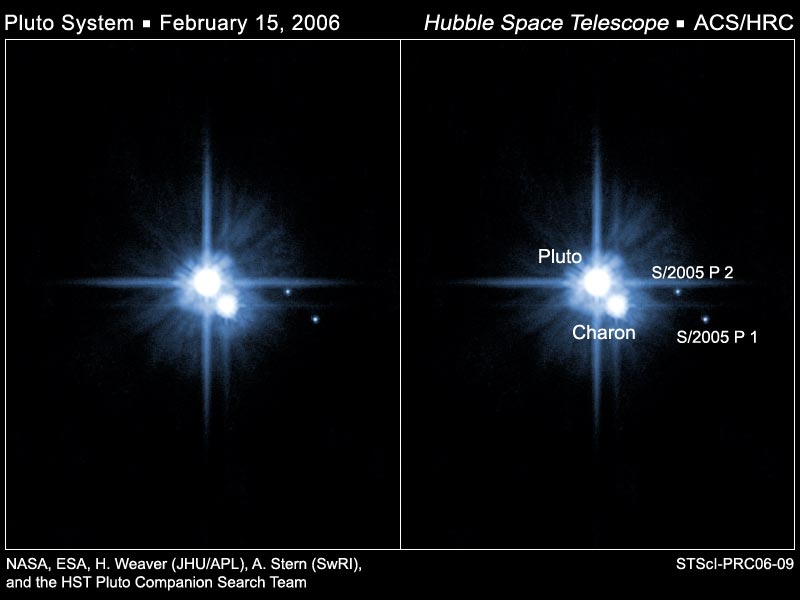
New Pluto's Moons - Credit Nasa/ESA
Astronomers using NASA's Hubble Space Telescope have confirmed the presence of two new moons around the distant planet Pluto. The moons were first discovered by Hubble in May 2005, but the Pluto Companion Search team probed even deeper into the Pluto system with Hubble on Feb. 15 to look for additional satellites and to characterize the orbits of the moons. In the image, Pluto is in the center and Charon is just below it. The moons, provisionally designated S/2005 P 1 and S/2005 P 2, are located to the right of Pluto and Charon.Sunday, February 12, 2006
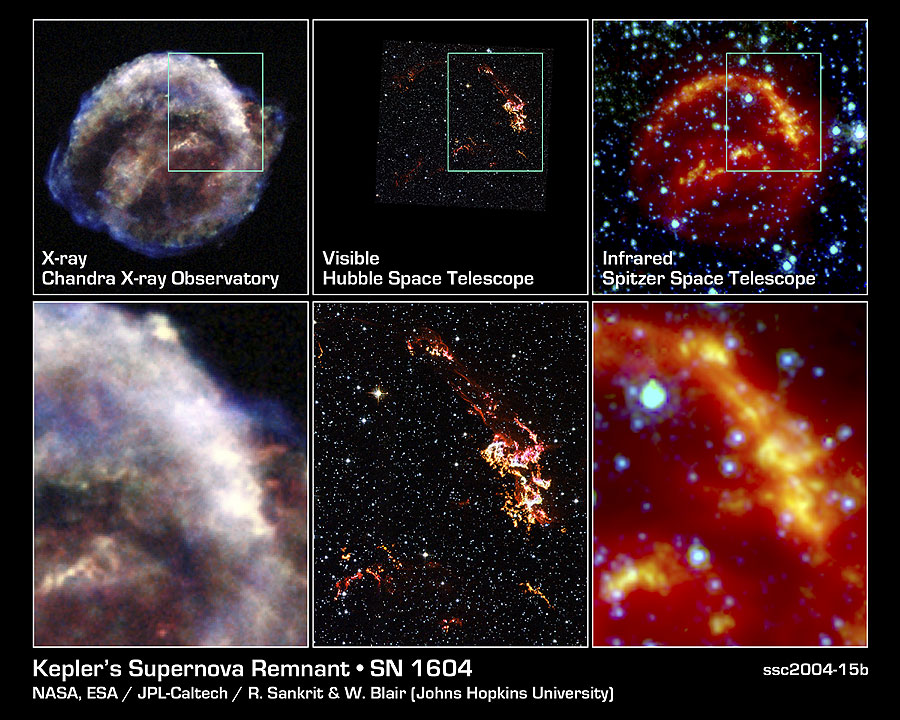
Kepler's Supernova Remnant - Credit Nasa/JPL-Caltech
These images represent views of Kepler's supernova remnant taken in X-rays, visible light, and infrared radiation.
Each top panel shows the entire remnant. Each color in this image represents a different region of the electromagnetic spectrum, from X-rays to infrared light. The X-ray and infrared data cannot be seen with the human eye. Astronomers have color-coded those data so they can be seen in these images.
The bottom panels are close-up views of the remnant. In the bottom, center image, Hubble sees fine details in the brightest, densest areas of gas. The region seen in these images is outlined in the top, center panel.
View of Distant Galaxies - Courtesy Nasa/JPL-Caltech
The larger picture (top) depicts one-tenth of the Spitzer Wide-area Infrarede Extragalatic (SWIRE) survey field called ELAIS-N1. In this image, the bright blue sources are hot stars in our own Milky Way, which range anywhere from 3 to 60 times the mass of our Sun. The fainter green spots are cooler stars and galaxies beyond the Milky Way whose light is dominated by older stellar populations. The red dots are dusty galaxies that are undergoing intense star formation. The faintest specks of red-orange are galaxies billions of light-years away in the distant universe. The three lower panels highlight several regions of interest within the ELAIS-N1 field.
The Tadpole galaxy (bottom left) is the result of a recent galactic interaction in the local universe. Although these galactic mergers are rare in the universe's recent history, astronomers believe that they were much more common in the early universe. Thus, SWIRE team members will use this detailed image of the Tadpole galaxy to help understand the nature of the "faint red-orange specks" of the early universe.
The middle panel features an unusual ring-like galaxy called CGCG 275-022. The red spiral arms indicate that this galaxy is very dusty and perhaps undergoing intense star formation. The star-forming activity could have been initiated by a near head-on collision with another galaxy.
The most distant galaxies that SWIRE is able to detect are revealed in a zoom of deep space (bottom right). The colors in this feature represent the same objects as those in the larger field image of ELAIS-N1.
Saturday, February 11, 2006
Fire Within the Antennae Galaxies - Courtesy Nasa/JPL - Caltech/Z
This false-color image from NASA's Spitzer Space Telescope reveals hidden populations of newborn stars at the heart of the colliding "Antennae" galaxies. These two galaxies, known individually as NGC 4038 and 4039, are located around 68 million light-years away and have been merging together for about the last 800 million years. The latest Spitzer observations provide a snapshot of the tremendous burst of star formation triggered in the process of this collision, particularly at the site where the two galaxies overlap.
Stellar Snowflake Cluster - Courtesy Nasa/JPL
Newborn stars, hidden behind thick dust, are revealed in this image of a section of the Christmas Tree Cluster from NASA's Spitzer Space Telescope, created in joint effort between Spitzer's Infrared Array Camera (IRAC) and Multiband Imaging Photometer (MIPS) instruments. The newly revealed infant stars appear as pink and red specks toward the center of the combined IRAC-MIPS image (left panel). The stars appear to have formed in regularly spaced intervals along linear structures in a configuration that resembles the spokes of a wheel or the pattern of a snowflake. Hence, astronomers have nicknamed this the "Snowflake Cluster."
Star-forming clouds like this one are dynamic and evolving structures. Since the stars trace the straight line pattern of spokes of a wheel, scientists believe that these are newborn stars, or "protostars." At a mere 100,000 years old, these infant structures have yet to "crawl" away from their location of birth. Over time, the natural drifting motions of each star will break this order, and the snowflake design will be no more.
Cosmic Tornado - HH49/50 - Courtesy Nasa/JPL-Caltech

This "tornado," designated Herbig-Haro 49/50, is shaped by a cosmic jet packing a powerful punch as it plows through clouds of interstellar gas and dust.
The tornado-like feature is actually a shock front created by a jet of material flowing downward through the field of view. A still-forming star located off the upper edge of the image generates this outflow. The jet slams into neighboring dust clouds at a speed of more than 100 miles per second, heating the dust to incandescence and causing it to glow with infrared light detectable by Spitzer. The triangular shape results from the wake created by the jet's motion, similar to the wake behind a speeding boat.
HH 49/50 is located in the Chamaeleon I star-forming complex, a region containing more than 100 young stars. Most of the new stars are smaller than the sun, although some are more massive. Visible-light observations have found a number of outflows in the region, however most of those outflows have no infrared counterpart.
Thursday, January 19, 2006
The Southern Ring Nebula (NGC 3132) - Courtesy Nasa/Hubble Heritage
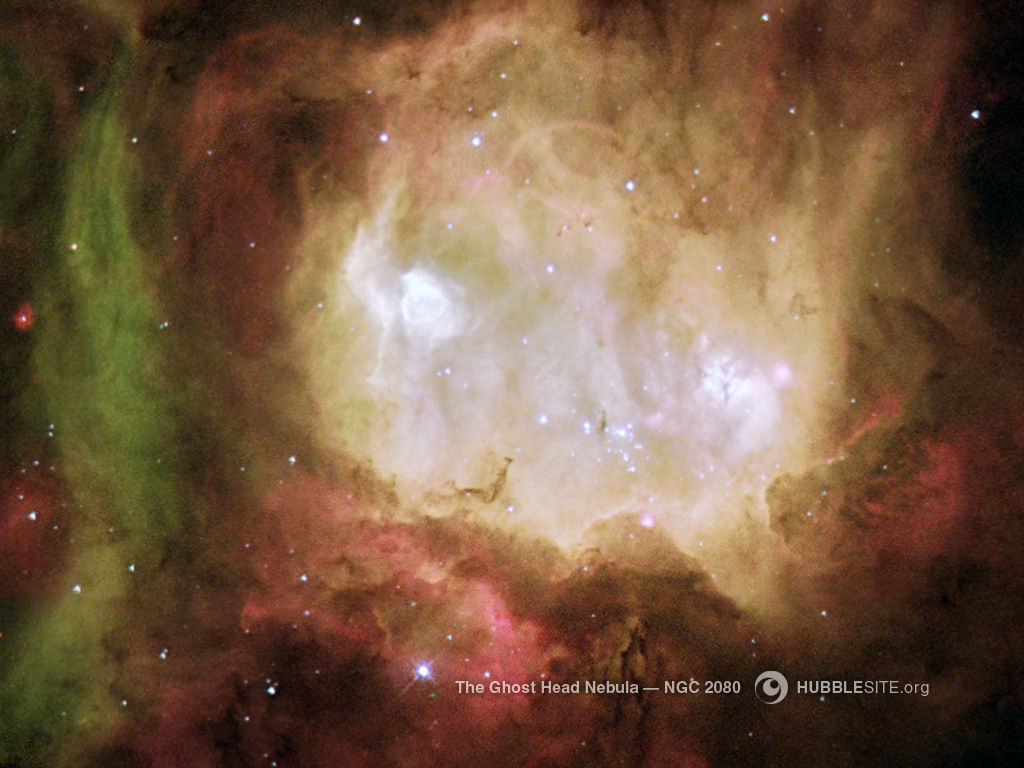
This planetary nebula, also known as the "Eight-Burst" Nebula because of its figure-8 appearance through amateur astronomer telescopes, is visible in the southern hemisphere. NGC 3132 is nearly half a light year in diameter and 2,000 light years away. Gases are moving away from the dying star at its center at a speed of nine miles per second (14.4 km/s).The Ghost Head Nebula - NGC 2028 - Courtesy Nasa/Esa
This nebula is one of a chain of star-forming regions lying south of the 30 Doradus nebula in the Large Magellanic Cloud. The red and blue light comes from regions of hydrogen gas heated by nearby stars. The green light comes from glowing oxygen, illuminated by the energy of a stellar wind. The white center shows a core of hot, massive stars.
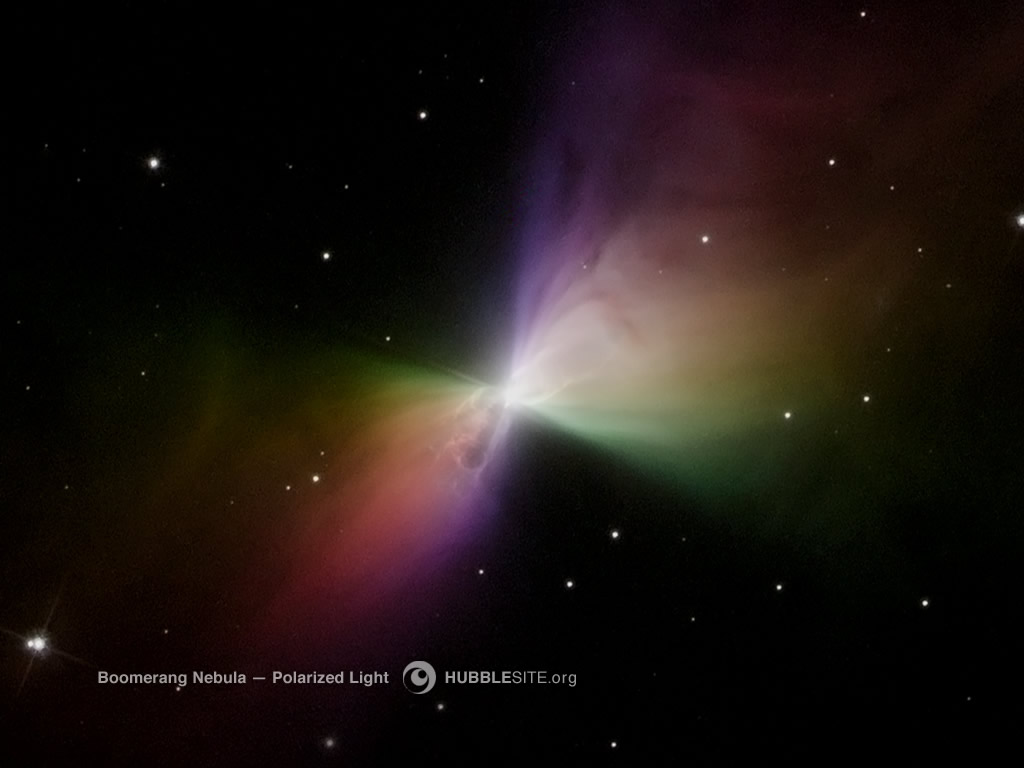
Boomerang Nebula
The Hubble Space Telescope has "caught" the Boomerang Nebula in these new images taken with the Advanced Camera for Surveys. This reflecting cloud of dust and gas has two nearly symmetric lobes (or cones) of matter that are being ejected from a central star. Over the last 1,500 years, nearly one and a half times the mass of our Sun has been lost by the central star of the Boomerang Nebula in an ejection process known as a bipolar outflow. The nebula's name is derived from its symmetric structure as seen from ground-based telescopes. Hubble's sharp view is able to resolve patterns and ripples in the nebula very close to the central star that are not visible from the ground.Orion Nebula - Courtesy Nasa/Hubble Heritage
NASA's Hubble Space Telescope has captured one of the most detailed astronomical images in history. Released yesterday, the original of this Orion Nebula image is a mosaic of a billion pixels—nearly 5,000 times sharper than the 212,521-pixel version on this page.
Despite their stunning depiction of stars still forming in wombs of gas and dust (as well as thousands of heretofore unseen stars), these details aren't simply in the service of beauty.
Wednesday, January 11, 2006
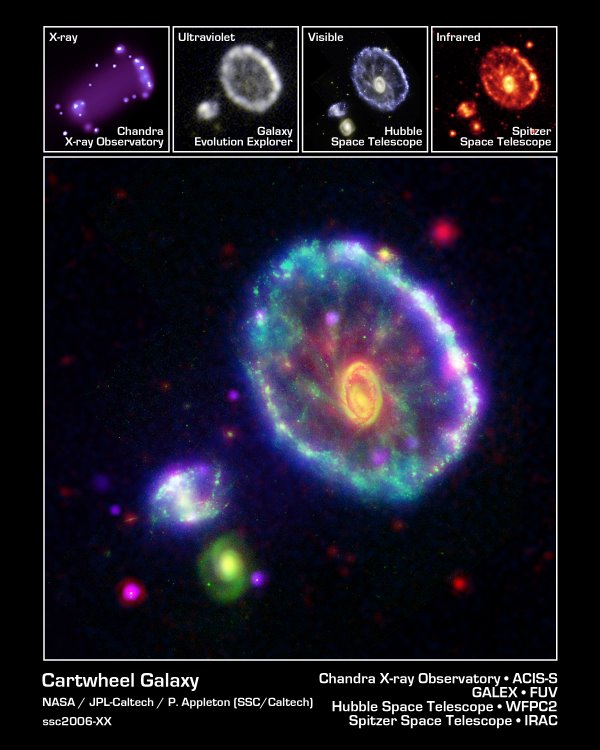
Cartwheel Galaxy
Image Left:Tuesday, January 03, 2006
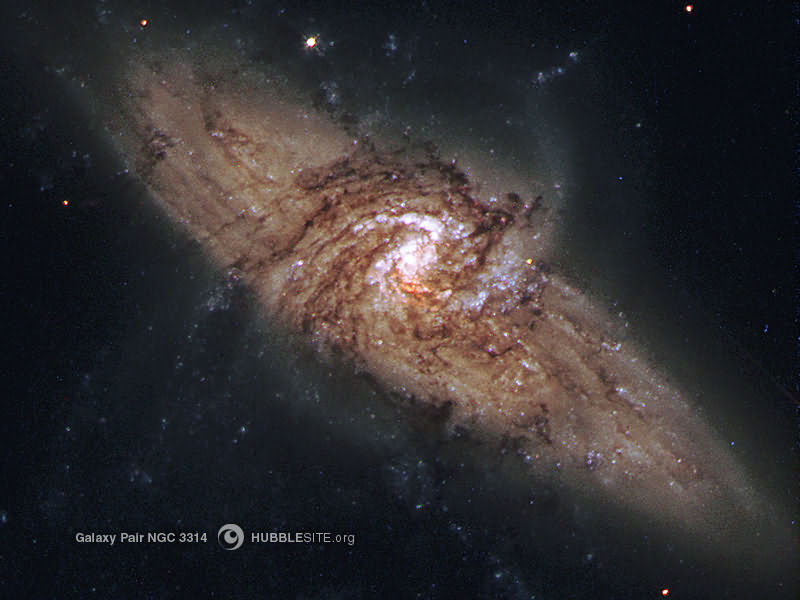
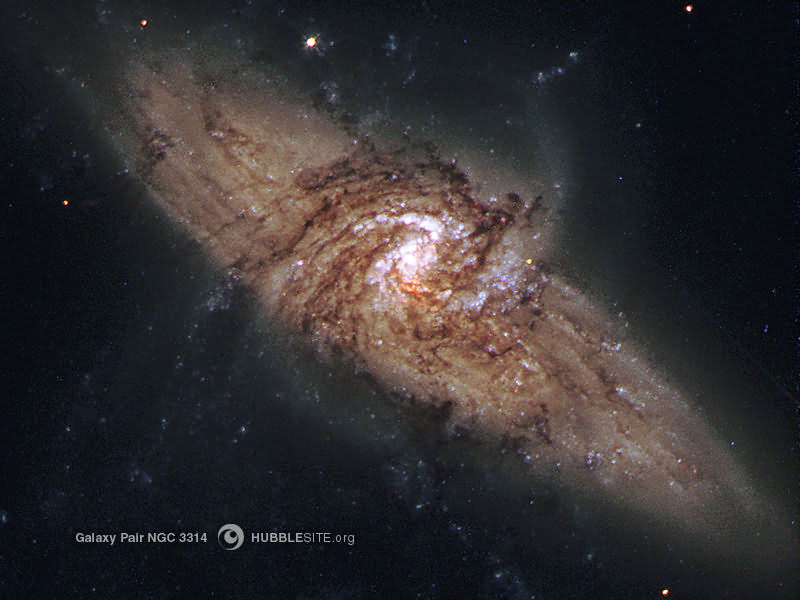
Galaxy Pair NGC 3314
This image from NASA's Hubble Space Telescope and its Wide Field Planetary Camera 2(WFPC2) shows the unique galaxy pair called NGC 3314. Through an extraordinary chance alignment, a face-0n spiral galaxy lies precisely
in front of another larger spiral. This line-up provides us with rare chance to visualize dark material within the front galaxy, seen only because it is silhouetted against the object behind it.