Showing posts with label massive elliptical galaxies. Show all posts

Monday, December 14, 2020

That young but already mature entirely self-made galaxy

Color image of the galaxy C1-23152 at redshift z=3.352, when the Universe was 1.8 billion years old. The image is the sum of 3 images at different wavelengths taken with the Hubble Space Telescope.  C1-23152 appears a regular spheroidal galaxy, its light profile matches exactly those of typical elliptical galaxies in the local Universe. Its stellar mass is about 200 billions of stars like sun and it is formed in less than 500 million years.

So young and already so mature: thanks to observations obtained at the Large Binocular Telescope, an international team of researchers coordinated by Paolo Saracco of the Istituto Nazionale di Astrofisica (INAF, Italy) was able to reconstruct the wild evolutionary history of an extremely massive galaxy that existed 12 billions years ago, when the Universe was only 1,8 billions years old, less than 13% of the present age. This galaxy, dubbed C1-23152, formed in "just" 500 million years, an incredibly short time to give rise to a mass of about 200 billion suns. To do so, it produced as many as 450 stars per year, more than one per day, a star formation rate almost 300 times higher than the current rate in our galaxy, the Milky Way.  The information obtained from this study will be fundamental for galaxy formation models for which the nature of objects such as C1-23152 is still difficult to account for.

The most massive galaxies that we observe in the Universe reach masses several hundred billion times that of the Sun and although they are numerically just one third of all galaxies, they contain more than 70% of the stars in the Universe. For this reason, how and how rapidly these galaxies formed are among the most debated questions of modern astrophysics. The current model of galaxy formation - the so-called hierarchical model - predicts that smaller galaxies formed earlier, while more massive systems formed later, through subsequent mergers of the pre-existing smaller galaxies. On the other hand, some of the properties of the most massive galaxies observed in the local Universe, such as the age of their stellar populations, suggest instead that they were formed at early epochs. Unfortunately, the variety of evolutionary phenomena that galaxies can undergo during their lives does not allow us to uniquely define, through studies conducted in the nearby Universe, the way in which they formed, leaving large margins of uncertainty. However, an answer to these questions can come from the study of the properties of massive galaxies in the early Universe, as close as possible to the time when they formed most of their mass.

Seventeen hours of spectroscopic observations with the Large Binocular Telescope (LBT) of the elliptical galaxy C1-23152, previously identified at a distance at which the Universe age was less than 13% of its current age, allowed Saracco’s team to reconstruct its evolutionary history. “The data show that the formation time of C1-23152, that is the time elapsed between the formation of the first stars from the pre-existing gas to the moment when the star formation has almost completely ceased, is less than 500 million of years” says Paolo Saracco, researcher at INAF in Milan and first author of the article published in The Astrophysical Journal. “Also, from the data collected with LBT we were able to establish that in this short time, corresponding to less than 4 hundredths of the age of the Universe, the galaxy formed a mass equal to about 200 billion stars like the Sun, that is about 450 suns per year. Our galaxy, the Milky Way, now forms no more than two a year", adds Danilo Marchesini, full professor at Tufts University and second author of the article. But that is not all. The large amount of information collected allowed the team to quantify for the first time in a galaxy so distant the abundance of chemical elements heavier than helium (the so-called metallicity): the stars of this galaxy have, surprisingly, a higher metallicity than that of the Sun, similar to that observed in the most massive galaxies in the Universe today.

Spectrum of galaxy C1-23152. The top panel shows the atmospheric transmission in the wavelength range of observations. In the middle panel the one-dimensional spectrum of galaxy C1-23152 is shown in the original form (dark-gray curve) and smoothed by a boxcar filter over three pixels (black curve) corresponding to the instrumental resolution. The main absorption and emission lines are marked by solid and dashed lines, respectively. The red curve is the best-fitting composite model obtained with STARLIGHT. The shaded gray regions are those masked in the fitting because of bad sky transmission or the presence of emission lines. For comparison, the bottom panel shows the observed spectrum of a typical post-starburst galaxy in the local Universe selected from the Sloan Digital Sky Survey (SDSS).

“These observations showed that the formation of the most massive galaxies in the Universe can occur extremely quickly, through an extremely intense star formation process in the early Universe, as for C1-23152", underlines Francesco La Barbera, researcher at INAF in Naples, in the team that conducted the study. "Understanding whether the scenario that describes the formation of C1-23152 is a particular case or whether, on the contrary, it is what happens for most of the most massive galaxies in the Universe is of fundamental importance since this would require a profound revision of the galaxy formation models”, adds Adriana Gargiulo, also a researcher at INAF in Milan and co-author of the study.

Likely formation scenario of massive elliptical galaxies like C1-23152. Massive primordial gas clouds, falling in the same region under the effect of gravitational force, collide triggering violent and massive star formation processes. The starburst phase is expected to last few hundreds of million years during which hundreds to thousands stars per year are formed, as for C1-23152. The resulting massive elliptical galaxy will then evolve with time, possibly experiencing different evolutionary phenomena. 

The formation of stellar masses as high as for C1-23152 requires both high masses of gas to convert into stars and particular physical conditions. A possible scenario hypothesized by the researchers is that massive primordial gas clouds, falling under the effect of gravitational force in the same region, collide, triggering violent and massive star formation processes. From the observational point of view, the precursors of the most massive galaxies could therefore be remote galaxies with a very high rate of star formation.
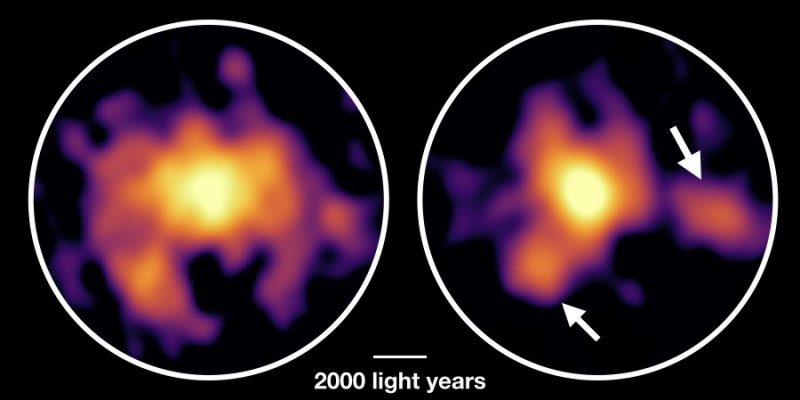
This image shows an example of starburst galaxies forming about a thousand of stars per year at the time of observation. This phase is most likely the formation phase of massive galaxies in the early Universe, like C1-23152.

"To test our hypotheses, the observations that the next generation of instrumentations will allow us to carry out will be decisive, in particular the James Webb Space Telescope (JWST) which will be launched in orbit at the end of 2021, and the Extremely Large Telescope (ELT) the largest ground-based telescope ever built, with a main mirror of 39 meters in diameter, which will be operational in 2026”, concludes Saracco.

Science Contacts:

INAF Press Release:     https://www.media.inaf.it/2020/12/10/galassia-vega/

Publication link:  https://arxiv.org/pdf/2011.04657.pdf


 Source: 


Wednesday, January 23, 2019

Seeds of Giant Galaxies formed in the Early Universe

Figure 1: A wide field-of-view false-color image of a massive quiescent galaxy taken by Surpime-Cam on the Subaru Telescope (main image) and a high resolution close-up (inset) by IRCS (Infrared Camera and Spectrograph) on the Subaru Telescope. The yellow circle shows the point spread function of this observation corrected with the AO188 adaptive optics system. (Credit: NAOJ)

An international research team has shown that the largest galaxies in the Universe may have started out as ultra-dense objects in the very early Universe that then expanded over time.

Modern galaxies show a wide diversity, including dwarf galaxies, irregular galaxies, spiral galaxies, and massive elliptical galaxies. This final type, massive elliptical galaxies, provides astronomers with a puzzle. Although they are the most massive galaxies with the most stars, almost all of their stars are old. At some time during the past the progenitors of massive elliptical galaxies must have rapidly formed many stars and then stopped for some reason.

Fortunately, the finite speed of light gives scientists a way to turn back the clock and view the early Universe. If a galaxy is located 12 billion light-years away, then light from that galaxy must have traveled for 12 billion years before it reached Earth. This means that the light we observe today must have left the galaxy 12 billion years ago. In other words the light is the image of what the galaxy looked like 12 billion years ago. By observing galaxies at various distances from Earth, astronomers can reconstruct the history of the Universe.

An international team including researchers from the National Astronomical Observatory of Japan (NAOJ), the University of Tokyo, and Copenhagen University used data from NAOJ's Subaru Telescope and other telescopes to search for galaxies located 12 billion light-years away. Among this sample they identified massive quiescent galaxies, meaning massive galaxies without active star formation, as the probable progenitors of modern giant elliptical galaxies. It is surprising that mature giant galaxies already existed very early, when the Universe was only about ~13% of its current age.

The team then used the Subaru Telescope to perform high resolution follow-up observations in near infrared for the 5 brightest massive quiescent galaxies located 12 billion light-years away.

The results show that although the massive quiescent galaxies are compact (only about 2% the size of the Milky Way) they are almost as heavy as modern galaxies. This means that to become modern giant elliptical galaxies they must puff up about 100 times in size, but only increase in mass by about 5 times. Comparing the observations to toy models, the team showed that this would be possible if the growth was driven, not by major mergers where two similar galaxies merge to form a larger one, but by minor mergers where a large galaxy cannibalizes smaller ones.

Figure 2: The stellar mass (x-axis) and size (y-axis) relation derived assuming that the most massive galaxies at each epoch are the progenitors of the modern most massive giant elliptical galaxies (red). Gray solid and dashed curves show the size evolution driven by many minor mergers and major mergers, respectively. (Credit: NAOJ)

"We are very excited about the implications of our findings," explains corresponding author Mariko Kubo, a post-doctoral researcher at NAOJ. "But we are now at the resolution limit of existing telescopes. The superior spatial resolution of the Thirty Meter Telescope currently under development will allow us to study the morphologies of distant galaxies more precisely. For more distant galaxies beyond 12 billion light-years, we need the next generation James Webb Space Telescope."

These results appeared as Kubo et al. 2018, "The Rest-frame Optical Sizes of Massive Galaxies with Suppressed Star Formation at z∼4" in the Astrophysical Journal on November 20, 2018. This research paper is also available as a preprint (Kubo et al., arXiv:1810.00543) on arxiv.org. This research is supported by KAKENHI Grant Numbers JP15K17617, JP16K17659, and JP18K13578.


Saturday, December 29, 2018

Seeds of Giant Galaxies formed in the Early Universe

Figure 1: A wide field-of-view false-color image of a massive quiescent galaxy taken by Surpime-Cam on the Subaru Telescope (main image) and a high resolution close-up (inset) by IRCS (Infrared Camera and Spectrograph) on the Subaru Telescope. The yellow circle shows the point spread function of this observation corrected with the AO188 adaptive optics system. (Credit: NAOJ)

An international research team has shown that the largest galaxies in the Universe may have started out as ultra-dense objects in the very early Universe that then expanded over time.

Modern galaxies show a wide diversity, including dwarf galaxies, irregular galaxies, spiral galaxies, and massive elliptical galaxies. This final type, massive elliptical galaxies, provides astronomers with a puzzle. Although they are the most massive galaxies with the most stars, almost all of their stars are old. At some time during the past the progenitors of massive elliptical galaxies must have rapidly formed many stars and then stopped for some reason.

Fortunately, the finite speed of light gives scientists a way to turn back the clock and view the early Universe. If a galaxy is located 12 billion light-years away, then light from that galaxy must have traveled for 12 billion years before it reached Earth. This means that the light we observe today must have left the galaxy 12 billion years ago. In other words the light is the image of what the galaxy looked like 12 billion years ago. By observing galaxies at various distances from Earth, astronomers can reconstruct the history of the Universe.

An international team including researchers from the National Astronomical Observatory of Japan (NAOJ), the University of Tokyo, and Copenhagen University used data from NAOJ's Subaru Telescope and other telescopes to search for galaxies located 12 billion light-years away. Among this sample they identified massive quiescent galaxies, meaning massive galaxies without active star formation, as the probable progenitors of modern giant elliptical galaxies. It is surprising that mature giant galaxies already existed very early, when the Universe was only about ~13% of its current age.v The team then used the Subaru Telescope to perform high resolution follow-up observations in near infrared for the 5 brightest massive quiescent galaxies located 12 billion light-years away.

The results show that although the massive quiescent galaxies are compact (only about 2% the size of the Milky Way) they are almost as heavy as modern galaxies. This means that to become modern giant elliptical galaxies they must puff up about 100 times in size, but only increase in mass by about 5 times. Comparing the observations to toy models, the team showed that this would be possible if the growth was driven, not by major mergers where two similar galaxies merge to form a larger one, but by minor mergers where a large galaxy cannibalizes smaller ones.


Figure 2: The stellar mass (x-axis) and size (y-axis) relation derived assuming that the most massive galaxies at each epoch are the progenitors of the modern most massive giant elliptical galaxies (red). Gray solid and dashed curves show the size evolution driven by many minor mergers and major mergers, respectively. (Credit: NAOJ)

"We are very excited about the implications of our findings," explains corresponding author Mariko Kubo, a post-doctoral researcher at NAOJ. "But we are now at the resolution limit of existing telescopes. The superior spatial resolution of the Thirty Meter Telescope currently under development will allow us to study the morphologies of distant galaxies more precisely. For more distant galaxies beyond 12 billion light-years, we need the next generation James Webb Space Telescope."

These results appeared as Kubo et al. 2018,  "The Rest-frame Optical Sizes of Massive Galaxies with Suppressed Star Formation at z∼4" in the Astrophysical Journal on November 20, 2018. This research paper is also available as a preprint (Kubo et al., arXiv:1810.00543) on arxiv.org. This research is supported by KAKENHI Grant Numbers JP15K17617, JP16K17659, and JP18K13578.


Monday, September 03, 2018

The formation of the most diffuse giant galaxy cores in the Universe

Fig. 1: These images show the stellar density distribution in the centres of merging elliptical galaxies. About 30 million years before the final coalescence of the galactic nuclei the supermassive black holes (black dots) are still surrounded by a concentration of stars (upper left panel). When the black holes form a tight binary most of these stars have been ejected, leaving behind a low-density core (upper right panel). A core does not form if the galaxies do not have supermassive black holes (bottom panels). © MPA

Supermassive black holes (SMBH) of up to tens of billon solar masses are hiding in the centers of giant elliptical galaxies. At the same time, these galaxies have ‘missing’ nuclear light as the stellar densities at their cores are much lower than in other giant galaxies. A team of researchers at the University of Helsinki and the astronomical Max Planck Institutes in Garching have used a newly developed simulation technique to investigate the origin of this ‘missing’ light with realistic galaxy models. When two massive elliptical galaxies merge, many central stars are expelled during the final coalescence of the stellar nuclei and their SMBHs. This new model can explain the simultaneous formation of the most diffuse giant galaxy cores as well as other observed core properties such as decoupled rotation and anisotropic stellar velocity distributions.

Massive elliptical galaxies are not just the largest – with up to 1013 solar masses – they also have markedly different properties than their smaller siblings. At their centres they harbour supermassive black holes (SMBHs) with typical masses of 0.1% of the total stellar mass of the galaxy – i.e. these SMBHs can easily exceed billions of solar masses. Also the properties of the stars in the centres of these galaxies are very special. The observed surface densities are much lower than for other giant galaxies, and instead of steep central cusps, these galaxies have very flat density cores. In addition, in many cases the stars in the central regions are predominantly moving on circular orbits, with a conspicuous lack of stars on more radial orbits. Furthermore, the central region as a whole is often rotating quite disconnected from the rest of the galaxy – a property termed decoupled rotation.

The reason behind these differing properties might be merger events - merging elliptical galaxies can be commonly observed in the sky. Already, numerical models have indicated that low-density cores can form when two elliptical galaxies merge. The coalescing nuclei with the SMBHs eject stars from the galaxy centres in a process called ‘SMBH scouring’. Reliable models for this process require very accurate simulation codes in order to correctly resolve the small-scale gravitational interaction of the forming binary black holes with the surrounding stars and the final merger of the SMBHs. Earlier studies so far have typically been limited to relatively low particle numbers as well as idealized galaxy models, and often did not simulate the final merger of the two SMBHs.

Fig. 2: Surface brightness distribution of 7 elliptical galaxy merger simulations with increasing masses of the central SMBHs (various colours, from top to bottom). The magenta line shows the simulation without SMBHs. For increasingly more massive black holes, the central surface brightness is systematically reduced and a larger region of the central core is affected. The models can even explain the observed surface brightness distribution of NGC1600 (open circles), a galaxy with an unusually massive SMBH. © MPA

A team of researchers from the University of Helsinki and MPA/MPE have developed a novel simulation method called KETJU – the Finnish word for chain. This simulation technique allows for much larger and more accurate simulations. The KETJU code combines a hierarchical tree method on large-scales with a modern regularization procedure on small-scales. This allows for the accurate computation of the gravitational forces on kilo-parsec scales in the galactic halo down to the milli-parsec scales where the binary SMBHs emit gravitational waves and finally merge. The simulated elliptical galaxy mergers are also more realistic, as they now include the massive and extended dark matter halo component, in addition to the central stellar component.

The study demonstrates that a central low-density core can form rapidly on a timescale of ~ 30 Myr – but only in cases where merging binary SMBHs are found in the centre of the galaxy. Over this timescale, stars with a total mass similar to the combined mass of the two SMBHs are ejected from the galaxy. In the absence of central SMBHs the central region keeps its high stellar density and no stars are ejected (Fig. 1). The ejection process is stronger for more massive black holes, in good agreement with observations. The simulations can even explain the very extended core region of the very massive galaxy NGC1600 (Fig. 2). For its stellar mass this galaxy has an unusually massive black hole with an accompanying very large low-density core region.

Fig. 3: Velocity maps for simulations with no black hole (top) and a supermassive black Hole (SMBH with 17 × 109 solar masses, bottom). Blue coloured regions are moving towards the observer, red coloured regions are moving away from the observer. A counter-rotating region of the size of the diffuse core is forming in the centre if the SMBH is very massive– very much like in observed giant elliptical galaxies. The contours indicate constant surface density. © MPA

However, the merging black holes affect not only the stellar density of the cores but also the kinematics of the stars in the central region. After the ejection process, the remaining stars are mostly moving on circular orbits and do not come close to the central SMBH binary. Stars on more radial orbits have already before experienced strong interactions with the central SMBH binary and have been kicked out as a result. Again, this process is found to be stronger for more massive SMBHs and agrees well with observational estimates. Finally, the study also shows that massive SMBH binaries can give rise to rotation of the core region. In the case presented here the core is even counter-rotating (Fig. 3). This type of decoupled or misaligned rotation is commonly observed in many massive elliptical galaxies with both SMBHs and low density cores.

The team was able to demonstrate that all major photometric and kinematic properties of the centres of massive elliptical galaxies, such as low density cores, velocity anisotropies, and decoupled rotation, can be explained by a single process: the dynamical evolution and eventual coalescence of SMBHs in a galaxy merger. This process can explain the origin of even the most diffuse galaxy cores in the Universe. In a follow-up study the researchers will investigate the gravitational wave emission signals from the final stages of the SMBH mergers.

Thorsten Naab for the research team:

Antti Rantala & Peter Johansson (University of Helsinki, Finland)

Thorsten Naab & Matteo Frigo (Max Planck Institute for Astrophysics, Garching, Germany)

Jens Thomas (Max Planck Institute for extraterrestrial Physics, Garching, Germany)

We acknowledge support from the Finnish supercomputing center: CSC-IT Center for Science and the Max Planck Supercomputing and Data Facility.


Author

Naab, Thorsten
Scientific Staff
Phone: 2295
Email: tnaab@mpa-garching.mpg.de
Room: 123

Links:

personal homepage (the institute is not responsible for the contents of personal homepages)


Original Publications

1. Rantala, Antti; Pihajoki, Pauli; Johansson, Peter H.; Naab, Thorsten; Lahén, Natalia; Sawala, Till Post-Newtonian Dynamical Modeling of Supermassive Black Holes in Galactic-scale Simulations

ApJ, 840, 53

Source | DOI

2. Rantala, Antti; Johansson, Peter H.; Naab, Thorsten; Thomas, Jens; Frigo, Matteo The formation of extremely diffuse galaxy cores by merging supermassive black holes

Submitted to ApJ

Source


Wednesday, January 29, 2014

Hubble Helps Solve Mystery of Ultra-Compact, Burned-Out Galaxies


Development of Massive Elliptical Galaxies 
This graphic shows the evolutionary sequence in the growth of massive elliptical galaxies over 13 billion years, as gleaned from space-based and ground-based telescopic observations. The growth of this class of galaxies is quickly driven by rapid star formation and mergers with other galaxies.  Credit: NASA, ESA, S. Toft (Niels Bohr Institute), and A. Feild (STScI)

Astronomers combining the power of the Hubble Space Telescope, Spitzer and Herschel infrared space telescopes, and ground-based telescopes have assembled a coherent picture of the formation history of the most massive galaxies in the universe, from their initial burst of violent star formation through their appearance as high stellar-density galaxy cores and to their ultimate destiny as giant ellipticals.

This solves a decade-long mystery as to how compact elliptical-shaped galaxies that existed when the universe was only 3 billion years old, or one-quarter of its current age of 13.8 billion years, already had completed star formation. These compact ellipticals have now been definitively linked directly to an earlier population of dusty starburst galaxies that voraciously used up available gas for star formation very quickly. Then they grew slowly through merging as the star formation in them was quenched, and they eventually became giant elliptical galaxies.

"This is the first time anybody has put together a representative spectroscopic sample of ultra-compact, burned-out galaxies with the high quality of infrared imaging of Hubble," said Sune Toft of the Dark Cosmology Center at the Niels Bohr Institute in Copenhagen.

"We at last show how these compact galaxies can form, how it happened, and when it happened," Toft added. "This basically is the missing piece in the understanding of how the most massive galaxies formed, and how they evolved into the giant ellipticals of today. This had been a great mystery for many years because just 3 billion years after the big bang we see that half of the most massive galaxies have already completed their star formation."

Even more surprising, said Toft, is that these massive, burned-out galaxies were once extremely compact, compared to similar elliptical galaxies seen today in the nearby universe. This means that stars had to be crammed together 10 to 100 times more densely than seen in galaxies today. "It's comparable to the densities of stars in globular clusters, but on the larger scale of a galaxy," said Toft.

In tying together an evolutionary sequence for these compact massive galaxies, Toft identified their progenitors as highly dust-obscured galaxies undergoing rapid star formation at rates that are thousands of times faster than in our Milky Way galaxy. Starbursts in these galaxies are likely ignited when two gas-rich galaxies collided. These galaxies are so dusty that they are almost invisible at optical wavelengths, but are bright at submillimeter wavelengths, where they were first identified nearly two decades ago by the SCUBA (Submillimeter Common-User Bolometer Array) camera on the James Clerk Maxwell Telescope in Hawaii.
Toft's team assembled, for the first time, representative samples of the two galaxy populations using the rich dataset in Hubble's COSMOS (Cosmic Evolution Survey) program.

They constructed the first representative sample of compact quiescent galaxies with accurate sizes and distances (spectroscopic redshifts) measured from the Hubble Space Telescope's CANDELS (Cosmic Assembly Near-Infrared Deep Extragalactic Legacy Survey) and 3D-HST programs. 3D-HST is a near-infrared Hubble spectroscopic survey to study the physical processes that shape galaxies in the distant universe. The astronomers combined these data with observations from the Subaru telescope in Hawaii and NASA's Spitzer Space Telescope. This allowed for accurate stellar age estimates, from which they concluded that galaxies formed in intense starbursts 1 billion to 2 billion years earlier, in the very early universe.

The team then made the first representative sample of the most distant submillimeter galaxies using the rich COSMOS data from the Hubble, Spitzer, and Herschel space telescopes, and ground-based telescopes such as Subaru, the James Clerk Maxwell Telescope, and the Submillimeter Array. This multi-spectral information, stretching from optical light through submillimeter wavelengths, yielded a full suite of information about the sizes, stellar masses, star-formation rates, dust content, and precise distances of the dust-enshrouded galaxies present early on in the universe.

When Toft's team compared the samples of these two galaxy populations, they discovered a link between the compact elliptical galaxies and the submillimeter galaxies observed 1 billion to 2 billion years earlier. The observations show that the violent starburst activity in the earlier galaxies had the same characteristics that would have been predicted for progenitors to the compact elliptical galaxies. The team also calculated that the intense starburst activity only lasted about 40 million years before the interstellar gas supply was exhausted.

CONTACT

Donna Weaver / Ray Villard
Space Telescope Science Institute, Baltimore, Md.
410-338-4493 / 410-338-4514

dweaver@stsci.edu / villard@stsci.edu
 
Sune Toft
Dark Cosmology Center, Niels Bohr Institute, Copenhagen, Denmark
011-45-3532-5908

sune@dark-cosmology.dk