Showing posts with label gamma-ray blazar. Show all posts

Monday, April 21, 2025

Distant Flares and Nearby Remnants

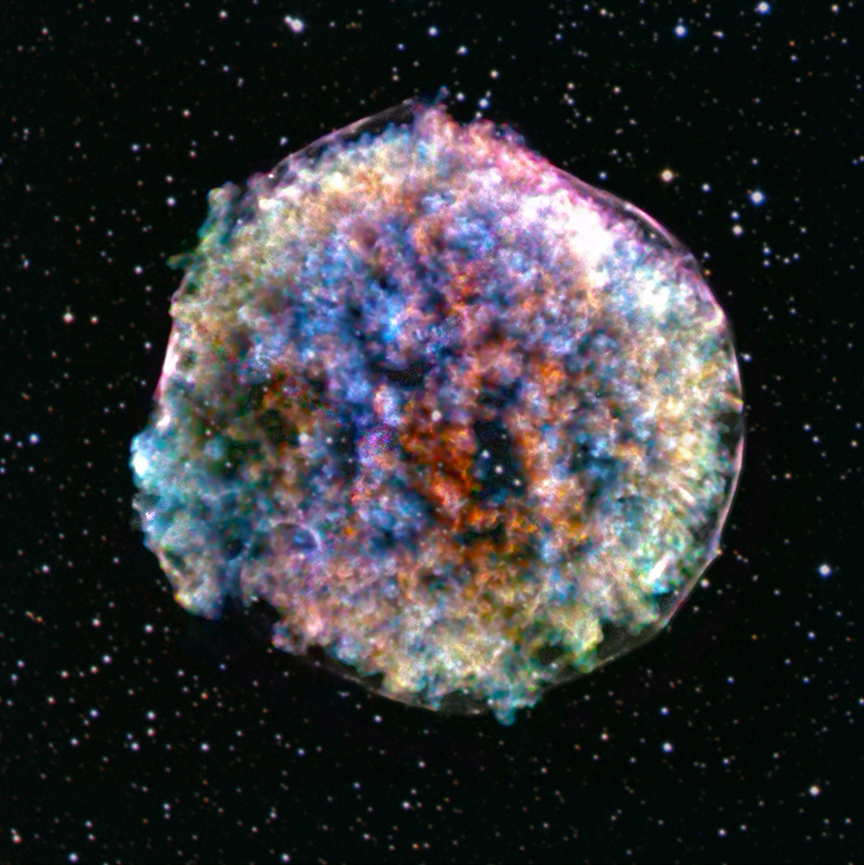
An X-ray image of the Tycho supernova remnant built up from years of observations by the Chandra space telescope, showing the clumpy shape of the explosion's debris. New NuSTAR data will locate energetic sites of cosmic ray acceleration within the remnant. Image credit: NASA/CXC/RIKEN & GSFC/T. Sato et al; DSS.   Download Image


NuSTAR recently observed the distant gamma-ray blazar 4FGL J1428.9+5406 in response to a flare detected by NASA’s Fermi-LAT gamma-ray telescope. Blazars are a subclass of active galaxies—that is, galaxies containing a central supermassive black hole that is actively consuming matter—capable of launching relativistic jets aligned with our line of sight. These objects are highly variable and can produce bright flares lasting from a few days to several weeks. In the early Universe, blazars are typically faint gamma-ray sources and are only detectable during such flare events. These rare flares offer valuable insights into the physics of black hole jets at redshifts greater than 3—that is, within the first 2 billion years after the Big Bang. This NuSTAR observation of 4FGL J1428.9+5406 was triggered by a team monitoring about 80 high-redshift blazars with Fermi-LAT. Their program aims to collect near-simultaneous data across multiple wavelengths, from radio to X-ray, which are essential for probing the origin of the flare and constraining the power of the jet. Understanding how such powerful jets are launched and sustained in the early Universe will inform models of black hole growth and feedback during this epoch of high activity.

Last week, NuSTAR observed the Tycho supernova remnant, the remains of a stellar explosion that was famously visible to the naked eye 453 years ago. Young supernova remnants like Tycho are known to accelerate cosmic rays, such as electrons, to ultra-relativistic energies exceeding 1 TeV. This extreme phenomenon can be detected in the high energy X-ray band through synchrotron radiation emitted by these energetic electrons. NuSTAR first observed the Tycho remnant in 2014 for a total of 750 ks—more than eight days of exposure time—showcasing its exceptional high energy X-ray imaging and spectral capabilities by pinpointing the most energetic acceleration sites down to arcminute scales within this 9-arcminute-wide remnant, and precisely measuring their synchrotron spectra to high X-ray energies of 40 keV. A new observation begun last week totaling 500 ks, or nearly six days, will reveal how Tycho's electron acceleration has evolved over the past decade, providing a unique opportunity to tightly constrain the spectrum of accelerated electrons, deepen our understanding of cosmic-ray acceleration mechanisms, and estimate Tycho's contribution to the most energetic Galactic cosmic rays. For a related study by the same team of researchers on a similar source, see this recent article about Cassiopeia A.

Authors: Andrea Gokus (McDonnell Center Postdoctoral Fellow, Washington University), Jooyun Woo (Postdoctoral scholar, Columbia University), Hannah Earnshaw (NuSTAR Project Scientist, Caltech).


Thursday, August 25, 2016

NASA's WISE, Fermi Missions Reveal a Surprising Blazar Connection

An analysis of blazar properties observed by the Wide-field Infrared Survey Explorer (WISE) and Fermi's Large Area Telescope (LAT) reveal a correlation in emissions from the mid-infrared to gamma rays, an energy range spanning a factor of 10 billion. When plotted by gamma-ray and mid-infrared colors, confirmed Fermi blazars (gold dots) form a unique band not shared by other sources beyond our galaxy. A blue line marks the best fit of these values. The relationship allows astronomers to identify potential new gamma-ray blazars by studying WISE infrared data.
Credits: NASA's Goddard Space Flight Center/Francesco Massaro, University of Turin

Black-hole-powered galaxies called blazars are the most common sources detected by NASA's Fermi Gamma-ray Space Telescope. As matter falls toward the supermassive black hole at the galaxy's center, some of it is accelerated outward at nearly the speed of light along jets pointed in opposite directions. When one of the jets happens to be aimed in the direction of Earth, as illustrated here, the galaxy appears especially bright and is classified as a blazar. Credits: M. Weiss/CfA. Hi-res image


Astronomers studying distant galaxies powered by monster black holes have uncovered an unexpected link between two very different wavelengths of the light they emit, the mid-infrared and gamma rays. The discovery, which was accomplished by comparing data from NASA’s Wide-field Infrared Survey Explorer (WISE) and Fermi Gamma-ray Space Telescope, has enabled the researchers to uncover dozens of new blazar candidates.

Francesco Massaro at the University of Turin in Italy and Raffaele D’Abrusco at the Harvard-Smithsonian Center for Astrophysics in Cambridge, Massachusetts, show for the first time that the mid-infrared colors of blazars in WISE data correlate to an equivalent measurement of their gamma-ray output.

"This connection links two vastly different forms of light over an energy range spanning a factor of 10 billion," said Massaro. "Ultimately, it will help us decipher how supermassive black holes in these galaxies manage to convert the matter around them into vast amounts of energy."

Blazars constitute more than half of the discrete gamma-ray sources seen by Fermi's Large Area Telescope (LAT). At the heart of a blazar lies a supersized black hole with millions of times the sun's mass surrounded by a disk of hot gas and dust. As material in the disk falls toward the black hole, some of it forms dual jets that blast subatomic particles straight out of the disk in opposite directions at nearly the speed of light. A blazar appears bright to Fermi for two reasons. Its jets produce many gamma rays, the highest-energy form of light, and we happen to be viewing the galaxy face on, which means one of its jets is pointing in our direction.

From January to August 2010, NASA's WISE mapped the entire sky in four infrared wavelengths, cataloging more than half a billion sources. In 2011, Massaro, D’Abrusco and their colleagues began using WISE data to investigate Fermi blazars.

"WISE made it possible to explore the mid-infrared colors of known gamma-ray blazars," said D’Abrusco. "We found that when we plotted Fermi blazars by their WISE colors in a particular way, they occupied a distinctly different part of the plot than other extragalactic gamma-ray sources."
The scientists detail new aspects of the infrared/gamma-ray connection in a paper published in The Astrophysical Journal on Aug. 9. They say the electrons, protons and other particles accelerated in blazar jets leave a specific "fingerprint" in the infrared light they emit. This same pattern is also clearly evident in their gamma rays. The relationship effectively connects the dots for blazars across an enormous swath of the electromagnetic spectrum.

About a thousand Fermi sources remain unassociated with known objects at any other wavelength. Astronomers suspect many of these are blazars, but there isn't enough information to classify them. The infrared/gamma-ray connection led the authors to search for new blazar candidates among WISE infrared sources located within the positional uncertainties of Fermi's unidentified gamma-ray objects. When the researchers applied this relationship to Fermi's unknown sources, they quickly found 130 potential blazars. Efforts are now under way to confirm the nature of these objects through follow-up studies and to search for additional candidates using the WISE connection.

"About a third of the gamma-ray objects seen by Fermi remained unknown in the most recent catalog, and this result represents an important advance in understanding their natures," said David Thompson, a Fermi deputy project scientist at NASA’s Goddard Space Flight Center in Greenbelt, Maryland.

NASA's Jet Propulsion Laboratory in Pasadena, California, manages and operates WISE for NASA's Science Mission Directorate in Washington. The spacecraft was put into hibernation mode in 2011 after twice scanning the entire sky, thereby completing its main objectives. In September 2013, WISE was reactivated, renamed NEOWISE and assigned a new mission to assist NASA's efforts to identify potentially hazardous near-Earth objects.

NASA's Fermi Gamma-ray Space Telescope is an astrophysics and particle physics partnership, developed in collaboration with the U.S. Department of Energy and with important contributions from academic institutions and partners in France, Germany, Italy, Japan, Sweden and the United States.

For more information on Fermi, visit:  www.nasa.gov/fermi
For more information on WISE, visit:  www.nasa.gov/wise


For additional information, please contact:

Elizabeth Landau
Jet Propulsion Laboratory, Pasadena, Calif.
818-354-6425

elizabeth.landau@jpl.nasa.gov


By Francis Reddy
NASA's Goddard Space Flight Center, Greenbelt, Maryland

Saturday, April 30, 2016

Possible Extragalactic Source of High-Energy Neutrinos

Coincidence of a highly energetic outburst of an active galactic nucleus with a neutrino event at PeV energy

Nearly 10 billion years ago in a galaxy known as PKS B1424-418, a dramatic explosion occurred. Light from this blast began arriving at Earth in 2012. Now, an international team of astronomers, including scientists from the Max Planck Institute for Radio Astronomy in Bonn, have shown that a record-breaking neutrino seen around the same time likely was born in the same event. The results are published in "Nature Physics".

Fermi LAT images showing the gamma-ray sky around the blazar PKS B1424-418. Brighter colors indicate greater numbers of gamma rays. The dashed arc marks part of the source region established by IceCube for the Big Bird neutrino (50-percent confidence level). Left: An average of LAT data centered on July 8, 2011 covering 300 days when the blazar was inactive. Right: An average of 300 active days centered on Feb. 27, 2013, when PKS B1424-418 was the brightest blazar in this part of the sky. © NASA/DOE/LAT-Kollaboration


Neutrinos are the fastest, lightest and most unsociable understood fundamental particles, and scientists are just now capable of detecting high-energy ones arriving from deep space. The present work provides the first plausible association between a single extragalactic object and one of these cosmic neutrinos.

Although neutrinos far outnumber all the atoms in the universe, they rarely interact with matter, which makes detecting them quite a challenge. But this same property lets neutrinos make a fast exit from places where light cannot easily escape -- such as the core of a collapsing star -- and zip across the universe almost completely unimpeded. Neutrinos can provide information about processes and environments that simply aren't available through a study of light alone.

Recently, the IceCube Neutrino Observatory at the South Pole found first evidence for a flux of extraterrestrial neutrinos, which was named the Physics World breakthrough of the year 2013. To date, the science team of IceCube Neutrino has announced about a hundred very high-energy neutrinos and nicknamed the most extreme events after characters on the children's TV series "Sesame Street." On Dec. 4, 2012, IceCube detected an event known as Big Bird, a neutrino with an energy exceeding 2 quadrillion electron volts (PeV). To put that in perspective, it's more than a million million times greater than the energy of a dental X-ray packed into a single particle thought to possess less than a millionth the mass of an electron. Big Bird was the highest-energy neutrino ever detected at the time and still ranks second.

Where did it come from? The best IceCube position only narrowed the source to a patch of the southern sky about 32 degrees across, equivalent to the apparent size of 64 full moons. “It’s like a crime scene investigation”, says lead author Matthias Kadler, a professor of astrophysics at the University of Würzburg in Germany, “The case involves an explosion, a suspect, and various pieces of circumstantial evidence.”

Starting in the summer of 2012, NASA’s Fermi satellite witnessed a dramatic brightening of PKS B1424-418, an active galaxy classified as a gamma-ray blazar. An active galaxy is an otherwise typical galaxy with a compact and unusually bright core. The excess luminosity of the central region is produced by matter falling toward a supermassive black hole weighing millions of times the mass of our sun. As it approaches the black hole, some of the material becomes channeled into particle jets moving outward in opposite directions at nearly the speed of light. In blazars one of these jets happens to point almost directly toward Earth.

During the year-long outburst, PKS B1424-418 shone between 15 and 30 times brighter in gamma rays than its average before the eruption. The blazar is located within the Big Bird source region, but then so are many other active galaxies detected by Fermi.

These radio images from the TANAMI project reveal the 2012-2013 eruption of PKS B1424-418 at a radio frequency of 8.4 GHz. The core of the blazar’s jet brightened by four times, producing the most dramatic blazar outburst TANAMI has observed to date. © TANAMI Collaboration

The scientists searching for the neutrino source then turned to data from a long-term observing program named TANAMI. Since 2007, TANAMI has routinely monitored nearly 100 active galaxies in the southern sky, including many flaring sources detected by Fermi. Three radio observations between 2011 and 2013 cover the period of the Fermi outburst. They reveal that the core of the galaxy's jet had been brightening by about four times. “No other of our galaxies observed by TANAMI over the life of the program has exhibited such a dramatic change”, explains Eduardo Ros, from the Max Planck Institute for Radio Astronomy (MPIfR) in Bonn, Germany.

Within their jets, blazars are capable of accelerating protons to relativistic energies. Interactions of these protons with light in the central regions of the blazar can create pions. When these pions decay, both gamma rays and neutrinos are produced. "We combed through the field where Big Bird must have originated looking for astrophysical objects capable of producing high-energy particles and light," says coauthor Felicia Krauß, a doctoral student at the University of Erlangen-Nürnberg in Germany. "There was a moment of wonder and awe when we realized that the most dramatic outburst we had ever seen in a blazar happened in just the right place at just the right time."

In a paper published Monday, April 18, in Nature Physics, the team suggests the PKS B1424-418 outburst and Big Bird are linked, calculating only a 5-percent probability the two events occurred by chance alone. Using data from Fermi, NASA’s Swift and WISE satellites, the LBA and other facilities, the researchers determined how the energy of the eruption was distributed across the electromagnetic spectrum and showed that it was sufficiently powerful to produce a neutrino at PeV energies.

"Taking into account all of the observations, the blazar seems to have had means, motive and opportunity to fire off the Big Bird neutrino, which makes it our prime suspect," explains Matthias Kadler.

Francis Halzen, the principal investigator of IceCube at the University of Wisconsin–Madison, and not involved in this study, thinks the result is an exciting hint of things to come. "IceCube is about to send out real-time alerts when it records a neutrino that can be localized to an area a little more than half a degree across, or slightly larger than the apparent size of a full moon," he says. "We're slowly opening a neutrino window onto the cosmos." "This study demonstrates the vital importance of classical astronomical observations in an era when new detection methods like neutrino observatories and gravitational-wave detectors open new but unknown skies", concludes Anton Zensus, director at MPIfR and head of its Radio Astronomy/VLBI research department, also a coauthor of the study.

Source: Max Planck Institute for Radio Astronomy


Local Contacts


Prof. Dr. Eduardo Ros
Phone:+49 228 525-125
Email: ros@mpifr-bonn.mpg.de  
Max-Planck-Institut für Radioastronomie, Bonn

Prof. Dr. J. Anton Zensus
Director and Head of "Radio Astronomy/VLBI" Research Dept.
Phone: +49 228 525-298 (secretary)
Email: azensus@mpifr-bonn.mpg.de
Max-Planck-Institut für Radioastronomie, Bonn

Dr. Norbert Junkes
Press and Public Outreach Phone:+49 228 525-399
Email: njunkes@mpifr-bonn.mpg.de
Max-Planck-Institut für Radioastronomie, Bonn


Original Paper 


TANAMI is a multiwavelength monitoring program of active galaxies in the Southern sky. It includes regular radio observations using the Australian Long Baseline Array (LBA) and associated telescopes in Chile, South Africa, New Zealand and Antarctica. When networked together, they operate as a single radio telescope more than 6,000 miles across and provide a unique high-resolution look into the jets of active galaxies.

The IceCube Neutrino Observatory, built into a cubic kilometer of clear glacial ice at the South Pole, detects neutrinos when they interact with atoms in the ice. This triggers a cascade of fast-moving charged particles that emit a faint glow, called Cerenkov light, as they travel, which is picked up by thousands of optical sensors strung throughout IceCube. Scientists determine the energy of an incoming neutrino by the amount of light its particle cascade emits.

NASA's Fermi Gamma-ray Space Telescope is an astrophysics and particle physics partnership, developed in collaboration with the U.S. Department of Energy and with important contributions from academic institutions and partners in France, Germany, Italy, Japan, Sweden and the United States.

MPIfR scientists involved in the project are Eduardo Ros and J. Anton Zensus.