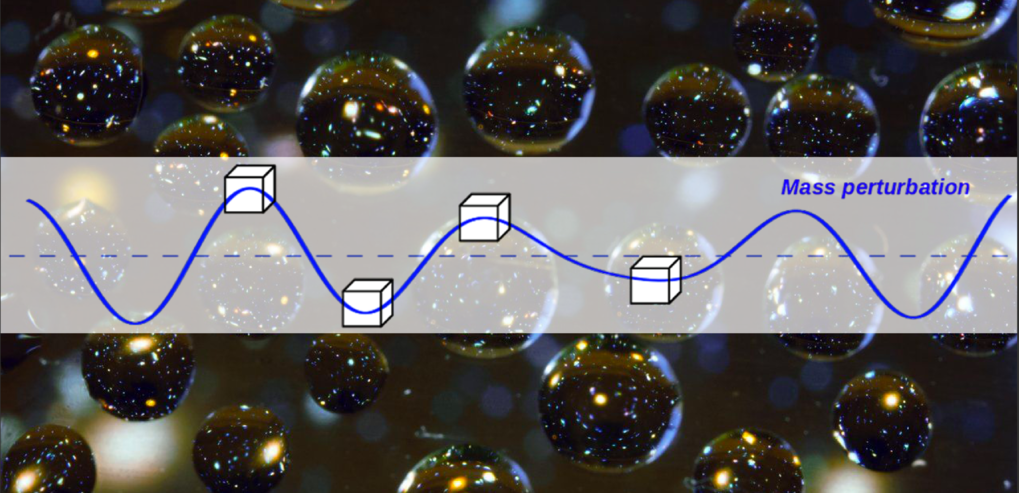
Summary sketch of the Separate Universe Formalism: structure formation in special regions of our Universe is equivalent to structure formation in appropriately modified/separate Universes. The blue line is a mass perturbation: regions above the dashed line have more mass than the average. © MPA, Background image: Tess Cholson, Hi-res image
Rather than trying to study special regions in large-volume simulations, scientists at MPA have used the IllustrisTNG model to create whole separate universes with a modified cosmology. Their study of these separate universes shows that when the baryon density (the density of ordinary matter) changes, the number of galaxies can increase or decrease depending on how this number is measured. Also, the large-scale distribution of matter is affected by the effects of baryons, with various measures reacting differently.
Imagine we are travelling across the Universe and want to measure some property such as the number of galaxies around us. This number is not going to be the same everywhere during our journey because various regions of the Universe are not equal. For example, in some regions, there was a slight excess of mass and energy at the beginning of the Universe, the Big Bang, which means there was more material to form galaxies, and so we would count more galaxies there. Astrophysicists need to take this variability into account when analysing observational data. In particular, it could be the case that the observed part of the Universe is special and not representative of the whole Universe. Such an analysis can be performed with the aid of so-called Response Functions, which tell us how a given statistical measurement of the Universe changes when the properties of the underlying region change.
Researchers at MPA have been interested in studying response functions and their applications for some time now. This can be done with the “Separate Universe Formalism”, which establishes that structures forming in our Universe in a special (e.g. over- or under-dense) region are the same as the structures that would form in a normal region of a different/separate Universe (see Fig. 1). Studying responses is easier in this formalism, because numerical simulations can easily be used to study structure formation in other Universes -- this is much easier than to simulate structure formation in special regions of our Universe. In the past, numerical studies of response functions were done with simulations that took into account only the effect of gravity. A team of researchers at MPA has recently gone beyond this limitation by running separate universe simulations with the IllustrisTNG galaxy formation model, which, for the first time, allowed them to study response functions including also important baryonic effects such as hydro- dynamical forces, gas cooling, star and black hole formation.
Galaxy formation with an excess of baryons

Sketch of a compensated isocurvature perturbation (CIP): the total matter stays the same, but in some regions, more baryons are compensated by less dark matter. © MPA
Matter in the Universe can broadly be divided into two types: (i) dark matter, which does not interact with light and comprises the majority of the mass (80 %), and (ii) all the rest. This rest is made up of the particles detected in particle physics experiments, which are called baryons. While dark matter is the dominant source of gravitational energy that drives structure formation, stars and galaxies are made up of baryons. Therefore the number of galaxies should depend on the amount of baryons available inside some observed region. In other words, the number of galaxies responds to the baryonic density.
A few theoretical models of the very early Universe (also known as the period of Inflation) predict that there should be regions in the Universe with an excess of baryons that is exactly compensated by a suppression in the number of dark matter particles; these are called compensated isocurvature perturbations (CIP), see Fig. 2. Researchers at MPA have studied how the number of galaxies responds to these perturbations using the separate universe formalism by simulating galaxy formation in Universes with different total amounts of baryons and dark matter.
The results of this study showed that, indeed, the number of galaxies depends strongly on the amount of baryonic matter. More interestingly, however, the sign of this dependency depends also on the quantity used to classify the galaxies. If the number of galaxies is measured as a function of total mass (dark matter + baryons), the response to CIP perturbations is negative, i.e., there are fewer galaxies with a given total mass. However, if the number of galaxies is measured as a function of the mass in stars (not the total mass), the response now displays the opposite trend, i.e. there are more galaxies with a given stellar mass. The MPA researchers traced back the origin of this change of sign to the modifications that the CIP perturbations induce on the relation between total mass and stellar mass in the galaxies.
This study provided the first ever prediction of the impact of CIP perturbations on the observed number of galaxies, which can now be incorporated in theoretical models of the distribution of galaxies in the Universe. This in turn will allow astronomers to use the statistics of galaxies to look for important signatures from the early Universe.
Using responses to predict weak gravitational lensing

The top image shows a simulated weak-lensing map of the sky, as well as 2-, 3- and 4-point functions drawn on top. The lower panel shows the percentage impact of the baryonic effects on the N-point functions. The quantity on the x-axis is inversely proportional to distance: large scales on the left, smaller scales on the right. The vertical dashed lines correspond to those scales, where the effect of baryons exceed 1%. All N-point functions are affected by baryonic effects on small scales, but they all respond differently. © MPA
The separate universe formalism can also be applied to large-scale maps of the total matter distribution. The light emitted by distant galaxies travels towards Earth along trajectories that are perturbed by the gravitational effect of the intervening matter. This effect, known as weak gravitational lensing, distorts the observed images of the distant galaxies and can be used to construct sky maps of the total mass between Earth and the galaxies, see Fig. 3. These maps contain information about the physics of our Universe and a popular way to organize this information is in N-point correlation functions: how does the matter density correlate between N points.
For quite some time, cosmologists have considered only the effect of gravity to obtain theoretical predictions for these statistics, but recently the community became aware of the critical importance of baryonic effects. For example, the heating and ejection of gas by black holes at the centre of massive galaxies can significantly alter the total distribution of the mass that weak lensing observations are sensitive to. The impact of baryonic effects on higher-order functions has remained largely unexplored, but researchers at MPA have recently made progress on this front. Specifically, separate universe simulations of galaxy formation were used to measure the impact of baryonic effects on the response of the 2-point function, which was in turn used in theoretical models to predict the impact of baryons on 3- and 4-point functions.
The fractional impact of the baryonic effects on 2-, 3- and 4-point correlation functions is shown in Fig. 3.All statistics display a suppression of their amplitude of approximately 5%-20% on the smallest scales (right part). This is as expected from the impact of black hole activity, which makes the density field smoother and the correlation of perturbations weaker. A key aspect revealed by this study was the fact that, quantitatively, the various N-point functions are affected differently by the same black hole activity. This work by the MPA researchers opens up a new window to study important effects on galaxy formation (like black hole activity) using combined analysis of different weak-lensing N-point functions.
Source: Max Planck Institute for Astrophysics
Author
Postdoc
Tel.: 2241
for the team: Alexandre Barreira, Giovanni Cabass, Dylan Nelson, Rüdiger Pakmor, Fabian Schmidt and Volker Springel
Original publications
1. A. Barreira, G. Cabass, D. Nelson, F. Schmidt
Baryon-CDM isocurvature galaxy bias with IllustrisTNG
Submitted to JCAP
2. A. Barreira, D. Nelson, A. Pillepich, V. Springel, F. Schmidt, R. Pakmor, L. Hernquist, M. Vogelsberger
Separate Universe Simulations with IllustrisTNG: baryonic effects on power spectrum responses and higher-order statistics
MNRAS, Volume 488, Issue 2, September 2019, Pages 2079–2092,