Showing posts with label Wolf 359. Show all posts

Thursday, July 10, 2025

Exo-Saturns and Exo-Jupiters Are Within JWST’s Reach

Illustration of Jupiter and a Jupiter-like exoplanet.
Credit:
NASA/JPL-Caltech

A JWST image of the exoplanet Epsilon Indi Ab, one of the coldest exoplanets to be directly imaged. The planet’s temperature is estimated to be just 275K (35℉/2℃). Credit:
NASA, ESA, CSA, STScI, Elisabeth Matthews (MPIA)

Of the nearly 6,000 currently known exoplanets, few closely resemble any of the planets in our solar system. New research suggests that JWST is capable of directly imaging exoplanets with temperatures and orbital distances similar to Jupiter and Saturn, placing truly familiar exoplanets within our observational grasp.

Increasingly Cold Discoveries

JWST has already proven itself to be a powerful tool to directly image exoplanet systems. The telescope has imaged increasingly cold planets, but the gas giants in our solar system are substantially colder than the coldest planet imaged by JWST so far. This raises the question of whether JWST is capable of directly imaging Jupiter and Saturn if they orbited another star.

Answering this question requires a deep dive into the abilities of JWST’s instruments. The current go-to method for directly imaging planets with JWST is coronagraphy with its Near-Infrared Camera (NIRCam). In this observing mode, the instrument blocks the light from the star, allowing the fainter thermal glow of the planet to shine through.

But as Rachel Bowens-Rubin (University of Michigan and Eureka Scientific) and collaborators note in a recent research article, this may not be the best way to detect cold giant planets. Models suggest that these planets have cloudy atmospheres, which means that they wouldn’t be bright at NIRCam’s preferred near-infrared wavelengths, and would instead be detected more easily in the mid-infrared, where JWST’s Mid-Infrared Instrument (MIRI) reigns.

Temperatures of coldest detectable planets as a function of separation from the host star for Wolf 350 and EV Lac. Results are shown for MIRI F2100W imaging and NIRCam F444W coronagraphy. Credit: Bowens-Rubin et al. 2025

Combining Data and Models

To examine the capabilities of both of these instruments, Bowens-Rubin’s team analyzed JWST observations from the Cool Kids on the Block program, which targets cold, low-mass giant planets around nearby low-mass stars with NIRCam coronagraphy and MIRI imaging. The team used observations of nearby M-dwarf stars Wolf 359 and EV Lac to construct constrast curves: the level of planet–star flux contrast that is detectable by each instrument as a function of distance from each star. These curves depend on the flux of the star and the planet as well as the limitations of the instrument — the detector noise and background noise.

Bowens-Rubin and coauthors converted the contrast curves into information about the coldest planet each instrument can detect. To do this, the team modeled the atmospheres of planets with temperatures down to 50K and generated thermal emission spectra, which allowed them to relate the temperature of their modeled planets to the level of contrast.

Temperatures of planets detectable to a signal-to-noise ratio of 3 as a function of distance from Earth. Detection limits for MIRI and NIRCam are shown as red and blue lines, respectively. Credit: Bowens-Rubin et al. 2025


NIRCam vs. MIRI

This analysis showed that MIRI is the best choice for directly imaging cold planets around nearby stars (within 65 light-years). MIRI should be able to detect giant planets with temperatures down to 94K around Wolf 359 and 114K around EV Lac — about the temperature of Saturn and slightly colder than Jupiter, respectively. For Wolf 359, sub-100K planets are detectable at orbital distances of at least 4.8 au, meaning these planets could also have similar orbital separations to Jupiter and Saturn.

NIRCam coronagraphy can match MIRI’s performance only for the unlikely case of cloud-free giant planets; for cloudy planets around nearby stars, MIRI can spot planets 90–130K colder than NIRCam can. NIRCam has the advantage for more distant stars — beyond about 200 light-years — but only planets significantly warmer than Jupiter and Saturn are detectable at these distances.

As impressive as these results are already, Bowens-Rubin and coauthors noted that future work, such as developing strategies to mitigate MIRI’s “brighter-fatter effect” that limits sensitivity at small angular separations from the host star, could enhance the search for exo-Saturns and exo-Jupiters even further.

Citation

J“NIRCam Yells at Cloud: JWST MIRI Imaging Can Directly Detect Exoplanets of the Same Temperature, Mass, Age, and Orbital Separation as Saturn and Jupiter,” Rachel Bowens-Rubin et al 2025 ApJL 986 L26. doi:10.3847/2041-8213/addbde


Monday, January 27, 2025

Exoplanets Need to be Prepared for Extreme Space Weather, Chandra Finds

Wolf 359
Credit: X-ray: NASA/CXC/SAO/S.Wolk, et al.; Illustration: NASA/CXC/SAO/M.Weiss; Image processing: NASA/CXC/SAO/N. Wolk


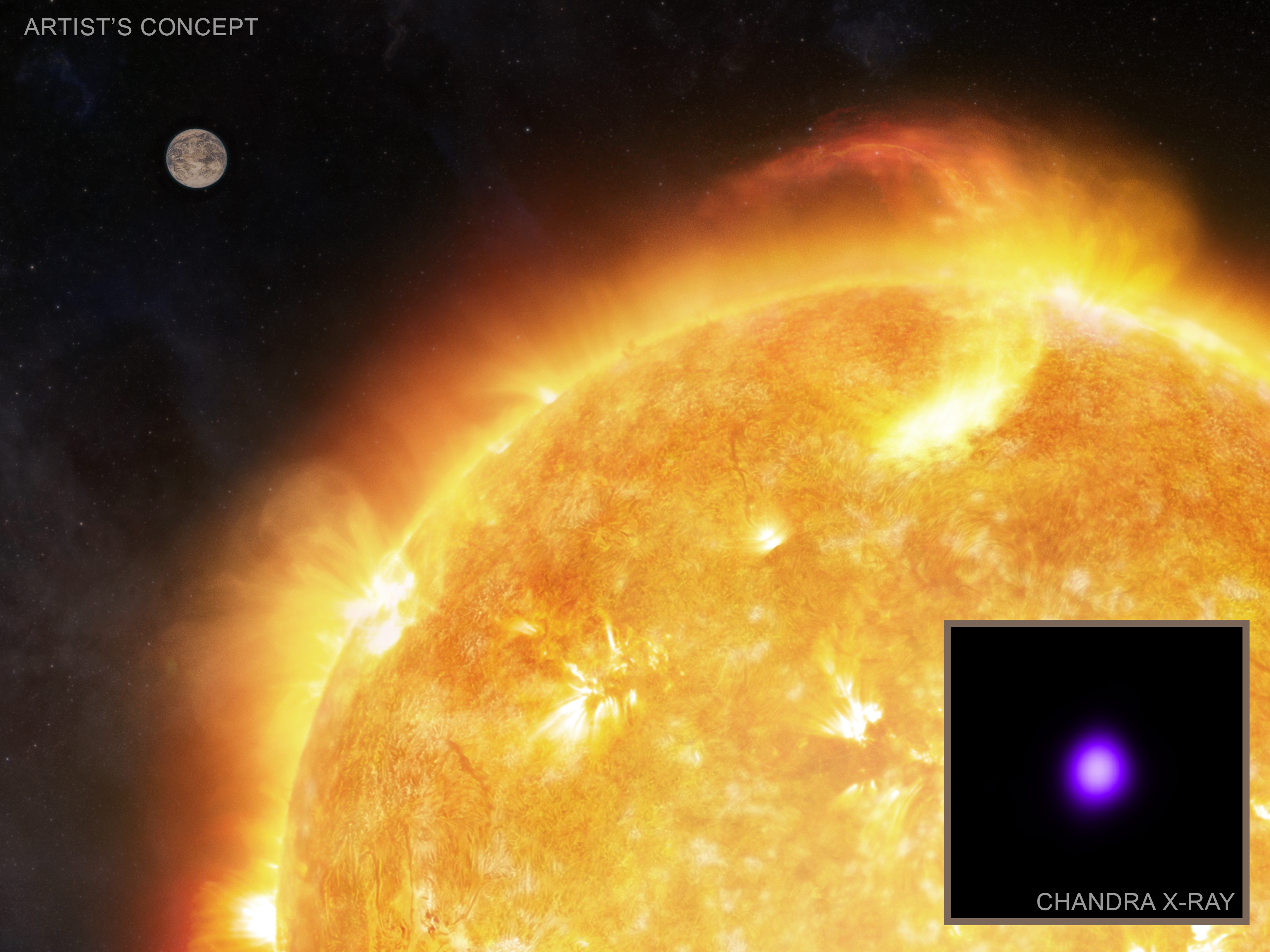
This artist’s illustration represents the results from a new study that examines the effects of X-ray and other high-energy radiation unleashed on potential exoplanets from a host star. As outlined in our latest press release, astronomers using NASA’s Chandra X-ray Observatory and ESA’s XMM-Newton observed Wolf 359, a red dwarf that is only 7.8 light-years from Earth, making it one of the closest stars to the Earth other than the Sun.

The artist’s rendering shows Wolf 359 in the foreground and a potential planet in orbit around it in the background. Red dwarfs are the most common type of star in the Universe. They are much smaller and dimmer than Sun-like stars, which allows them to last for trillions of years. This would give planets in orbit around them ample time for life to form and emerge, which makes them particularly interesting to scientists looking for life beyond the Solar System.

In the new study, researchers used Chandra and XMM to study the impact of steady X-ray and energetic ultraviolet (UV) radiation from Wolf 359 on the atmospheres of planets that might be orbiting the star. They found that only a planet with greenhouse gases like carbon dioxide in its atmosphere and at a relatively large distance away from Wolf 359 would have a chance to support life as we know it around a nearby star. The planet is depicted with the heavy cloud cover expected from the effects of greenhouse gases.

Animation of a Sun & Planet System
Animation Credit: NASA/CXC/SAO/A.Jubett)

Their work suggests that just being far enough away from the star’s harmful radiation would not be enough to allow a planet around Wolf 359 to sustain life. The team looked at the “habitable zone,” the region around a star where liquid water could exist on a planet’s surface, for Wolf 359. They found that an Earth-like planet in the middle of the habitable zone blanketed with greenhouse gases should be able to sustain an atmosphere for almost two billion years.

In addition to the dangers posed by the steady, everyday high-energy radiation from a star like Wolf 359, any orbiting planets would be subjected to occasional giant bursts of X-rays. Using observations with Chandra and XMM-Newton, astronomers discovered 18 X-ray flares, or outbursts, from Wolf 359 in under 4 days. Chandra data of Wolf 359 is shown in the inset. Extrapolating from these observed flares, the team expects that much more powerful and damaging flares would occur over longer periods of time. The combined effects of the steady X-ray and UV radiation and the flares means that any planet located in the habitable zone is unlikely to have a significant atmosphere long enough for multicellular life, as we know it on Earth, to form and survive. (Evidence suggests that it took at least 3 billion years for multicellular life to emerge on Earth.) The exception is the habitable zone's outer edge if a planet has a significant greenhouse effect.

The researchers used a special technique to estimate the energetic UV radiation from Wolf 359 using Chandra. The team looked at the difference in radiation measured with the High Resolution Camera (HRC) using two different filters: first, a thick filter that allows only X-rays to be detected, and second, a thinner filter that allows both X-rays and UV radiation to be detected. There are currently no specialized space missions for studying the most energetic ultraviolet radiation.

These results were presented at the 245th meeting of the American Astronomical Society in National Harbor, MD and are being prepared for publication in a journal. NASA's Marshall Space Flight Center manages the Chandra program. The Smithsonian Astrophysical Observatory's Chandra X-ray Center controls science operations from Cambridge, Massachusetts, and flight operations from Burlington, Massachusetts.


Visual Description:

This release features an artist's illustration of the red dwarf star Wolf 359, with a small orbiting planet in the distance. An inset image is included at our lower right.

Wolf 359 occupies much of the illustration. The fiery orange and yellow star fills the lower right corner of the image, extending well beyond the edges of the frame. The star's exterior appears to churn, with white hot flares bursting off the surface. A glowing yellow and orange haze surrounds the star, blanketing white flares and tendrils of hot gas.

In the distance, at our upper left, is an illustration of a small planet set against a black background dotted with faint specks of light. This represents one of two planets that may be in orbit around Wolf 359. Here, the orbiting planet has a blue-grey surface beneath a layer of swirling clouds. The water-like surface and cloudy atmosphere suggest that in this depiction, the planet is in Wolf 359's habitable zone, which may allow life to flourish.

Inset at our lower righthand corner is an X-ray image of Wolf 359. Here, the red dwarf star is a distant lavender dot glowing with purple haze, set against a pitch black background.


Fast Facts for Wolf 359:

Scale: Image is about 10 arcsec (3.8 billion km or 0.0004 light-years) across.
Category: Normal Stars & Star Clusters
Coordinates (J2000): RA 10h 56m 29s | Dec +07° 00´ 52"
Constellation: Leo
Observation Dates: 2 observations Nov 9-10, 2023
Observation Time: 244 hours 4 minutes (4 hours 4 minutes)
Obs. ID: 26490, 29051
Instrument: HRC
References: S. Wolk et al., 2025, 245th AAS meeting
Color Code: X-ray: purple
Distance Estimate: About 7.9 light-years


Thursday, January 30, 2020

Seeing Stars in 3D: The New Horizons Parallax Program


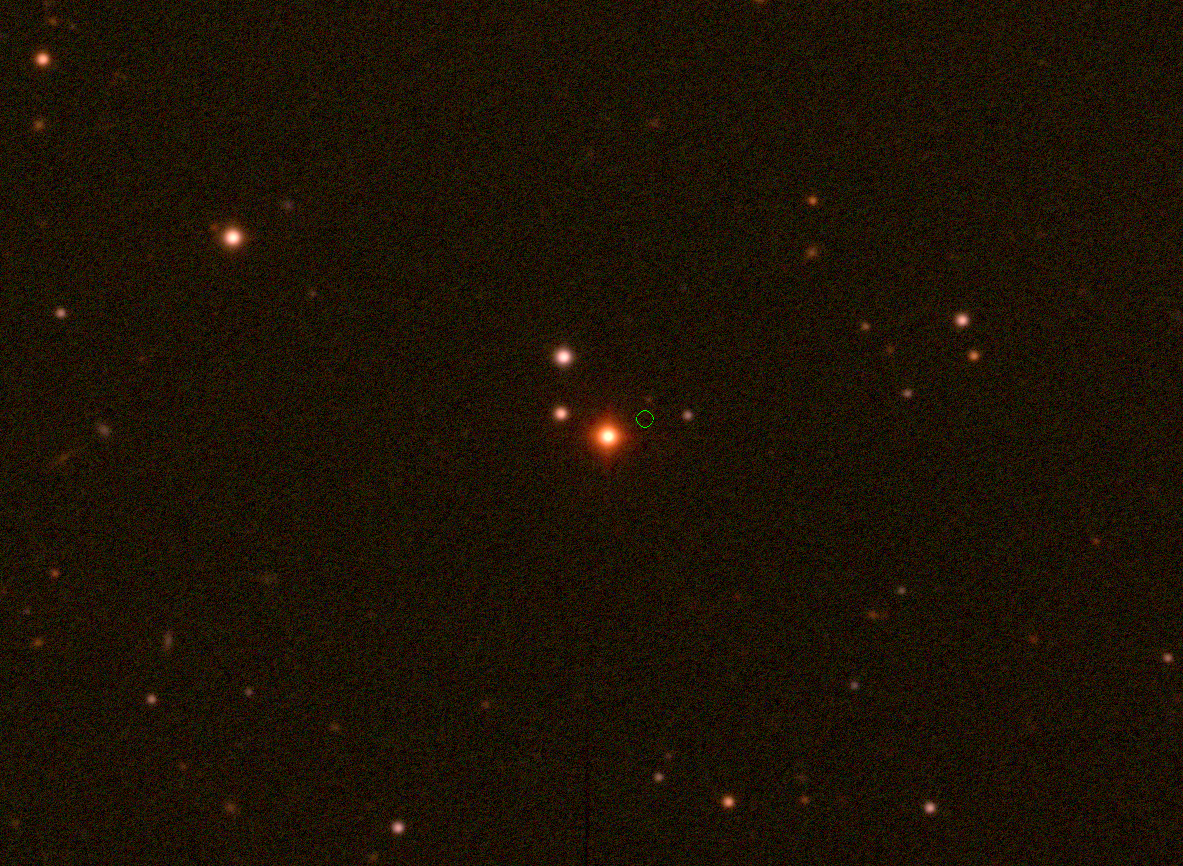
Color images of the Wolf 359 (top) and Proxima Centauri star fields, obtained in late 2019. The large proper motions of both stars (at the center of each image) will cause them to shift by over an arcsecond by April 2020, when NASA's New Horizons spacecraft, nearly five billion miles (8 billion kilometers) from Earth, will image them. A green circle provides a rough estimate of where both stars will appear in the New Horizons images. (Credit: William Keel/University of Alabama/SARA Observatory)

NASA's Pluto-Kuiper Belt mission invites public participation in a record-setting astronomical measurement

Have a good-sized telescope with a digital camera? Then you can team up with NASA's New Horizons mission this spring on a really cool – and record-setting -- deep-space experiment.

In April, New Horizons, which by then will be more than 46 times farther from the Sun than Earth, nearing 5 billion miles (8 billion kilometers) from home, will be used to detect "shifts" in the relative positions of nearby stars as compared with the way they appear to observers on Earth.

The technique is called parallax, and it has been used by astronomers for nearly two centuries to measure the distances of faraway stars; see the accompanying sidebar article for more detail.

On April 22 and 23, New Horizons will take images of two of the very nearest stars, Proxima Centauri and Wolf 359. When combined with Earth-based images made on the same dates, the result will be a record-setting parallax measurement yielding 3D images of these stars popping out of their background star fields that the New Horizons project will share with the public.

The mission team is coordinating the use of astronomical observatories and a public observing campaign to image the same stars on the same day to demonstrate the "parallax" effect.parallax effect

"These exciting 3D images, which we'll release in May, will be as if you had eyes as wide as the solar system and could detect the distance of these stars yourself," said New Horizons Principal Investigator Alan Stern, of the Southwest Research Institute, Boulder, Colorado. "It'll be a truly vivid demonstration of the immense distance New Horizons has traveled, and a cool way to take advantage of the spacecraft's unique vantage point out on the very frontier of our solar system!"

New Horizons' two target stars can be observed by anyone with a camera-equipped, 6-inch or larger telescope. Once New Horizons sends its images to Earth, the mission team will provide them for comparison to images obtained with amateur telescopes. Wolf 359 and Proxima Centauri will appear to shift in position between the Earth-based and space-based images.

In addition, working with New Horizons participating scientist and Queen guitarist Brian May – an astrophysicist himself – the New Horizons team will create and release 3D images showing these two stars.

"For all of history, the fixed stars in the night sky have served as navigation markers," said Tod Lauer, a New Horizons science team member from the National Science Foundation's National Optical-Infrared Astronomy Research Laboratory. "As we voyage out of the solar system and into interstellar space, how the nearer stars shift can serve as a new way to navigate. We will see this for the first time with New Horizons."

Get more details on the New Horizons Parallax program – including background info on the target stars and the best times to take images – at http://pluto.jhuapl.edu/Learn/Get-Involved.php#Parallax-Program.

New Horizons is the first mission to explore Pluto and distant Kuiper Belt. The Johns Hopkins University Applied Physics Laboratory, Laurel, Maryland, manages the New Horizons mission for NASA's Science Mission Directorate. Alan Stern, of the Southwest Research Institute (SwRI) is the principal investigator and leads the mission; SwRI also leads the science team, payload operations, and encounter science planning, data analyses and archiving. New Horizons is part of the New Frontiers Program managed by NASA's Marshall Space Flight Center in Huntsville, Alabama. APL designed, built and operates the New Horizons spacecraft.

For more information, visit www.nasa.gov/newhorizons and http://pluto.jhuapl.edu.


What's a Parallax?

The "parallax effect" is when an object appears to shift in position with respect to more distant objects. This is how our sense of depth perception works: each eye has a slightly different perspective, and the brain uses this to figure out which objects are close and which are far away. You can check this by holding up a finger, blinking with each eye, and noting how your finger it jumps back and forth against more distant background objects. You also see a parallax when you rock from side to side to see around someone blocking your view of a more distant object.

In traditional "stellar parallax" measurements, astronomers use Earth's own back-and-forth rocking motion, as it orbits the Sun, to deduce distances to nearby stars. Earth's orbit is about 186 million miles in diameter, so in half a year – the time it takes Earth to go from one side of its orbit to the other – its vantage point to nearby stars will change by that much. The orbit thus serves as a "baseline" for measuring distances. The bigger the baseline, the bigger the parallaxes.

As they wondered how far away the stars were, astronomers in the early 1700s predicted that nearer stars should shift in position more than distant stars as Earth moved around its orbit. Because distances to even the nearest stars are almost a half-million times greater than the baseline provided by Earth's orbit, the effect is subtle. It took until 1838 for Friedrich Bessel to obtain the first parallax observations by observing semi-annual shifts in the position of the star 61 Cygni.

Accurate stellar parallaxes allow us to survey distances to stars throughout our own Milky Way galaxy, and in doing so anchor our ability to measure distances to other galaxies and determine the overall size of the universe itself! The work to obtain ever more precise parallaxes continues today, with data from the European Space Agency's Gaia mission.

As fundamental as stellar parallaxes are to astronomy, however, they are difficult to demonstrate simply because the shifts are typically smaller than the scales on which telescope can easily resolve, so they require exceedingly careful measurement techniques to be accurately detected. An additional complication: all stars have their own random drifts as they orbit around our galaxy, which means that as we wait several months for Earth's movement to provide the parallaxes, the stars are not staying put. The drifts, known as "proper motions," often cause shifts in a star's position larger than its parallax. The solution is to measure the stellar positions over a few years, so that the change in their positions due to Earth's orbit can be recognized and separated from their constant proper motions. This means parallaxes are evident only with careful numerical analysis applied to years of observations.

The great distance of New Horizons from Earth provides a baseline that is 23 times larger than that previously used to measure parallaxes, thus the shifts of the stars seen in comparison of Earth and New Horizons images will be visually obvious. And, because New Horizons and Earth-based observers can image the same fields at the same time, proper motions over time are irrelevant – meaning we can obtain parallaxes instantly!