Showing posts with label ESA's Venus Express Mission. Show all posts

Monday, April 09, 2018

Cloudy Venus

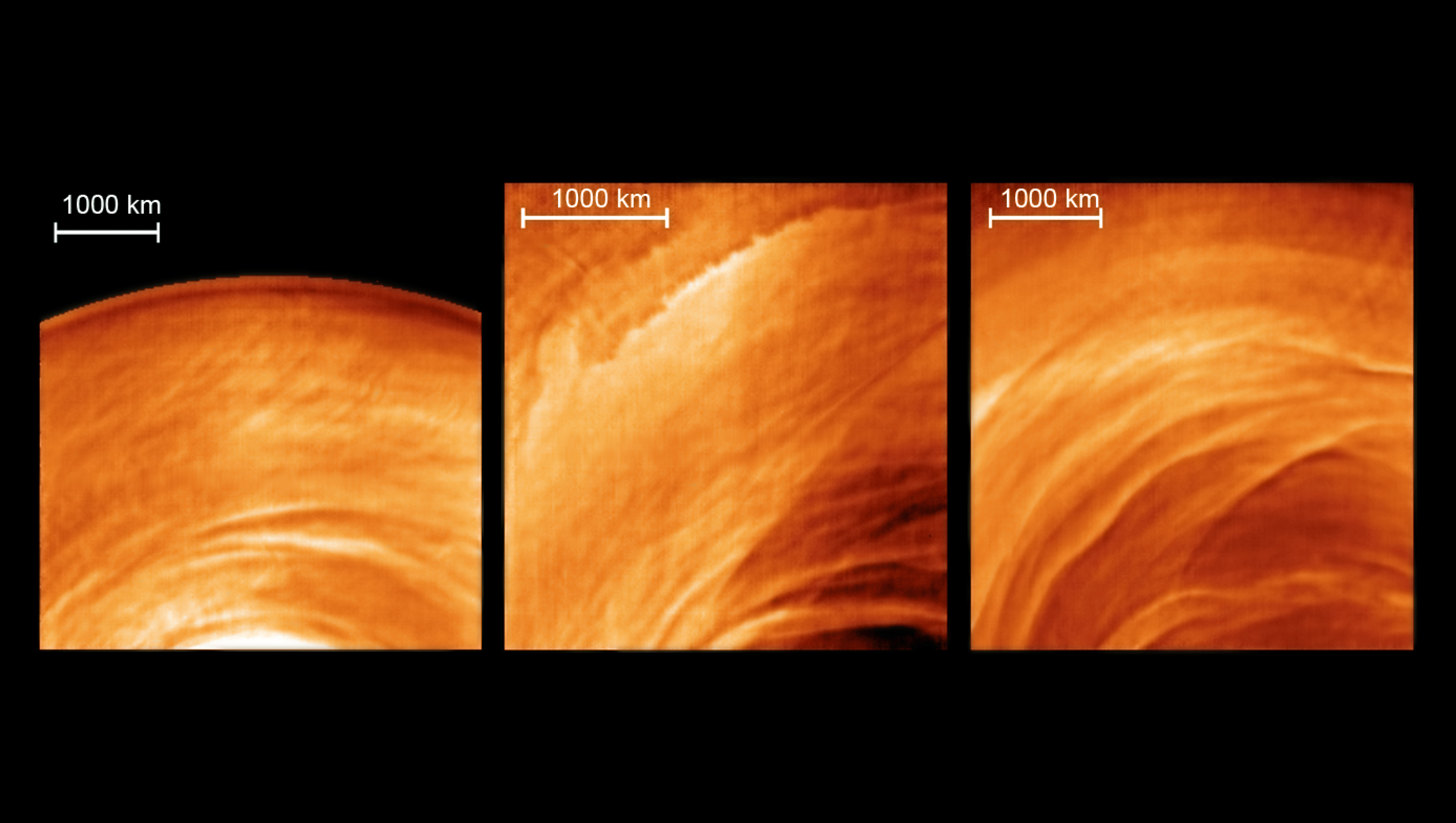
Copyright ESA, NASA, J. Peralta & R. Hueso


Our sister planet Venus is a dynamic and unusual place. Strong winds swirl around the planet, dragging thick layers of cloud with them as they go. These fierce winds move so speedily that they display ‘super-rotation’: Earth’s can move at up to a fifth of our planet’s rotation speed, but winds on Venus can travel up to 60 times faster than the planet.

Observations from ESA’s Venus Express, which orbited Venus from 2006 to 2014, and other international spacecraft have probed deeper into this wind and cloud in past years, and uncovered some peculiar behaviour.

The side of the planet facing away from the Sun is somewhat more mysterious than the other side, but what we do know shows it to be quite different, with never-before-seen cloud types, shapes and dynamics – some of which appear to be connected to features on the surface below.

Super-rotation appears to behave more chaotically on the night side than the day side, but climate modellers remain unsure why. Night-side clouds also create different patterns and shapes than those found elsewhere – large, wavy, patchy irregular and filament-like patterns – and are dominated by mysterious ‘stationary waves’. These waves rise up within the atmosphere, do not move with the planet’s rotation, and appear to be concentrated above steep and higher-altitude regions of the surface, suggesting that Venus’ topography may well affect what happens in the cloud layers way up above.

These three images from the visible and infrared camera on Venus Express show these cloud features in detail: stationary waves (left), dynamical instabilities (middle) and mysterious filaments (right).

Venus Express was launched in 2005 and began orbiting Venus in 2006; the mission ended in December 2014. This image is based on the news item Venus' mysterious night side revealed, published in 2017.


Monday, June 20, 2016

Venus has potential but not for water


Electric field at Venus
Copyright: ESA–C. Carreau


ESA’s Venus Express may have helped to explain the puzzling lack of water on Venus. The planet has a surprisingly strong electric field – the first time this has been measured at any planet – that is sufficient to deplete its upper atmosphere of oxygen, one of the components of water. 

Venus is often called Earth’s twin, since the second planet from the Sun is only slightly smaller than our own. 

But its atmosphere is quite different, consisting mainly of carbon dioxide, with a little nitrogen and trace amounts of sulphur dioxide and other gases. It is much thicker than Earth’s, reaching pressures of over 90 times that of Earth at sea level, and incredibly dry, with a relative abundance of water about 100 times lower than in Earth’s gaseous shroud. 

In addition, Venus now has a runaway greenhouse effect and a surface temperature high enough to melt lead. Also, unlike our home planet, it has no significant magnetic field of its own. 

Scientists think Venus did once host large amounts of water on its surface over 4 billion years ago. But as it heated up, much of this water evaporated into the atmosphere, where it could then be ripped apart by sunlight and subsequently lost to space. 

The solar wind – a powerful stream of charged subatomic particles blowing from the Sun – is one of the culprits, stripping hydrogen ions (protons) and oxygen ions from the planet’s atmosphere and so depriving it of the raw materials that make water.  

Now, scientists using Venus Express have identified another difference between the two planets: Venus has a substantial electric field, with a potential around 10 V. 

This is at least five times larger than expected. Previous observations in search of electric fields at Earth and Mars have failed to make a decisive detection, but they indicate that, if one exists, it is less than 2 V. 

“We think that all planets with atmospheres have a weak electric field, but this is the first time we have actually been able to detect one,” says Glyn Collinson from NASA’s Goddard Flight Space Center, lead author of the study. 

In any planetary atmosphere, protons and other ions feel a pull from the planet’s gravity. Electrons are much lighter and thus feel a smaller pull – they are able to escape the gravitational tug more easily. 

As the negative electrons drift upwards in the atmosphere and away into space, they are nevertheless still connected to the positive protons and ions via the electromagnetic force, and this results in an overall vertical electric field being created above the planet’s atmosphere. 

The electric field detected by Venus Express is much stronger than expected, and it can provide enough energy to oxygen ions to accelerate them upwards fast enough to escape the gravitational pull of the planet.

The discovery thus reveals another process, in addition to the solar wind stripping, that could contribute to the very low water content at Venus.

The electric field detected by Venus Express is much stronger than expected, and it can provide enough energy to oxygen ions to accelerate them upwards fast enough to escape the gravitational pull of the planet.

The discovery thus reveals another process, in addition to the solar wind stripping, that could contribute to the very low water content at Venus.

“The electric field of Venus is much stronger than we ever dreamed it could be, and really powerful if you’re as tiny as an oxygen ion,” adds Glyn.

“However, in real terms, the total power is only roughly the same as a single wind turbine, and it’s spread out over hundreds of kilometers of altitude, so as you can imagine, it’s incredibly hard to measure.”

The scientists patiently scrutinised two years’ data collected with an electron spectrometer, part of the ASPERA-4 instrument on Venus Express. They found 14 brief one-minute windows when the spacecraft was in just the right place with all the right conditions to measure an electric field. On every such occasion, the field was observed.

The reason why Venus has a much higher electric field than Earth is still under investigation. Glyn and his colleagues suspect that the planet’s closer position to the Sun might play a role.

“As it’s closer to the Sun than Earth, Venus receives twice as much ultraviolet light, which results in a higher number of free electrons in its atmosphere and, as a consequence, may cause a stronger electric field above the planet,” says Andrew Coates from Mullard Space Science Laboratory, UK, lead investigator of the ASPERA-4 electron spectrometer.

The presence of such a field at Venus suggests that particles and ions necessary to form water are leaving the planet’s atmosphere faster than was expected. In turn, this means that Venus might have hosted even larger amounts of water in the past, before being almost entirely stripped away.

“Water has a key role for life as we know it on Earth and possibly elsewhere in the Universe,” says Håkan Svedhem, Venus Express Project Scientist at ESA.

“By suggesting a mechanism able to deprive a planet close to its parent star of most of its water, this discovery calls for a rethink of how we define a ‘habitable’ planet, not only in our Solar System, but also in the context of exoplanets.”


Notes for Editors

“The electric wind of Venus: A global and persistent “polar wind”-like ambipolar electric field sufficient for the direct escape of heavy ionospheric ions,” by G.A. Collinson et al. is published in Geophysical Research Letters

The study is based on data from the electron spectrometer, part of the ASPERA-4 instrument on Venus Express, which is led by Y. Futaana at the Swedish Institute of Space Physics in Kiruna, Sweden. 

ESA’s Venus Express was launched in 2005, arrived at Venus in 2006, and spent eight years exploring the planet from orbit. The mission ended in December 2014 after the spacecraft ran out of orbit-raising propellant and entered the atmosphere. 


For further information, please contact:

Glyn A. Collinson
NASA Goddard Space Flight Center
Greenbelt, Maryland, USA
Phone: +1 301 286 2511
Email:
glyn.a.collinson@nasa.gov

Andrew J. Coates
Mullard Space Science Laboratory
University College London, UK
Email:
a.coates@ucl.ac.uk

Håkan Svedhem
Venus Express Project Scientist
European Space Agency

Email: Hakan.Svedhem@esa.int

Markus Bauer


ESA Science Communication Officer


Tel: +31 71 565 6799


Mob: +31 61 594 3 954


Email:
markus.bauer@esa.int


Saturday, February 22, 2014

NASA Researcher Finds Planet-Sized Space Weather Explosions at Venus

 
Giant perturbations called hot flow anomalies in the solar wind near Venus can pull the upper layers of its atmosphere, the ionosphere, up and away from the surface of the planet. Image Credit: NASA. Large Image

Researchers recently discovered that a common space weather phenomenon on the outskirts of Earth’s magnetic bubble, the magnetosphere, has much larger repercussions for Venus. The giant explosions, called hot flow anomalies, can be so large at Venus that they’re bigger than the entire planet and they can happen multiple times a day.

"Not only are they gigantic," said Glyn Collinson, a space scientist at NASA’s Goddard Space Flight Center in Greenbelt, Md. "But as Venus doesn’t have a magnetic field to protect itself, the hot flow anomalies happen right on top of the planet. They could swallow the planet whole."

Collinson is the first author of a paper on these results that appeared online in the Journal of Geophysical Research in February 2014. The work is based on observations from the European Space Agency's Venus Express. The results show just how large and how frequent this kind of space weather is at Venus.

Earth is protected from the constant streaming solar wind of radiation by its magnetosphere. Venus, however, has no such luck. A barren, inhospitable planet, with an atmosphere so dense that spacecraft landing there are crushed within hours, Venus has no magnetic protection.

Scientists like to compare the two: What happened differently at Earth to make it into the life-supporting planet it is today? What would Earth be like without its magnetic field?

At Earth, hot flow anomalies do not make it inside the magnetosphere, but they release so much energy just outside that the solar wind is deflected, and can be forced to move back toward the sun. Without a magnetosphere, what happens at Venus is very different.

Venus's only protection from the solar wind is the charged outer layer of its atmosphere called the ionosphere. A sensitive pressure balance exists between the ionosphere and the solar wind, a balance easily disrupted by the giant energy rush of a hot flow anomaly. The hot flow anomalies may create dramatic, planet-scale disruptions, possibly sucking the ionosphere up and away from the surface of the planet.

Karen C. Fox
NASA's Goddard Space Flight Center, Greenbelt, Md.