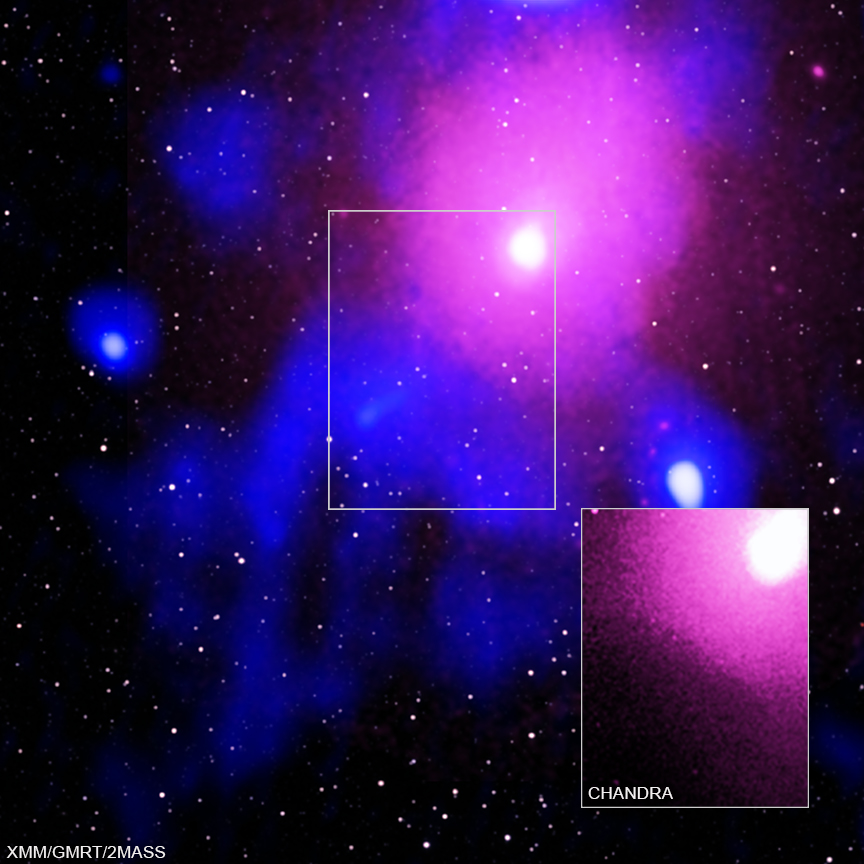
Credit: X-ray: Chandra: NASA/CXC/NRL/S. Giacintucci, et al., XMM: ESA/XMM;
Radio: NCRA/TIFR/GMRT;
Infrared: 2MASS/UMass/IPAC-Caltech/NASA/NSF
Evidence for the biggest explosion seen in the Universe is contained in these composite images. This discovery, covered in our latest press release,
combines data from NASA's Chandra X-ray Observatory, ESA's XMM-Newton,
the Murchison Widefield Array, and the Giant Metrewave Telescope.
This extremely powerful eruption occurred in the Ophiuchus galaxy cluster, which is located about 390 million light years
from Earth. Galaxy clusters are the largest structures in the Universe
held together by gravity, containing thousands of individual galaxies, dark matter, and hot gas.
The hot gas that pervades clusters like Ophiuchus gives off much of its light as X-rays.
The main panel contains X-rays from XMM-Newton (pink) along with radio
data from GMRT (blue), and infrared data from 2MASS (white). In the
inset, Chandra's X-ray data are pink.
In the center of the Ophiuchus cluster is a large galaxy containing a supermassive black hole. Researchers have traced the source of this gigantic eruption to jets that blasted away from the black hole and carved out a large cavity in the hot gas. (A labeled version
includes a dashed line showing the edge of the cavity in the hot gas
seen in X-rays from both Chandra and XMM-Newton.) Radio emission from
electrons accelerated to almost the speed of light fills this cavity,
providing evidence that an eruption of unprecedented size took place.
A cross in the labeled version gives the location of the central galaxy. The publicly-available infrared data, which show the stars and galaxies in the field of view, are not sensitive enough to reveal the galaxy. (Even with higher quality data the galaxy would still not be visible in this composite image because it overlaps with bright X-ray and radio emission surrounding it.)
One interesting aspect of the Ophiuchus observations is that the densest and coolest gas seen in X-rays is located about 6,500 light years to the north of the central galaxy. This corresponds to a distance on the image that is smaller than the size of the cross. If this gas shifted away from the galaxy it would have deprived the black hole of fuel for its growth, turning off the jets. This gas displacement is likely caused by "sloshing" of the gas around the middle of the cluster, like wine sloshing around in a glass. Usually the merger of two galaxy clusters triggers such sloshing, but here it could have been set off by the eruption.
A paper describing these results appears online on February 27th in The Astrophysical Journal, and a preprint is available here. The authors of this paper are Simona Giancintucci (Naval Research Laboratory, Washington, DC), Maxim Markevitch (Goddard Space Flight Center, Greenbelt, Maryland), Melanie Johnston-Hollitt (International Centre for Radio Astronomy, Australia), Daniel Wik (University of Utah), Qian Wang (University of Utah), and Tracy Clarke (Naval Research Laboratory). The 2016 paper by Norbert Werner was published in the Monthly Notices of the Royal Astronomical Society.
NASA's Marshall Space Flight Center manages the Chandra program. The Smithsonian Astrophysical Observatory's Chandra X-ray Center controls science and flight operations from Cambridge and Burlington, Massachusetts.
Source: NASA’s Chandra X-ray Observatory
Fast Facts for Ophiuchus Galaxy Cluster:
Scale: Main image is about 25.2 arcmin (2.8 million light years) across. The inset image is about 6.5 arcmin (720,000 light years) across.
Category: Groups & Clusters of Galaxies, Black HolesCoordinates (J2000): RA 17h 12m 27.82s | Dec -23° 22´ 11"
Constellation: Ophiuchus
Observation Date: 9 pointings from July 1, 2014 to Aug 9, 2014
Observation Time: 63 hours 9 minutes (2 days 15 hours 9 minutes)
Obs. ID: 16142-16143,16464,16626-16627, 16633-16635,16645
Instrument: ACIS
References: Giacintucci, S., et al., 2020, ApJ in press; arXiv:2002.01291
Color Code: X-ray: Pink; Radio: Blue; Infrared: White
Distance Estimate: About 390 million light years