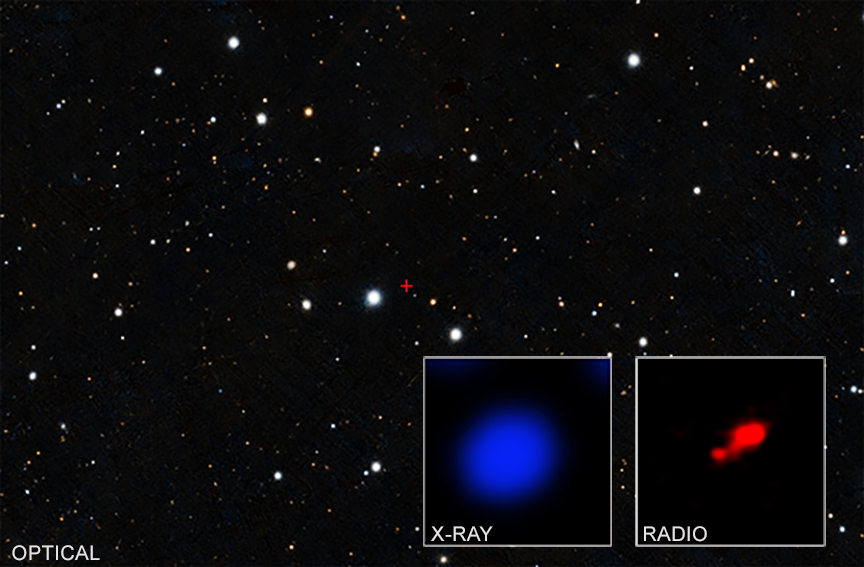
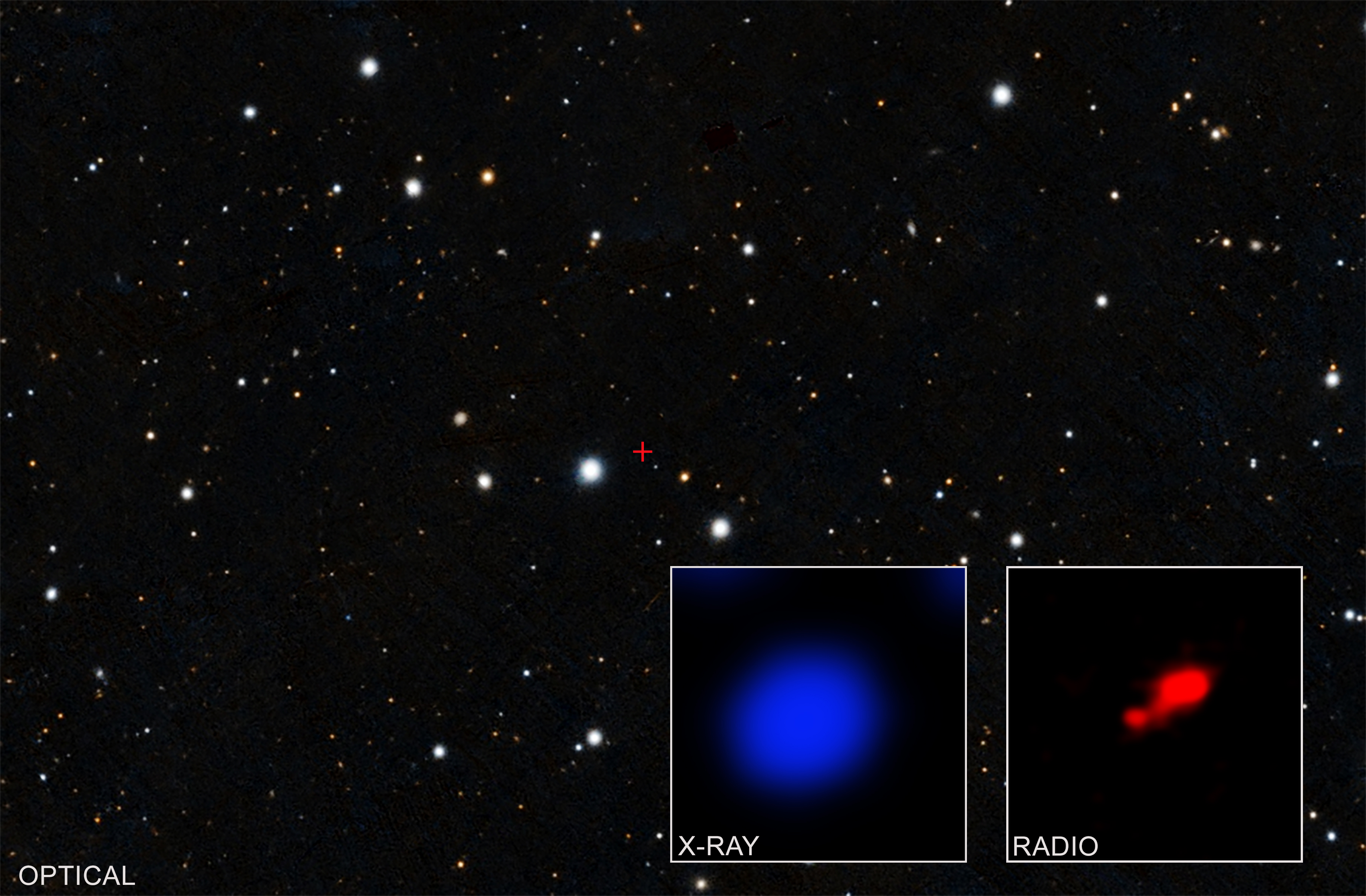
Quasar 1604+159: distribution of fractional polarization (color) at 1.7 GHz
Credit: Hu et al., 2024.
Credit: Hu et al., 2024.
Chinese astronomers have conducted multi-frequency polarimetric observations of a quasar known as 1604+159. Results of the observational campaign, published August 13 on the pre-print server arXiv, shed more light on the properties of this quasar, including its morphology and magnetic field.
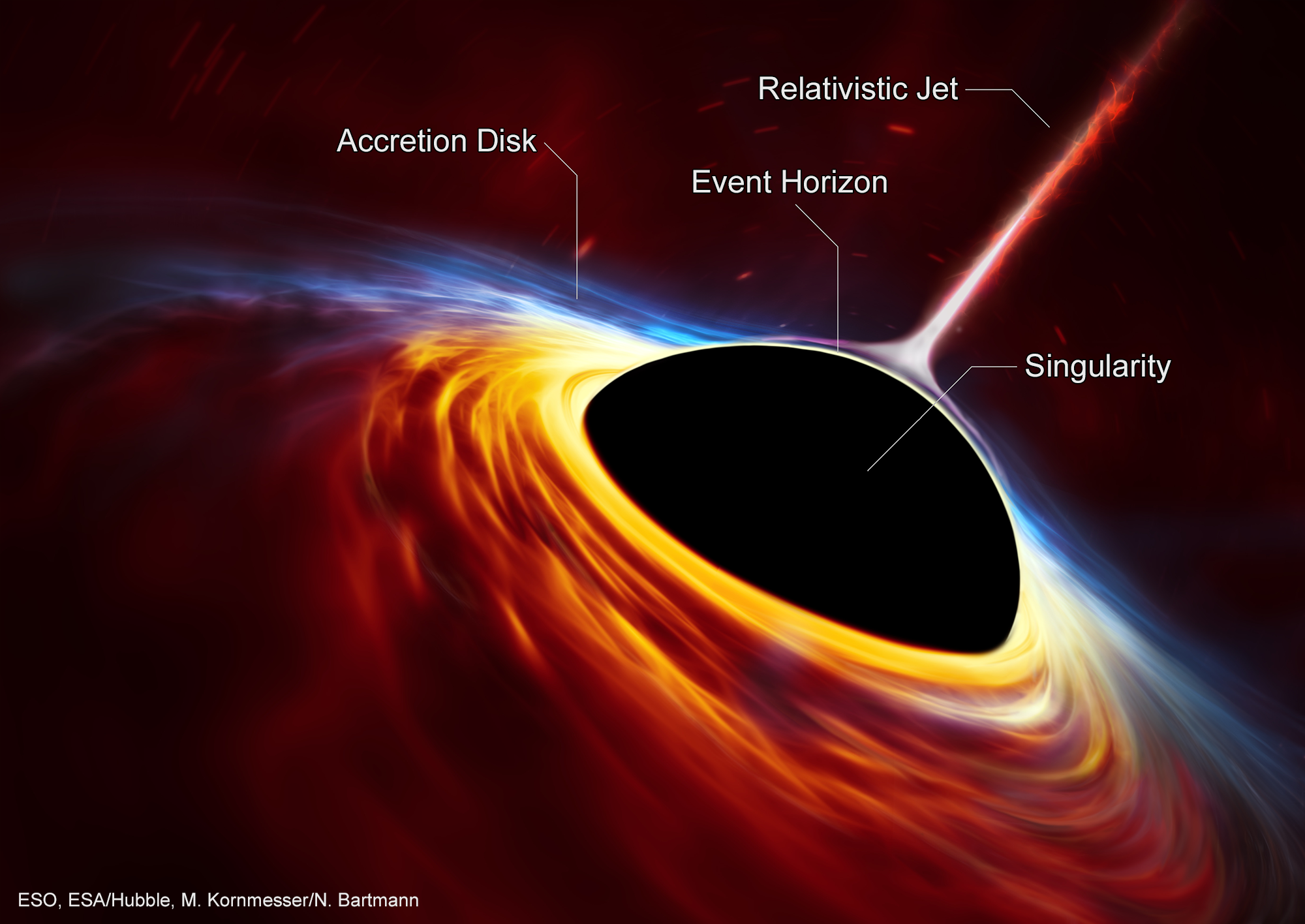
Quasars, or quasi-stellar objects (QSOs) are active galactic nuclei (AGN) of very high luminosity, emitting electromagnetic radiation observable in radio, infrared, visible, ultraviolet and X-ray wavelengths.
They are among the brightest and most distant objects in the known universe, and serve as fundamental tools for numerous studies in astrophysics as well as cosmology. For instance, quasars have been used to investigate the large-scale structure of the universe and the era of reionization. They also improved our understanding of the dynamics of supermassive black holes and the intergalactic medium.
At a redshift of approximately 0.5, 1604+159 is a low-spectral peaked (LSP) quasar with a linear scale of 19,750 light years/arcsecond. Previous observations have found that it has flat radio spectral and low radio variability.
Aiming to get more insights into the properties of 1604+159, a team of astronomers led by Xu-Zhi Hu of Shanghai Astronomical Observatory in China, has observed this quasar with the American Very Long Baseline Array (VLBA) and the Very Large Array (VLA).
"This work contains one observation with the Very Long Baseline Array and three observations with the Very Large Array, all in dual-polarization mode," the researchers explained.
The observations show that 1604+159 has several lobes and bulges, which together form a cocoon shape. Moreover, the images show several bulges surrounding the core, jets, and hotspots are towards the quasar's edges. The largest structure detected reaches about 50 arcseconds.
According to the paper, 1604+159 has a global helical magnetic field extending from the jet base to the outer jet region. The helical magnetic field has a large intrinsic pitch angle, of about 80 degrees, in the jet rest frame.
The study detected polarization at the core of 1604+159. This polarization appears to be normal to the edges of the structure. However, the fractional polarization turned up to be relatively high—about 60%. This is approximately 15% higher than that of the core.
The observations found that the jet of the quasar generally propagates in a collimating structure with several slight bends. As it bends, the jet shows strong polarized intensity and high fractional polarization towards the bending edge.
The authors of the paper conclude that the results suggest that it may be in the stage when the cocoon expands. Due to this, shocks, formed during the expansion, heat the interstellar medium, contributing to the jet-driven AGN feedback.
by Tomasz Nowakowski , Phys.org
Source: Phys.org/Space-News
More information: Xu-Zhi Hu et al, Magnetic Field of the Quasar 1604+159 from Parsec to Kilo-parsec Scale, arXiv (2024). DOI: 10.48550/arxiv.2408.06647
Journal information: arXiv
© 2024 Science X Network
Explore further