Showing posts with label NGC 6388. Show all posts

Wednesday, July 18, 2018

Supersharp Images from New VLT Adaptive Optics

Neptune from the VLT with MUSE/GALACSI Narrow Field Mode adaptive optics

PR Image eso1824b
Neptune from the VLT with and without adaptive optics

PR Image eso1824c
Neptune from the VLT and Hubble

PR Image eso1824d
MUSE images of the globular star cluster NGC 6388


Videos
ESOcast 172 Light: Supersharp Images from New VLT Adaptive Optics (4K UHD)

Zooming in on the globular star cluster NGC 6388
Zooming in on the globular star cluster NGC 6388 


ESO’s Very Large Telescope (VLT) has achieved first light with a new adaptive optics mode called laser tomography — and has captured remarkably sharp test images of the planet Neptune, star clusters and other objects. The pioneering MUSE instrument in Narrow-Field Mode, working with the GALACSI adaptive optics module, can now use this new technique to correct for turbulence at different altitudes in the atmosphere. It is now possible to capture images from the ground at visible wavelengths that are sharper than those from the NASA/ESA Hubble Space Telescope. The combination of exquisite image sharpness and the spectroscopic capabilities of MUSE will enable astronomers to study the properties of astronomical objects in much greater detail than was possible before.

The MUSE (Multi Unit Spectroscopic Explorer) instrument on ESO’s Very Large Telescope (VLT) works with an adaptive optics unit called GALACSI. This makes use of the Laser Guide Star Facility, 4LGSF, a subsystem of the Adaptive Optics Facility (AOF). The AOF provides adaptive optics for instruments on the VLTs Unit Telescope 4 (UT4). MUSE was the first instrument to benefit from this new facility and it now has two adaptive optics modes — the Wide Field Mode and the Narrow Field Mode [1].

The MUSE Wide Field Mode coupled to GALACSI in ground-layer mode corrects for the effects of atmospheric turbulence up to one kilometre above the telescope over a comparatively wide field of view. But the new Narrow Field Mode using laser tomography corrects for almost all of the atmospheric turbulence above the telescope to create much sharper images, but over a smaller region of the sky [2]

With this new capability, the 8-metre UT4 reaches the theoretical limit of image sharpness and is no longer limited by atmospheric blur. This is extremely difficult to attain in the visible and gives images comparable in sharpness to those from the NASA/ESA Hubble Space Telescope. It will enable astronomers to study in unprecedented detail fascinating objects such as supermassive black holes at the centres of distant galaxies, jets from young stars, globular clusters, supernovae, planets and their satellites in the Solar System and much more.

Adaptive optics is a technique to compensate for the blurring effect of the Earth’s atmosphere, also known as astronomical seeing, which is a big problem faced by all ground-based telescopes. The same turbulence in the atmosphere that causes stars to twinkle to the naked eye results in blurred images of the Universe for large telescopes. Light from stars and galaxies becomes distorted as it passes through our atmosphere, and astronomers must use clever technology to improve image quality artificially.

To achieve this four brilliant lasers are fixed to UT4 that project columns of intense orange light 30 centimetres in diameter into the sky, stimulating sodium atoms high in the atmosphere and creating artificial Laser Guide Stars. Adaptive optics systems use the light from these “stars” to determine the turbulence in the atmosphere and calculate corrections one thousand times per second, commanding the thin, deformable secondary mirror of UT4 to constantly alter its shape, correcting for the distorted light.

MUSE is not the only instrument to benefit from the Adaptive Optics Facility. Another adaptive optics system, GRAAL, is already in use with the infrared camera HAWK-I. This will be followed in a few years by the powerful new instrument ERIS. Together these major developments in adaptive optics are enhancing the already powerful fleet of ESO telescopes, bringing the Universe into focus.

This new mode also constitutes a major step forward for the ESO’s Extremely Large Telescope, which will need Laser Tomography to reach its science goals. These results on UT4 with the AOF will help to bring ELT’s engineers and scientists closer to implementing similar adaptive optics technology on the 39-metre giant.


Notes


[1] MUSE and GALACSI in Wide-Field Mode already provides a correction over a 1.0-arcminute-wide field of view, with pixels 0.2 by 0.2 arcseconds in size. This new Narrow-Field Mode from GALACSI covers a much smaller 7.5-arcsecond field of view, but with much smaller pixels just 0.025 by 0.025 arcseconds to fully exploit the exquisite resolution.


[2] Atmospheric turbulence varies with altitude; some layers cause more degradation to the light beam from stars than others. The complex adaptive optics technique of Laser Tomography aims to correct mainly the turbulence of these atmospheric layers. A set of pre-defined layers are selected for the MUSE/GALACSI Narrow Field Mode at 0 km (ground layer; always an important contributor), 3, 9 and 14 km altitude. The correction algorithm is then optimised for these layers to enable astronomers to reach an image quality almost as good as with a natural guide star and matching the theoretical limit of the telescope.


More Information

ESO is the foremost intergovernmental astronomy organisation in Europe and the world’s most productive ground-based astronomical observatory by far. It has 15 Member States: Austria, Belgium, the Czech Republic, Denmark, France, Finland, Germany, Italy, the Netherlands, Poland, Portugal, Spain, Sweden, Switzerland and the United Kingdom, along with the host state of Chile and with Australia as a strategic partner. ESO carries out an ambitious programme focused on the design, construction and operation of powerful ground-based observing facilities enabling astronomers to make important scientific discoveries. ESO also plays a leading role in promoting and organising cooperation in astronomical research. ESO operates three unique world-class observing sites in Chile: La Silla, Paranal and Chajnantor. At Paranal, ESO operates the Very Large Telescope and its world-leading Very Large Telescope Interferometer as well as two survey telescopes, VISTA working in the infrared and the visible-light VLT Survey Telescope. ESO is also a major partner in two facilities on Chajnantor, APEX and ALMA, the largest astronomical project in existence. And on Cerro Armazones, close to Paranal, ESO is building the 39-metre Extremely Large Telescope, the ELT, which will become “the world’s biggest eye on the sky”.


Links


Contacts

Joël Vernet
ESO MUSE and GALACSI Project Scientist
Garching bei München, Germany
Tel: +49 89 3200 6579
Email:
jvernet@eso.org

Roland Bacon
MUSE Principal Investigator / Lyon Centre for Astrophysics Research (CRAL)
France
Cell: +33 6 08 09 14 27
Email:
rmb@obs.univ-lyon1.fr

Calum Turner
ESO Public Information Officer
Garching bei München, Germany
Tel: +49 89 3200 6655
Cell: +49 151 1537 3591
Email:
pio@eso.org

Source: ESO/News
 

Monday, April 20, 2015

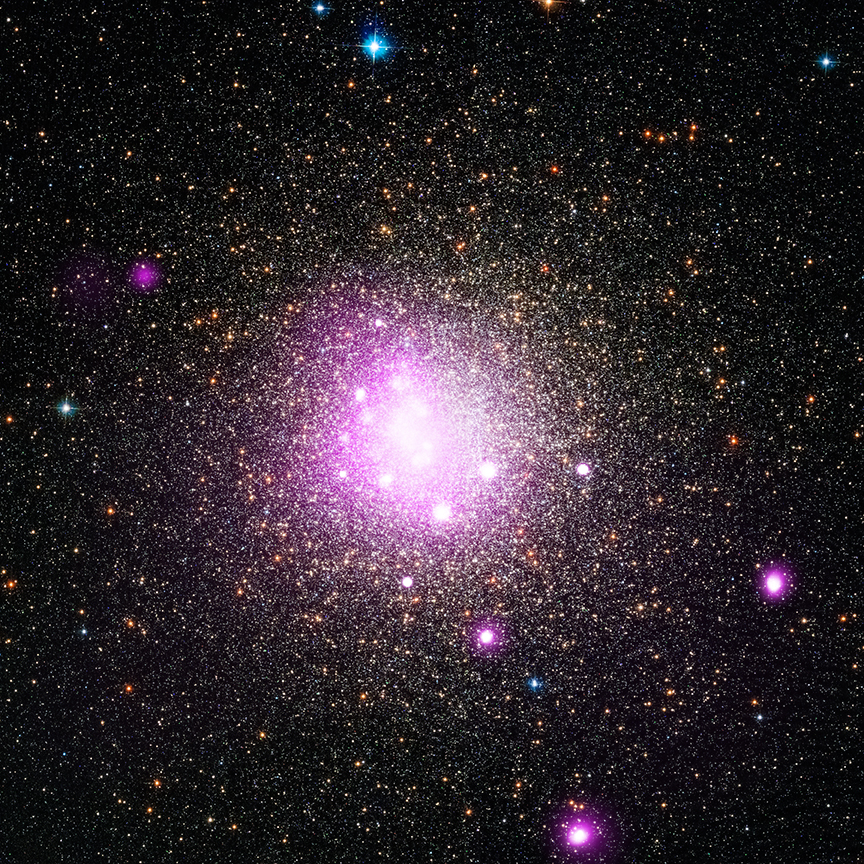
NGC 6388: White Dwarf May Have Shredded Passing Planet

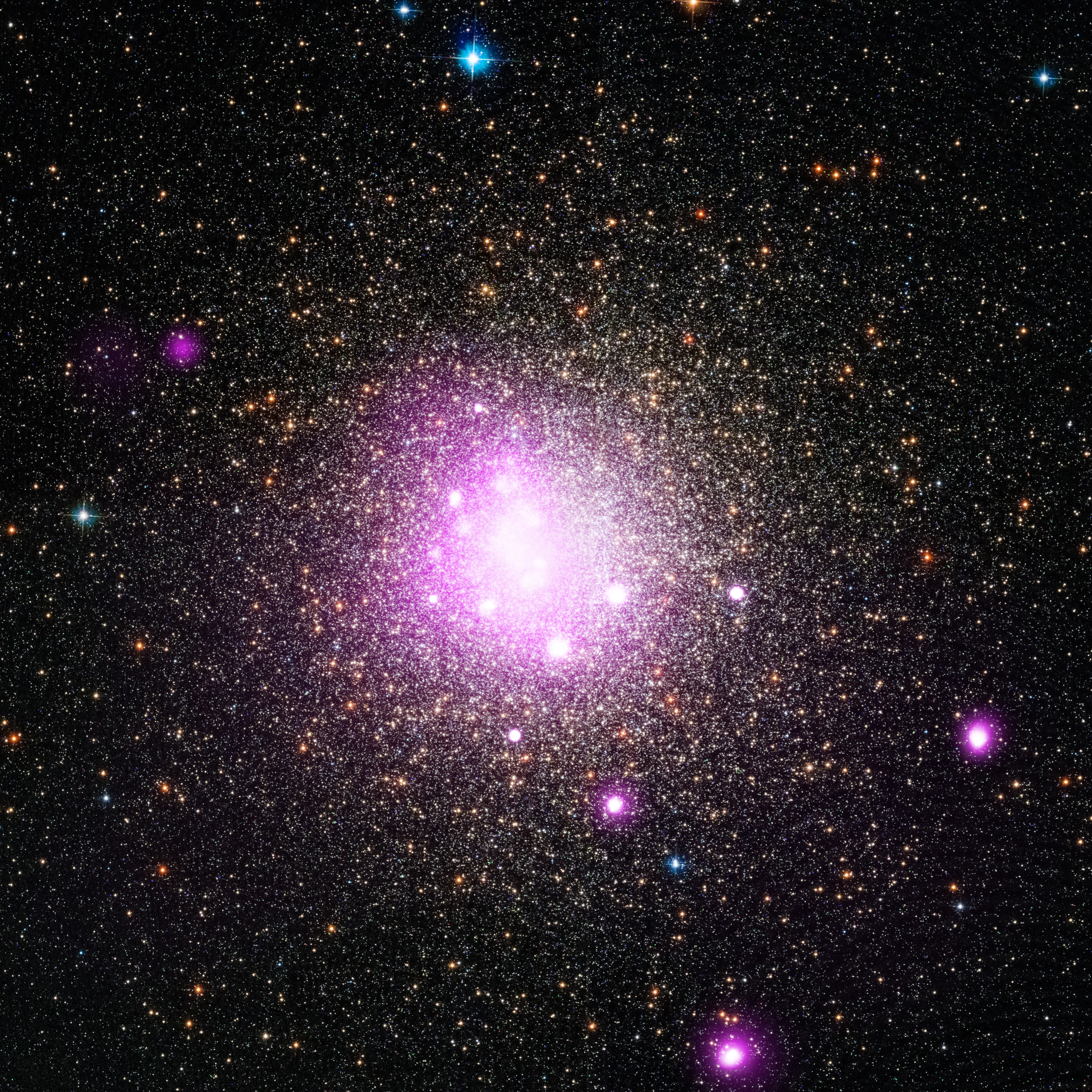
NGC 6388
Credit: X-ray: NASA/CXC/IASF Palermo/M.Del Santo et al; Optical: NASA/STScI


animation
Tour of NGC 6388


The destruction of a planet may sound like the stuff of science fiction, but a team of astronomers has found evidence that this may have happened in an ancient cluster of stars at the edge of the Milky Way galaxy.

Using several telescopes, including NASA's Chandra X-ray Observatory, researchers have found evidence that a white dwarf star - the dense core of a star like the Sun that has run out of nuclear fuel - may have ripped apart a planet as it came too close.

How could a white dwarf star, which is only about the size of the Earth, be responsible for such an extreme act? The answer is gravity. When a star reaches its white dwarf stage, nearly all of the material from the star is packed inside a radius one hundredth that of the original star. This means that, for close encounters, the gravitational pull of the star and the associated tides, caused by the difference in gravity's pull on the near and far side of the planet, are greatly enhanced. For example, the gravity at the surface of a white dwarf is over ten thousand times higher than the gravity at the surface of the Sun.

Researchers used the European Space Agency's INTErnational Gamma-Ray Astrophysics Laboratory (INTEGRAL) to discover a new X-ray source near the center of the globular cluster NGC 6388. Optical observations had hinted that an intermediate-mass black hole with mass equal to several hundred Suns or more resides at the center of NGC 6388. The X-ray detection by INTEGRAL then raised the intriguing possibility that the X-rays were produced by hot gas swirling towards an intermediate-mass black hole.

In a follow-up X-ray observation, Chandra's excellent X-ray vision enabled the astronomers to determine that the X-rays from NGC 6388 were not coming from the putative black hole at the center of the cluster, but instead from a location slightly off to one side. A new composite image shows NGC 6388 with X-rays detected by Chandra in pink and visible light from the Hubble Space Telescope in red, green, and blue, with many of the stars appearing to be orange or white. Overlapping X-ray sources and stars near the center of the cluster also causes the image to appear white.

With the central black hole ruled out as the potential X-ray source, the hunt continued for clues about the actual source in NGC 6388. The source was monitored with the X-ray telescope on board NASA's Swift Gamma Ray Burst mission for about 200 days after the discovery by INTEGRAL.

The source became dimmer during the period of Swift observations. The rate at which the X-ray brightness dropped agrees with theoretical models of a disruption of a planet by the gravitational tidal forces of a white dwarf. In these models, a planet is first pulled away from its parent star by the gravity of the dense concentration of stars in a globular cluster. When such a planet passes too close to a white dwarf, it can be torn apart by the intense tidal forces of the white dwarf. The planetary debris is then heated and glows in X-rays as it falls onto the white dwarf. The observed amount of X-rays emitted at different energies agrees with expectations for a tidal disruption event.

The researchers estimate that the destroyed planet would have contained about a third of the mass of Earth, while the white dwarf has about 1.4 times the Sun's mass.

While the case for the tidal disruption of a planet is not iron-clad, the argument for it was strengthened when astronomers used data from the multiple telescopes to help eliminate other possible explanations for the detected X-rays. For example, the source does not show some of the distinctive features of a binary containing a neutron star, such as pulsations or rapid X-ray bursts. Also, the source is much too faint in radio waves to be part of a binary system with a stellar-mass black hole.

A paper describing these results was published in an October 2014 issue of the Monthly Notices of the Royal Astronomical Society. The first author is Melania Del Santo of the National Institute for Astrophysics (INAF), IASF-Palermo, Italy, and the co-authors are Achille Nucita of the Universitá del Salento in Lecce, Italy; Giuseppe Lodato of the Universitá Degli Studi di Milano in Milan, Italy; Luigi Manni and Francesco De Paolis of the Universitá del Salento in Lecce, Italy; Jay Farihi of University College London in London, UK; Giovanni De Cesare of the National Institute for Astrophysics in IAPS-Rome, Italy and Alberto Segreto of the National Institute for Astrophysics (INAF), IASF-Palermo, Italy.

NASA's Marshall Space Flight Center in Huntsville, Alabama, manages the Chandra program for NASA's Science Mission Directorate in Washington. The Smithsonian Astrophysical Observatory in Cambridge, Massachusetts, controls Chandra's science and flight operations.


Fast Facts for NGC 6388: 

Release Date: April 16, 2015  
Scale Image: is 3 arcmin across (about 38 light years)  
Category: Normal Stars & Star Clusters 
Coordinates (J2000): RA 17h 36m 17.46s | Dec -44° 44' 08.34"  
Constellation: Scorpius
Observation Date: 2 pointings on 21 Apr 2005 and 29 Aug 2011  
Observation Time: 13 hours.  
Obs. ID: 5505, 12453  
Instrument: ACIS
References: Del Santo, M. et al, 2014, MNRAS, 444, 93; arXiv:1407.5081  
Color Code: X-ray (Pink); Optical (Red, Green, Blue)  
Distance Estimate: About 43,000 light years 


Thursday, December 20, 2012

Stars Reveal the Secrets of Looking Young

 
The globular cluster NGC 6388 observed by the European Southern Observatory
The globular cluster NGC 6388, 
observed by the NASA/ESA Hubble Space Telescope

NGC 6388 seen from the ground and space

Globular clusters seen by Hubble and from the ground

 Videos
Evolution of globular clusters

Some people are in great shape at the age of 90, while others are decrepit before they’re 50. We know that how fast people age is only loosely linked to how old they actually are — and may have more to do with their lifestyle. A new study using both the MPG/ESO 2.2-metre telescope at ESO’s La Silla Observatory and the NASA/ESA Hubble Space Telescope reveals that the same is true of star clusters.
Globular clusters are spherical collections of stars, tightly bound to each other by their mutual gravity. Relics of the early years of the Universe, with ages of typically 12–13 billion years (the Big Bang took place 13.7 billion years ago), there are roughly 150 globular clusters in the Milky Way and they contain many of our galaxy’s oldest stars.

But while the stars are old and the clusters formed in the distant past, astronomers using the MPG/ESO 2.2-metre telescope and the NASA/ESA Hubble Space Telescope have found that some of these clusters are still young at heart. The research is presented in the 20 December 2012 issue of the journal Nature.

“Although these clusters all formed billions of years ago,” says Francesco Ferraro (University of Bologna, Italy), the leader of the team that made the discovery, “we wondered whether some might be aging faster or slower than others. By studying the distribution of a type of blue star that exists in the clusters, we found that some clusters had indeed evolved much faster over their lifetimes, and we developed a way to measure the rate of aging.”

Star clusters form in a short period of time, meaning that all the stars within them tend to have roughly the same age. Because bright, high-mass stars burn up their fuel quite quickly, and globular clusters are very old, there should only be low-mass stars still shining within them.

This, however, turns out not to be the case: in certain circumstances, stars can be given a new burst of life, receiving extra fuel that bulks them up and substantially brightens them. This can happen if one star pulls matter off a close neighbour, or if they collide. The re-invigorated stars are called blue stragglers [1], and their high mass and brightness are properties that lie at the heart of this study.

Heavier stars sink towards the centre of a cluster as the cluster ages, in a process similar to sedimentation. Blue stragglers’ high masses mean they are strongly affected by this process, while their brightness makes them relatively easy to observe [2].

To better understand cluster aging, the team mapped the location of blue straggler stars in 21 globular clusters, as seen in images from the MPG/ESO 2.2-metre telescope and Hubble, among other observatories [3]. Hubble provided high resolution imagery of the crowded centres of 20 of the clusters, while the ground-based imagery gave a wider view of their less busy outer regions.

Analysing the observational data, the team found that a few clusters appeared young, with blue straggler stars distributed throughout, while a larger group appeared old, with the blue stragglers clumped in the centre. A third group was in the process of aging, with the stars closest to the core migrating inwards first, then stars ever further out progressively sinking towards the centre.

“Since these clusters all formed at roughly the same time, this reveals big differences in the speed of evolution from cluster to cluster,” said Barbara Lanzoni (University of Bologna, Italy), a co-author of the study. “In the case of fast-aging clusters, we think that the sedimentation process can be complete within a few hundred million years, while for the slowest it would take several times the current age of the Universe.”

As a cluster’s heaviest stars sink towards the centre, the cluster eventually experiences a phenomenon called core collapse, where the centre of the cluster bunches together extremely densely. The processes leading towards core collapse are quite well understood, and revolve around the number, density and speed of movement of the stars. However, the rate at which they happened was not known until now [4]. This study provides the first empirical evidence of how quickly different globular clusters age.

Notes

[1] Blue stragglers are so called because of their blue colour, and the fact that their evolution lags behind that of their neighbours.

[2] Blue stragglers combine being relatively bright and high mass by the standards of globular cluster stars, but they are not the only stars within these clusters that are either bright or massive.

Red giant stars are brighter, but they have a much lower mass, and therefore are not affected by the sedimentation process in the same way. (It is easy to distinguish these from blue stragglers because their colour is very different.)

Neutron stars, the extremely dense cores of stars much bigger than the Sun that exploded billions of years ago in the early history of globular clusters, have a similar mass to blue stragglers, and are affected by the sedimentation process, but they are incredibly difficult to observe and therefore do not make a useful subject for this study.

Blue stragglers are the only stars within clusters that combine high mass and high brightness.

[3] Of the 21 clusters covered by this research, 20 were studied with Hubble, 12 with the MPG/ESO 2.2-metre telescope, eight with the Canada-France-Hawaii telescope and one with NAOJ’s Subaru Telescope.

[4] Such a rate depends in a complex manner on the number of stars, their density and their velocity within a cluster. While the first two quantities are relatively easy to measure, velocity is not. For these reasons, previous estimates of the rate of globular cluster dynamical aging were based only on theoretical arguments, while the new method allows a totally empirical measurement.

More information

This research was presented in a paper, “Dynamical age differences amongst coeval star clusters as revealed by blue stragglers“, by F. R. Ferraro et al., to appear in the journal Nature on 20 December 2012.

The team is composed of F. R. Ferraro (University of Bologna, Italy), B. Lanzoni (University of Bologna), E. Dalessandro (University of Bologna), G. Beccari (ESO, Garching, Germany), M. Pasquato (University of Bologna), P. Miocchi (University of Bologna), R. T. Rood (University of Virginia, Charlottesville, USA), S. Sigurdsson (Pennsylvania State University, USA), A. Sills (McMaster University, Hamilton, Canada), E. Vesperini (Indiana University, Bloomington, USA), M. Mapelli (INAF-Osservatorio Astronomico di Padova, Italy), R. Contreras (University of Bologna), N. Sanna (University of Bologna), A. Mucciarelli (University of Bologna).

This research is part of the Cosmic-Lab project (www.cosmic-lab.eu) funded by the ERC (European Research Council) for a total amount of € 1.8 million for 5 years. Set up in 2007 by the European Union, the ERC aims to stimulate scientific excellence in Europe by encouraging competition for funding between the very best, creative researchers of any nationality and age. Since its launch, the ERC has funded over 2 500 researchers and their frontier research projects across Europe. The ERC operates according to an "investigator-driven", or "bottom-up", approach, allowing researchers to identify new opportunities in all fields of research (Physical Sciences and Engineering, Life Sciences, and Social Sciences and Humanities). It has also become a benchmark of the competitiveness of national research systems and complements existing funding schemes at national and European levels. The ERC, which is the newest component of the EU's Seventh Research Framework Programme, has a total budget of €7.5 billion from 2007 to 2013. Last year, the European Commission proposed a substantial increase in the ERC's budget for 2014 to 2020 under the new framework programme ('Horizon 2020'). The ERC is composed of an Executive Agency and a Scientific Council. The Scientific Council is made up of 22 top researchers and sets the ERC's scientific strategy. The ERC is led by President Prof. Helga Nowotny and the Scientific Council is represented in Brussels by Secretary General Prof. Donald Dingwell. The ERC Executive Agency implements the "Ideas" Specific Programme and is led by Director (ad int.) Pablo Amor.

The year 2012 marks the 50th anniversary of the founding of the European Southern Observatory (ESO). ESO is the foremost intergovernmental astronomy organisation in Europe and the world’s most productive ground-based astronomical observatory by far. It is supported by 15 countries: Austria, Belgium, Brazil, the Czech Republic, Denmark, France, Finland, Germany, Italy, the Netherlands, Portugal, Spain, Sweden, Switzerland and the United Kingdom. ESO carries out an ambitious programme focused on the design, construction and operation of powerful ground-based observing facilities enabling astronomers to make important scientific discoveries. ESO also plays a leading role in promoting and organising cooperation in astronomical research. ESO operates three unique world-class observing sites in Chile: La Silla, Paranal and Chajnantor. At Paranal, ESO operates the Very Large Telescope, the world’s most advanced visible-light astronomical observatory and two survey telescopes. VISTA works in the infrared and is the world’s largest survey telescope and the VLT Survey Telescope is the largest telescope designed to exclusively survey the skies in visible light. ESO is the European partner of a revolutionary astronomical telescope ALMA, the largest astronomical project in existence. ESO is currently planning the 39-metre European Extremely Large optical/near-infrared Telescope, the E-ELT, which will become “the world’s biggest eye on the sky”.
Links


Contacts

 Francesco Ferraro
 University of Bologna
 Italy
 Tel: +39 051 209 5774
 Email:
francesco.ferraro3@unibo.it

 Barbara Lanzoni
 University of Bologna
 Italy
 Tel: +39 051 209 5792
 Email:
barbara.lanzoni3@unibo.it

 Richard Hook
 ESO, La Silla, Paranal, E-ELT & Survey Telescopes Press Officer
 Garching bei München, Germany
 Tel: +49 89 3200 6655
 Cell: +49 151 1537 3591
 Email:
rhook@eso.org
Oli Usher
Hubble/ESA
Garching bei München, Germany
Tel: +49 89 3200 6855