Showing posts with label DDO 68. Show all posts

Thursday, May 17, 2018

Hubble shows the local Universe in ultraviolet

The glowing spiral arms of NGC 6744

Dwarf galaxy UGCA 281

Messier 66 — member of the Leo Triplet
Pockets of star formation in DDO 68

PR Image heic1810e
Wave of star formation in Messier 96
Parts of Messier 106


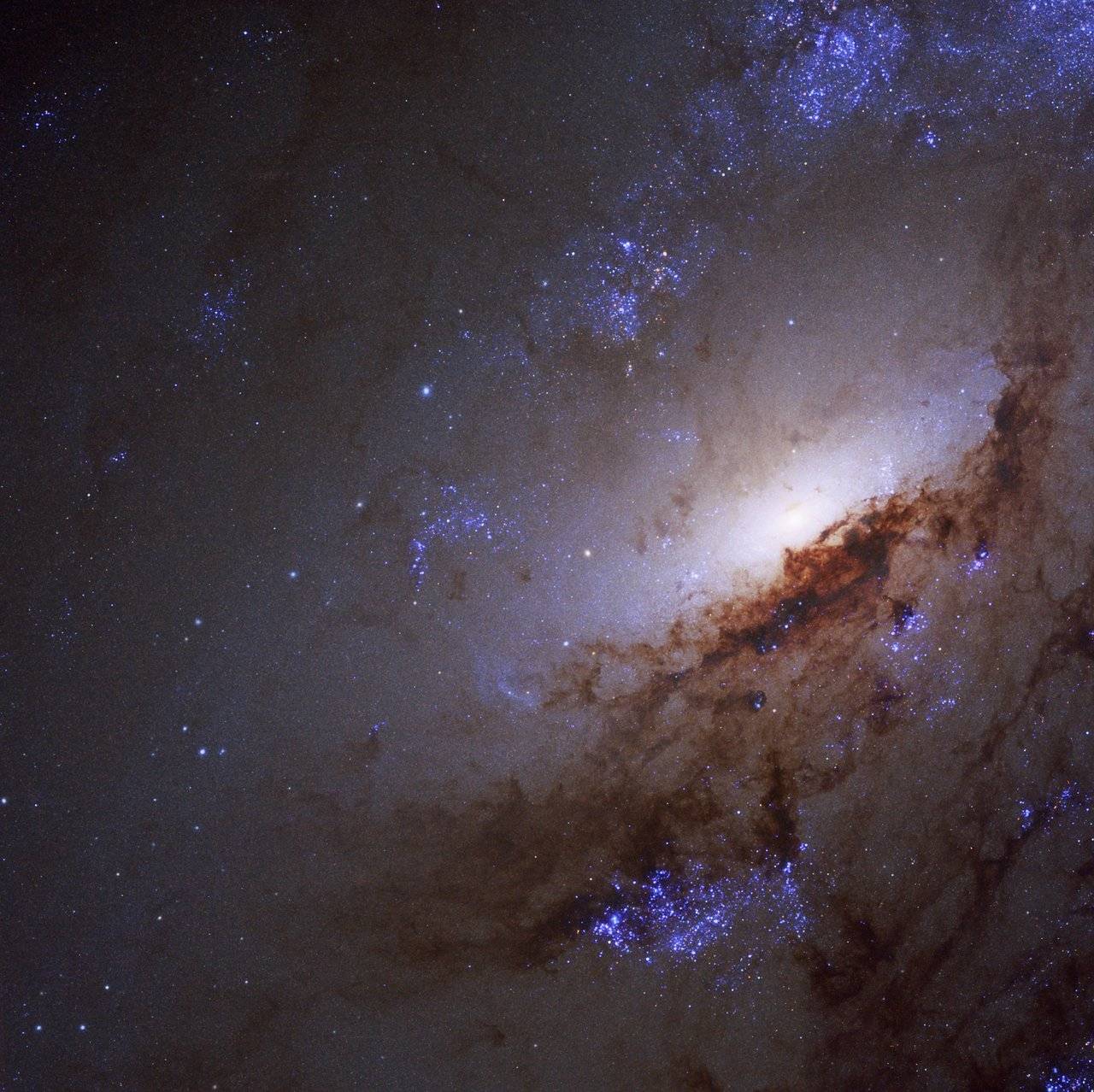
Using the unparalleled sharpness and ultraviolet observational capabilities of the NASA/ESA Hubble Space Telescope, an international team of astronomers has created the most comprehensive high-resolution ultraviolet-light survey of star-forming galaxies in the local Universe. The catalogue contains about 8000 clusters and 39 million hot blue stars.

Ultraviolet light is a major tracer of the youngest and hottest stars. These stars are short-lived and intensely bright. Astronomers have now finished a survey called LEGUS (Legacy ExtraGalactic UV Survey) that captured the details of 50 local galaxies within 60 million light-years of Earth in both visible and ultraviolet light.

The LEGUS team carefully selected its targets from among 500 candidate galaxies compiled from ground-based surveys. They chose the galaxies based on their mass, star-formation rate, and their abundances of elements heavier than hydrogen and helium. Because of the proximity of the selected galaxies, Hubble was able to resolve them into their main components: stars and star clusters. With the LEGUS data, the team created a catalogue with about 8000 young clusters and it also created a star catalogue comprising about 39 million stars that are at least five times more massive than our Sun.

The data, gathered with Hubble’s Wide Field Camera 3 and Advanced Camera for Surveys, provide detailed information on young, massive stars and star clusters, and how their environment affects their development. As such, the catalogue offers an extensive resource for understanding the complexities of star formation and galaxy evolution.

One of the key questions the survey may help astronomers answer is the connection between star formation and the major structures, such as spiral arms, that make up a galaxy. These structured distributions are particularly visible in the youngest stellar populations.

By resolving the fine details of the studied galaxies, while also studying the connection to larger galactic structures, the team aims to identify the physical mechanisms behind the observed distribution of stellar populations within galaxies.

Figuring out the final link between gas and star formation is key to fully understanding galaxy evolution. Astronomers are studying this link by looking at the effects of the environment on star clusters, and how their survival is linked to their surroundings.

LEGUS will not only allow astronomers to understand the local Universe. It will also help interpret views of distant galaxies, where the ultraviolet light from young stars is stretched to infrared wavelengths due to the expansion of space. The NASA/ESA/CSA James Webb Space Telescope and its ability to observe in the far infrared will complement the LEGUS views.


More Information

The Hubble Space Telescope is a project of international cooperation between ESA and NASA.
Image credit: NASA, ESA, LEGUS team


Links


Contacts

Linda Smith
European Space Agency
Baltimore, Maryland, USA
Tel: 001 4103384926
Email:
lsmith@stsci.edu

Mathias Jäger
ESA/Hubble, Public Information Officer
Garching bei München, Germany
Cell: +49 176 62397500
Email:
mjaeger@partner.eso.org


Thursday, September 25, 2014

A galaxy of deception Hubble snaps what looks like a young galaxy in the local Universe

Dwarf galaxy DDO 68

The area around dwarf galaxy DDO 68 (ground-based image) 

 *  *  *  *  *  *  *  *  *  *  *  *  *

 Videos

Zooming in on dwarf galaxy DDO 68

Panning across DDO 68


Hubble snaps what looks like a young galaxy in the local Universe

Astronomers usually have to peer very far into the distance to see back in time, and view the Universe as it was when it was young. This new NASA/ESA Hubble Space Telescope image of galaxy DDO 68, otherwise known as UGC 5340, was thought to offer an exception. This ragged collection of stars and gas clouds looks at first glance like a recently-formed galaxy in our own cosmic neighbourhood. But, is it really as young as it looks?


Astronomers have studied galactic evolution for decades, gradually improving our knowledge of how galaxies have changed over cosmic history. The NASA/ESA Hubble Space Telescope has played a big part in this, allowing astronomers to see further into the distance, and hence further back in time, than any telescope before it — capturing light that has taken billions of years to reach us.

Looking further into the very distant past to observe younger and younger galaxies is very valuable, but it is not without its problems for astronomers. All newly-born galaxies lie very far away from us and appear very small and faint in the images. On the contrary, all the galaxies near to us appear to be old ones.

DDO 68, captured here by the NASA/ESA Hubble Space Telescope, was one of the best candidates so far discovered for a newly-formed galaxy in our cosmic neighbourhood. The galaxy lies around 39 million light-years away from us; although this distance may seem huge, it is in fact roughly 50 times closer than the usual distances to such galaxies, which are on the order of several billions of light years.

By studying galaxies of various ages, astronomers have found that those early in their lives are fundamentally different from those that are older. DDO 68 looks to be relatively youthful based on its structure, appearance, and composition. However, without more detailed modelling astronomers cannot be sure and they think it may be older than it lets on.

Elderly galaxies tend to be larger thanks to collisions and mergers with other galaxies that have bulked them out, and are populated with a variety of different types of stars — including old, young, large, and small ones. Their chemical makeup is different too. Newly-formed galaxies have a similar composition to the primordial matter created in the Big Bang (hydrogen, helium and a little lithium), while older galaxies are enriched with heavier elements forged in stellar furnaces over multiple generations of stars.

DDO 68 is the best representation yet of a primordial galaxy in the local Universe as it appears at first glance to be very low in heavier elements — whose presence would be a sign of the existence of previous generations of stars.

Hubble observations were carried out in order to study the properties of the galaxy’s light, and to confirm whether or not there are any older stars in DDO 68. If there are, which there seem to be, this would disprove the hypothesis that it is entirely made up of young stars. If not, it would confirm the unique nature of this galaxy. More complex modelling is needed before we can know for sure but Hubble's picture certainly gives us a beautiful view of this unusual object.

The image is made up of exposures in visible and infrared light taken with Hubble's Advanced Camera for Surveys.

Notes

The Hubble Space Telescope is a project of international cooperation between ESA and NASA.

More information


Image credit: NASA & ESA
Acknowledgement: A. Aloisi (Space Telescope Science Institute)

Links


Contacts


Georgia Bladon
Hubble/ESA
Garching, Germany
Tel: +49-89-3200-6855
Email:
gbladon@partner.eso.org