Showing posts with label Legacy ExtraGalactic UV Survey (LEGUS). Show all posts

Friday, June 23, 2017

Surveying the cosmos

Credit:  ESA/Hubble & NASA


The object in the middle of this image, sitting alone within a star-studded cosmos, is a galaxy known as ESO 486-21. ESO 486-21 is a spiral galaxy — albeit with a somewhat irregular and ill-defined structure — located some 30 million light-years from Earth.

The NASA/ESA Hubble Space Telescope observed this object while performing a survey — the Legacy ExtraGalactic UV Survey (LEGUS) — of 50 nearby star-forming galaxies. The LEGUS sample was selected to cover a diverse range of galactic morphologies, star formation rates, galaxy masses, and more. Astronomers use such data to understand how stars form and evolve within clusters, and how these processes affect both their home galaxy and the wider Universe. ESO 486-21 is an ideal candidate for inclusion in such a survey as it is known to be in the process of forming new stars, which are created when large clouds of gas and dust (seen here in pink) within the galaxy crumple inwards upon themselves.

LEGUS made use of Hubble’s Wide Field Camera 3 (WFC3) and Advanced Camera for Surveys (ACS). The WFC3 obtained detailed observations of the target objects while the ACS obtained what are known as parallel fields — instead of leaving ACS idle, it was instead trained on a small patch of sky just offset from the target field itself, allowing it to gather additional valuable information while the primary target was being observed by WFC3. Parallel fields played an important role in Hubble’s Frontier Fields programme, which used the magnifying power of large galaxy clusters (via a phenomenon known as gravitational lensing) to explore objects in the distant Universe.


Friday, July 11, 2014

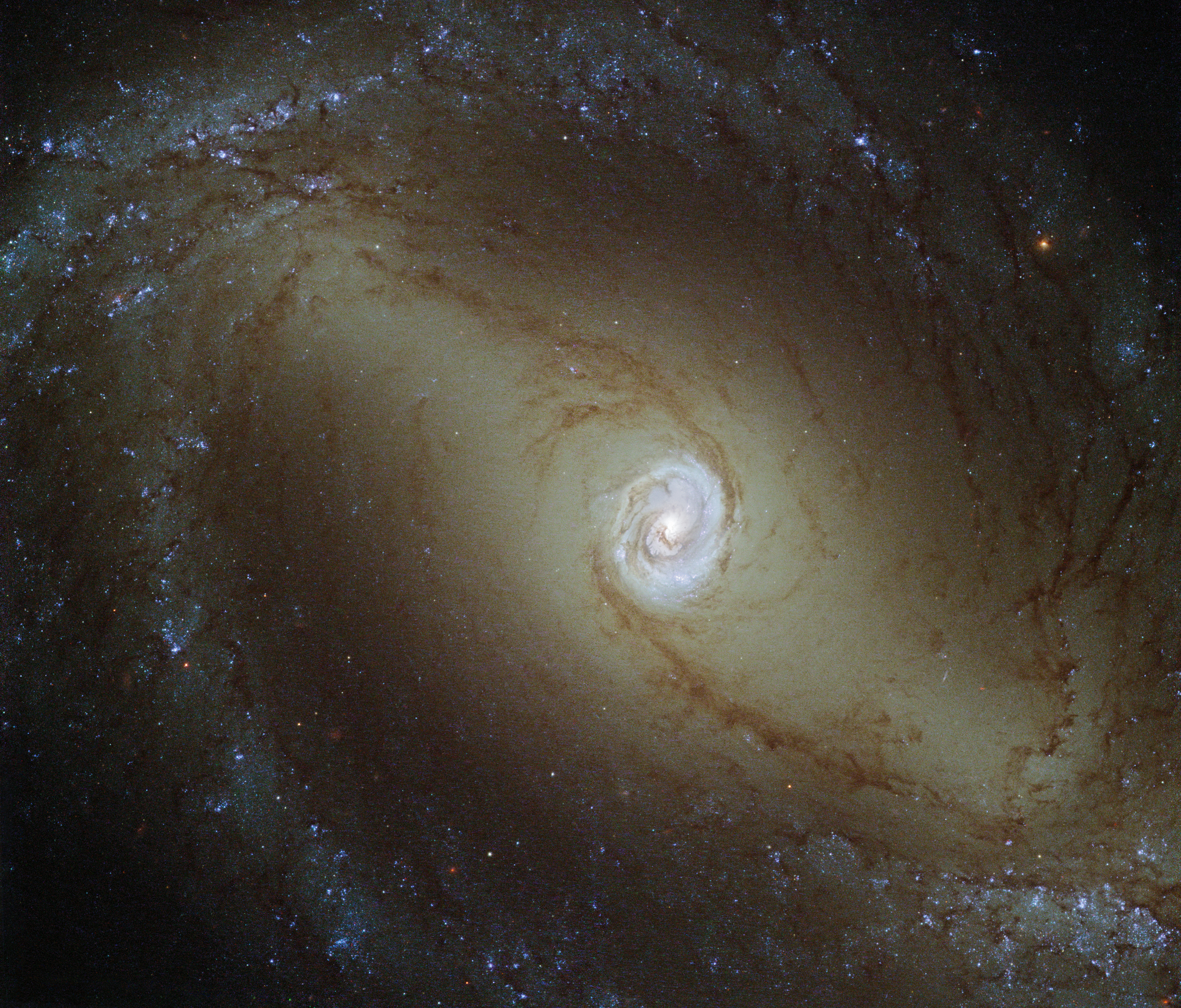
A galaxy with a glowing heart

Credit: ESA/Hubble & NASA
Acknowledgements: D. Calzetti (UMass) and the LEGUS Team

This view, captured by the NASA/ESA Hubble Space Telescope, shows a nearby spiral galaxy known as NGC 1433. At about 32 million light-years from Earth, it is a type of very active galaxy known as a Seyfert galaxy — a classification that accounts for 10% of all galaxies. They have very bright, luminous centres comparable to that of our galaxy, the Milky Way.

Galaxy cores are of great interest to astronomers. The centres of most, if not all, galaxies are thought to contain a supermassive black hole, surrounded by a disc of infalling material.

NGC 1433 is being studied as part of a survey of 50 nearby galaxies known as the Legacy ExtraGalactic UV Survey (LEGUS). Ultraviolet radiation is observed from galaxies, mainly tracing the most recently formed stars. In Seyfert galaxies, ultraviolet light is also thought to emanate from the accretion discs around their central black holes. Studying these galaxies in the ultraviolet part of the spectrum is incredibly useful to study how the gas is behaving near the black hole. This image was obtained using a mix of ultraviolet, visible, and infrared light.

LEGUS will study a full range of properties from a sample of galaxies, including their internal structure. This Hubble survey will provide a unique foundation for future observations with the James Webb Space Telescope (JWST) and the Atacama Large Millimeter/submillimeter Array (ALMA). ALMA has already caught unexpected results relating to the centre of NGC 1433, finding a surprising spiral structure in the molecular gas close to the centre of NGC 1433. The astronomers also found a jet of material flowing away from the black hole, extending for only 150 light-years — the smallest such molecular outflow ever observed in a galaxy beyond our own.

Links

Source: ESA/Hubble - Space Telescope