


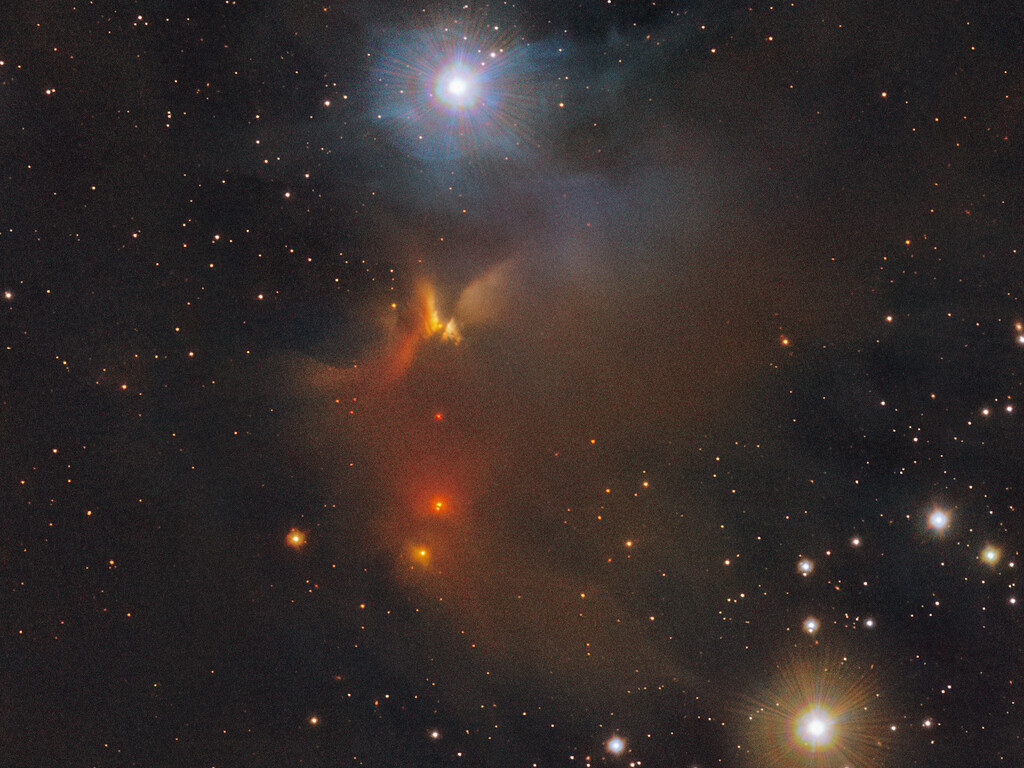


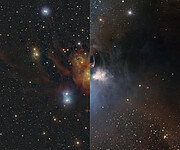
The Coronet region in visible light
Videos
Hidden views of vast stellar nurseries (ESOcast 262 Light)

Using ESO’s Visible and Infrared Survey
Telescope for Astronomy (VISTA), astronomers have created a vast
infrared atlas of five nearby stellar nurseries by piecing together more
than one million images. These large mosaics reveal young stars in the
making, embedded in thick clouds of dust. Thanks to these observations,
astronomers have a unique tool with which to decipher the complex puzzle
of stellar birth.
“In these images we can detect even the faintest
sources of light, like stars far less massive than the Sun, revealing
objects that no one has ever seen before,” says Stefan Meingast, an
astronomer at the University of Vienna in Austria and lead author of
the new study published today in Astronomy & Astrophysics. “This will allow us to understand the processes that transform gas and dust into stars.”
Stars form when clouds of gas and dust collapse under their
own gravity, but the details of how this happens are not fully
understood. How many stars are born out of a cloud? How massive are
they? How many stars will also have planets?
To answer these questions, Meingast’s team surveyed five nearby star-forming regions with the VISTA telescope at ESO’s Paranal Observatory in Chile. Using VISTA’s infrared camera VIRCAM, the team captured light coming from deep inside the clouds of dust. “The dust obscures these young stars from our view, making them virtually
invisible to our eyes. Only at infrared wavelengths can we look deep
into these clouds, studying the stars in the making,” explains Alena Rottensteiner, a PhD student also at the University of Vienna and co-author of the study.
The survey, called VISIONS, observed star-forming regions in the constellations of Orion, Ophiuchus, Chamaeleon, Corona Australis and Lupus. These regions are less than 1500 light-years away and so large that they span a huge area in the sky. The diameter of VIRCAM’s field of view is as wide as three full Moons, which makes it uniquely suited to map these immensely big regions.
The team obtained more than one million images over a
period of five years. The individual images were then pieced together
into the large mosaics released here, revealing vast cosmic landscapes.
These detailed panoramas feature dark patches of dust, glowing clouds,
newly-born stars and the distant background stars of the Milky Way.
Since the same areas were observed repeatedly, the VISIONS data will also allow astronomers to study how young stars move. “With
VISIONS we monitor these baby stars over several years, allowing us to
measure their motion and learn how they leave their parent clouds,”
explains João Alves, an astronomer at the University of Vienna and
Principal Investigator of VISIONS. This is not an easy feat, as the
apparent shift of these stars as seen from Earth is as small as the
width of a human hair seen from 10 kilometres away. These measurements
of stellar motions complement those obtained by the European Space
Agency’s Gaia mission at visible wavelengths, where young stars are hidden by thick veils of dust.
The VISIONS atlas will keep astronomers busy for years to come. “There is tremendous long-lasting value for the astronomical community here, which is why ESO steers Public Surveys like VISIONS,”
says Monika Petr-Gotzens, an astronomer at ESO in Garching, Germany,
and co-author of this study. Moreover, VISIONS will set the groundwork
for future observations with other telescopes such as ESO’s Extremely
Large Telescope (ELT), currently under construction in Chile and set to start operating later this decade. “The
ELT will allow us to zoom into specific regions with unprecedented
detail, giving us a never-seen-before close-up view of individual stars
that are currently forming there,” concludes Meingast.
More Information
This research was presented in the paper “VISIONS: The VISTA Star Formation Atlas”, to appear in Astronomy & Astrophysics (doi: 10.1051/0004-6361/202245771)
The team is composed of Stefan Meingast (University of Vienna, Austria [Vienna]), João Alves (Vienna), Hervé Bouy (Université de Bordeaux, France [Bordeaux]), Monika G. Petr-Gotzens (European Southern Observatory, Germany [ESO]), Verena Fürnkranz (Max-Planck-Institut für Astronomie, Germany [MPIA]]), Josefa E. Großschedl (Vienna), David Hernandez (Vienna), Alena Rottensteiner (Vienna), Joana Ascenso (Universidade do Porto, Portugal [Porto]; Universidade de Lisboa, Portugal [Lisboa]), Amelia Bayo (ESO; Universidad de Valparaíso, Chile), Erik Brändli (Vienna), Anthony G. A. Brown (Leiden University, Netherlands), Jan Forbrich (University of Hertfordshire, UK [Hertfordshire]), Alyssa Goodman (Harvard-Smithsonian Center for Astrophysics, USA [CfA]), Alvaro Hacar (Vienna), Birgit Hasenberger (Vienna), Rainer Köhler (The CHARA Array of Georgia State University, USA), Karolina Kubiak (Lisboa), Michael Kuhn (Hertfordshire), Charles Lada (CfA), Kieran Leschinski (Vienna), Marco Lombardi (Università degli Studi di Milano, Italy), Diego Mardones (Universidad de Chile, Chile), Núria Miret-Roig (European Space Agency, European Space Research and Technology Centre, Netherlands [ESA]), André Moitinho (Lisboa), Koraljka Mužiiić (Porto; Lisboa), Martin Piecka (Vienna), Laura Posch (Vienna), Timo Prusti (ESA), Karla Peña Ramírez (Universidad de Antofagasta, Chile), Ronny Ramlau (Johannes Kepler University Linz, Austria; Johann Radon Institute for Computational and Applied Mathematics, Austria), Sebastian Ratzenböck (Vienna; Research Network Data Science at Uni Vienna), Germano Sacco (INAF – Osservatorio Astrofisico di Arcetri, Italy), Cameren Swiggum (Vienna), Paula Stella Teixeira (University of St Andrews, UK), Vanessa Urban (Vienna), Eleonora Zari (MPIA), and Catherine Zucker (Bordeaux).
The European Southern Observatory (ESO) enables scientists worldwide to discover the secrets of the Universe for the benefit of all. We design, build and operate world-class observatories on the ground — which astronomers use to tackle exciting questions and spread the fascination of astronomy — and promote international collaboration in astronomy. Established as an intergovernmental organisation in 1962, today ESO is supported by 16 Member States (Austria, Belgium, the Czech Republic, Denmark, France, Finland, Germany, Ireland, Italy, the Netherlands, Poland, Portugal, Spain, Sweden, Switzerland and the United Kingdom), along with the host state of Chile and with Australia as a Strategic Partner. ESO’s headquarters and its visitor centre and planetarium, the ESO Supernova, are located close to Munich in Germany, while the Chilean Atacama Desert, a marvellous place with unique conditions to observe the sky, hosts our telescopes. ESO operates three observing sites: La Silla, Paranal and Chajnantor. At Paranal, ESO operates the Very Large Telescope and its Very Large Telescope Interferometer, as well as survey telescopes such as VISTA. Also at Paranal ESO will host and operate the Cherenkov Telescope Array South, the world’s largest and most sensitive gamma-ray observatory. Together with international partners, ESO operates ALMA on Chajnantor, a facility that observes the skies in the millimetre and submillimetre range. At Cerro Armazones, near Paranal, we are building “the world’s biggest eye on the sky” — ESO’s Extremely Large Telescope. From our offices in Santiago, Chile we support our operations in the country and engage with Chilean partners and society.
The team is composed of Stefan Meingast (University of Vienna, Austria [Vienna]), João Alves (Vienna), Hervé Bouy (Université de Bordeaux, France [Bordeaux]), Monika G. Petr-Gotzens (European Southern Observatory, Germany [ESO]), Verena Fürnkranz (Max-Planck-Institut für Astronomie, Germany [MPIA]]), Josefa E. Großschedl (Vienna), David Hernandez (Vienna), Alena Rottensteiner (Vienna), Joana Ascenso (Universidade do Porto, Portugal [Porto]; Universidade de Lisboa, Portugal [Lisboa]), Amelia Bayo (ESO; Universidad de Valparaíso, Chile), Erik Brändli (Vienna), Anthony G. A. Brown (Leiden University, Netherlands), Jan Forbrich (University of Hertfordshire, UK [Hertfordshire]), Alyssa Goodman (Harvard-Smithsonian Center for Astrophysics, USA [CfA]), Alvaro Hacar (Vienna), Birgit Hasenberger (Vienna), Rainer Köhler (The CHARA Array of Georgia State University, USA), Karolina Kubiak (Lisboa), Michael Kuhn (Hertfordshire), Charles Lada (CfA), Kieran Leschinski (Vienna), Marco Lombardi (Università degli Studi di Milano, Italy), Diego Mardones (Universidad de Chile, Chile), Núria Miret-Roig (European Space Agency, European Space Research and Technology Centre, Netherlands [ESA]), André Moitinho (Lisboa), Koraljka Mužiiić (Porto; Lisboa), Martin Piecka (Vienna), Laura Posch (Vienna), Timo Prusti (ESA), Karla Peña Ramírez (Universidad de Antofagasta, Chile), Ronny Ramlau (Johannes Kepler University Linz, Austria; Johann Radon Institute for Computational and Applied Mathematics, Austria), Sebastian Ratzenböck (Vienna; Research Network Data Science at Uni Vienna), Germano Sacco (INAF – Osservatorio Astrofisico di Arcetri, Italy), Cameren Swiggum (Vienna), Paula Stella Teixeira (University of St Andrews, UK), Vanessa Urban (Vienna), Eleonora Zari (MPIA), and Catherine Zucker (Bordeaux).
The European Southern Observatory (ESO) enables scientists worldwide to discover the secrets of the Universe for the benefit of all. We design, build and operate world-class observatories on the ground — which astronomers use to tackle exciting questions and spread the fascination of astronomy — and promote international collaboration in astronomy. Established as an intergovernmental organisation in 1962, today ESO is supported by 16 Member States (Austria, Belgium, the Czech Republic, Denmark, France, Finland, Germany, Ireland, Italy, the Netherlands, Poland, Portugal, Spain, Sweden, Switzerland and the United Kingdom), along with the host state of Chile and with Australia as a Strategic Partner. ESO’s headquarters and its visitor centre and planetarium, the ESO Supernova, are located close to Munich in Germany, while the Chilean Atacama Desert, a marvellous place with unique conditions to observe the sky, hosts our telescopes. ESO operates three observing sites: La Silla, Paranal and Chajnantor. At Paranal, ESO operates the Very Large Telescope and its Very Large Telescope Interferometer, as well as survey telescopes such as VISTA. Also at Paranal ESO will host and operate the Cherenkov Telescope Array South, the world’s largest and most sensitive gamma-ray observatory. Together with international partners, ESO operates ALMA on Chajnantor, a facility that observes the skies in the millimetre and submillimetre range. At Cerro Armazones, near Paranal, we are building “the world’s biggest eye on the sky” — ESO’s Extremely Large Telescope. From our offices in Santiago, Chile we support our operations in the country and engage with Chilean partners and society.
Link
- Research paper
- Photos of VISTA
- For journalists: subscribe to receive our releases under embargo in your language
- For scientists: got a story? Pitch your research
Contacts:
Stefan Meingast
University of Vienna
Vienna, Austria
Email: stefan.meingast@univie.ac.at
Juan Carlos Muñoz Mateos
ESO Media Officer
Garching bei München, Germany
Tel: +49 89 3200 6176
Email: press@eso.org


