Showing posts with label Chamaeleon constellation. Show all posts

Monday, October 06, 2025

Six billion tonnes a second: Rogue planet found growing at record rate

PR Image eso2516a
Illustration of the rogue planet Cha 1107-7626

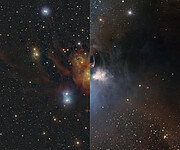
PR Image eso2516b
Location in the sky of the rogue planet Cha 1107-7626 (infrared)

PR Image eso2516c
Location in the sky of the rogue planet Cha 1107-7626 (visible light)


Videos

Rogue planet found growing at record rate | ESO News
PR Video eso2516a
Rogue planet found growing at record rate | ESO News
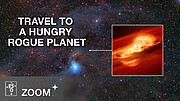
Zooming in on the rogue planet Cha 1107-7626

PR Video eso2516b
Zooming in on the rogue planet Cha 1107-7626

Animation of the growth spurt in the rogue planet Cha 1107-7626
PR Video eso2516c
Animation of the growth spurt in the rogue planet Cha 1107-7626
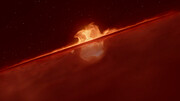
Animation of the growth spurt in the rogue planet Cha 1107-7626
PR Video eso2516d
Animation of the growth spurt in the rogue planet Cha 1107-7626


Astronomers have identified an enormous ‘growth spurt’ in a so-called rogue planet. Unlike the planets in our Solar System, these objects do not orbit stars, free-floating on their own instead. The new observations, made with the European Southern Observatory’s Very Large Telescope (ESO’s VLT), reveal that this free-floating planet is eating up gas and dust from its surroundings at a rate of six billion tonnes a second. This is the strongest growth rate ever recorded for a rogue planet, or a planet of any kind, providing valuable insights into how they form and grow.

People may think of planets as quiet and stable worlds, but with this discovery we see that planetary-mass objects freely floating in space can be exciting places,” says Víctor Almendros-Abad, an astronomer at the Astronomical Observatory of Palermo, National Institute for Astrophysics (INAF), Italy and lead author of the new study.

The newly studied object, which has a mass five to 10 times the mass of Jupiter, is located about 620 light-years away in the constellation Chamaeleon. Officially named Cha 1107-7626, this rogue planet is still forming and is fed by a surrounding disc of gas and dust. This material constantly falls onto the free-floating planet, a process known as accretion. However, the team led by Almendros-Abad has now found that the rate at which the young planet is accreting is not steady.

By August 2025, the planet was accreting about eight times faster than just a few months before, at a rate of six billion tonnes per second! “This is the strongest accretion episode ever recorded for a planetary-mass object,” says Almendros-Abad. The discovery, published today in The Astrophysical Journal Letters, was made with the X-shooter spectrograph on ESO’s VLT, located in Chile’s Atacama Desert. The team also used data from the James Webb Space Telescope, operated by the US, European and Canadian space agencies, and archival data from the SINFONI spectrograph on ESO's VLT.

"The origin of rogue planets remains an open question: are they the lowest-mass objects formed like stars, or giant planets ejected from their birth systems?” asks co-author Aleks Scholz, an astronomer at the University of St Andrews, United Kingdom. The findings indicate that at least some rogue planets may share a similar formation path to stars since similar bursts of accretion have been spotted in young stars before. As co-author Belinda Damian, also an astronomer at the University of St Andrews, explains: “This discovery blurs the line between stars and planets and gives us a sneak peek into the earliest formation periods of rogue planets.”

By comparing the light emitted before and during the burst, astronomers gathered clues about the nature of the accretion process. Remarkably, magnetic activity appears to have played a role in driving the dramatic infall of mass, something that has only been observed in stars before. This suggests that even low-mass objects can possess strong magnetic fields capable of powering such accretion events. The team also found that the chemistry of the disc around the planet changed during the accretion episode, with water vapour being detected during it but not before. This phenomenon had been spotted in stars but never in a planet of any kind.

Free-floating planets are difficult to detect, as they are very faint, but ESO’s upcoming Extremely Large Telescope (ELT), operating under the world's darkest skies for astronomy, could change that. Its powerful instruments and giant main mirror will enable astronomers to uncover and study more of these lonely planets, helping them to better understand how star-like they are. As co-author and ESO astronomer Amelia Bayo puts it: “The idea that a planetary object can behave like a star is awe-inspiring and invites us to wonder what worlds beyond our own could be like during their nascent stages.”

Source: ESO/News


More information

This research was presented in a paper titled “Discovery of an Accretion Burst in a Free-Floating Planetary-Mass Object” to appear in The Astrophysical Journal Letters (doi:10.3847/2041-8213/ae09a8).

The team is composed of  V. Almendros-Abad (Istituto Nazionale di Astrofisica - Osservatorio Astronomico di Palermo, Italy), Aleks Scholz (School of Physics & Astronomy, University of St Andrews, United Kingdom [St Andrews]), Belinda Damian (St Andrews), Ray Jayawardhana (Department of Physics & Astronomy, Johns Hopkins University, USA [JHU]), Amelia Bayo (European Southern Observatory, Germany), Laura Flagg (JHU), Koraljka Mužić (Instituto de Astrofísica e Ciências do Espaço, Faculdade de Ciências, Universidade de Lisboa, Portugal), Antonella Natta (School of Cosmic Physics, Dublin Institute for Advanced Studies and University College Dublin, Ireland) Paola Pinilla (Mullard Space Science Laboratory, University College London, UK) and Leonardo Testi (Dipartimento di Fisica e Astronomia, Università di Bologna, Italy).

The European Southern Observatory (ESO) enables scientists worldwide to discover the secrets of the Universe for the benefit of all. We design, build and operate world-class observatories on the ground — which astronomers use to tackle exciting questions and spread the fascination of astronomy — and promote international collaboration for astronomy. Established as an intergovernmental organisation in 1962, today ESO is supported by 16 Member States (Austria, Belgium, Czechia, Denmark, France, Finland, Germany, Ireland, Italy, the Netherlands, Poland, Portugal, Spain, Sweden, Switzerland and the United Kingdom), along with the host state of Chile and with Australia as a Strategic Partner. ESO’s headquarters and its visitor centre and planetarium, the ESO Supernova, are located close to Munich in Germany, while the Chilean Atacama Desert, a marvellous place with unique conditions to observe the sky, hosts our telescopes. ESO operates three observing sites: La Silla, Paranal and Chajnantor. At Paranal, ESO operates the Very Large Telescope and its Very Large Telescope Interferometer, as well as survey telescopes such as VISTA. Also at Paranal, ESO will host and operate the south array of the Cherenkov Telescope Array Observatory, the world’s largest and most sensitive gamma-ray observatory. Together with international partners, ESO operates ALMA on Chajnantor, a facility that observes the skies in the millimetre and submillimetre range. At Cerro Armazones, near Paranal, we are building “the world’s biggest eye on the sky” — ESO’s Extremely Large Telescope. From our offices in Santiago, Chile we support our operations in the country and engage with Chilean partners and society.


Links


Contacts

Víctor Almendros-Abad
INAF Astronomical Observatory of Palermo
Palermo, Italy
Tel: +39 3762144093
Email:
victor.almendrosabad@inaf.it

Aleks Scholz
University of St. Andrews
St. Andrews, United Kingdom
Tel: +44 (0)1334 46 1668
Email:
as110@st-andrews.ac.uk

Belinda Damian
University of St. Andrews
St. Andrews, United Kingdom
Tel: +44 (0)1334 46 3098
Email:
bd64@st-andrews.ac.uk

Amelia Bayo
European Southern Observatory
Garching, Germany
Tel: +49 89 3200 6499
Email:
AmeliaMaria.BayoAran@eso.org

Bárbara Ferreira
ESO Media Manager
Garching, Germany
Tel: +49 89 3200 6670
Cell: +49 151 241 664 00
Email:
press@eso.org


Tuesday, March 25, 2025

NASA's Webb Telescope Unmasks True Nature of the Cosmic Tornado

Herbig-Haro 49/50 (NIRCam and MIRI Image)
Credits/Image: NASA, ESA, CSA, STScI

Herbig-Haro 49/50 (Spitzer and Webb Images)
Credits/Image: NASA, ESA, CSA, STScI, NASA-JPL, SSC

Herbig-Haro 49/50 (NIRCam and MIRI Compass Image)
Credits/Image: NASA, ESA, CSA, STScI

Credits/Video: NASA, ESA, CSA, Joseph DePasquale (STScI), Leah Hustak (STScI), Greg Bacon (STScI), Ralf Crawford (STScI), Danielle Kirshenblat (STScI), Christian Nieves (STScI), Alyssa Pagan (STScI), Frank Summers (STScI)


Craving an ice cream sundae with a cherry on top? This random alignment of Herbig-Haro 49/50 — a frothy-looking outflow from a nearby protostar — with a multi-hued spiral galaxy may do the trick. This new composite image combining observations from NASA’s James Webb Space Telescope’s NIRCam (Near-Infrared Camera) and MIRI (Mid-Infrared Instrument) provides a high-resolution view to explore the exquisite details of this bubbling activity.

Herbig-Haro objects are outflows produced by jets launched from a nearby, forming star. The outflows, which can extend for light-years, plow into a denser region of material. This creates shock waves, heating the material to higher temperatures. The material then cools by emitting light at visible and infrared wavelengths.

When NASA's retired Spitzer Space Telescope observed it in 2006, scientists nicknamed Herbig-Haro 49/50 (HH 49/50) the “Cosmic Tornado” for its helical appearance, but they were uncertain about the nature of the fuzzy object at the tip of the “tornado.”  With its higher imaging resolution, Webb provides a different visual impression of HH 49/50 by revealing fine features of the shocked regions in the outflow, uncovering the fuzzy object to be a distant spiral galaxy, and displaying a sea of distant background galaxies.

HH 49/50 is located in the Chamaeleon I Cloud complex, one of the nearest active star formation regions in our Milky Way, which is creating numerous low-mass stars similar to our Sun. This cloud complex is likely similar to the environment that our Sun formed in. Past observations of this region show that the HH 49/50 outflow is moving away from us at speeds of 60-190 miles per second (100-300 kilometers per second) and is just one feature of a larger outflow.

Webb’s NIRCam and MIRI observations of HH 49/50 trace the location of glowing hydrogen molecules, carbon monoxide molecules, and energized grains of dust, represented in orange and red, as the protostellar jet slams into the region. Webb’s observations probe details on small spatial scales that will help astronomers to model the properties of the jet and understand how it is affecting the surrounding material.

The arc-shaped features in HH 49/50, similar to a water wake created by a speeding boat, point back to the source of this outflow. Based on past observations, scientists suspect that a protostar known as Cederblad 110 IRS4 is a plausible driver of the jet activity. Located roughly 1.5 light-years away from HH 49/50 (off the lower right corner of the Webb image), CED 110 IRS4 is a Class I protostar. Class I protostars are young objects (tens of thousands to a million years old) in the prime time of gaining mass. They usually have a discernable disk of material surrounding it that is still falling onto the protostar. Scientists recently used Webb’s NIRCam and MIRI observations to study this protostar and obtain an inventory of the icy composition of its environment.

These detailed Webb images of the arcs in HH 49/50 can more precisely pinpoint the direction to the jet source, but not every arc points back in the same direction. For example, there is an unusual outcrop feature (at the top right of the main outflow) which could be another chance superposition of a different outflow, related to the slow precession of the intermittent jet source. Alternatively, this feature could be a result of the main outflow breaking apart.

The galaxy that appears by happenstance at the tip of HH 49/50 is a much more distant, face-on spiral galaxy. It has a prominent central bulge represented in blue that shows the location of older stars. The bulge also shows hints of “side lobes” suggesting that this could be a barred-spiral galaxy. Reddish clumps within the spiral arms show the locations of warm dust and groups of forming stars. The galaxy even displays evacuated bubbles in these dusty regions, similar to nearby galaxies observed by Webb as part of the PHANGS program.

Webb has captured these two unassociated objects in a lucky alignment. Over thousands of years, the edge of HH 49/50 will move outwards and eventually appear to cover up the distant galaxy.

Want more? Take a closer look at the image, “fly through” it in a visualization, and compare Webb’s image to the Spitzer Space Telescope’s.


Herbig-Haro 49/50 is located about 625 light-years from Earth in the constellation Chamaeleon.

The James Webb Space Telescope is the world's premier space science observatory. Webb is solving mysteries in our solar system, looking beyond to distant worlds around other stars, and probing the mysterious structures and origins of our universe and our place in it. Webb is an international program led by NASA with its partners, ESA (European Space Agency) and the Canadian Space Agency.


About This Release

Credits:

Media Contact:

Quyen Hart
Space Telescope Science Institute, Baltimore, Maryland

Christine Pulliam
Space Telescope Science Institute, Baltimore, Maryland

Permissions: Content Use Policy


Friday, May 12, 2023

ESO telescope reveals hidden views of vast stellar nurseries

PR Image eso2307a
An infrared view of the L1688 region in Ophiuchus

PR Image eso2307b
An infrared view of the Lupus 2 region

PR Image eso2307c
An infrared view of the Lupus 3 region

PR Image eso2307d
An infrared view of the HH 909 A object in Chamaeleon

PR Image eso2307e
An infrared view of the IRAS 11051-7706 object in Chamaeleon

PR Image eso2307f
An infrared view of the region around the Coronet star cluster

PR Image eso2307g
The L1688 region in visible light

PR Image eso2307h
The Lupus 3 region in visible light

PR Image eso2307i
The Coronet region in visible light


Videos

Hidden views of vast stellar nurseries (ESOcast 262 Light)  


Using ESO’s Visible and Infrared Survey Telescope for Astronomy (VISTA), astronomers have created a vast infrared atlas of five nearby stellar nurseries by piecing together more than one million images. These large mosaics reveal young stars in the making, embedded in thick clouds of dust. Thanks to these observations, astronomers have a unique tool with which to decipher the complex puzzle of stellar birth.

In these images we can detect even the faintest sources of light, like stars far less massive than the Sun, revealing objects that no one has ever seen before,” says Stefan Meingast, an astronomer at the University of Vienna in Austria and lead author of the new study published today in Astronomy & Astrophysics. “This will allow us to understand the processes that transform gas and dust into stars.

Stars form when clouds of gas and dust collapse under their own gravity, but the details of how this happens are not fully understood. How many stars are born out of a cloud? How massive are they? How many stars will also have planets?

To answer these questions, Meingast’s team surveyed five nearby star-forming regions with the VISTA telescope at ESO’s Paranal Observatory in Chile. Using VISTA’s infrared camera VIRCAM, the team captured light coming from deep inside the clouds of dust. “The dust obscures these young stars from our view, making them virtually invisible to our eyes. Only at infrared wavelengths can we look deep into these clouds, studying the stars in the making,” explains Alena Rottensteiner, a PhD student also at the University of Vienna and co-author of the study.

The survey, called VISIONS, observed star-forming regions in the constellations of Orion, Ophiuchus, Chamaeleon, Corona Australis and Lupus. These regions are less than 1500 light-years away and so large that they span a huge area in the sky. The diameter of VIRCAM’s field of view is as wide as three full Moons, which makes it uniquely suited to map these immensely big regions.

The team obtained more than one million images over a period of five years. The individual images were then pieced together into the large mosaics released here, revealing vast cosmic landscapes. These detailed panoramas feature dark patches of dust, glowing clouds, newly-born stars and the distant background stars of the Milky Way.

Since the same areas were observed repeatedly, the VISIONS data will also allow astronomers to study how young stars move. “With VISIONS we monitor these baby stars over several years, allowing us to measure their motion and learn how they leave their parent clouds,” explains João Alves, an astronomer at the University of Vienna and Principal Investigator of VISIONS. This is not an easy feat, as the apparent shift of these stars as seen from Earth is as small as the width of a human hair seen from 10 kilometres away. These measurements of stellar motions complement those obtained by the European Space Agency’s Gaia mission at visible wavelengths, where young stars are hidden by thick veils of dust.

The VISIONS atlas will keep astronomers busy for years to come. “There is tremendous long-lasting value for the astronomical community here, which is why ESO steers Public Surveys like VISIONS,” says Monika Petr-Gotzens, an astronomer at ESO in Garching, Germany, and co-author of this study. Moreover, VISIONS will set the groundwork for future observations with other telescopes such as ESO’s Extremely Large Telescope (ELT), currently under construction in Chile and set to start operating later this decade. “The ELT will allow us to zoom into specific regions with unprecedented detail, giving us a never-seen-before close-up view of individual stars that are currently forming there,” concludes Meingast.


More Information

This research was presented in the paper “VISIONS: The VISTA Star Formation Atlas”, to appear in Astronomy & Astrophysics (doi: 10.1051/0004-6361/202245771)

The team is composed of Stefan Meingast (University of Vienna, Austria [Vienna]), João Alves (Vienna), Hervé Bouy (Université de Bordeaux, France [Bordeaux]), Monika G. Petr-Gotzens (European Southern Observatory, Germany [ESO]), Verena Fürnkranz (Max-Planck-Institut für Astronomie, Germany [MPIA]]), Josefa E. Großschedl (Vienna), David Hernandez (Vienna), Alena Rottensteiner (Vienna), Joana Ascenso (Universidade do Porto, Portugal [Porto]; Universidade de Lisboa, Portugal [Lisboa]), Amelia Bayo (ESO; Universidad de Valparaíso, Chile), Erik Brändli (Vienna), Anthony G. A. Brown (Leiden University, Netherlands), Jan Forbrich (University of Hertfordshire, UK [Hertfordshire]), Alyssa Goodman (Harvard-Smithsonian Center for Astrophysics, USA [CfA]), Alvaro Hacar (Vienna), Birgit Hasenberger (Vienna), Rainer Köhler (The CHARA Array of Georgia State University, USA), Karolina Kubiak (Lisboa), Michael Kuhn (Hertfordshire), Charles Lada (CfA), Kieran Leschinski (Vienna), Marco Lombardi (Università degli Studi di Milano, Italy), Diego Mardones (Universidad de Chile, Chile), Núria Miret-Roig (European Space Agency, European Space Research and Technology Centre, Netherlands [ESA]), André Moitinho (Lisboa), Koraljka Mužiiić (Porto; Lisboa), Martin Piecka (Vienna), Laura Posch (Vienna), Timo Prusti (ESA), Karla Peña Ramírez (Universidad de Antofagasta, Chile), Ronny Ramlau (Johannes Kepler University Linz, Austria; Johann Radon Institute for Computational and Applied Mathematics, Austria), Sebastian Ratzenböck (Vienna; Research Network Data Science at Uni Vienna), Germano Sacco (INAF – Osservatorio Astrofisico di Arcetri, Italy), Cameren Swiggum (Vienna), Paula Stella Teixeira (University of St Andrews, UK), Vanessa Urban (Vienna), Eleonora Zari (MPIA), and Catherine Zucker (Bordeaux).

The European Southern Observatory (ESO) enables scientists worldwide to discover the secrets of the Universe for the benefit of all. We design, build and operate world-class observatories on the ground — which astronomers use to tackle exciting questions and spread the fascination of astronomy — and promote international collaboration in astronomy. Established as an intergovernmental organisation in 1962, today ESO is supported by 16 Member States (Austria, Belgium, the Czech Republic, Denmark, France, Finland, Germany, Ireland, Italy, the Netherlands, Poland, Portugal, Spain, Sweden, Switzerland and the United Kingdom), along with the host state of Chile and with Australia as a Strategic Partner. ESO’s headquarters and its visitor centre and planetarium, the ESO Supernova, are located close to Munich in Germany, while the Chilean Atacama Desert, a marvellous place with unique conditions to observe the sky, hosts our telescopes. ESO operates three observing sites: La Silla, Paranal and Chajnantor. At Paranal, ESO operates the Very Large Telescope and its Very Large Telescope Interferometer, as well as survey telescopes such as VISTA. Also at Paranal ESO will host and operate the Cherenkov Telescope Array South, the world’s largest and most sensitive gamma-ray observatory. Together with international partners, ESO operates ALMA on Chajnantor, a facility that observes the skies in the millimetre and submillimetre range. At Cerro Armazones, near Paranal, we are building “the world’s biggest eye on the sky” — ESO’s Extremely Large Telescope. From our offices in Santiago, Chile we support our operations in the country and engage with Chilean partners and society.


Link


Contacts:

Stefan Meingast
University of Vienna
Vienna, Austria
Email:
stefan.meingast@univie.ac.at

Juan Carlos Muñoz Mateos
ESO Media Officer
Garching bei München, Germany
Tel: +49 89 3200 6176
Email
: press@eso.org

Source: ESO/News


Monday, March 22, 2021

Discovery of a Mystery Hidden in Chamaeleon

Artist's illustration of a symbiotic binary in outburst
Credit: NASA, ESA, and D. Berry (STScI)

“One of the advantages to being disorganized is that one is always having surprising discoveries.” —A.A. Milne

So begins a recent publication exploring the mystery of CN Cha, an unexpected discovery found in the “disorganization” of vast archives of data. What did we find, and how can we learn from it? The story starts with an unexpectedly luminous star in the Gaia mission’s second data release.

A comparison of two images of CN Cha (red crosshairs), the top taken in April 1991 and the bottom in June 2016

Credit: Adapted from Lancaster et al. 2020

Morphing Appearances

CN Cha is a star located in the direction of the Chamaeleon constellation. This object was first recorded in 1963 as a Mira variable — a massive red-giant star that varies in luminosity regularly as the star expands and contracts.

But when a team of scientists led by Lachlan Lancaster (Princeton University) combed through a recent Gaia catalog looking for interesting bright and distant objects for spectroscopic follow-up, they found a different description of CN Cha: an unusually luminous star that’s not variable.

What followed for Lancaster and collaborators was a detailed dive into decades of archival photometric data — data produced by more than a dozen different observatories and ranging from infrared to ultraviolet wavelengths.

An Eruptive History

By cobbling together this archival data, Lancaster and collaborators were also able to piece together CN Cha’s unusual story.

CN Cha started out with all the properties of a Mira variable star — but then, in 2013, it underwent a spectacular outburst, brightening by about 8 optical magnitudes. For roughly 3 years, it maintained this brightened state, before starting to dim at a rate of 1.4 magnitudes per year.

The authors use this history and new spectroscopic observations to identify the most likely explanation for this mystery: CN Cha is probably a symbiotic binary system that recently experienced a long-duration nova eruption.


Photometry from the ASAS (black), APASS (light-blue) and the ASAS–SN (pink) surveys showing the outburst and 3-year plateau in CN Cha’s optical luminosity. Credit: Adapted from Lancaster et al. 2020.

Puzzling Behavior

Symbiotic binaries consist of an evolved star — in the case of CN Cha, presumably a Mira variable — in an orbit with a white dwarf. As mass is transferred onto the white dwarf, it can ignite thermonuclear fusion, causing the system to go into outburst.

The identification of CN Cha as a slow symbiotic nova is intriguing because there are only a few known examples of these outbursts. And though most of CN Cha’s properties are perfectly consistent with those of other slow symbiotic novae, the 3-year extent of its optical brightness plateau is unusually short for this class of transients: one to several decades is more common.


The Vera Rubin Observatory, pictured under construction in this image from May 2019, will soon be a new source of large quantities of time-domain survey data. Credit: LSST Project/NSF/AURA

Organizing the Future

So what can we learn from this mysterious source? First, further study of CN Cha may provide valuable insights into symbiotic novae, the evolution of stars in the galactic thick disk, and even the possible progenitors of Type Ia supernova eruptions.

But what’s more, CN Cha’s story underscores how many discoveries are still hidden in the vast — and rapidly growing — quantities of human-collected astronomical data.

The astronomy community is making strides toward developing better systems and tools that centralize different data archives and make them accessible and searchable. Perhaps as we become more organized, stories like CN Cha’s will become routine rather than surprising.

Citation

“A Mystery in Chamaeleon: Serendipitous Discovery of a Galactic Symbiotic Nova,” Lachlan Lancaster et al 2020 AJ 160 125. doi:10.3847/1538-3881/aba435

 By

Source: American Astronomical Society (AAS Nova)