Showing posts with label FU Orionis. Show all posts

Monday, November 25, 2024

NASA's Hubble Finds Sizzling Details About Young Star FU Orionis

This is an artist's concept of the early stages of the young star FU Orionis (FU Ori) outburst, surrounded by a disk of material. A team of astronomers has used the Hubble Space Telescope's ultraviolet capabilities to learn more about the interaction between FU Ori's stellar surface and the accretion disk that has been dumping gas onto the growing star for nearly 90 years. They found that the inner disk, touching the star, is much hotter than expected—16,000 kelvins—nearly three times our Sun's surface temperature. That sizzling temperature is nearly twice as hot as previously believed.Credits/Artwork: NASA-JPL, Caltech


In 1936, astronomers saw a puzzling event in the constellation Orion: the young star FU Orionis (FU Ori) became a hundred times brighter in a matter of months. At its peak, FU Ori was intrinsically 100 times brighter than our Sun. Unlike an exploding star though, it has declined in luminosity only languidly since then.

Now, a team of astronomers has wielded NASA's Hubble Space Telescope's ultraviolet capabilities to learn more about the interaction between FU Ori's stellar surface and the accretion disk that has been dumping gas onto the growing star for nearly 90 years. They find that the inner disk touching the star is extraordinarily hot—which challenges conventional wisdom.

The observations were made with the telescope's COS (Cosmic Origins Spectrograph) and STIS (Space Telescope Imaging Spectrograph) instruments. The data includes the first far-ultraviolet and new near-ultraviolet spectra of FU Ori.

"We were hoping to validate the hottest part of the accretion disk model, to determine its maximum temperature, by measuring closer to the inner edge of the accretion disk than ever before," said Lynne Hillenbrand of Caltech in Pasadena, California, and a co-author of the paper. "I think there was some hope that we would see something extra, like the interface between the star and its disk, but we were certainly not expecting it. The fact we saw so much extra — it was much brighter in the ultraviolet than we predicted — that was the big surprise."

A Better Understanding of Stellar Accretion

Originally deemed to be a unique case among stars, FU Ori exemplifies a class of young, eruptive stars that undergo dramatic changes in brightness. These objects are a subset of classical T Tauri stars, which are newly forming stars that are building up by accreting material from their disk and the surrounding nebula. In classical T Tauri stars, the disk does not touch the star directly because it is restricted by the outward pressure of the star's magnetic field.

The accretion disks around FU Ori objects, however, are susceptible to instabilities due to their enormous mass relative to the central star, interactions with a binary companion, or infalling material. Such instability means the mass accretion rate can change dramatically. The increased pace disrupts the delicate balance between the stellar magnetic field and the inner edge of the disk, leading to material moving closer in and eventually touching the star’s surface.

The enhanced infall rate and proximity of the accretion disk to the star make FU Ori objects much brighter than a typical T Tauri star. In fact, during an outburst, the star itself is outshined by the disk. Furthermore, the disk material is orbiting rapidly as it approaches the star, much faster than the rotation rate of the stellar surface. This means that there should be a region where the disk impacts the star and the material slows down and heats up significantly.

"The Hubble data indicates a much hotter impact region than models have previously predicted," said Adolfo Carvalho of Caltech and lead author of the study. "In FU Ori, the temperature is 16,000 kelvins [nearly three times our Sun's surface temperature]. That sizzling temperature is almost twice the amount prior models have calculated. It challenges and encourages us to think of how such a jump in temperature can be explained."

To address the significant difference in temperature between past models and the recent Hubble observations, the team offers a revised interpretation of the geometry within FU Ori's inner region: The accretion disk's material approaches the star and once it reaches the stellar surface, a hot shock is produced, which emits a lot of ultraviolet light.

Planet Survival Around FU Ori

Understanding the mechanisms of FU Ori's rapid accretion process relates more broadly to ideas of planet formation and survival.

"Our revised model based on the Hubble data is not strictly bad news for planet evolution, it's sort of a mixed bag," explained Carvalho. "If the planet is far out in the disk as it's forming, outbursts from an FU Ori object should influence what kind of chemicals the planet will ultimately inherit. But if a forming planet is very close to the star, then it's a slightly different story. Within a couple outbursts, any planets that are forming very close to the star can rapidly move inward and eventually merge with it. You could lose, or at least completely fry, rocky planets forming close to such a star."

Additional work with the Hubble UV observations is in progress. The team is carefully analyzing the various spectral emission lines from multiple elements present in the COS spectrum. This should provide further clues on FU Ori's environment, such as the kinematics of inflowing and outflowing gas within the inner region.

"A lot of these young stars are spectroscopically very rich at far ultraviolet wavelengths," reflected Hillenbrand. "A combination of Hubble, its size and wavelength coverage, as well as FU Ori's fortunate circumstances, let us see further down into the engine of this fascinating star-type than ever before."

These findings have been published in The Astrophysical Journal Letters.

The observations were taken as part of General Observer program 17176.

The Hubble Space Telescope has been operating for over three decades and continues to make ground-breaking discoveries that shape our fundamental understanding of the universe. Hubble is a project of international cooperation between NASA and ESA (European Space Agency). NASA's Goddard Space Flight Center in Greenbelt, Maryland, manages the telescope and mission operations. Lockheed Martin Space, based in Denver, also supports mission operations at Goddard. The Space Telescope Science Institute in Baltimore, which is operated by the Association of Universities for Research in Astronomy, conducts Hubble science operations for NASA.


About This Release

Credits:

Media Contact:

Abigail Major
Space Telescope Science Institute, Baltimore, Maryland

Ray Villard
Space Telescope Science Institute, Baltimore, Maryland

Permissions: Content Use Policy

Contact Us: Direct inquiries to the News Team.

Related Links and Documents


Tuesday, February 05, 2019

Retreating Snow Line Reveals Organic Molecules around Young Star

False-color image of V883 Ori taken with ALMA. The distribution of dust is shown in orange and the distribution of methanol, an organic molecule, is shown in blue. Credit: ALMA (ESO/NAOJ/NRAO), Lee et al. Hi-res image

Artist’s impression of the protoplanetary disk around a young star V883 Ori. The outer part of the disk is cold and dust particles are covered with ice. ALMA detected various complex organic molecules around the snow line of water in the disk. Credit: National Astronomical Observatory of Japan. Hi-res image

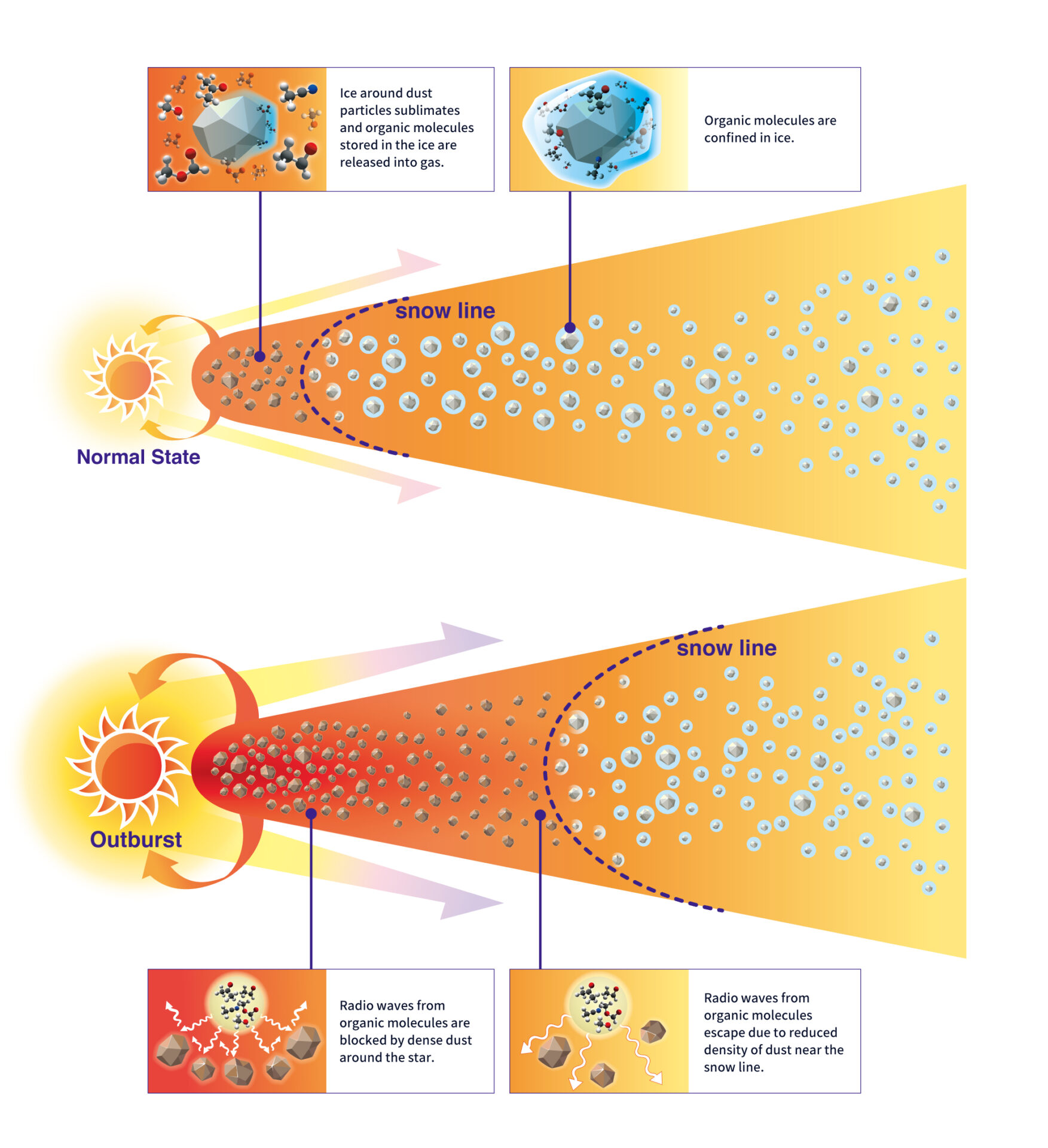
Schematic illustration of the composition of protoplanetary disks in normal state and outburst phase. V883 Ori is experiencing an FU Orionis outburst and the increase in disk temperature pushes the snow line outward, causing various molecules contained in ice to be released into gas. Credit: National Astronomical Observatory of Japan. Hi-res image


Astronomers using ALMA have detected various complex organic molecules around the young star V883 Ori. A sudden outburst from this star is releasing molecules from the icy compounds in the planet forming disk. The chemical composition of the disk is similar to that of comets in the modern Solar System. Sensitive ALMA observations enable astronomers to reconstruct the evolution of organic molecules from the birth of the Solar System to the objects we see today.

The research team led by Jeong-Eun Lee (Kyung Hee University, Korea) used the Atacama Large Millimeter/submillimeter Array (ALMA) to detect complex organic molecules including methanol (CH3OH), acetone (CH3COCH3), acetaldehyde (CH3CHO), methyl formate (CH3OCHO), and acetonitrile (CH3CN). This is the first time that acetone was unambiguously detected in a planet forming region or protoplanetary disk.

Various molecules are frozen in ice around micrometer-sized dust particles in protoplanetary disks. V883 Ori’s sudden flare-up is heating the disk and sublimating the ice, which releases the molecules into gas. The region in a disk where the temperature reaches the sublimation temperature of the molecules is called the “snow line.” The radii of snow lines are about a few astronomical units (au) around normal young stars, however, they are enlarged almost 10 times around bursting stars.

“It is difficult to image a disk on the scale of a few au with current telescopes,” said Lee. “However, around an outburst star, ice melts in a wider area of the disk and it is easier to see the distribution of molecules. We are interested in the distribution of complex organic molecules as the building blocks of life.”

Ice, including frozen organic molecules, could be closely related to the origin of life on planets. In our Solar System, comets are the focus of attention because of their rich icy compounds. For example, the European Space Agency’s legendary comet explorer Rosetta found rich organic chemistry around the comet Churyumov-Gerasimenko. Comets are thought to have been formed in the outer colder region of the proto-Solar System, where the molecules were contained in ice. Probing the chemical composition of ice in protoplanetary disks is directly related to probing the origin of organic molecules in comets, and the origin of the building blocks of life.

Thanks to ALMA’s sharp vision and the enlarged snow line due to the flare-up of the star, the astronomers obtained the spatial distribution of methanol and acetaldehyde. The distribution of these molecules has a ring-like structure with a radius of 60 au, which is twice the size of Neptune’s orbit. The researchers assume that inside of this ring the molecules are invisible because they are obscured by thick dusty material, and are invisible outside of this radius because they are frozen in ice.

“Since rocky and icy planets are made from solid material, the chemical composition of solids in disks is of special importance. An outburst is a unique chance to investigate fresh sublimates, and thus the composition of solids.” says Yuri Aikawa at the University of Tokyo, a member of the research team.

V883 Ori is a young star located at 1300 light-years away from the Earth. This star is experiencing a so-called FU Orionis type outburst, a sudden increase of luminosity due to a bursting torrent of material flowing from the disk to the star. These outbursts last only on the order of 100 years, therefore the chance to observe a burst is rather rare. However, since young stars with a wide range of ages experience FU Ori bursts, astronomers expect to be able to trace the chemical composition of ice throughout the evolution of young stars.

Note: Another ALMA observation (van’t Hoff et al. 2018, ApJL, 864, 23) also detected CH3OH emissions from V883 Ori. However, the sensitivity and resolution of the observations were not enough to resolve the structure inside the water snow line.


Additional Information

These observation results are published as Lee et al. “The ice composition in the disk around V883 Ori revealed by its stellar outburst” in Nature Astronomy on February 4, 2019.

The research team members are:


Jeong-Eun Lee (Kyung Hee University), Seokho Lee (Kyung Hee University), Giseon Baek (Kyung Hee University), Yuri Aikawa (The University of Tokyo), Lucas Cieza (Universidad Diego Prtales), Sung-Yong Yoon (Kyung Hee University), Gregory Herczeg (Peking University), Doug Johnstone (NRC Herzberg Astronomy and Astrophysics), Simon Casassus (Universidad de Chile)

This research was supported by the Basic Science Research Program through the National Research Foundation of Korea (grant No. NRF-2018R1A2B6003423), the Korea Astronomy and Space Science Institute under the R&D program supervised by the Ministry of Science, ICT and Future Planning, JSPS KAKENHI (No. 16K13782 and 18H05222), the general grant (No. 11473005) by the National Science Foundation of China, National Research Council of Canada, and NSERC Discovery Grant.


Contact

Valeria Foncea
Education and Public Outreach Officer
Joint ALMA Observatory Santiago - Chile
Phone: +56 2 2467 6258
Cell phone: +56 9 7587 1963
Email: valeria.foncea@alma.cl

Masaaki Hiramatsu
Education and Public Outreach Officer, NAOJ Chile
Observatory
, Tokyo - Japan
Phone: +81 422 34 3630
Email: hiramatsu.masaaki@nao.ac.jp

Charles E. Blue
Public Information Officer
National Radio Astronomy Observatory Charlottesville, Virginia - USA
Phone: +1 434 296 0314
Cell phone: +1 202 236 6324
Email: cblue@nrao.edu

Calum Turner
ESO Assistant Public Information Officer
Garching bei München, Germany
Phone: +49 89 3200 6670
Email: calum.turner@eso.org


Thursday, July 28, 2016

Loneliest Young Star Seen by Spitzer and WISE

An unusual celestial object called CX330 was first detected as a source of X-ray light in 2009. It has been launching "jets" of material into the gas and dust around it. Credit: NASA/JPL-Caltech.  › Full image and caption


Alone on the cosmic road, far from any known celestial object, a young, independent star is going through a tremendous growth spurt.

The unusual object, called CX330, was first detected as a source of X-ray light in 2009 by NASA's Chandra X-Ray Observatory while it was surveying the bulge in the central region of the Milky Way. Further observations indicated that this object was emitting optical light as well. With only these clues, scientists had no idea what this object was.

But when Chris Britt, postdoctoral researcher at Texas Tech University in Lubbock, and colleagues were examining infrared images of the same area taken with NASA's Wide-field Infrared Survey Explorer (WISE), they realized this object has a lot of warm dust around it, which must have been heated by an outburst.

Comparing WISE data from 2010 with Spitzer Space Telescope data from 2007, researchers determined that CX330 is likely a young star that had been outbursting for several years. In fact, in that three-year period its brightness had increased by a few hundred times.

Astronomers looked at data about the object from a variety of other observatories, including the ground-based SOAR, Magellan, and Gemini telescopes. They also used the large telescope surveys VVV and the OGLE-IV to measure the intensity of light emitted from CX330. By combining all of these different perspectives on the object, a clearer picture emerged.

"We tried various interpretations for it, and the only one that makes sense is that this rapidly growing young star is forming in the middle of nowhere," said Britt, lead author of a study on CX330 recently published in the Monthly Notices of the Royal Astronomical Society.

The lone star's behavior has similarities to FU Orionis, a young outbursting star that had an initial three-month outburst in 1936-7. But CX330 is more compact, hotter and likely more massive than the FU Orionis-like objects known. The more isolated star launches faster "jets," or outflows of material that slam into the gas and dust around it.

"The disk has probably heated to the point where the gas in the disk has become ionized, leading to a rapid increase in how fast the material falls onto the star," said Thomas Maccarone, study co-author and associate professor at Texas Tech.

Most puzzling to astronomers, FU Orionis and the rare objects like it -- there are only about 10 of them -- are located in star-forming regions. Young stars usually form and feed from their surrounding gas and dust-rich regions in star-forming clouds. By contrast, the region of star formation closest to CX330 is over a thousand light-years away.

"CX330 is both more intense and more isolated than any of these young outbursting objects that we've ever seen," said Joel Green, study co-author and researcher at the Space Telescope Science Institute in Baltimore. "This could be the tip of the iceberg -- these objects may be everywhere."

In fact, it is possible that all stars go through this dramatic stage of development in their youth, but that the outbursts are too short in cosmological time for humans to observe many of them.

How did CX330 become so isolated? One idea is that it may have been born in a star-forming region, but was ejected into its present lonely pocket of the galaxy. But this is unlikely, astronomers say.

Because CX330 is in a youthful phase of its development -- likely less than 1 million years old -- and is still eating its surrounding disk, it must have formed near its present location in the sky.

"If it had migrated from a star-forming region, it couldn't get there in its lifetime without stripping its disk away entirely," Britt said.

CX330 may also help scientists study the way stars form under different circumstances. One scenario is that stars form through turbulence. In this "hierarchical" model, a critical density of gas in a cloud causes the cloud to gravitationally collapse into a star. A different model, called "competitive accretion," suggests that stars begin as low-mass cores that fight over the mass of material left in the cloud. CX330 more naturally fits into the first scenario, as the turbulent circumstances would theoretically allow for a lone star to form.

It is still possible that other intermediate- to low-mass stars are in the immediate vicinity of CX330, but have not been detected yet.

When CX330 was last viewed in August 2015, it was still outbursting. Astronomers plan to continue studying the object, including with future telescopes that could view it in other wavelengths of light.

Outbursts from a young star change the chemistry of the star's disk, from which planets may eventually form. If the phenomenon is common, that means that planets, including our own, may carry the chemical signatures of an ancient disk of gas and dust scarred by stellar outbursts.

But as CX330 is continuing to devour its disk with increasing voracity, astronomers do not expect that planets are forming in its system.

"If it's truly a massive star, its lifetime is short and violent, and I wouldn't recommend being a planet around it," Green said. "You could experience some pretty intense heat for a few centuries."


For more information on WISE, visit: http://www.nasa.gov/wise

For more information on Spitzer, visit: http://www.nasa.gov/spitzer


News Media Contact

Elizabeth Landau
Jet Propulsion Laboratory, Pasadena, Calif.
818-354-6425

elizabeth.landau@jpl.nasa.gov

 Source: JPL-Caltech

Wednesday, June 15, 2016

Gluttonous Star May Hold Clues to Planet Formation


In 1936, the young star FU Orionis began gobbling material from its surrounding disk of gas and dust with a sudden voraciousness. During a three-month binge, as matter turned into energy, the star became 100 times brighter, heating the disk around it to temperatures of up to 12,000 degrees Fahrenheit (7,000 Kelvin). FU Orionis is still devouring gas to this day, although not as quickly.

This brightening is the most extreme event of its kind that has been confirmed around a star the size of the sun, and may have implications for how stars and planets form. The intense baking of the star's surrounding disk likely changed its chemistry, permanently altering material that could one day turn into planets. 

"By studying FU Orionis, we're seeing the absolute baby years of a solar system," said Joel Green, a project scientist at the Space Telescope Science Institute, Baltimore, Maryland. "Our own sun may have gone through a similar brightening, which would have been a crucial step in the formation of Earth and other planets in our solar system."

Visible light observations of FU Orionis, which is about 1,500 light-years away from Earth in the constellation Orion, have shown astronomers that the star's extreme brightness began slowly fading after its initial 1936 burst. But Green and colleagues wanted to know more about the relationship between the star and surrounding disk. Is the star still gorging on it? Is its composition changing? When will the star's brightness return to pre-outburst levels? 

To answer these questions, scientists needed to observe the star’s brightness at infrared wavelengths, which are longer than the human eye can see and provide temperature measurements.

Green and his team compared infrared data obtained in 2016 using the Stratospheric Observatory for Infrared Astronomy, SOFIA, to observations made with NASA's Spitzer Space Telescope in 2004. 

SOFIA, the world's largest airborne observatory, is jointly operated by NASA and the German Aerospace Center and provides observations at wavelengths no longer attainable by Spitzer. The SOFIA data were taken using the FORCAST instrument (Faint Object infrared Camera for the SOFIA Telescope).

"By combining data from the two telescopes collected over a 12-year interval, we were able to gain a unique perspective on the star's behavior over time," Green said. He presented the results at the American Astronomical Society meeting in San Diego, this week.

Using these infrared observations and other historical data, researchers found that FU Orionis had continued its ravenous snacking after the initial brightening event: The star has eaten the equivalent of 18 Jupiters in the last 80 years.

The recent measurements provided by SOFIA inform researchers that the total amount of visible and infrared light energy coming out of the FU Orionis system decreased by about 13 percent over the 12 years since the Spitzer observations. Researchers determined that this decrease is caused by dimming of the star at short infrared wavelengths, but not at longer wavelengths. That means up to 13 percent of the hottest material of the disk has disappeared, while colder material has stayed intact.  

"A decrease in the hottest gas means that the star is eating the innermost part of the disk, but the rest of the disk has essentially not changed in the last 12 years," Green said. "This result is consistent with computer models, but for the first time we are able to confirm the theory with observations."

Astronomers predict, partly based on the new results, that FU Orionis will run out of hot material to nosh on within the next few hundred years. At that point, the star will return to the state it was in before the dramatic 1936 brightening event. Scientists are unsure what the star was like before or what set off the feeding frenzy.

"The material falling into the star is like water from a hose that's slowly being pinched off," Green said. 

"Eventually the water will stop."

If our sun had a brightening event like FU Orionis did in 1936, this could explain why certain elements are more abundant on Mars than on Earth. A sudden 100-fold brightening would have altered the chemical composition of material close to the star, but not as much farther from it. Because Mars formed farther from the sun, its component material would not have been heated up as much as Earth's was.

At a few hundred thousand years old, FU Orionis is a toddler in the typical lifespan of a star. The 80 years of brightening and fading since 1936 represent only a tiny fraction of the star's life so far, but these changes happened to occur at a time when astronomers could observe.

"It's amazing that an entire protoplanetary disk can change on such a short timescale, within a human lifetime," said Luisa Rebull, study co-author and research scientist at the Infrared Processing and Analysis Center (IPAC), based at Caltech, Pasadena, California. 

Green plans to gain more insight into the FU Orionis feeding phenomenon with NASA's James Webb Space Telescope, which will launch in 2018. SOFIA has mid-infrared high-resolution spectrometers and far-infrared science instrumentation that complement Webb’s planned near- and mid-infrared capabilities. 

Spitzer is expected to continue exploring the universe in infrared light, and enabling groundbreaking scientific investigations, into early 2019.

NASA's Jet Propulsion Laboratory, Pasadena, California, manages the Spitzer Space Telescope mission for NASA. Science operations are conducted at the Spitzer Science Center at Caltech. Spacecraft operations are based at Lockheed Martin Space Systems Company, Littleton, Colorado. Data are archived at the Infrared Science Archive housed at IPAC at Caltech. Caltech manages JPL for NASA.

SOFIA is a joint project of NASA and the German Aerospace Center (DLR). The aircraft is based at NASA Armstrong Flight Research Center's facility in Palmdale, California. NASA's Ames Research Center in Moffett Field, California, manages the SOFIA science and mission operations in cooperation with the Universities Space Research Association (USRA) headquartered in Columbia, Maryland, and the German SOFIA Institute (DSI) at the University of Stuttgart.

Monday, March 30, 2015

Don’t Blink: A Light Show in a Dynamic Stellar Nursery

The region of Re50 and Re50N observed in 2006 with SuprimeCam at the Subaru telescope, and in 2014 with the Gemini Multi-Object Spectrograph (GMOS) at the Gemini South telescope. A [SII] filter was used for both images. The seeing was in both cases 0.5 arcsec. Each image is about 3 arcmin wide. North is up and east is left. 

Changes in the universe don’t often happen on human timescales.

In the cosmic “blink of an eye,” astronomers have detected rapid changes in brightness and appearance of a restless stellar nursery in Orion. The luminous cloud of gas, going by the designation Re50, first appeared about half a century ago in the constellation of Orion. Now, astronomers using the Gemini South telescope, and other telescopes around the world, have discovered that the chaotic caldron has once again brightened further. According to team member Bo Reipurth, of the University of Hawaii’s Institute for Astronomy, “This most recent brightening, happened, I believe in 2014, when unfortunately we weren’t able to look since Orion was in the Sun’s glare.” Reipurth adds that areas of stellar birth, in this case called a Class I protostar, are extremely dynamic places and change on human timescales, “… while we missed the initial brightening event, we can still study the changes going on and learn a lot about what’s happening.” Based on the team’s observations, they conclude that curtains of obscuring material are likely casting patterns of illumination and shadows onto the molecular cloud that envelopes the nursery, “…which gives us a spectacular stellar light show!” says Reipurth. 
 
Learn more in the team’s paper, which is accepted for publication in The Astrophysical Journal, at: http://arxiv.org/abs/1503.04241

Abstract:

The luminous Class I protostar HBC 494, embedded in the Orion A cloud, is associated with a pair of reflection nebulae, Re50 and Re50N, which appeared sometime between 1955 and 1979. We have found that a dramatic brightening of Re50N has taken place sometime between 2006 and 2014. This could result if the embedded source is undergoing a FUor eruption. However, the near-infrared spectrum shows a featureless very red continuum, in contrast to the strong CO bandhead absorption displayed by FUors. Such heavy veiling, and the high luminosity of the protostar, is indicative of strong accretion but seemingly not in the manner of typical FUors. We favor the alternative explanation that the major brightening of Re50N and the simultaneous fading of Re50 is caused by curtains of obscuring material that cast patterns of illumination and shadows across the surface of the molecular cloud. This is likely occurring as an outflow cavity surrounding the embedded protostar breaks through to the surface of the molecular cloud. Several Herbig-Haro objects are found in the region. 


Saturday, June 14, 2014

Spectro-Astrometry of V1515 Cygni with Adaptive Optics

FU Orionis objects are a class of young stars with powerful bursts in luminosity that show evidence of accretion and ejection activity. It is generally accepted that they are surrounded by a Keplerian circumstellar disk and an infalling envelope. The outburst occurs because of a sudden increase in the accretion rate through the disk. In this scenario, all young stars experience FU Ori phases during their evolution. Despite the evidence of winds/outflows and accretion activity in these objects, a detailed study of their physical properties has been difficult to carry out with high-resolution instruments manly due to the faintness and the distance to these objects. 

Using the integral field spectrograph OASIS, at the William Herschel Telescope, combined with the adaptive optics module NAOMI, astronomers obtained optical observations of the FU Ori star V1515 Cyg with an angular resolution of 0.7 arcseconds (Gaussian core FWHM). From the analysis of the data they find evidence for the existence of a surrounding disk in V1515, being this one of the few spatial inferences of a disk observed in an FU Ori object. 

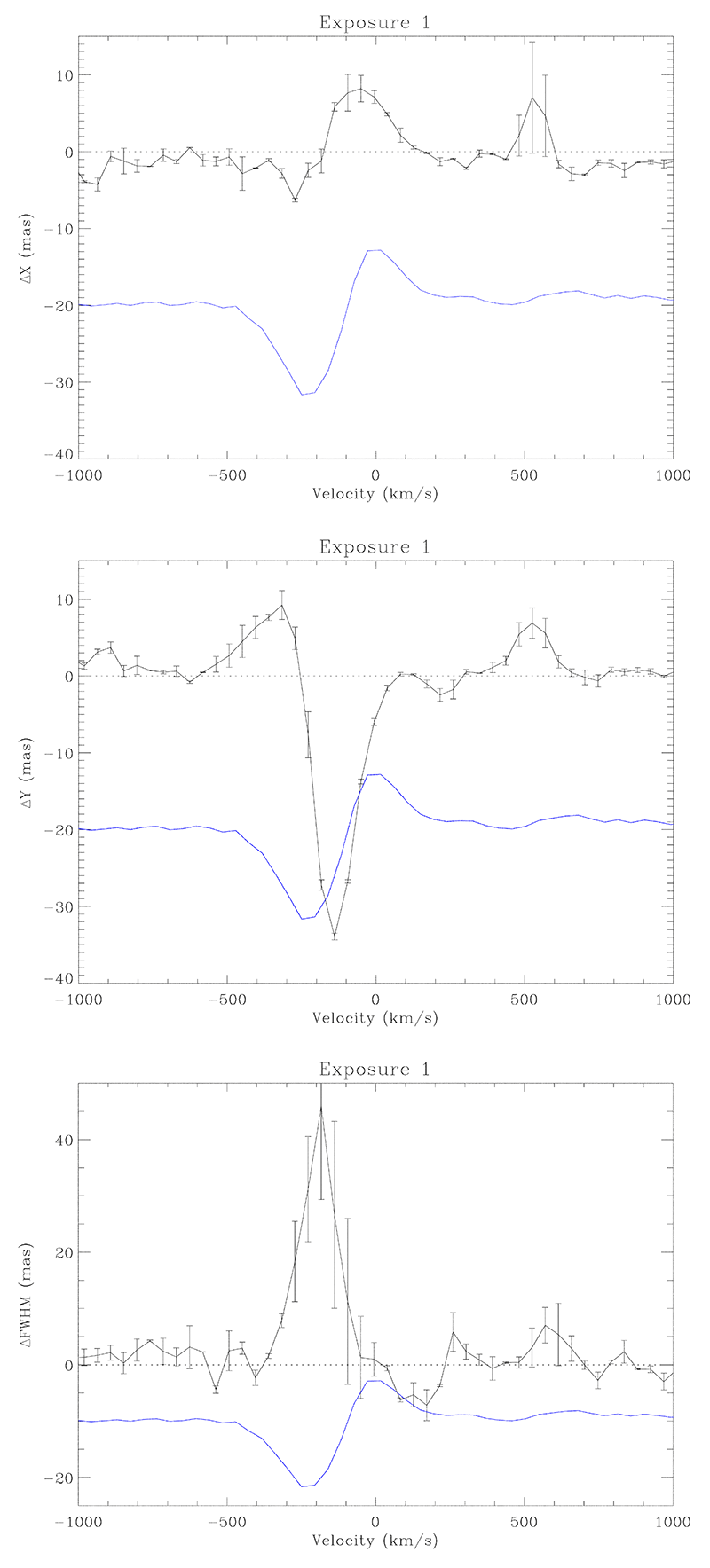
They applied a spectro-astrometry technique to both spatial directions. A two-dimensional circular Gaussian was fitted to each image of the data cube, with a Levenberg-Marquardt algorithm. The wavelength-dependent Gaussian centers and Gaussian full width at half maximum (FWHM) are the spectro-astrometric signal. Figure 1 shows, for one of the individual exposures, the detected spectro-astrometric signal in the spatial directions for the spectral region around the Hα 6562Å line. A small spectro-astrometric signal is detected in the horizontal direction. However, considering the error bars, the signal in the vertical direction is clearly detected at blueshifted velocities of ∼-100 km s-1.


For the first individual exposure, Gaussian centers of the spectro- astrometric signal as a function of the velocity in both the W-E (east for ΔX > 0) and S-N (north for ΔY > 0) directions, in top and middle panels, respectively. Bottom panel shows the differential FWHM. The Hα line profile is overplotted in blue showing a clear P Cygni profile [ GIF ]

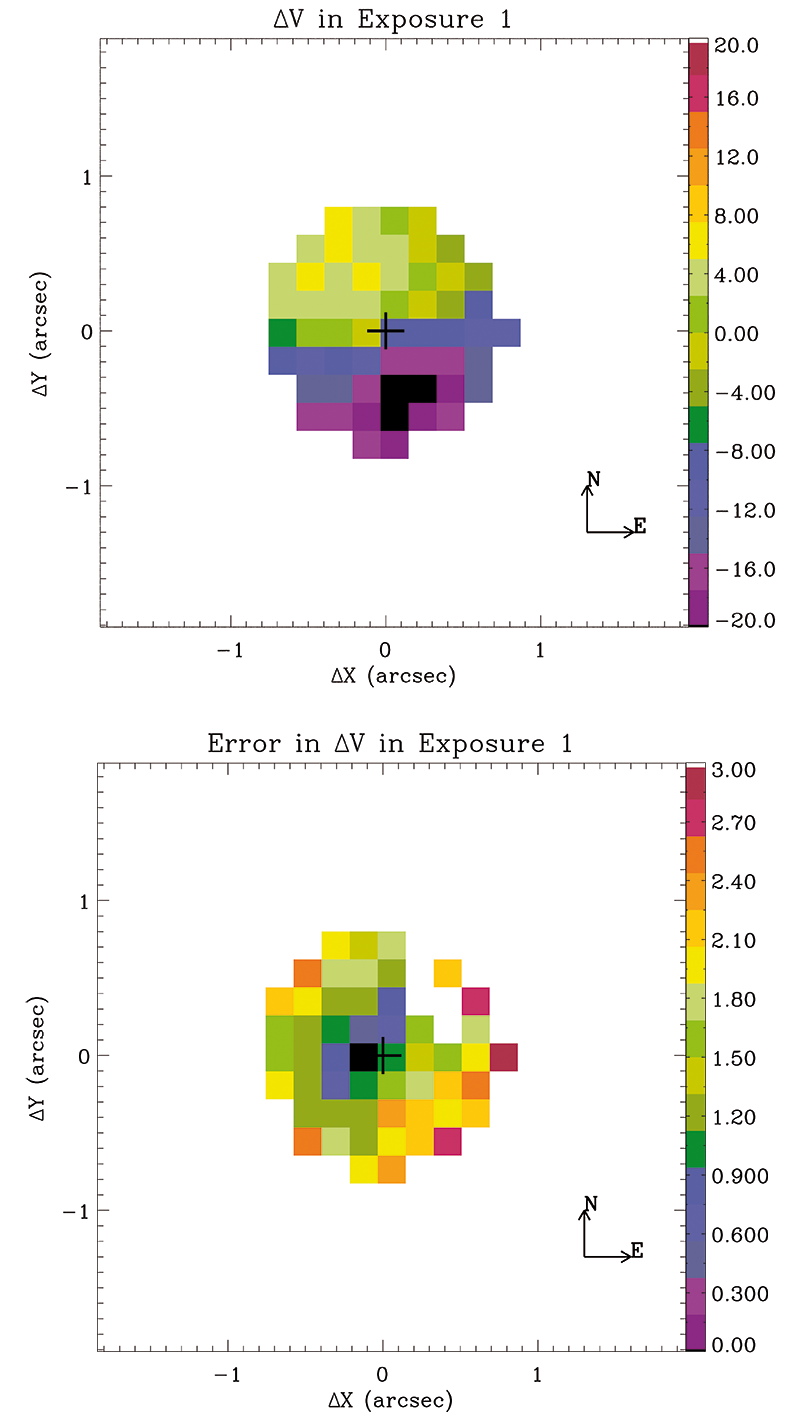
In order to ruled out the possibility of a bias due to a deficient wavelength calibration, a model fitting between each spectrum in the field and the one at the stellar position was carried out. The top panel in Figure 2 shows the spatially distribution of the measured shift for the same exposures as in Figure 1. A clear structure is seen in the center of the field with an approximate size of ∼2 arcseconds in both spatial directions.

The astronomers identify two clear distinct regions, one showing redshifted velocities and the other blueshifted, almost symmetrical to the previous one. This structure, similar to 12CO observations in several T Tauri stars suggests scattering coming from a disk surrounding the star. 

Top: shift in velocity obtained from a cross-correlation of the P Cygni profile between the spectrum at the position of the star and each individual spectra in the field, for exposure 1. Color scale is km s-1. The continuum emission center is marked as a black cross. The physical orientation is also given. Bottom: error in the shift also in km s-1 [ PNG ]

More information:

V. Agra-Amboage and P. J. V. Garcia, 2014, "Spectro-astrometry of V1515 Cygni", A&A, 565, A92.
Paper
 
Contact:  

Javier Méndez  (Public Relations Officer)