Showing posts with label "Fermi's Gamma-ray Burst Monitor (GBM). Show all posts

Friday, August 21, 2020

NASA's Webb to Study Quasars and Their Host Galaxies in Three Dimensions

Quasars—accreting supermassive black holes—are paradoxically some of the brightest objects in the universe. Astronomers widely consider the energy from quasars to be the main driver in limiting the growth of massive galaxies. Scientists plan to use Webb to study the impact of three carefully selected quasars on their host galaxies in a program called Q3D. Credits: STScI.Hi-res image

Supermassive black holes, which likely reside at the centers of virtually all galaxies, are unimaginably dense, compact regions of space from which nothing — not even light — can escape. As such a black hole, weighing in at millions or billions of times the mass of the Sun, devours material, it is surrounded by a swirling disk of gas. When gas from this disk falls towards the black hole, it releases a tremendous amount of energy. This energy creates a brilliant and powerful galactic core called a quasar, whose light can greatly outshine its host galaxy.

Astronomers widely believe that the energy from quasars is responsible for limiting the growth of massive galaxies. Shortly after the launch of NASA’s James Webb Space Telescope, scientists plan to study the effect of three carefully selected quasars on their host galaxies in a program called Q3D.

A supermassive black hole is very small compared to its host galaxy — it’s the equivalent of a penny in relation to the size of the entire Moon. Still, supermassive black holes have an immense influence on the galaxies they inhabit.

“Physically very small objects, supermassive black holes seem to have an enormous impact on the evolution of galaxies and eventually on the way our universe looks today,” said Q3D principal investigator Dominika Wylezalek, a Research Group Leader at the University of Heidelberg in Germany.  

Two decades ago, scientists hypothesized the critical role of quasars in limiting galaxy growth, but specific observational evidence has been surprisingly hard to come by. Scientists think a quasar’s torrential winds push out the equivalent of hundreds of solar masses of material each year. As the quasar winds sweep across the galaxy's disk, material that otherwise would have formed new stars is violently carried away from the galaxy, causing star birth to cease. But observing the power and reach of quasars on their host galaxies remains a major unresolved issue in modern astrophysics. The Webb telescope could change that.

Analyzing Data in 3D

In addition to its exquisite sensitivity, resolution and infrared vision, Webb’s capabilities include unique three-dimensional imaging spectroscopy. This special observing technique allows the team to get detailed measurements of light for every single pixel across the field of view. It stitches together many images at slightly different wavelengths. This allows scientists to spatially map gas motions inside the galaxy. The technique will revolutionize the understanding of the relationship between supermassive black holes and their host galaxies by allowing scientists to probe the stars, gas and dust in nearby and distant galaxies.

“Imaging spectroscopy is important for us because the winds in these distant quasars are not necessarily symmetric,” explained co-principal investigator Sylvain Veilleux, a professor of astronomy at the University of Maryland, College Park. “So, one needs a spectrum at every position to determine what is their geometry and be able to draw the important information from these winds and the impact they have on their host galaxies.”

The James Webb Space Telescope’s capabilities include three-dimensional imaging spectroscopy. This is possible because of an innovative instrument called an integral field unit (IFU), which captures images and spectra at the same time. This video gives a basic overview of how the IFU works. Credits: STScI. Video

Studying Three Quasars and Their Hosts

The Q3D team will study three bright quasars to measure the activity that comes from accreting material onto supermassive black holes, and how the host galaxies are affected by that activity. The team chose the three quasars for scientific reasons, but also to test and assess the capabilities of Webb. The objects intentionally span a very broad range of distance from Earth, from relatively nearby to very far away. They are also among the most luminous quasars at their respective distances and are known to have outflows of material.

Powerful quasar outflows appear to prevent a galaxy’s gas from forming new stars and growing the galaxy. Scientists think this quasar–galaxy connection is crucial in determining how galaxies evolve from the early universe to today. It’s especially important for galaxies a few times larger than the Milky Way, because quasar hosts are generally more massive galaxies. 

Seeing Beyond the Bright Light

Quasars are very bright compared with the material around them, so the team is developing special software tools that allow them to study the phenomena. When quasars were discovered in the 1950s, they were brilliant radio sources that looked like stars on photographic plates, so they were called “quasi-stellar radio sources.” Eventually, astronomers learned that quasars were actually inside of galaxies, but they were so bright that they outshone their host galaxies. 

“We’re interested in the quasar itself — the bright, star-like thing in the middle — but we’re also interested in the fainter host galaxy. And not just the host galaxy, but the even fainter outflow from the host. This is the gas that’s not circling around the quasar, or the center of the galaxy, but is instead flowing out. To see this really faint stuff behind the quasar, we have to remove the quasar’s light. That’s one unique thing the software will do.” said co-investigator David Rupke, associate professor of physics at Rhodes College in Memphis, Tennessee. Rupke is leading the effort to write the software to analyze the Q3D data.

Paving the Way for Future Webb Studies

The Q3D study is part of the Director’s Discretionary–Early Release Science program, which provides public data to the entire scientific community early in the telescope's mission. This program allows the astronomical community to quickly learn how best to use Webb’s capabilities, while also yielding robust science.

“From a technical standpoint, with our observations, we are testing different modes, filters and combinations,” explained Wylezalek. “It will be very useful for the scientific community to see the performance in these different modes. Scientifically, we are probing quasars at different luminosities and cosmic times to inform the community about Webb’s performance when assessing different scientific questions.”

The Q3D software will not only be useful for users observing quasars but for anyone observing bright, point-like, central sources on top of fainter sources. Such observations could include super star clusters, supernovas, tidal disruption events, or gamma-ray bursts.

The James Webb Space Telescope will be the world’s premier space science observatory when it launches in 2021. Webb will solve mysteries in our solar system, look beyond to distant worlds around other stars, and probe the mysterious structures and origins of our universe and our place in it. Webb is an international program led by NASA with its partners, ESA (European Space Agency) and the Canadian Space Agency.

For more information about Webb, visit www.nasa.gov/webb.

By Ann Jenkins
Space Telescope Science Institute, Baltimore, Md.

Editor: Lynn Jenner

 Source: NASA/Solar System and Beyond


Saturday, February 24, 2018

Magnetic Reconnection in the Sun

An ultraviolet picture of the sun's chromosphere, the thin layer of solar atmosphere sandwiched between the visible surface, the photosphere, and the corona. Astronomers have developed a simulation to address magnetic reconnection in the chromosphere. The image was taken by the Hinode spacecraft. JAXA/NASA


The Sun glows with a surface temperature of about 5500 degrees Celsius. On the other hand its hot outer layer, the corona, has a temperature of over a million degrees and ejects a wind of charged particles at a rate equivalent to about one-millionth of the moon's mass each year. Some of these particles bombard the Earth, producing auroral glows and occasionally disrupting global communications. In between these two regions of the Sun is the chromosphere. Within this complex interface zone, only a few thousand kilometers deep, the density of the gas drops with height by a factor of about one million and the temperature increases. Almost all of the mechanical energy that drives solar activity is converted into heat and radiation within this interface zone.

Charged particles are produced by the high temperatures of the gas, and their motions produce powerful, dynamic magnetic fields. Those field lines can sometimes break apart forcefully, but movement of the underlying charged particles often leads them to reconnect. There are two important, longstanding, and related questions about the hot solar wind: how is it heated, and how does the corona produce the wind? Astronomers suspect that magnetic reconnection in the chromosphere plays a key role.

CfA astronomer Nicholas Murphy and his three colleagues have completed complex new simulations of magnetic reconnection in hot ionized gas like that present in the solar chromosphere. (The lead author on the study, Lei Ni, was a visitor to the CfA.) The scientists include for the first time the effects of incompletely ionized gas in lower temperature regions, certain particle-particle effects, and other details of the neutral and ionized gas interactions. They find that the neutral and ionized gas is well-coupled throughout the reconnection region, and conclude that reconnection can often occur in the cooler portions of the zone. They also note that new, high-resolution solar telescopes are capable of studying smaller and smaller regions of low ionization for which their results are particularly applicable.

Reference(s):


"Magnetic Reconnection in Strongly Magnetized Regions of the Low Solar Chromosphere," Lei Ni, Vyacheslav S. Lukin, Nicholas A. Murphy, and Jun Lin, ApJ 852, 95, 2018.


Wednesday, October 22, 2014

NASA's Fermi Satellite Finds Hints of Starquakes in Magnetar 'Storm'

NASA's Fermi Gamma-ray Space Telescope detected a rapid-fire "storm" of high-energy blasts from a highly magnetized neutron star, also called a magnetar, on Jan. 22, 2009. Now astronomers analyzing this data have discovered underlying signals related to seismic waves rippling throughout the magnetar.

A rupture in the crust of a highly magnetized neutron star, shown here in an artist's rendering, can trigger high-energy eruptions. Fermi observations of these blasts include information on how the star's surface twists and vibrates, providing new insights into what lies beneath. Image Credit: NASA's Goddard Space Flight Center/S. Wiessinger. Related multimedia from NASA Goddard's Scientific Visualization Studio

Such signals were first identified during the fadeout of rare giant flares produced by magnetars. Over the past 40 years, giant flares have been observed just three times -- in 1979, 1998 and 2004 -- and signals related to starquakes, which set the neutron stars ringing like a bell, were identified only in the two most recent events.

"Fermi's Gamma-ray Burst Monitor (GBM) has captured the same evidence from smaller and much more frequent eruptions called bursts, opening up the potential for a wealth of new data to help us understand how neutron stars are put together," said Anna Watts, an astrophysicist at the University of Amsterdam in the Netherlands and co-author of a new study about the burst storm. "It turns out that Fermi's GBM is the perfect tool for this work."

In the midst of SGR J1550-5418's 2009 burst storm, Swift's X-Ray Telescope captured an expanding halo produced by the magnetar's brightest bursts. The rings formed as X-rays from the brightest bursts scattered off of intervening dust clouds. Clouds closer to Earth produced larger rings. Image Credit: NASA/Swift/Jules Halpern, Columbia University. Download this video in additional formats from NASA Goddard's Scientific Visualization Studio

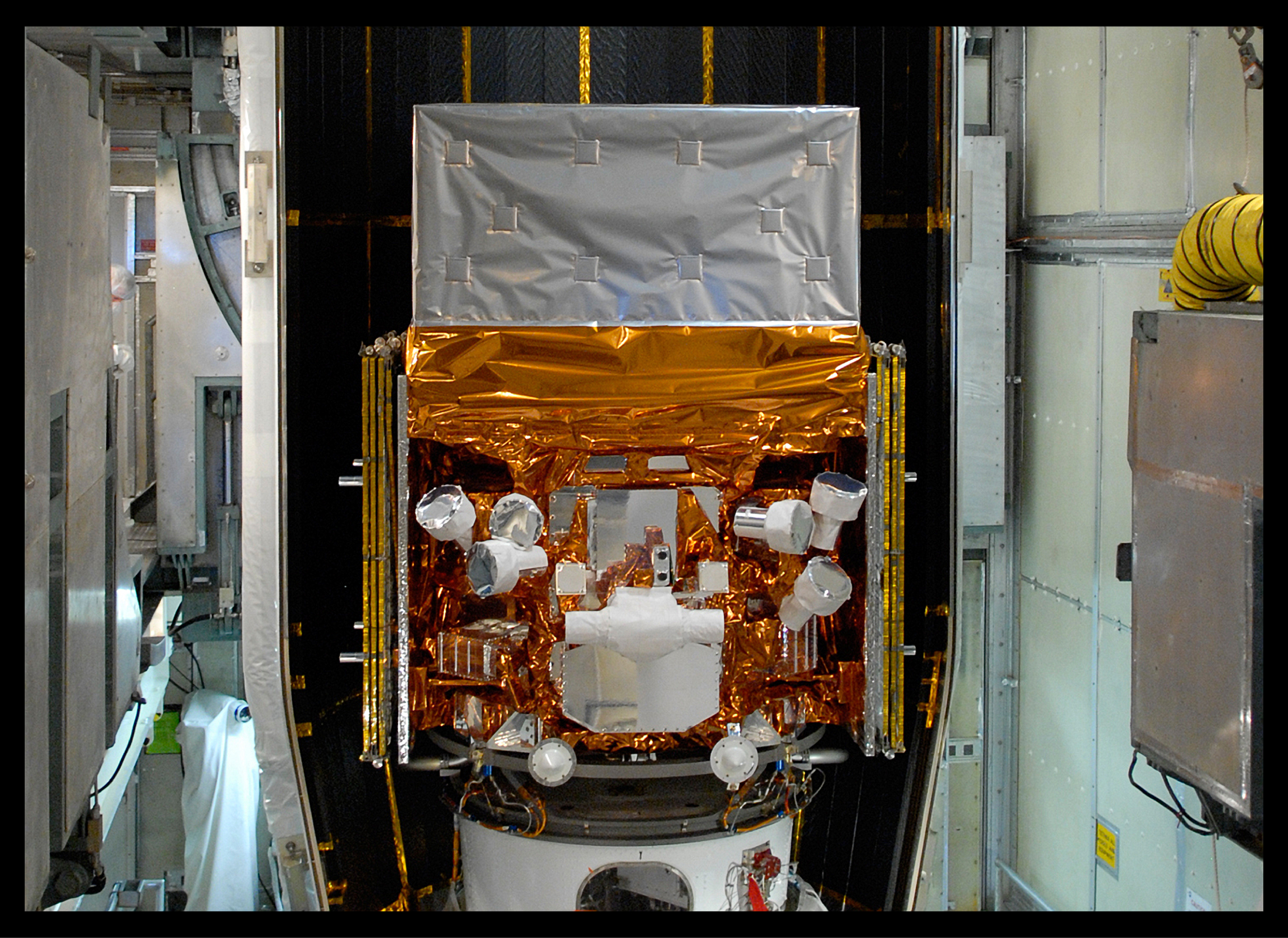
This image of NASA's Fermi Gamma-ray Space Telescope, shown here in May 2008 being readied for launch, highlights the spacecraft's instruments. The Gamma-ray Burst Monitor (GBM) is an array of 14 crystal detectors sensitive to short-lived gamma-ray blasts. Image Credit: NASA/Jim Grossmann. Unlabeled image

Neutron stars are the densest, most magnetic and fastest-spinning objects in the universe that scientists can observe directly. Each one is the crushed core of a massive star that ran out of fuel, collapsed under its own weight, and exploded as a supernova. A neutron star packs the equivalent mass of half-a-million Earths into a sphere about 12 miles across, roughly the length of Manhattan Island in New York City.

While typical neutron stars possess magnetic fields trillions of times stronger than Earth's, the eruptive activity observed from magnetars requires fields 1,000 times stronger still. To date, astronomers have confirmed only 23 magnetars.

Because a neutron star's solid crust is locked to its intense magnetic field, a disruption of one immediately affects the other. A fracture in the crust will lead to a reshuffling of the magnetic field, or a sudden reorganization of the magnetic field may instead crack the surface. Either way, the changes trigger a sudden release of stored energy via powerful bursts that vibrate the crust, a motion that becomes imprinted on the burst’s gamma-ray and X-ray signals.

It takes an incredible amount of energy to convulse a neutron star. The closest comparison on Earth is the 9.5-magnitude Chilean earthquake of 1960, which ranks as the most powerful ever recorded on the standard scale used by seismologists. On that scale, said Watts, a starquake associated with a magnetar giant flare would reach magnitude 23.

The 2009 burst storm came from SGR J1550−5418, an object discovered by NASA's Einstein Observatory, which operated from 1978 to 1981. Located about 15,000 light-years away in the constellation Norma, the magnetar was quiet until October 2008, when it entered a period of eruptive activity that ended in April 2009. At times, the object produced hundreds of bursts in as little as 20 minutes, and the most intense explosions emitted more total energy than the sun does in 20 years. High-energy instruments on many spacecraft, including NASA's Swift and Rossi X-ray Timing Explorer, detected hundreds of gamma-ray and X-ray blasts.

Speaking at the Fifth Fermi International Symposium in Nagoya, Japan, on Oct. 21, Watts said the new study examined 263 individual bursts detected by Fermi's GBM and confirms vibrations in the frequency ranges previously seen in giant flares. "We think these are likely twisting oscillations of the star where the crust and the core, bound by the super-strong magnetic field, are vibrating together," she explained. "We also found, in a single burst, an oscillation at a frequency never seen before and which we still do not understand."

A key element of the research is a new analysis technique developed by University of Amsterdam researcher Daniela Huppenkothen. Normally scientists search for oscillations in high-energy data by looking for variations aligned to a particular frequency. Such methods are best suited for finding a strong signal with little competition rather than a faint signal immersed in a bright and rapidly changing environment, such as a burst.

Huppenkothen likens the problem to detecting ripples from a stone tossed into a quiet pond. "Now imagine you're in the middle of the North Atlantic during a storm, searching for those ripples amidst huge waves in a churning sea," she explained. "Our old methods really weren't appropriate for this, but I have in effect developed a way of accounting for the rough sea so we can find ripples even in stormy conditions." 

A paper describing the research, which was led by Huppenkothen, appeared in the June 1 edition of The Astrophysical Journal.

While there are many efforts to describe the interiors of neutron stars, scientists lack enough observational detail to choose between differing models. Neutron stars reach densities far beyond the reach of laboratories and their interiors may exceed the density of an atomic nucleus by as much as 10 times. Knowing more about how bursts shake up these stars will give theorists an important new window into understanding their internal structure.

"Right now," added Watts, "we are waiting for more bursts -- and if we're lucky, a giant flare -- to take advantage of GBM's excellent capabilities."


Related Links