Showing posts with label irregular-type galaxies. Show all posts

Friday, May 01, 2015

Galactic refurbishment

UGC 5797
Credit: ESA/Hubble & NASA 
Acknowledgement: Luca Limatola


The smudge of stars at the centre of this NASA/ESA Hubble Space Telescope image is a galaxy known as UGC 5797. UGC 5797 is an emission line galaxy, meaning that it is currently undergoing active star formation. The result is a stellar population that is constantly being refurbished as massive bright blue stars form. Galaxies with prolific star formation are not only veiled in a blue tint, but are key to the continuation of a stellar cycle

In this image UGC 5797 appears in front of a background of spiral galaxies. Spiral galaxies have copious amounts of dust and gas — the main ingredient for stars — and therefore often also belong to the class of emission line galaxies.

Spiral galaxies have disc-like shapes that drastically vary in appearance depending on the angle at which they are observed. The collection of spiral galaxies in this frame exhibits this attribute acutely: Some are viewed face-on, revealing the structure of the spiral arms, while the two in the bottom left are seen edge-on, appearing as plain streaks in the sky. There are many spiral galaxies, with varying colours and at different angles sprinkled across this image — just take a look

A version of this image was entered into the Hubble’s Hidden Treasures image processing competition by Luca Limatola.


Source: ESA/Hubble - Space Telescope

Wednesday, April 22, 2015

Extragalactic peculiarity

Credit: ESA/Hubble & NASA


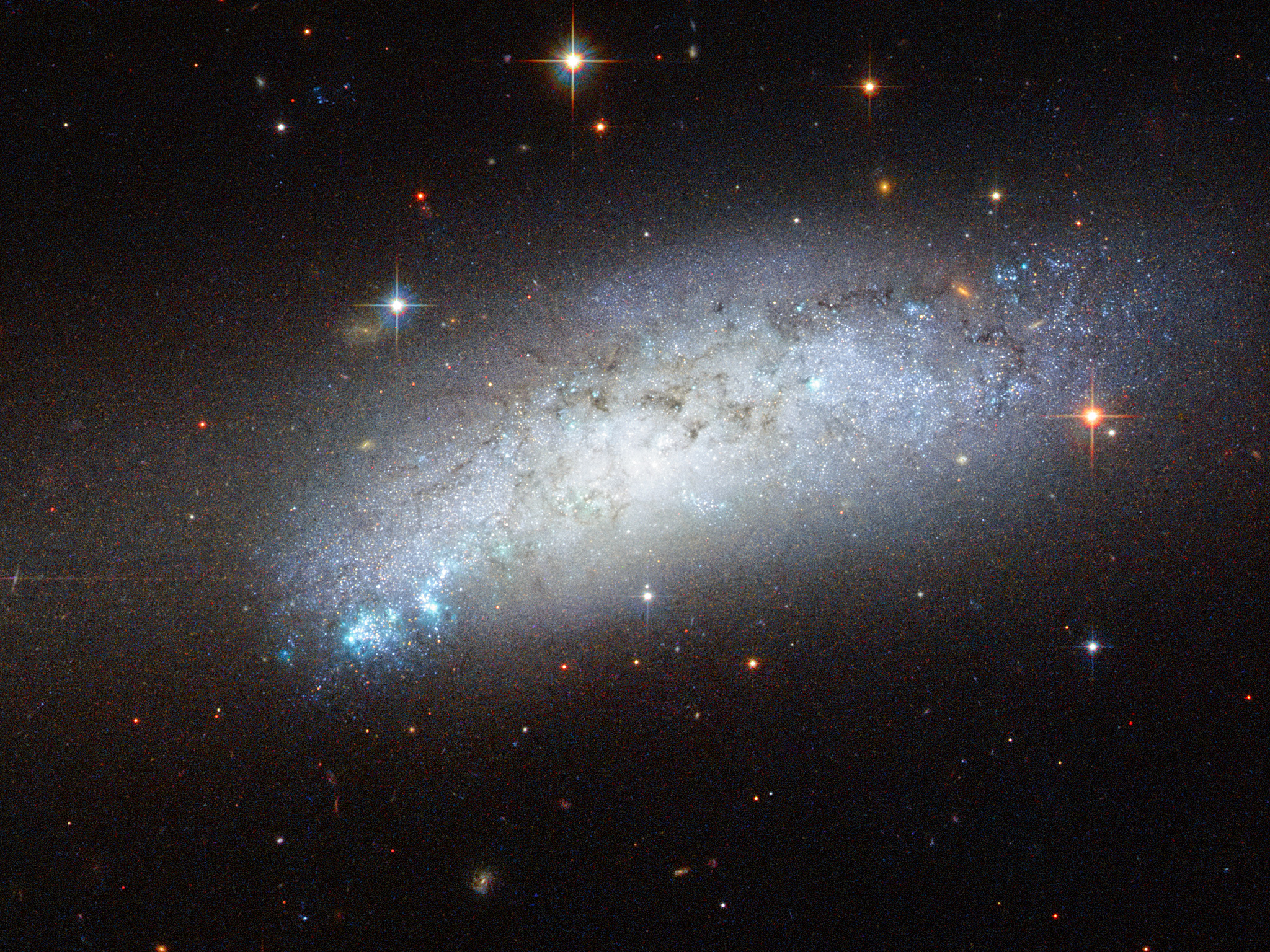
This galaxy goes by the name of ESO 162-17 and is located about 40 million light-years away in the constellation of Carina. At first glance this image seems like a fairly standard picture of a galaxy with dark patches of dust and bright patches of young, blue stars. However, a closer look reveals several peculiar features.

Firstly, ESO 162-17 is what is known as a peculiar galaxy — a galaxy that has gone through interactions with its cosmic neighbours, resulting in an unusual amount of dust and gas, an irregular shape, or a strange composition.

Secondly, on 23 February 2010 astronomers observed the supernova known as SN 2010ae nestled within this galaxy. The supernova belongs to a recently discovered class of supernovae called Type Iax supernovae. This class of objects is related to the better known Type-Ia supernovae.

Type Ia supernovae result when a white dwarf accumulates enough mass either from a companion or, rarely, through collision with another white dwarf, to initiate a catastrophic collapse followed by a spectacular explosion as a supernova.  Type Iax supernovae also involve a white dwarf as the central star, but in this case it may survive the event. Type Iax supernovae are much fainter and rarer than Type Ia supernovae, and their exact mechanism is still a matter of open debate.

The rather beautiful four-pointed shape of foreground stars distributed around ESO 162-17 also draws the eye. This is an optical effect introduced as the incoming light is diffracted by the four struts that support the Hubble Space Telescope’s small secondary mirror.


Source: ESA/HUBBLE - Space Telescope

Friday, November 29, 2013

Blue and gold

Credit: ESA/Hubble & NASA
Acknowledgement: Luca Limatola

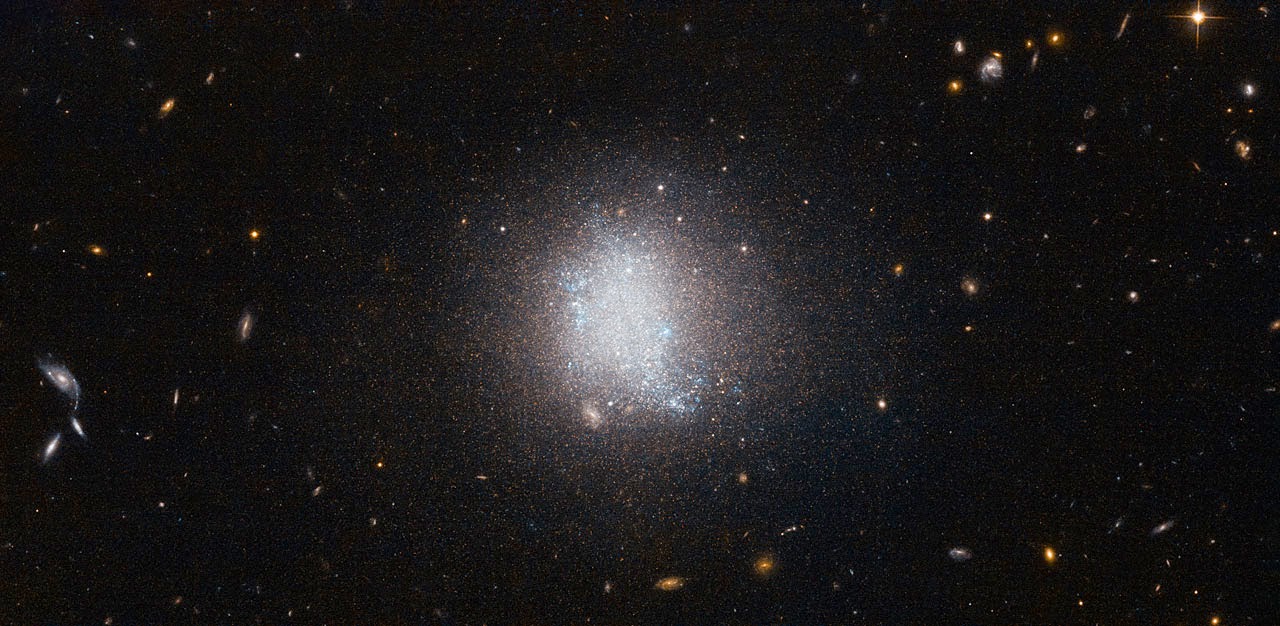
This sprinkling of cosmic glitter makes up the galaxy known as ESO 149-3, located some 20 million light-years away from us. It is an example of an irregular galaxy, characterised by its amorphous, undefined shape — a property that sets it apart from its perhaps more photogenic spiral and elliptical relatives. Around one quarter of all galaxies are thought to be irregular-type galaxies.

In this image taken with the NASA/ESA Hubble Space Telescope ESO 149-3 can be seen as a smattering of golden and blue stars, with no apparent central nucleus or arm structure. The surrounding sky is rich in other more distant galaxies, visible as small, colourful streaks and dashes.

A version of this image was submitted to the Hubble's Hidden Treasures image processing competition by contestant Luca Limatola.