Showing posts with label dua supermassive black hole. Show all posts

Tuesday, August 28, 2018

Gemini Confirms the Most Distant Radio Galaxy


Top: Two-dimensional GMOS spectrum of the strong emission line observed in the radio galaxy TGSS J1530+1049. The size of the emission region is a bit less than one arcsec. Bottom: One-dimensional profile of the observed emission line. The asymmetry indicates that the line is Lyman-α at redshift of z = 5.72, making TGSS J1530+1049 the most distant radio galaxy known to date.

Using the Gemini North telescope in Hawai`i, an international team of astronomers from Brazil, Italy, the Netherlands, and the UK has discovered the most distant radio galaxy to date, at 12.5 billion light years, when the Universe was just 7% of its current age.

The team used spectroscopic data from the Gemini Multi-Object Spectrograph (GMOS-N) to measure a redshift of z = 5.72 for the radio galaxy identified as TGSS J1530+1049. This is the largest redshift of any known radio galaxy. The redshift of a galaxy tells astronomers its distance because galaxies at greater distances move away from us at higher speeds, and this motion causes the galaxy's light to shift farther into the red. Because light has a finite speed and takes time to reach us, more distant galaxies are also seen at earlier times in the history of the Universe.

The study was led by graduate students Aayush Saxena (Leiden Observatory, Netherlands) and Murilo Marinello (Observatório Nacional, Brazil), and the observations were obtained through Brazil's participation in Gemini. "In the Gemini spectrum of TGSS J1530+1049, we found a single emission line of hydrogen, known as the Lyman alpha. The observed shift of this line allowed us to estimate the galaxy's distance," explains Marinello.

The relatively small size of the radio emission region in TGSS J1530+1049 indicates that it is quite young, as expected at such early times. Thus, the galaxy is still in the process of assembling. The radio emission in this kind of galaxy is powered by a supermassive black hole that is sucking in material from the surrounding environment. This discovery of the most distant radio galaxy confirms that black holes can grow to enormous masses very quickly in the early Universe.

The measured redshift of TGSS J1530+1049 places it near the end of the Epoch of Reionization, when the majority of the neutral hydrogen in the Universe was ionized by high-energy photons from young stars and other sources of radiation. "The Epoch of Reionization is very important in cosmology, but it is still not well understood," said Roderik Overzier, also of Brazil's Observatorio Nacional, and the Principal Investigator of the Gemini program. "Distant radio galaxies can be used as tools to find out more about this period."

The research has been published by Monthly Notices of the Royal Astronomical Society. A preprint of the paper is available at astro-ph.


Wednesday, October 04, 2017

Seeing Double: Scientists Find Elusive Giant Black Hole Pairs

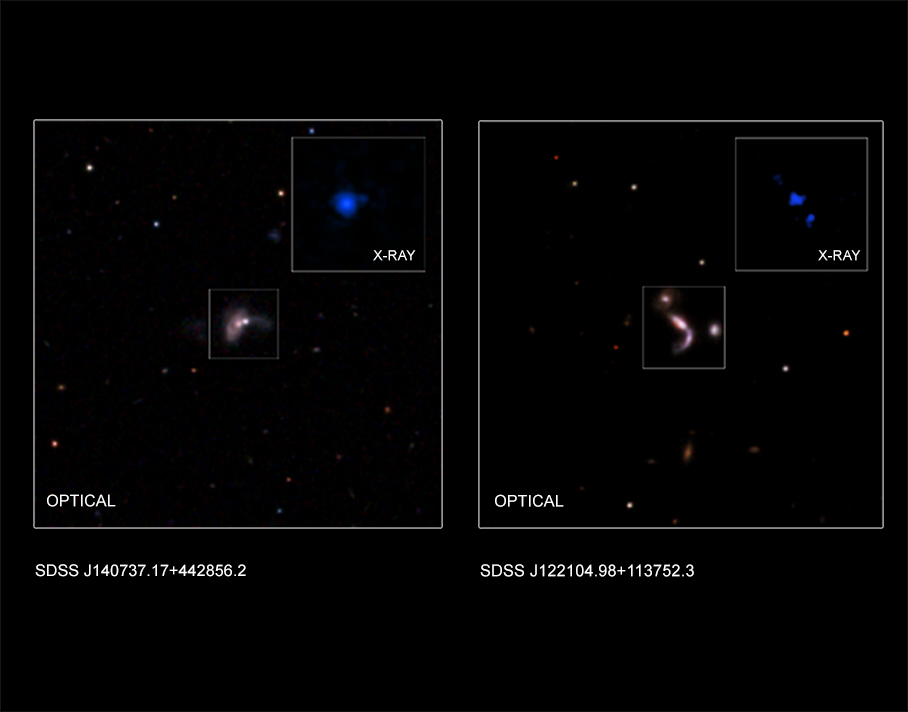
J140737.17+442856.2 and J122104.98+113752.3
Credit X-ray: NASA/CXC/Univ. of Victoria/S.Ellison et al.; Optical: SDSS (J140737)
Credit X-ray: NASA/CXC/George Mason Univ./S.Satyapal et al.; Optical: SDSS (J122104)


This graphic shows two of five new pairs of supermassive black holes recently identified by astronomers using a combination of data from NASA's Chandra X-ray Observatory, the Wide-Field Infrared Sky Explorer Survey (WISE), the ground-based Large Binocular Telescope in Arizona, and the Sloan Digital Sky Survey (SDSS) Mapping Nearby Galaxies at APO (MaNGA) survey. This discovery could help astronomers better understand how giant black holes grow and how they may produce the strongest gravitational wave signals in the Universe, as described in our press release.

Each pair contains two supermassive black holes weighing millions of times the mass of the Sun. These black hole couples formed when two galaxies collided and merged with each other, forcing their supermassive black holes close together. While theoretical models have predicted such giant growing black hole pairings should be relatively abundant, they have been difficult to find.

 Illustration of Dual Supermassive Black Holes
This illustration depicts two centrally located supermassive black holes surrounded by disks of hot gas. The black holes orbit each other for hundreds of millions of years before they merge to form a single supermassive black hole that sends out intense gravitational waves. Illustration: NASA/CXC/A.Hobart


To uncover these latest supermassive black hole pairs, astronomers used optical data from the Sloan Digital Sky Survey (SDSS) — shown in the main panel of each image — to identify galaxies where it appeared that a merger between two smaller galaxies was underway. Next, they selected objects where the separation between the centers of the two galaxies in the SDSS data is less than 30,000 light years, and the infrared colors from WISE data match those predicted for a rapidly growing supermassive black hole.

Seven merging systems containing at least one supermassive black hole were found with this technique. Because strong X-ray emission is a hallmark of growing supermassive black holes, the team then observed these systems with Chandra. They found that five systems contained pairs of X-ray sources that were separated by a relatively small distance (see inset for two examples), providing compelling evidence that they contain two growing, or feeding, supermassive black holes.

Both the X-ray data from Chandra and the infrared WISE observations suggest that the supermassive black holes are buried in large amounts of dust and gas. Because these two wavelengths are able to penetrate the obscuring clouds, this makes the combination of infrared selection with X-ray follow-up a very effective way to find these black hole pairs. Chandra's sharp vision is also critical as it is able to resolve each of the X-ray sources in the pairs.

Four of the dual black hole candidates were reported in a paper by Satyapal et al. that was recently accepted for publication in The Astrophysical Journal, and appears online. The other dual black hole candidate was reported in a paper by Ellison et al., which was published in the September 2017 issue of the Monthly Notices of the Royal Astronomical Society and appears online.

NASA's Marshall Space Flight Center in Huntsville, Alabama, manages the Chandra program for NASA's Science Mission Directorate in Washington. The Smithsonian Astrophysical Observatory in Cambridge, Massachusetts, controls Chandra's science and flight operations.


Fast Facts for J140737:

Scale: Image is 3 arcmin (~1.5 million light years) wide
Category: Quasars & Active Galaxies, Black Holes
Coordinates (J2000): RA 14h 07m 37.17s | Dec 44° 28´ 56.2"
Constellation: Boötes
Observation Date: 1 pointing in February 2017
Observation Time: 8 hours 15 min
Obs. ID: 19990
Instrument: ACIS
References: Ellison, S. et al., 2017, MNRAS, 470, L49, arXiv:1705.05465
Color Code: X-ray (Blue), Optical (Red, Green, Blue)
Distance Estimate: About 1.8 billion light years (z=0.14)


Fast Facts for J122104:

Scale: Image is 3 arcmin (~760,000 light years) wide.
Category: Quasars & Active Galaxies, Black Holes
Coordinates (J2000): RA 12h 21m 04.98s | Dec +11° 37´ 52.3"
Constellation: Virgo
Observation Date: 1 pointing in July 2014
Observation Time: 1 hour 2 min
Obs. ID: 16073
Instrument: ACIS
References: Satyapal, S et al., 2017, ApJ (in press), arXiv:1707.03921
Color Code: X-ray (Blue), Optical (Red, Green, Blue)
Distance Estimate: About 910 million light years (z=0.068)