Showing posts with label WASP-76b. Show all posts

Thursday, June 22, 2023

Gemini North Detects Multiple Rock-Forming Elements in the Atmosphere of a Scorching Exoplanet


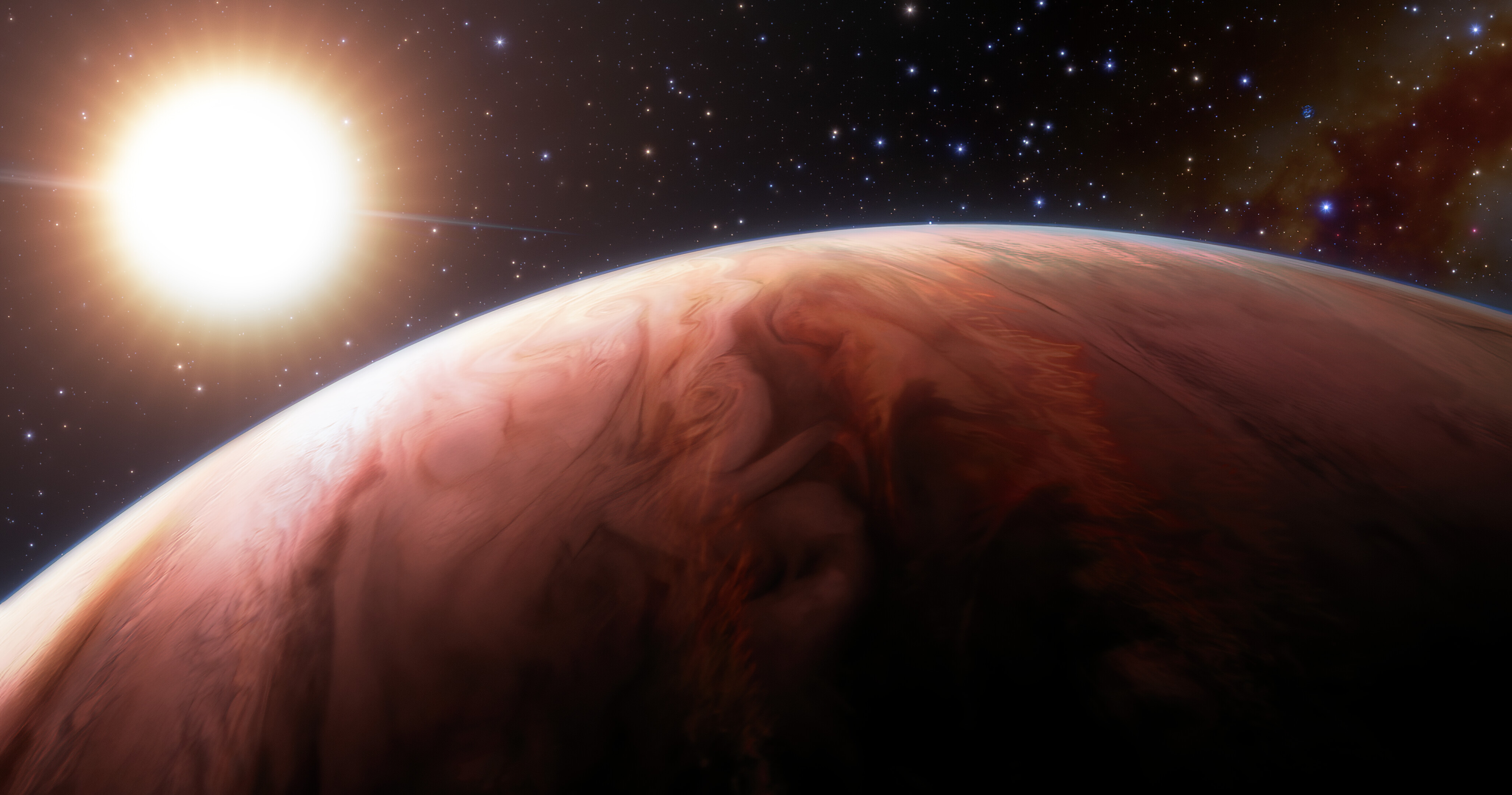
Astronomers using the Gemini North telescope, one half of the International Gemini Observatory operated by NSF’s NOIRLab, have made multiple detections of rock-forming elements in the atmosphere of a Jupiter-sized exoplanet, WASP-76b. The so-called “hot Jupiter” is perilously close to its host star, which is heating the planet’s atmosphere to astounding temperatures and vaporized rock-forming elements such as magnesium, calcium and iron, providing insight into how our own Solar System formed.Credit: International Gemini Observatory/NOIRLab/NSF/AURA/J. da Silva/Spaceengine/M. Zamani. download:
Large JPEG

Chemistry of so-called ‘hot Jupiter’ provides new insights into the formation of our Solar System

Astronomers using the Gemini North telescope, one half of the International Gemini Observatory operated by NSF’s NOIRLab, have detected multiple rock-forming elements in the atmosphere of a Jupiter-sized exoplanet, WASP-76b. The planet is so perilously close to its host star that rock-forming elements — such as magnesium, calcium, and nickel — become vaporized and dispersed throughout its scorching atmosphere. This intriguing chemical profile provides new insights into the formation of planetary systems, including our own.

WASP-76b is a strange world. Located 634 light-years from Earth in the direction of the constellation of Pisces, the Jupiter-like exoplanet orbits its host star at an exceptionally close distance — approximately 12 times closer than Mercury is to the Sun — which heats its atmosphere to a searing 2000°C. Such extreme temperatures have “puffed up” the planet, increasing its volume to nearly six times that of Jupiter.

At such extreme temperatures, mineral- and rock-forming elements, which would otherwise remain hidden in the atmosphere of a colder gas-giant planet, can reveal themselves. 

Using the Gemini North telescope, one half of the International Gemini Observatory operated by NSF’s NOIRLab, an international team of astronomers has detected 11 of these rock-forming elements in the atmosphere of WASP-76b. The presence and relative amounts of these elements can provide key insights into exactly how giant gas planets form — something that remains uncertain even in our own Solar System. The results are published in the journal Nature

Since its discovery in 2013 during the Wide Angle Search for Planets (WASP) program, many astronomers have studied the enigmatic WASP-76b. These studies have led to the identification of various elements present in the hot exoplanet’s atmosphere. Notably, in a study published in March 2020, a team concluded that there could be iron rain on the planet.

Aware of these existing studies, Stefan Pelletier, a PhD student with the Trottier Institute for Research on Exoplanets at the Université de Montréal and lead author on the paper, was inspired to explore the mysteries of this strange exoplanet and the chemistry of its searing atmosphere. 

In 2020 and 2021, using Gemini North’s MAROON-X (a new instrument specially designed to detect and study exoplanets), Pelletier and his team observed the planet as it passed in front of its host star on three separate occasions. These new observations uncovered a number of rock-forming elements in the atmosphere of WASP-76b, including sodium, potassium, lithium, nickel, manganese, chromium, magnesium, vanadium, barium, calcium, and, as previously detected, iron.

Due to the extreme temperatures of WASP-76b’s atmosphere, the elements detected by the researchers,  which would normally form rocks here on Earth, are instead vaporized and thus present in the atmosphere in their gaseous forms. While these elements contribute to the composition of gas giants in our Solar System, those planets are too cold for the elements to vaporize into the atmosphere making them virtually undetectable.

“Truly rare are the times when an exoplanet hundreds of light-years away can teach us something that would otherwise likely be impossible to know about our own Solar System,” said Pelletier. “That is the case with this study.”

The abundance of many of these elements closely match the abundances found in both our Sun and the exoplanet’s host star. This may be no coincidence and provides additional evidence that gas-giant planets, like Jupiter and Saturn, form in a manner more akin to star formation — coalescing out of the gas and dust of a protoplanetary disk — rather than the gradual accretion and collision of dust, rocks, and planetesimals, which go on to form rocky planets, like Mercury, Venus, and Earth.

Another notable result of the study is the first-ever unambiguous detection of vanadium oxide (V2O5) on an exoplanet. “This molecule is of high interest to astronomers because it can have a great impact on the atmospheric structure of hot giant planets,” says Pelletier. “This molecule plays a similar role to ozone being extremely efficient at heating Earth’s upper atmosphere.” 

Pelletier and his team are motivated to learn more about WASP-76b and other ultra-hot planets. They also hope other researchers will leverage what they learned from this giant exoplanet and apply it to better our understanding of our own Solar System planets and how they came to be. 

Available to astronomers across the globe, the International Gemini Observatory continues to deliver new insights that push our understanding of the physical and chemical structure of other worlds. Through such observational programs we are developing a clearer picture of the wider universe and our own place in it,” said NSF Gemini Observatory program director Martin Still.

“Generations of researchers have used Jupiter, Saturn, Uranus, and Neptune measured abundances for hydrogen and helium to benchmark formation theories of gaseous planets,” says Université de Montréal professor Björn Benneke, a co-author on the study. “Likewise, the measurements of heavier elements such as calcium or magnesium on WASP-76b will help further understanding the formation of gaseous planets.”


Notes

Reference: Pelletier, S, Benneke, B, and Ali-Dib, M, et al. (2023). “Vanadium oxide and a sharp onset of cold-trapping on a giant exoplanet.” Nature.

NSF’s NOIRLab, the US center for ground-based optical-infrared astronomy, operates the International Gemini Observatory (a facility of NSF, NRC–Canada, ANID–Chile, MCTIC–Brazil, MINCyT–Argentina, and KASI–Republic of Korea), Kitt Peak National Observatory (KPNO), Cerro Tololo Inter-American Observatory (CTIO), the Community Science and Data Center (CSDC), and Vera C. Rubin Observatory (operated in cooperation with the Department of Energy’s SLAC National Accelerator Laboratory). It is managed by the Association of Universities for Research in Astronomy (AURA) under a cooperative agreement with NSF and is headquartered in Tucson, Arizona. The astronomical community is honored to have the opportunity to conduct astronomical research on Iolkam Du’ag (Kitt Peak) in Arizona, on Maunakea in Hawai‘i, and on Cerro Tololo and Cerro Pachón in Chile. We recognize and acknowledge the very significant cultural role and reverence that these sites have to the Tohono O’odham Nation, to the Native Hawaiian community, and to the local communities in Chile, respectively.


Links


Contacts:

Stefan Pelletier
Université de Montréal, Montréal, Canada
Email:
stefan.pelletier@umontreal.ca

Charles Blue
Public Information Officer
NSF’s NOIRLab
Tel: +1 202 236 6324
Email:
charles.blue@noirlab.edu

Josie Fenske
NSF’s NOIRLab
Email:
 josie.fenske@noirlab.edu


Wednesday, March 11, 2020

ESO Telescope Observes Exoplanet Where It Rains Iron

Artist’s impression of the night side of WASP-76

Another artist’s impression of WASP-76b


Videos

ESOcast 218: The Stranger Exoplanets

A ‘fly to’ WASP-76, the star around which WASP-76b orbits

A view of the orbit of WASP-76b around its host star WASP-76


Researchers using ESO’s Very Large Telescope (VLT) have observed an extreme planet where they suspect it rains iron. The ultra-hot giant exoplanet has a day side where temperatures climb above 2400 degrees Celsius, high enough to vaporise metals. Strong winds carry iron vapour to the cooler night side where it condenses into iron droplets.

One could say that this planet gets rainy in the evening, except it rains iron,” says David Ehrenreich, a professor at the University of Geneva in Switzerland. He led a study, published today in the journal Nature, of this exotic exoplanet. Known as WASP-76b, it is located some 640 light-years away in the constellation of Pisces.

This strange phenomenon happens because the 'iron rain' planet only ever shows one face, its day side, to its parent star, its cooler night side remaining in perpetual darkness. Like the Moon on its orbit around the Earth, WASP-76b is ‘tidally locked’: it takes as long to rotate around its axis as it does to go around the star.

On its day side, it receives thousands of times more radiation from its parent star than the Earth does from the Sun. It’s so hot that molecules separate into atoms, and metals like iron evaporate into the atmosphere. The extreme temperature difference between the day and night sides results in vigorous winds that bring the iron vapour from the ultra-hot day side to the cooler night side, where temperatures decrease to around 1500 degrees Celsius.

Not only does WASP-76b have different day-night temperatures, it also has distinct day-night chemistry, according to the new study. Using the new ESPRESSO instrument on ESO’s VLT in the Chilean Atacama Desert, the astronomers identified for the first time chemical variations on an ultra-hot gas giant planet. They detected a strong signature of iron vapour at the evening border that separates the planet’s day side from its night side. “Surprisingly, however, we do not see the iron vapour in the morning,” says Ehrenreich. The reason, he says, is that “it is raining iron on the night side of this extreme exoplanet.

“The observations show that iron vapour is abundant in the atmosphere of the hot day side of WASP-76b," adds María Rosa Zapatero Osorio, an astrophysicist at the Centre for Astrobiology in Madrid, Spain, and the chair of the ESPRESSO science team. "A fraction of this iron is injected into the night side owing to the planet's rotation and atmospheric winds. There, the iron encounters much cooler environments, condenses and rains down."

This result was obtained from the very first science observations done with ESPRESSO, in September 2018, by the scientific consortium who built the instrument: a team from Portugal, Italy, Switzerland, Spain and ESO.

ESPRESSO — the Echelle SPectrograph for Rocky Exoplanets and Stable Spectroscopic Observations — was originally designed to hunt for Earth-like planets around Sun-like stars. However, it has proven to be much more versatile. “We soon realised that the remarkable collecting power of the VLT and the extreme stability of ESPRESSO made it a prime machine to study exoplanet atmospheres,” says Pedro Figueira, ESPRESSO instrument scientist at ESO in Chile.

What we have now is a whole new way to trace the climate of the most extreme exoplanets,” concludes Ehrenreich.


Notes
  • A previous version of this press release mistakenly indicated the distance to WASP-76b as being 390 light-years, based on a 2016 study. More recent data indicates that the exoplanet is 640 light-years away.


More information

This research was presented in a paper to appear in Nature.

The team is composed of David Ehrenreich (Observatoire astronomique de l’Université de Genève, Geneva, Switzerland [UNIGE]), Christophe Lovis (UNIGE), Romain Allart (UNIGE), María Rosa Zapatero Osorio (Centro de Astrobiología, Madrid, Spain [CSIC-INTA]), Francesco Pepe (UNIGE), Stefano Cristiani (INAF Osservatorio Astronomico di Trieste, Italy [INAF Trieste]), Rafael Rebolo (Instituto de Astrofísica de Canarias, Tenerife, Spain [IAC]), Nuno C. Santos (Instituto de Astrofísica e Ciências do Espaço, Universidade do Porto, Portugal [IA/UPorto] & Departamento de Física e Astronomia, Faculdade de Ciências, Universidade do Porto, Portugal [FCUP]), Francesco Borsa (INAF Osservatorio Astronomico di Brera, Merate, Italy [INAF Brera]), Olivier Demangeon (IA/UPorto), Xavier Dumusque (UNIGE), Jonay I. González Hernández (IAC), Núria Casasayas-Barris (IAC), Damien Ségransan (UNIGE), Sérgio Sousa (IA/UPorto), Manuel Abreu (Instituto de Astrofísica e Ciências do Espaço, Universidade de Lisboa, Portugal [IA/FCUL] & Departamento de Física da Faculdade de Ciências da Universidade de Lisboa, Portugal [FCUL], Vardan Adibekyan [IA/UPorto], Michael Affolter (Physikalisches Institut & Center for Space and Habitability, Universität Bern, Switzerland [Bern]), Carlos Allende Prieto (IAC), Yann Alibert (Bern), Matteo Aliverti (INAF Brera), David Alves (IA/FCUL & FCUL), Manuel Amate (IA/UPorto), Gerardo Avila (European Southern Observatory, Garching bei München, Germany [ESO]), Veronica Baldini (INAF Trieste), Timothy Bandy (Bern), Willy Benz (Bern), Andrea Bianco (INAF Brera), Émeline Bolmont (UNIGE), François Bouchy (UNIGE), Vincent Bourrier (UNIGE), Christopher Broeg (Bern), Alexandre Cabral (IA/FCUL & FCUL), Giorgio Calderone (INAF Trieste), Enric Pallé (IAC), H. M. Cegla (UNIGE), Roberto Cirami (INAF Trieste), João M. P. Coelho (IA/FCUL & FCUL), Paolo Conconi (INAF Brera), Igor Coretti (INAF Trieste), Claudio Cumani (ESO), Guido Cupani (INAF Trieste), Hans Dekker (ESO), Bernard Delabre (ESO), Sebastian Deiries (ESO), Valentina D’Odorico (INAF Trieste & Scuola Normale Superiore, Pisa, Italy), Paolo Di Marcantonio (INAF Trieste), Pedro Figueira (European Southern Observatory, Santiago de Chile, Chile [ESO Chile] & IA/UPorto), Ana Fragoso (IAC), Ludovic Genolet (UNIGE), Matteo Genoni (INAF Brera), Ricardo Génova Santos (IAC), Nathan Hara (UNIGE), Ian Hughes (UNIGE), Olaf Iwert (ESO), Florian Kerber (ESO), Jens Knudstrup (ESO), Marco Landoni (INAF Brera), Baptiste Lavie (UNIGE), Jean-Louis Lizon (ESO), Monika Lendl (UNIGE & Space Research Institute, Austrian Academy of Sciences, Graz, Austria), Gaspare Lo Curto (ESO Chile), Charles Maire (UNIGE), Antonio Manescau (ESO), C. J. A. P. Martins (IA/UPorto & Centro de Astrofísica da Universidade do Porto, Portugal), Denis Mégevand (UNIGE), Andrea Mehner (ESO Chile), Giusi Micela (INAF Osservatorio Astronomico di Palermo, Italy), Andrea Modigliani (ESO), Paolo Molaro (INAF Trieste & Institute for Fundamental Physics of the Universe, Trieste, Italy), Manuel Monteiro (IA/UPorto), Mario Monteiro (IA/UPorto & FCUP), Manuele Moschetti (INAF Brera), Eric Müller (ESO), Nelson Nunes (IA), Luca Oggioni (INAF Brera), António Oliveira (IA/FCUL & FCUL), Giorgio Pariani (INAF Brera), Luca Pasquini (ESO), Ennio Poretti (INAF Brera & Fundación Galileo Galilei, INAF, Breña Baja, Spain), José Luis Rasilla (IAC), Edoardo Redaelli (INAF Brera), Marco Riva (INAF Brera), Samuel Santana Tschudi (ESO Chile), Paolo Santin (INAF Trieste), Pedro Santos (IA/FCUL & FCUL), Alex Segovia Milla (UNIGE), Julia V. Seidel (UNIGE), Danuta Sosnowska (UNIGE), Alessandro Sozzetti (INAF Osservatorio Astrofisico di Torino, Pino Torinese, Italy), Paolo Spanò (INAF Brera), Alejandro Suárez Mascareño (IAC), Hugo Tabernero (CSIC-INTA & IA/UPorto), Fabio Tenegi (IAC), Stéphane Udry (UNIGE), Alessio Zanutta (INAF Brera), Filippo Zerbi (INAF Brera).

ESO is the foremost intergovernmental astronomy organisation in Europe and the world’s most productive ground-based astronomical observatory by far. It has 16 Member States: Austria, Belgium, the Czech Republic, Denmark, France, Finland, Germany, Ireland, Italy, the Netherlands, Poland, Portugal, Spain, Sweden, Switzerland and the United Kingdom, along with the host state of Chile and with AustralIA/FCULas a Strategic Partner. ESO carries out an ambitious programme focused on the design, construction and operation of powerful ground-based observing facilities enabling astronomers to make important scientific discoveries. ESO also plays a leading role in promoting and organising cooperation in astronomical research. ESO operates three unique world-class observing sites in Chile: La Silla, Paranal and Chajnantor. At Paranal, ESO operates the Very Large Telescope and its world-leading Very Large Telescope Interferometer as well as two survey telescopes, VISTA working in the infrared and the visible-light VLT Survey Telescope. Also at Paranal ESO will host and operate the Cherenkov Telescope Array South, the world’s largest and most sensitive gamma-ray observatory. ESO is also a major partner in two facilities on Chajnantor, APEX and ALMA, the largest astronomical project in existence. And on Cerro Armazones, close to Paranal, ESO is building the 39-metre Extremely Large Telescope, the ELT, which will become “the world’s biggest eye on the sky”.


Links


Contacts

David Ehrenreich
Associate Professor at the University of Geneva
Geneva, Switzerland
Tel: +41 22 379 23 90

Francesco Pepe
Professor at the University of Geneva and Principal Investigator of the ESPRESSO consortium
Geneva, Switzerland
Tel: +41 22 379 23 96

María Rosa Zapatero Osorio
Chair of the ESPRESSO science team at Centro de Astrobiología (CSIC-INTA)
Madrid, Spain
Tel: +34 9 15 20 64 27

Pedro Figueira
Astronomer at ESO and Instituto de Astrofísica e Ciências do Espaço, instrument scientist of ESPRESSO
Santiago, Chile
Tel: +56 2 2463 3074

Nuno C. Santos
Co-principal investigator of the ESPRESSO consortium at Instituto de Astrofísica e Ciências do Espaço, Universidade do Porto and Departamento de Física e Astronomia Faculdade de Ciências, Universidade do Porto
Porto, Portugal
Tel: +351 226 089 893

Stefano Cristiani
Co-principal investigator of the ESPRESSO consortium at INAF Astronomical Observatory of Trieste
Trieste, Italy
Tel: +39 040 3199220

Bárbara Ferreira
ESO Public Information Officer
Garching bei München, Germany
Tel: +49 89 3200 6670
Cell: +49 151 241 664 00
Email: pio@eso.org

Source: ESO/News