Showing posts with label OJ 287. Show all posts

Friday, August 01, 2025

OJ 287: New image reveals sharply curved plasma jet at heart of mysterious galaxy

A new image of galaxy OJ 287 reveals for the first time the sharply curved, ribbon-like structure of the plasma jet emitted from its center. Credit: Dr Efthalia Traianou, Heidelberg University, IWR


For more than 150 years, the OJ 287 galaxy and its brightness variations five billion light years away has both puzzled and fascinated astronomers, because they suspect two supermassive black holes are merging in the core.

An international research team led by Dr. Efthalia Traianou of Heidelberg University recently succeeded in taking an image of the heart of the galaxy at a special level of detail. The groundbreaking image, taken with the aid of a space radio telescope, shows a heretofore unknown, heavily curved segment of the plasma jet spinning off the galaxy's center. The image provides new insights into the extreme conditions that prevail around supermassive black holes.

The research is published in the journal Astronomy & Astrophysics.

The core of the OJ 287 galaxy belongs to the class of blazars that exhibit high activity and striking luminosity. The driving forces behind these active galactic cores are black holes. They absorb matter from their surroundings and can fling it off in the form of giant plasma jets comprised of cosmic radiation, heat, heavy atoms, and magnetic fields.

"We have never before observed a structure in the OJ 287 galaxy at the level of detail seen in the new image," emphasizes Dr. Traianou, a postdoctoral researcher in the team of Dr. Roman Gold at the Interdisciplinary Center for Scientific Computing of Heidelberg University.

The image, which penetrates deep into the galaxy's center, reveals the sharply curved, ribbon-like structure of the jet; it also points to new insights into the composition and the behavior of the plasma jet. Some regions exceed temperatures of ten trillion degrees Kelvin—evidence of extreme energy and movement being released in close proximity to a black hole.

The researchers also observed the formation, spread, and collision of a new shock wave along the jet and attribute it to an energy in the trillion-electron volt range from an unusual gamma ray measurement taken in 2017.

The image in the radio range was taken with a ground-space radio interferometer consisting of a radio telescope in Earth's orbit—a ten-meter-long antenna of the RadioAstron mission on board the Spektr-R satellite—and a network of 27 ground observatories distributed across Earth.

In this way, the researchers were able to create a virtual space telescope with a diameter five times greater than the diameter of Earth; its high resolution stems from the distance of the individual radio observatories to one another. The image is based on a method of measurement that takes advantage of the wave nature of light and the associated overlapping waves.

The interferometric image underpins the assumption that a binary supermassive black hole is located inside galaxy OJ 287. It also provides important information on how the movements of such black holes influence the form and orientation of the plasma jets emitted.

"Its special properties make the galaxy an ideal candidate for further research into merging black holes and the associated gravitational waves," states Efthalia Traianou.

Institutions from Germany, Italy, Russia, Spain, South Korea, and the US all contributed to the research.

Source:  Phys.org/News


More information: E. Traianou et al, Revealing a ribbon-like jet in OJ 287 with RadioAstron, Astronomy & Astrophysics (2025). DOI: 10.1051/0004-6361/202554929

Journal information: Astronomy & Astrophysics


.Provided by Heidelberg University

by Marietta Fuhrmann-Koch, Heidelberg University

edited by Gaby Clark, reviewed by Robert Egan


Friday, February 25, 2022

Colossal Black Holes Locked in Dance at Heart of Galaxy


Two supermassive black holes are seen orbiting each other in this artist's loopable animation. The more massive black hole, which is hundreds of millions times the mass of our sun, is shooting out a jet that changes in its apparent brightness as the duo circles each other. Astronomers found evidence for this scenario in a quasar called PKS 2131-021 after analyzing 45-years-worth of radio observations that show the system periodically dimming and brightening. The observed cyclical pattern is thought to be caused by the orbital motion of the jet. Credit: Caltech/R. Hurt (IPAC)


Artist's animation of a supermassive black hole circled by a spinning disk of gas and dust. The black hole is shooting out a relativistic jet—one that travels at nearly the speed of light. Credit: Caltech/R. Hurt (IPAC)


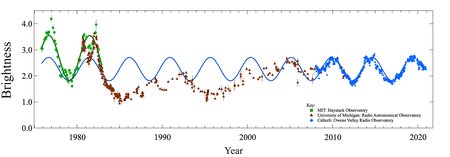
Three sets of radio observations of the quasar PKS 2131-02, spanning 45 years, are plotted here, with data from Owens Valley Radio Observatory (OVRO) in blue; University of Michigan Radio Astronomical Observatory (UMRAO) in brown; and Haystack Observatory in green. The observations match a simple sine wave, indicated in blue. Astronomers believe that the sine wave pattern is caused by two supermassive black holes at the heart of the quasar orbiting around each other every two years. (A period of five years was actually observed due to a Doppler effect caused by the expansion of the universe.) One of the black holes is shooting out a relativistic jet that dims and brightens periodically. Note that data from OVRO and UMRAO match for the peak in 2010, and the UMRAO and Haystack data match for the peak in 1981. The magnitudes of the peaks observed around 1980 are twice as large as those observed in recent times, presumably because more material was falling towards the black hole and being ejected at that time.

Tony Readhead / Sandra O'Neill


Astronomers find evidence for the tightest-knit supermassive black hole duo observed to date

Locked in an epic cosmic waltz 9 billion light years away, two supermassive black holes appear to be orbiting around each other every two years. The two giant bodies each have masses that are hundreds of millions of times larger than that of our sun, and the objects are separated by a distance roughly 50 times that which separates our sun and Pluto. When the pair merge in roughly 10,000 years, the titanic collision is expected to shake space and time itself, sending gravitational waves across the universe.

A Caltech-led team of astronomers has discovered evidence for this scenario taking place within a fiercely energetic object known as a quasar. Quasars are active cores of galaxies in which a supermassive black hole is siphoning material from a disk encircling it. In some quasars, the supermassive black hole creates a jet that shoots out at near the speed of light. The quasar observed in the new study, PKS 2131-021, belongs to a subclass of quasars called blazars in which the jet is pointing toward the Earth. Astronomers already knew quasars could possess two orbiting supermassive black holes, but finding direct evidence for this has proved difficult.

Reporting in The Astrophysical Journal Letters, the researchers argue that PKS 2131-021 is now the second known candidate for a pair of supermassive black holes caught in the act of merging. The first candidate pair, within a quasar called OJ 287, orbit each other at greater distances, circling every nine years versus the two years it takes for the PKS 2131-021 pair to complete an orbit.

The telltale evidence came from radio observations of PKS 2131-021 that span 45 years. According to the study, a powerful jet emanating from one of the two black holes within PKS 2131-021 is shifting back and forth due to the pair's orbital motion. This causes periodic changes in the quasar's radio-light brightness. Five different observatories registered these oscillations, including Caltech's Owens Valley Radio Observatory (OVRO), the University of Michigan Radio Astronomy Observatory (UMRAO), MIT's Haystack Observatory, the National Radio Astronomy Observatory (NRAO), Metsähovi Radio Observatory in Finland, and NASA's Wide-field Infrared Survey Explorer (WISE) space satellite.

The combination of the radio data yields a nearly perfect sinusoidal light curve unlike anything observed from quasars before.

"When we realized that the peaks and troughs of the light curve detected from recent times matched the peaks and troughs observed between 1975 and 1983, we knew something very special was going on," says Sandra O'Neill, lead author of the new study and an undergraduate student at Caltech who is mentored by Tony Readhead, Robinson Professor of Astronomy, Emeritus.


Ripples in Space and Time

Most, if not all, galaxies possess monstrous black holes at their cores, including our own Milky Way galaxy. When galaxies merge, their black holes "sink" to the middle of the newly formed galaxy and eventually join together to form an even more massive black hole. As the black holes spiral toward each other, they increasingly disturb the fabric of space and time, sending out gravitational waves, which were first predicted by Albert Einstein more than 100 years ago.

The National Science Foundation's LIGO (Laser Interferometer Gravitational-Wave Observatory), which is managed jointly by Caltech and MIT, detects gravitational waves from pairs of black holes up to dozens of times the mass of our sun. However, the supermassive black holes at the centers of galaxies have millions to billions of times as much mass as our sun, and give off lower frequencies of gravitational waves than those detected by LIGO.

In the future, pulsar timing arrays—which consist of an array of pulsing dead stars precisely monitored by radio telescopes—should be able to detect the gravitational waves from supermassive black holes of this heft. (The upcoming Laser Interferometer Space Antenna, or LISA, mission would detect merging black holes whose masses are 1,000 to 10 million times greater than the mass of our sun.) So far, no gravitational waves have been registered from any of these heavier sources, but PKS 2131-021 provides the most promising target yet.

In the meantime, light waves are the best option to detect coalescing supermassive black holes.

The first such candidate, OJ 287, also exhibits periodic radio-light variations. These fluctuations are more irregular, and not sinusoidal, but they suggest the black holes orbit each other every nine years. The black holes within the new quasar, PKS 2131-021, orbit each other every two years and are 2,000 astronomical units apart, about 50 times the distance between our sun and Pluto, or 10 to 100 times closer than the pair in OJ 287. (An astronomical unit is the distance between Earth and the sun.)

Revealing the 45-Year Light Curve

Readhead says the discoveries unfolded like a "good detective novel," beginning in 2008 when he and colleagues began using the 40-meter telescope at OVRO to study how black holes convert material they "feed" on into relativistic jets, or jets traveling at speeds up to 99.98 percent that of light. They had been monitoring the brightness of more than 1,000 blazars for this purpose when, in 2020, they noticed a unique case.

"PKS 2131 was varying not just periodically, but sinusoidally," Readhead says. "That means that there is a pattern we can trace continuously over time." The question, he says, then became how long has this sine wave pattern been going on?

The research team then went through archival radio data to look for past peaks in the light curves that matched predictions based on the more recent OVRO observations. First, data from NRAO's Very Long Baseline Array and UMRAO revealed a peak from 2005 that matched predictions. The UMRAO data further showed there was no sinusoidal signal at all for 20 years before that time—until as far back as 1981 when another predicted peak was observed.

"The story would have stopped there, as we didn't realize there were data on this object before 1980," Readhead says. "But then Sandra picked up this project in June of 2021. If it weren't for her, this beautiful finding would be sitting on the shelf."

O'Neill began working with Readhead and the study's second author Sebastian Kiehlmann, a postdoc at the University of Crete and former staff scientist at Caltech, as part of Caltech's Summer Undergraduate Research Fellowship (SURF) program. O'Neill began college as a chemistry major but picked up the astronomy project because she wanted to stay active during the pandemic. "I came to realize I was much more excited about this than anything else I had worked on," she says.

With the project back on the table, Readhead searched through the literature and found that the Haystack Observatory had made radio observations of PKS 2131-021 between 1975 and 1983. These data revealed another peak matching their predictions, this time occurring in 1976.

"This work shows the value of doing accurate monitoring of these sources over many years for performing discovery science," says co-author Roger Blandford, Moore Distinguished Scholar in Theoretical Astrophysics at Caltech who is currently on sabbatical from Stanford University.

Like Clockwork

Readhead compares the system of the jet moving back and forth to a ticking clock, where each cycle, or period, of the sine wave corresponds to the two-year orbit of the black holes (though the observed cycle is actually five years due to light being stretched by the expansion of the universe). This ticking was first seen in 1976 and it continued for eight years before disappearing for 20 years, likely due to changes in the fueling of the black hole. The ticking has now been back for 17 years.

"The clock kept ticking," he says, "The stability of the period over this 20-year gap strongly suggests that this blazar harbors not one supermassive black hole, but two supermassive black holes orbiting each other."

The physics underlying the sinusoidal variations were at first a mystery, but Blandford came up with a simple and elegant model to explain the sinusoidal shape of the variations.

"We knew this beautiful sine wave had to be telling us something important about the system," Readhead says. "Roger's model shows us that it is simply the orbital motion that does this. Before Roger worked it out, nobody had figured out that a binary with a relativistic jet would have a light curve that looked like this."

Says Kiehlmann: "Our study provides a blueprint for how to search for such blazar binaries in the future."

The Astrophysical Journal Letters study titled "The Unanticipated Phenomenology of the Blazar PKS 2131-021: A Unique Super-Massive Black hole Binary Candidate" was funded by Caltech, the Max Planck Institute for Radio Astronomy, NASA, National Science Foundation (NSF), the Academy of Finland, the European Research Council, ANID-FONDECYT (Agencia Nacional de Investigación y Desarrollo-Fondo Nacional de Desarrollo Científico y Tecnológico in Chile), the Natural Science and Engineering Council of Canada, the Foundation for Research and Technology – Hellas in Greece, the Hellenic Foundation for Research and Innovation in Greece, and the University of Michigan. Other Caltech authors include Tim Pearson, Vikram Ravi, Kieran Cleary, Matthew Graham, and Tom Prince. Other authors from the Jet Propulsion Laboratory, which is managed by Caltech for NASA, include Michele Vallisneri and Joseph Lazio.

Written by Whitney Clavin

Contact:

Whitney Clavin
(626) 395‑1944

wclavin@caltech.edu


Monday, January 24, 2022

Images at the Highest Angular Resolution in Astronomy


Fig. 1: The curved jet in the active galaxy OJ 287 from radio images taken at three different wavelengths and resolutions. Top left: RadioAstron at 1.3 cm wavelength - a global array including the space radio telescope Spektr-R in orbit around Earth. Top right: the Global mm-VLBI Array at 3.5 mm wavelength. Bottom: the Very Long Baseline Array at 2 cm wavelength - an array of ten antennas across the USA. The ellipses at the bottom left indicate the image resolution in each case, the angular and linear scale are shown by a horizontal white bar at the bottom. The top panel shows a record-breaking resolution of about 12 micro arc seconds, achieved when the space radio telescope is 15 earth diameters away from the ground telescopes (a distance of about 190.000 km, corresponding to half the distance between Moon and Earth). © Eduardo Ros/MPIfR (collage), Gómez et al., The Astrophysical Journal, 2022 (images).

Fig. 2: The Spektr-R satellite of the RadioAstron Space-VLBI project.
© A. Zakharov, IKI design

How a Binary Black Hole may be Bending the Relativistic Jet in the Quasar OJ 287

An international team of researchers including several scientists from the Max Planck Institute for Radio Astronomy has obtained an image of radio emission in the active galaxy OJ 287 at an angular resolution of 12 micro arcseconds, which is presently the highest resolution achieved in astronomical observations. This has been made possible with the technique of very long baseline interferometry (VLBI) which combines signals recorded at multiple radio telescopes simultaneously observing the same object and uses this combination to create a virtual telescope whose effective diameter is set by the largest distance between the participating telescopes. Combining together twelve radio telescopes distributed across the globe and an orbiting 10-metre antenna on board of the satellite Spektr-R launched and operated by the Russian Space Agency, the researchers have effectively constructed a radio telescope with a diameter of 193,000 km and used it to peer into the very heart of the galaxy OJ 287 believed to host a pair of supermassive black holes.

Their findings are published in the current issue of “The Astrophysical Journal”.

VLBI observations of the galaxy OJ 287 were performed at four different wavelengths. Observations including the space-borne antenna were carried out at a wavelength of 1.3 cm and amended with additional VLBI observations made with Earth-based telescopes only at wavelengths of 2, 0.7, and 0.3 cm wavelengths. The resulting images reach a record-breaking resolution of about 12 micro arcseconds at 1.3 cm, which is equivalent to being able to discern a 20 cent coin on the surface of the Moon.

The galaxy OJ 287, located at a distance of 5 billion light-years from Earth in the direction of the constellation Cancer, belongs to the class of blazar galaxies which manifest through powerful and variable emission originating in the close vicinity of the supermassive black hole residing in their centers.

The interferometric images at all four wavelengths consistently reveal several knots of emission in a strongly bent plasma jet. The jet bending becomes progressively stronger with increasing angular resolution and towards the jet origin, supporting the hypothesis of a supermassive binary black hole model powering the active galaxy. Analysis of the polarization properties reveals that the magnetic field has predominantly toroidal structure indicating that the innermost radio emitting region is threaded by a helical magnetic field, in agreement with jet formation models. The investigation of spectral properties demonstrates that the jet plasma is composed of electrons and positrons whose kinetic energy is balanced by the magnetic field. Repeated injections of more energetic particles into the jet plasma break this balance and flare up some portions of the inner jet.

OJ 287 is one of the best candidates for a binary supermassive black hole system we know so far in our cosmic neighborhood. The secondary black hole in this system is believed to be on a tight, elliptical orbit passing through the accretion disk of the primary twice every twelve years, producing powerful flares and driving the precession of the rotational axis of the primary black hole.

“One of the main questions related to the evolution of supermassive black holes today is how a pair of so massive black holes could end up merging – the so-called final parsec problem. Theory suggests that separation between the two black holes stops shrinking after they expel all surrounding stars and gas. This is where gravitational radiation comes into the game and causes the two black holes to keep approaching each other until they would ultimately merge,” says Andrei Lobanov from the Max Planck Institute for Radio Astronomy (MPIfR), one of the leading authors of the work. The expected binary supermassive black hole system in OJ287 is so close that it should emit gravitational waves which could soon be detectable with pulsar timing measurements. A substantial fraction of the energy released by the matter accreted by these black holes is channeled through bipolar jets of relativistic plasma jets which can be observed and studied in detail with VLBI. “The observed detailed fine structure of the inner jet region is ideally suited to the test the validity of the binary black hole model or if the observed jet bending is caused by other effects, such as helical magnetic fields, which are anchored in the rotating space time near the black hole”, adds Thomas Krichbaum, also from the MPIfR.

“These results helped us to move a step forward on broadening our knowledge on the morphology of relativistic jets close to the central engine, confirming the role of magnetic fields in jet launching and record one more time indirect signs of the existence of a proximate super massive black hole binary system deep in the heart of OJ 287”, says Thalia Traianou who is after her doctoral work at MPIfR at the Instituto de Astrofísica de Andalucía (IAA-CSIC) now.

“The objective of reaching the highest resolutions in astronomy has experienced a big step forward with the contribution of the RadioAstron mission and with the developments of millimetre-wavelength VLBI such as the MPIfR-operated Global mm-VLBI Array. Our pioneering work over the last decades is now collecting results, such as our exciting findings in OJ 287”, concludes J. Anton Zensus, director at the MPIfR, member of the RadioAstron International Science Council, and also co-author in the reported work.


Further Information

The Earth-to-Space Interferometer RadioAstron consisted of a 10-metre orbiting radio telescope (Spektr-R) and a collection of about two dozen of the world’s largest ground-based radio telescopes. When the signals of individual telescopes were combined using the interference of radio waves, this array of telescopes provides a maximum angular resolution equivalent to a radio telescope of 350.000 km in diameter – almost the distance between the Earth and Moon. This made RadioAstron the highest angular resolution instrument in the history of astronomy. The RadioAstron project, active from July 2011 to May 2019, was led by the Astro Space Center of the Lebedev Physical Institute of the Russian Academy of Sciences and the Lavochkin Scientific and Production Association under a contract with the State Space Corporation ROSCOSMOS, in collaboration with partner organizations in Russia and other countries.

The "Global mm-VLBI Array" (GMVA) is an international network of radio observatories interested in performing astronomical VLBI observations at millimeter wavelengths and with open access for the scientific community. The GMVA performs regular, coordinated global VLBI observations in the 3mm/7mm band twice per year. The inclusion of the largest telescopes operating in these bands enhances sensitivity and image fidelity. The GMVA received support from the European Union’s Horizon 2020 research and innovation programme under grant agreement No. 730562.

The already very high angular resolution of Earth-based cm-wave VLBI can be increased further in two ways, either by using longer baselines or by observing at shorter wavelengths. The first approach leads to "space-VLBI" (VLBI with one or more orbiting antennas), the second approach to "millimeter-VLBI" (mm-VLBI). In the more distant future, both techniques may be combined. This will lead to space-VLBI at millimeter wavelengths ("mm-space-VLBI"). Both the RadioAstron and the GMVA data were processed at the MPIfR VLBI Correlator Centre in Bonn.

Following collaborators of the presented work are affiliated to the MPIfR, in order of appearance at the author list: Efthalia (Thalia) Traianou, Thomas P. Krichbaum, Andrei P. Lobanov, Yuri Y. Kovalev, Mikhail M. Lisakov, Rocco Lico, Uwe Bach, Carolina Casadio, Eduardo Ros, Tuomas Savolainen, and J. Anton Zensus.

Yuri Y. Kovalev acknowledges the Friedrich Wilhelm Bessel research prize of the Alexander von Humboldt foundation.


Local Contact:

Dr. Andrei Lobanov
+49 228 525-191

alobanov@...
Max-Planck-Institut für Radioastronomie, Bonn

Dr. Efthalia Traianou
+34 958 1213-11

traianou@...
Instituto de Astrofisica de Andalucia, Granada, Spain

Prof. Dr. Eduardo Ros
+49 228 525-125
+49 228 525-229

ros@... 
Max-Planck-Institut für Radioastronomie, Bonn

Dr. Norbert Junkes
Press and Public Outreach
+49 228 525-399

njunkes@...
Max-Planck-Institut für Radioastronomie, Bonn