
The Pirate of the Southern Skies

Digitized Sky Survey image around NGC 2467

NGC 2467 in the constellation of Puppis
Videos

ESOcast 180 Light: The Pirate of the Southern Skies (4K UHD)

Zooming in on NGC 2467
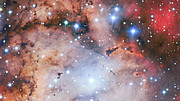
Panning across NGC 2467
FORS2, an instrument mounted on ESO’s
Very Large Telescope, has observed the active star-forming region NGC
2467 — sometimes referred to as the Skull and Crossbones Nebula. The
image was captured as part of the ESO Cosmic Gems Programme, which makes
use of the rare occasions when observing conditions are not suitable
for gathering scientific data. Instead of sitting idle, the ESO Cosmic
Gems Programme allows ESO’s telescopes to be used to capture visually
stunning images of the southern skies.
This vivid picture of an active star-forming region — NGC 2467,
sometimes referred to as the Skull and Crossbones Nebula — is as
sinister as it is beautiful. This image of dust, gas and bright young
stars, gravitationally bound into the form of a grinning skull, was
captured with the FORS instrument on ESO’s Very Large Telescope
(VLT). Whilst ESO’s telescopes are usually used for the collection of
science data, they can also capture images such as this — which are
beautiful for their own sake.
It is easy to see the motivation for the nickname Skull and
Crossbones. This young, bright formation distinctly resembles an
ominous hollow face, of which only the gaping mouth is visible here. NGC 2467 skulks in the constellation Puppis, which translates rather unromantically as The Poop Deck.
This nebulous collection of stellar clusters is the birthplace of many stars, where an excess of hydrogen gas provided the raw material for stellar creation. It is not, in fact, a single nebula, and its constituent stellar cluster are moving at different velocities. It is only a fortuitous alignment along the line of sight from the Earth that makes the stars and gas form a humanoid face. This luminous image might not tell astronomers anything new, but it provides us all with a glimpse into the churning southern skies, bright with wonders invisible to the human eye.
Puppis is one of three nautically named constellations that
sail the southern skies, and which used to make up the single, giant Argo Navis constellation, named after the ship of the mythical Jason and the Argonauts.
Argo Navis has since been divided into three: Carina (the keel), Vela
(the sails) and Puppis, where this nebula finds its home. Whilst a
heroic figure, Jason is most famous for his theft of the golden fleece,
so NGC 2467 rests not only in the midst of a vast celestial ship, but
amongst thieves — an appropriate abode for this piratical nebula.
This image was created as part of the ESO Cosmic Gems programme,
an outreach initiative to produce images of interesting, intriguing or
visually attractive objects using ESO telescopes, for the purposes of
education and public outreach. The programme makes use of telescope time
that cannot be used for science observations. All data collected may
also be suitable for scientific purposes, and are made available to
astronomers through ESO’s science archive.
More Information
ESO is the foremost intergovernmental astronomy organisation in Europe
and the world’s most productive ground-based astronomical observatory by
far. It has 16 Member States: Austria, Belgium, the Czech Republic,
Denmark, France, Finland, Germany, Ireland, Italy, the Netherlands,
Poland, Portugal, Spain, Sweden, Switzerland and the United Kingdom,
along with the host state of Chile and with Australia as a Strategic
Partner. ESO carries out an ambitious programme focused on the design,
construction and operation of powerful ground-based observing facilities
enabling astronomers to make important scientific discoveries. ESO also
plays a leading role in promoting and organising cooperation in
astronomical research. ESO operates three unique world-class observing
sites in Chile: La Silla, Paranal and Chajnantor. At Paranal, ESO
operates the Very Large Telescope and its world-leading Very Large
Telescope Interferometer as well as two survey telescopes, VISTA working
in the infrared and the visible-light VLT Survey Telescope. ESO is also
a major partner in two facilities on Chajnantor, APEX and ALMA, the
largest astronomical project in existence. And on Cerro Armazones, close
to Paranal, ESO is building the 39-metre Extremely Large Telescope, the
ELT, which will become “the world’s biggest eye on the sky”.
Links
Contacts
Calum Turner
ESO Public Information Officer
Garching bei München, Germany
Tel: +49 89 3200 6670
Email: pio@eso.org
ESO Public Information Officer
Garching bei München, Germany
Tel: +49 89 3200 6670
Email: pio@eso.org
Source: ESO/News


