Showing posts with label NGC 1514. Show all posts

Sunday, May 24, 2026

Gaze into the Crystal Ball Nebula and See the Light Emitted by a Dying Star 1500 Years Ago

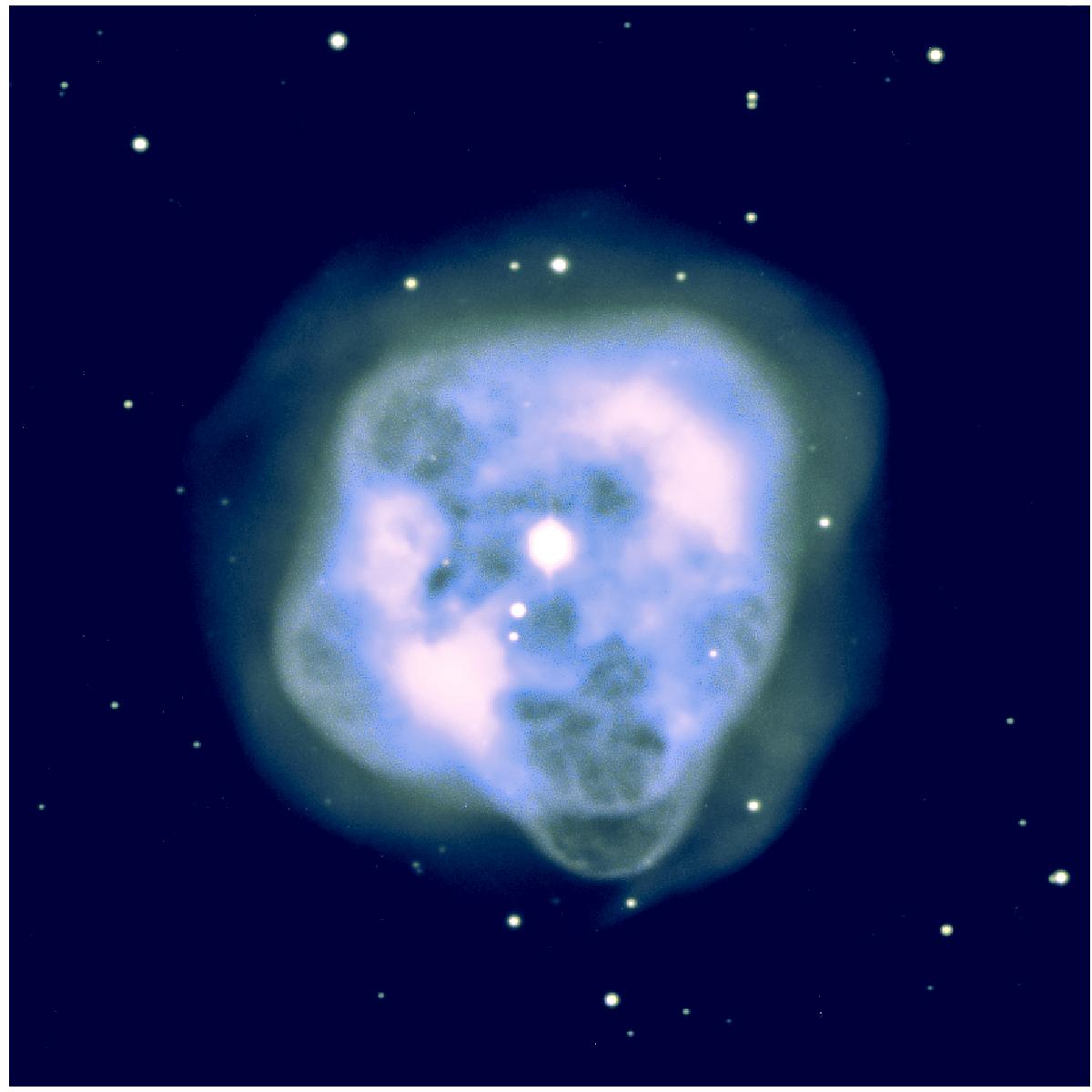
PR Image noirlab2613a
NGC 1514: The Crystal Ball Nebula
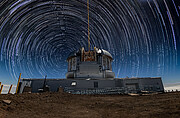
PR Image noirlab2613b
Star Trails Above Gemini North
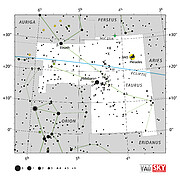
PR Image noirlab2613c
NGC 1514 finder chart


Videos

Pan on NGC 1514
PR Video noirlab2613a
NGC 1514: The Crystal Ball Nebula

Star Trails Above Gemini North
PR Image noirlab2613b
Star Trails Above Gemini North

NGC 1514 finder chart
PR Image noirlab2613c
NGC 1514 finder chart

Cosmoview Episodio 108: Nebulosa Bola de Cristal
PR Video noirlab2613d
Cosmoview Episodio 108: Nebulosa Bola de Cristal >
in English only


The cosmic splendor of NGC 1514 is revealed in this new image from the Gemini North telescope in Hawai‘i

The 8.1-meter Gemini North telescope, located on the summit of Maunakea in Hawai‘i, has captured NGC 1514, nicknamed the Crystal Ball Nebula, in awe-inspiring detail. This nebula, with its mesmerizing glow of gas, harbors hints of a past stellar death, and its asymmetrical shell is now being shaped by the pair of binary stars that lie at its center.

NGC 1514, nicknamed the Crystal Ball Nebula, is showcased in this enchanting image captured by Gemini Multi-Object Spectrograph (GMOS) on the Gemini North telescope, located on Maunakea in Hawai‘i. Gemini North is one half of the International Gemini Observatory, partly funded by the U.S. National Science Foundation (NSF) and operated by NSF NOIRLab.

German–British astronomer William Herschel discovered the Crystal Ball Nebula in 1790. It’s located in the constellation Taurus, near the border of Perseus. While, culturally, crystal balls are known for divining the future, the Crystal Ball Nebula provides us with a snapshot of the final stages of a star’s life from long ago. It sits around 1500 light-years from Earth. This means the light captured in this image left its source around 1500 years ago, traveling across the Universe before finally reaching Gemini North.

The Crystal Ball Nebula is categorized as a planetary nebula, a nomenclature first presented by the nebula’s discoverer, William Herschel. He coined the term in the 1700s after spotting the spherical shape of these objects, which reminded him of planets. In reality, planets and planetary nebulae are unrelated.

Planetary nebulae form when a low- or intermediate-mass star ejects its outer layers near the end of its life, forming a somewhat spherical cloud of gas. They typically have smoother, spherical shapes, making the Crystal Ball Nebula unique for its bumpy shells of gas. As the central star casts away this gas, its inner core is exposed. Radiation from the core energizes the gas, giving it a scorching temperature and chromatic glow. The Crystal Ball Nebula, for example, has an estimated temperature of 15,000 K.

Herschel found this object fascinating, amazed by its faintly illuminated shell. Prior to its discovery, he believed that nebulae were collections of stars that were too far away to individually resolve. The distinct bright point at the heart of the gaseous shell shattered this theory. He wrote in 1791, “Our judgment I may venture to say, will be, that the nebulosity about the star is not of a starry nature.” He believed the illumination of the Crystal Ball Nebula came from a single star, not a far-off grouping.

While it may appear in this image as if there is a single shining light source at the heart of the Crystal Ball Nebula, as Herschel saw, it actually contains two stars. These two stars orbit each other with a period of around nine years — the longest known for any binary pair within a planetary nebula. Scientists believe that one of these stars, which was once several times more massive than our Sun, released its outer layers while in the throes of death. As the progenitor star and its binary companion orbit each other, they mold the expanding shell of gas with their strong, asymmetrical winds, forming the lumpy layers we see today.


More information

This image was produced by NSF NOIRLab’s Communication, Education & Engagement team, as part of the NOIRLab Legacy Imaging Program.

NSF NOIRLab, the U.S. National Science Foundation center for ground-based optical-infrared astronomy, operates the International Gemini Observatory (a facility of NSF, NRC–Canada, ANID–Chile, MCTIC–Brazil, MINCyT–Argentina, and KASI–Republic of Korea), NSF Kitt Peak National Observatory (KPNO), NSF Cerro Tololo Inter-American Observatory (CTIO), the Community Science and Data Center (CSDC), and NSF–DOE Vera C. Rubin Observatory (in cooperation with DOE’s SLAC National Accelerator Laboratory). It is managed by the Association of Universities for Research in Astronomy (AURA) under a cooperative agreement with NSF and is headquartered in Tucson, Arizona. 

The scientific community is honored to have the opportunity to conduct astronomical research on I’oligam Du’ag (Kitt Peak) in Arizona, on Maunakea in Hawai‘i, and on Cerro Tololo and Cerro Pachón in Chile. We recognize and acknowledge the very significant cultural role and reverence of I’oligam Du’ag to the Tohono O’odham Nation, and Maunakea to the Kanaka Maoli (Native Hawaiians) community.


Links


Contacts:

Josie Fenske
Public Information Officer
NSF NOIRLab
Email:
josie.fenske@noirlab.edu


Wednesday, April 16, 2025

With NASA's Webb, Dying Star's Energetic Display Comes Into Full Focus

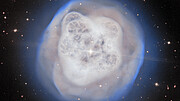
NASA’s James Webb Space Telescope has taken the most detailed image of planetary nebula NGC 1514 to date thanks to its unique mid-infrared observations. Webb shows its rings as intricate clumps of dust. It’s also easier to see holes punched through the bright pink central region. Credits/Image: NASA, ESA, CSA, STScI, Michael Ressler (NASA-JPL), Dave Jones (IAC)

Two infrared views of NGC 1514. At left is an observation from NASA’s Wide-field Infrared Survey Explorer (WISE). At right is a more refined image from NASA's James Webb Space Telescope.Credits/Image: NASA, ESA, CSA, STScI, NASA-JPL, Caltech, UCLA, Michael Ressler (NASA-JPL), Dave Jones (IAC)

This image of planetary nebula NGC 1514, captured by the James Webb Space Telescope’s MIRI (Mid-Infrared Instrument), shows compass arrows, scale bar, and color key for reference.

The north and east compass arrows show the orientation of the image on the sky. Note that the relationship between north and east on the sky (as seen from below) is flipped relative to direction arrows on a map of the ground (as seen from above).

The scale bar is labeled in light-years, which is the distance that light travels in one Earth-year. (It takes 0.6 years for light to travel a distance equal to the length of the scale bar.) One light-year is equal to about 5.88 trillion miles or 9.46 trillion kilometers.

This image shows invisible mid-infrared wavelengths of light that have been translated into visible-light colors. The color key shows which MIRI filters were used when collecting the light. The color of each filter name is the visible light color used to represent the infrared light that passes through that filter.Credits/Image: NASA, ESA, CSA, STScI, Michael Ressler (NASA-JPL), Dave Jones (IAC). Read a
full description of the image.


Gas and dust ejected by a dying star at the heart of NGC 1514 came into complete focus thanks to mid-infrared data from NASA’s James Webb Space Telescope. Its rings, which are only detected in infrared light, now look like “fuzzy” clumps arranged in tangled patterns, and a network of clearer holes close to the central stars shows where faster material punched through.

“Before Webb, we weren’t able to detect most of this material, let alone observe it so clearly,” said Mike Ressler, a researcher and project scientist for Webb’s MIRI (Mid-Infrared Instrument) at NASA’s Jet Propulsion Laboratory in southern California. He discovered the rings around NGC 1514 in 2010 when he examined the image (at left) from NASA’s Wide-field Infrared Survey Explorer (WISE). “With MIRI’s data, we can now comprehensively examine the turbulent nature of this nebula,” he said.

This scene has been forming for at least 4,000 years — and will continue to change over many more millennia. At the center are two stars that appear as one in Webb’s observation, and are set off with brilliant diffraction spikes. The stars follow a tight, elongated nine-year orbit and are draped in an arc of dust represented in orange.

One of these stars, which used to be several times more massive than our Sun, took the lead role in producing this scene. “As it evolved, it puffed up, throwing off layers of gas and dust in in a very slow, dense stellar wind,” said David Jones, a senior scientist at the Institute of Astrophysics on the Canary Islands, who proved there is a binary star system at the center in 2017.

Once the star’s outer layers were expelled, only its hot, compact core remained. As a white dwarf star, its winds both sped up and weakened, which might have swept up material into thin shells.

Its Hourglass Shape

Webb’s observations show the nebula is tilted at a 60-degree angle, which makes it look like a can is being poured, but it’s far more likely that NGC 1514 takes the shape of an hourglass with the ends lopped off. Look for hints of its pinched waist near top left and bottom right, where the dust is orange and drifts into shallow V-shapes.

What might explain these contours? “When this star was at its peak of losing material, the companion could have gotten very, very close,” Jones said. “That interaction can lead to shapes that you wouldn’t expect. Instead of producing a sphere, this interaction might have formed these rings.”

Though the outline of NGC 1514 is clearest, the hourglass also has “sides” that are part of its three-dimensional shape. Look for the dim, semi-transparent orange clouds between its rings that give the nebula body.

A Network of Dappled Structures

The nebula’s two rings are unevenly illuminated in Webb’s observations, appearing more diffuse at bottom left and top right. They also look fuzzy, or textured. “We think the rings are primarily made up of very small dust grains,” Ressler said. “When those grains are hit by ultraviolet light from the white dwarf star, they heat up ever so slightly, which we think makes them just warm enough to be detected by Webb in mid-infrared light.”

In addition to dust, the telescope also revealed oxygen in its clumpy pink center, particularly at the edges of the bubbles or holes.

NGC 1514 is also notable for what is absent. Carbon and more complex versions of it, smoke-like material known as polycyclic aromatic hydrocarbons, are common in planetary nebulae (expanding shells of glowing gas expelled by stars late in their lives). Neither were detected in NGC 1514. More complex molecules might not have had time to form due to the orbit of the two central stars, which mixed up the ejected material. A simpler composition also means that the light from both stars reaches much farther, which is why we see the faint, cloud-like rings.

What about the bright blue star to the lower left with slightly smaller diffraction spikes than the central stars? It’s not part of this nebula. In fact, this star lies closer to us.

This planetary nebula has been studied by astronomers since the late 1700s. Astronomer William Herschel noted in 1790 that NGC 1514 was the first deep sky object to appear genuinely cloudy — he could not resolve what he saw into individual stars within a cluster, like other objects he cataloged. With Webb, our view is considerably clearer.

NGC 1514 lies in the Taurus constellation approximately 1,500 light-years from Earth.

The James Webb Space Telescope is the world’s premier space science observatory. Webb will solve mysteries in our solar system, look beyond to distant worlds around other stars, and probe the mysterious structures and origins of our universe and our place in it. Webb is an international program led by NASA with its partners, ESA (European Space Agency) and the Canadian Space Agency.


About This Release

Credits:

Media Contact:

Claire Blome
Space Telescope Science Institute, Baltimore, Maryland

Christine Pulliam
Space Telescope Science Institute, Baltimore, Maryland

Science Advisor: Michael Ressler (NASA-JPL)

Permissions: Content Use Policy

Contact Us: Direct inquiries to the News Team.


Thursday, April 06, 2017

Planetary Nebula NGC 1514

Colour-composite image of the planetary nebula NGC 1514 obtained from narrowband Halpha+[N II] and [OIII] images taken using the Wide Field Camera (WFC) on the Isaac Newton Telescope (INT). Credit: David Jones (Instituto de Astrofisica de Canarias) [ JPEG ].

Planetary nebulae are believed to represent the fate of all Sun-like stars; as the star evolves it sheds its outers layers in the form of a dense stellar wind which is then ionised to form the glowing shell of the planetary nebula. It has become apparent that the wide array of shapes found in planetary nebulae are difficult to understand in a single star scenario. The interaction between a dying star and a companion star in a very close orbit (generally with an orbital period as short as a few hours to a few days) is the preferred mechanism for forming strongly aspherical morphologies.

Researchers from the Instituto de Astrofísica de Canarias (IAC), Spain and KU Leuven, Belgium have demonstrated that the star at the centre of NGC1514 has a binary companion orbiting roughly once every nine years—the longest orbital period known in a planetary nebula—demonstrating that even binaries with very long periods can play an important role in the shaping of their planetary nebulae.


More information: 

D. Jones, H. Van Winckel, A. Aller, K. Exter and O. De Marco, 2017, "The long-period binary central stars of the planetary nebulae NGC 1514 and LoTr 5", A&A, 600, L9 [ Paper ].

The longest stellar "dance" in a planetary nebula. IAC press release, 04 April 2017.


Contact:  

Javier Méndez  (Public Relations Officer) 


Wednesday, November 17, 2010

WISE Image Reveals Strange Specimen in Starry Sea

This image composite shows two views of a puffy, dying star, or planetary nebula, known as NGC 1514. The view on the left is from a ground-based, visible-light telescope; the view on the right shows the object in infrared light, as seen by NASA's Wide-field Infrared Survey Explorer, or WISE. Image credit: NASA/JPL-Caltech/UCLA. Full image and caption

PASADENA, Calif.-- A new image from NASA's Wide-field Infrared Survey Explorer shows what looks like a glowing jellyfish floating at the bottom of a dark, speckled sea. In reality, this critter belongs to the cosmos -- it's a dying star surrounded by fluorescing gas and two very unusual rings.

"I am reminded of the jellyfish exhibition at the Monterey Bay Aquarium -- beautiful things floating in water, except this one is in space," said Edward (Ned) Wright, the principal investigator of the WISE mission at UCLA, and a co-author of a paper on the findings, reported in the Astronomical Journal.

The object, known as NGC 1514 and sometimes the "Crystal Ball" nebula, belongs to a class of objects called planetary nebulae, which form when dying stars toss off their outer layers of material. Ultraviolet light from a central star, or in this case a pair of stars, causes the gas to fluoresce with colorful light. The result is often beautiful -- these objects have been referred to as the butterflies of space.

NGC 1514 was discovered in 1790 by Sir William Herschel, who noted that its "shining fluid" meant that it could not be a faint cluster of stars, as originally suspected. Herschel had previously coined the term planetary nebulae to describe similar objects with circular, planet-like shapes.

Planetary nebulae with asymmetrical wings of nebulosity are common. But nothing like the newfound rings around NGC 1514 had been seen before. Astronomers say the rings are made of dust ejected by the dying pair of stars at the center of NGC 1514. This burst of dust collided with the walls of a cavity that was already cleared out by stellar winds, forming the rings.

"I just happened to look up one of my favorite objects in our WISE catalogue and was shocked to see these odd rings," said Michael Ressler, a member of the WISE science team at NASA's Jet Propulsion Laboratory in Pasadena, Calif., and lead author of the Astronomical Journal paper. Ressler first became acquainted with the object years ago while playing around with his amateur telescope on a desert camping trip. "It's funny how things come around full circle like this."

WISE was able to spot the rings for the first time because their dust is being heated and glows with the infrared light that WISE can detect. In visible-light images, the rings are hidden from view, overwhelmed by the brightly fluorescing clouds of gas.

"This object has been studied for more than 200 years, but WISE shows us it still has surprises," said Ressler.

Infrared light has been color-coded in the new WISE picture, such that blue represents light with a wavelength of 3.4 microns; turquoise is 4.6-micron light; green is 12-micron light; and red is 22-micron light. The dust rings stand out in orange. The greenish glow at the center is an inner shell of material, blown out more recently than an outer shell that is too faint to be seen in WISE's infrared view. The white dot in the middle is the central pair of stars, which are too close together for WISE to see separately.

Ressler says NGC 1514's structure, though it looks unique, is probably similar in overall geometry to other hour-glass nebulae, such as the Engraved Hourglass Nebula (http://hubblesite.org/newscenter/archive/releases/1996/07). The structure looks different in WISE's view because the rings are detectable only by their heat; they do not fluoresce at visible wavelengths, as do the rings in the other objects.

Serendipitous findings like this one are common in survey missions like WISE, which comb through the whole sky. WISE has been surveying the sky in infrared light since January 2010, cataloguing hundreds of millions of asteroids, stars and galaxies. In late September, after covering the sky about one-and-a-half times, it ran out of the frozen coolant needed to chill its longest-wavelength detectors. The mission, now called NEOWISE, is still scanning the skies with two of its infrared detectors, focusing primarily on comets and asteroids, including near-Earth objects, which are bodies whose orbits pass relatively close to Earth's orbit around the sun.

The WISE science team says that more oddballs like NGC 1514 are sure to turn up in the plethora of WISE data -- the first batch of which will be released to the astronomical community in spring 2011.

Other study authors are Martin Cohen of the Monterey Institute for Research in Astronomy, Marina, Calif.; Stefanie Wachter and Don Hoard of NASA's Spitzer Science Center at the California Institute of Technology in Pasadena; and Amy Mainzer of JPL.

JPL manages and operates the Wide-field Infrared Survey Explorer for NASA's Science Mission Directorate, Washington. The mission was competitively selected under NASA's Explorers Program managed by the Goddard Space Flight Center, Greenbelt, Md. The science instrument was built by the Space Dynamics Laboratory, Logan, Utah, and the spacecraft was built by Ball Aerospace & Technologies Corp., Boulder, Colo. Science operations and data processing take place at the Infrared Processing and Analysis Center at Caltech. Caltech manages JPL for NASA. More information is online at http://www.nasa.gov/wise , http://wise.astro.ucla.edu and http://www.jpl.nasa.gov/wise .

Whitney Clavin 818-354-4673
Jet Propulsion Laboratory, Pasadena, Calif.
whitney.clavin@jpl.nasa.gov