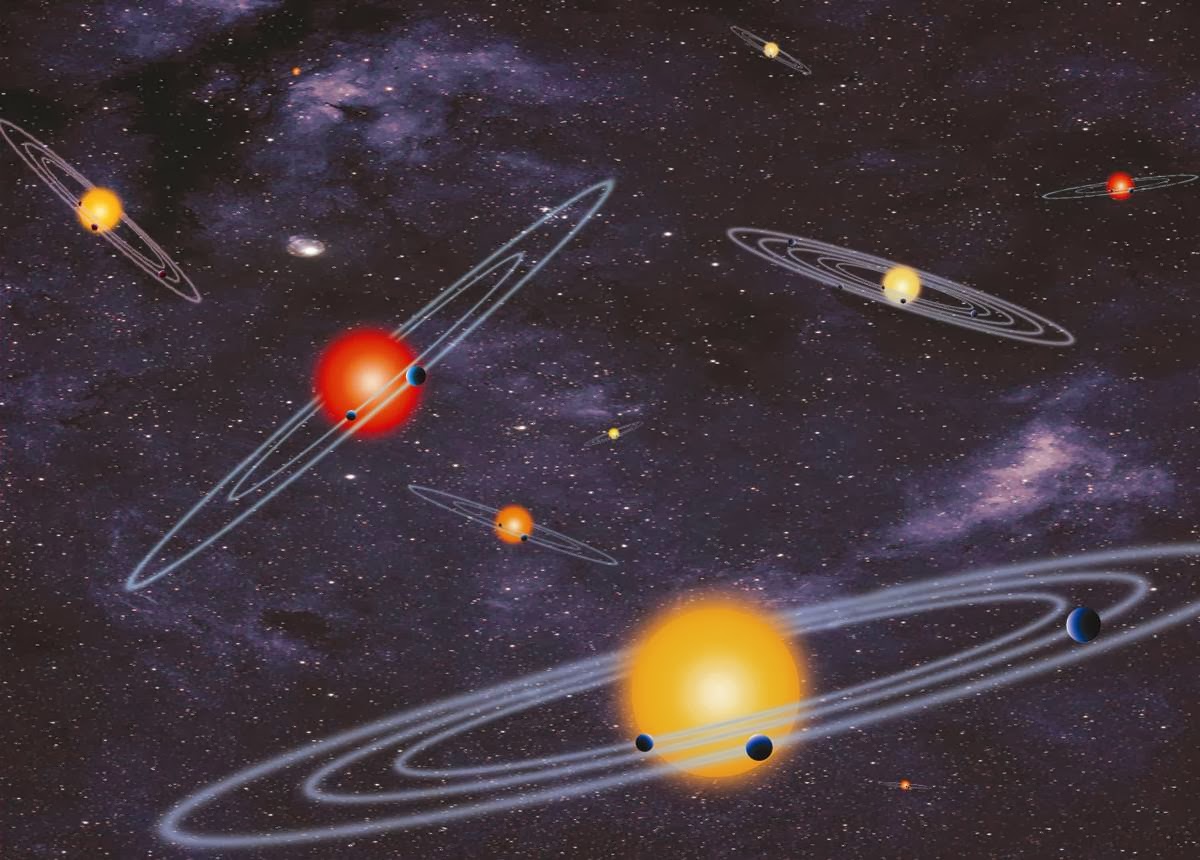
The artist concept depicts multiple-transiting planet systems, which are stars with more than one planet. The planets eclipse or transit their host star from the vantage point of the observer. This angle is called edge-on.
Image Credit:
NASA
NASA's
Kepler mission announced Wednesday the discovery of 715 new planets.
These newly-verified worlds orbit 305 stars, revealing multiple-planet
systems much like our own solar system.
Nearly 95 percent of these planets are smaller than Neptune, which is
almost four times the size of Earth.
This discovery marks a significant
increase in the number of known small-sized planets more akin to Earth
than previously identified exoplanets, which are planets outside our
solar system.
"The Kepler team continues to amaze and excite us with their planet
hunting results," said John Grunsfeld, associate administrator for
NASA's Science Mission Directorate in Washington. "That these new
planets and solar systems look somewhat like our own, portends a great
future when we have the James Webb Space Telescope in space to
characterize the new worlds.”
Since the discovery of the first planets outside our solar system
roughly two decades ago, verification has been a laborious
planet-by-planet process. Now, scientists have a statistical technique
that can be applied to many planets at once when they are found in
systems that harbor more than one planet around the same star.
To verify this bounty of planets, a research team co-led by Jack
Lissauer, planetary scientist at NASA's Ames Research Center in Moffett
Field, Calif., analyzed stars with more than one potential planet, all
of which were detected in the first two years of Kepler's observations
-- May 2009 to March 2011.
The research team used a technique called verification by
multiplicity, which relies in part on the logic of probability. Kepler
observes 150,000 stars, and has found a few thousand of those to have
planet candidates. If the candidates were randomly distributed among
Kepler's stars, only a handful would have more than one planet
candidate. However, Kepler observed hundreds of stars that have multiple
planet candidates. Through a careful study of this sample, these 715
new planets were verified.
This method can be likened to the behavior we know of lions and
lionesses. In our imaginary savannah, the lions are the Kepler stars and
the lionesses are the planet candidates. The lionesses would sometimes
be observed grouped together whereas lions tend to roam on their own. If
you see two lions it could be a lion and a lioness or it could be two
lions. But if more than two large felines are gathered, then it is very
likely to be a lion and his pride. Thus, through multiplicity the
lioness can be reliably identified in much the same way multiple planet
candidates can be found around the same star.
"Four years ago, Kepler began a string of announcements of first
hundreds, then thousands, of planet candidates --but they were only
candidate worlds," said Lissauer. "We've now developed a process to
verify multiple planet candidates in bulk to deliver planets wholesale,
and have used it to unveil a veritable bonanza of new worlds."
These multiple-planet systems are fertile grounds for studying
individual planets and the configuration of planetary neighborhoods.
This provides clues to planet formation.
Four of these new planets are less than 2.5 times the size of Earth
and orbit in their sun's habitable zone, defined as the range of
distance from a star where the surface temperature of an orbiting planet
may be suitable for life-giving liquid water.
One of these new habitable zone planets, called Kepler-296f, orbits a
star half the size and 5 percent as bright as our sun. Kepler-296f is
twice the size of Earth, but scientists do not know whether the planet
is a gaseous world, with a thick hydrogen-helium envelope, or it is a
water world surrounded by a deep ocean.
"From this study we learn planets in these multi-systems are small
and their orbits are flat and circular -- resembling pancakes -- not
your classical view of an atom," said Jason Rowe, research scientist at
the SETI Institute in Mountain View, Calif., and co-leader of the
research. "The more we explore the more we find familiar traces of
ourselves amongst the stars that remind us of home."
This latest discovery brings the confirmed count of planets outside
our solar system to nearly 1,700. As we continue to reach toward the
stars, each discovery brings us one step closer to a more accurate
understanding of our place in the galaxy.
Launched in March 2009, Kepler is the first NASA mission to find
potentially habitable Earth-size planets. Discoveries include more than
3,600 planet candidates, of which 961 have been verified as bona-fide
worlds.
Ames is responsible for the Kepler mission concept, ground system
development, mission operations and science data analysis. NASA's Jet
Propulsion Laboratory in Pasadena, Calif., managed Kepler mission
development. Ball Aerospace & Technologies Corp. in Boulder, Colo.,
developed the Kepler flight system and supports mission operations with
the Laboratory for Atmospheric and Space Physics at the University of
Colorado in Boulder. The Space Telescope Science Institute in Baltimore
archives, hosts and distributes Kepler science data. Kepler is NASA's
10th Discovery Mission and was funded by the agency's Science Mission
Directorate.