Showing posts with label Messier 94. Show all posts

Friday, October 23, 2015

Starburst galaxy Messier 94

Credit: ESA/Hubble & NASA


This image shows the galaxy Messier 94, which lies in the small northern constellation of the Hunting Dogs, about 16 million light-years away.

Within the bright ring around Messier 94 new stars are forming at a high rate and many young, bright stars are present within it – thanks to this, this feature is called a starburst ring.

The cause of this peculiarly shaped star-forming region is likely a pressure wave going outwards from the galactic centre, compressing the gas and dust in the outer region. The compression of material means the gas starts to collapse into denser clouds. Inside these dense clouds, gravity pulls the gas and dust together until temperature and pressure are high enough for stars to be born.


Saturday, June 29, 2013

NASA Decommissions Its Galaxy Hunter Spacecraft

Big Brother to the Milky Way
Credit: NASA/JPL-Caltech

Ultraviolet Ring of Stars
Credit: NASA/JPL-Caltech

Galaxy's Pencil-Thin Profile
Credit: NASA/JPL-Caltech

PASADENA, Calif. — NASA has turned off its Galaxy Evolution Explorer (GALEX) after a decade of operations in which the venerable space telescope used its ultraviolet vision to study hundreds of millions of galaxies across 10 billion years of cosmic time.

"GALEX is a remarkable accomplishment," said Jeff Hayes, NASA's GALEX program executive in Washington. "This small Explorer mission has mapped and studied galaxies in the ultraviolet, light we cannot see with our own eyes, across most of the sky."

Operators at Orbital Sciences Corporation in Dulles, Va., sent the signal to decommission GALEX at 12:09 p.m. PDT (3:09 p.m. EDT) Friday, June 28. The spacecraft will remain in orbit for at least 65 years, then fall to Earth and burn up upon re-entering the atmosphere. GALEX met its prime objectives and the mission was extended three times before being cancelled.

Highlights from the mission's decade of sky scans include:
  • Discovering a gargantuan, comet-like tail behind a speeding star called Mira.
  • Catching a black hole "red-handed" as it munched on a star.
  • Finding giant rings of new stars around old, dead galaxies.
  • Independently confirming the nature of dark energy.
  • Discovering a missing link in galaxy evolution -- the teenage galaxies transitioning from young to old.
The mission also captured a dazzling collection of snapshots, showing everything from ghostly nebulas to a spiral galaxy with huge, spidery arms.

In a first-of-a-kind move for NASA, the agency in May 2012 loaned GALEX to the California Institute of Technology in Pasadena, which used private funds to continue operating the satellite while NASA retained ownership. Since then, investigators from around the world have used GALEX to study everything from stars in our own Milky Way galaxy to hundreds of thousands of galaxies 5 billion light-years away.

In the space telescope's last year, it scanned across large patches of sky, including the bustling, bright center of our Milky Way. The telescope spent time staring at certain areas of the sky, finding exploded stars, called supernovae, and monitoring how objects, such as the centers of active galaxies, change over time. GALEX also scanned the sky for massive, feeding black holes and shock waves from early supernova explosions.

"In the last few years, GALEX studied objects we never thought we'd be able to observe, from the Magellanic Clouds to bright nebulae and supernova remnants in the galactic plane," said David Schiminovich of Columbia University, N.Y., N.Y, a longtime GALEX team member who led science operations over the past year. "Some of its most beautiful and scientifically compelling images are part of this last observation cycle."

Data from the last year of the mission will be made public in the coming year.

"GALEX, the mission, may be over, but its science discoveries will keep on going," said Kerry Erickson, the mission's project manager at NASA's Jet Propulsion Laboratory in Pasadena, Calif.

A slideshow showing some of the popular GALEX images is online at: http://go.nasa.gov/17xAVDd
JPL managed the GALEX mission and built the science instrument. The mission's principal investigator, Chris Martin, is at Caltech. NASA's Goddard Space Flight Center in Greenbelt, Md., developed the mission under the Explorers Program it manages. Researchers sponsored by Yonsei University in South Korea and the Centre National d'Etudes Spatiales (CNES) in France collaborated on the mission. Caltech manages JPL for NASA.

Monday, May 20, 2013

Galactic Wheels within Wheels

 
Credit: NASA/JPL-Caltech/SINGS Team

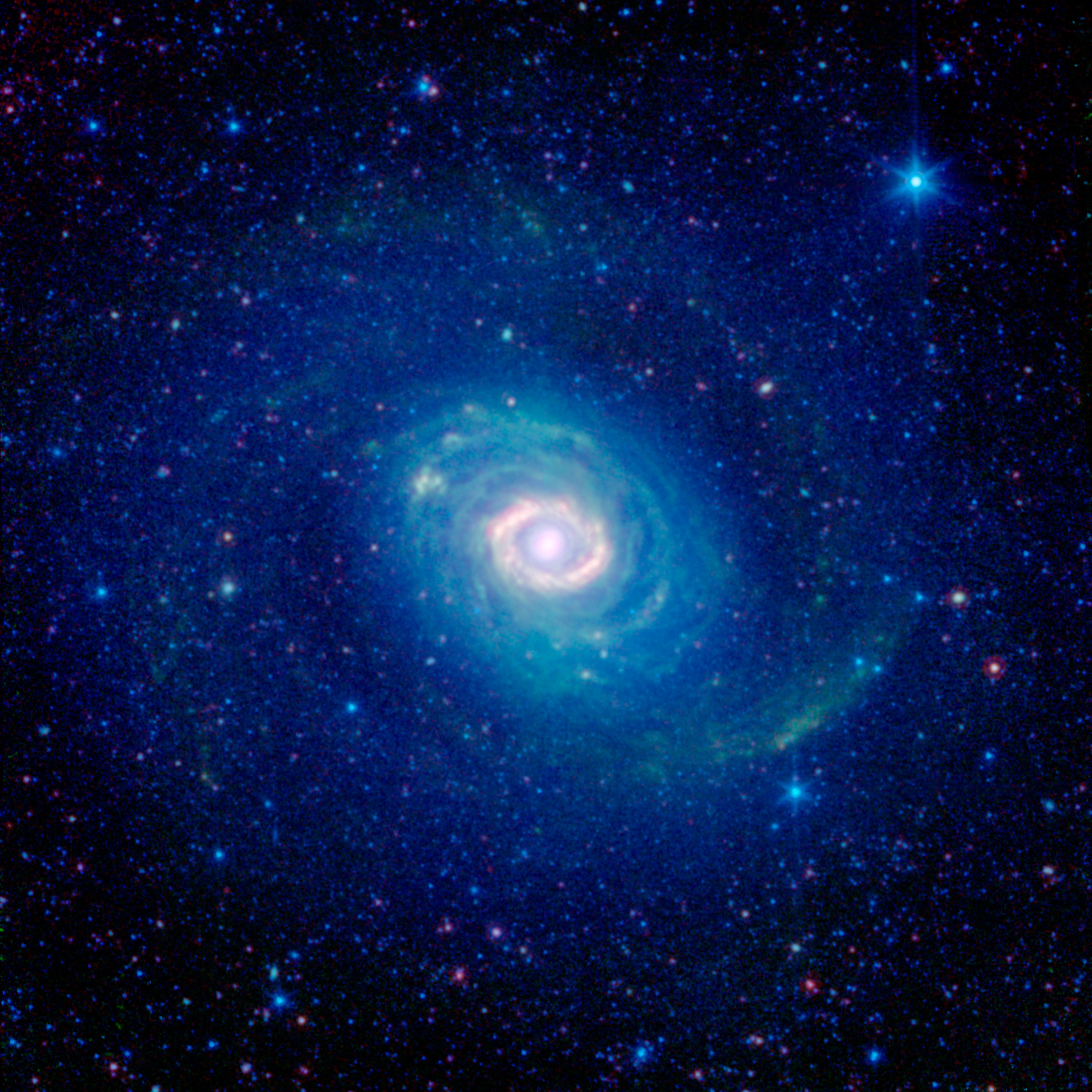
How many rings do you see in this striking new image of the galaxy Messier 94 (NGC 4736) as seen by the infrared eyes of NASA’s Spitzer Space Telescope? While at first glance one might see a number of them, astronomers believe there is just one.

Historically, Messier 94 was considered to have two strikingly different rings: a brilliant, compact band encircling the galaxy’s core, and a faint, broad, swath of stars falling outside its main disk.

Astronomers have recently discovered that the outer ring, seen here in the deep blue glow of starlight, may actually be more of an optical illusion. Their 2009 study combined infrared Spitzer observations with ultraviolet data from NASA’s Galaxy Evolution Explorer, and ground-based surveys in visible (Sloan Digital Sky Survey) and near infrared light (Two Micron All Sky Survey). This more complete picture of Messier 94 indicates that we are really seeing two separate spiral arms that, from our perspective, take on the appearance of a single, unbroken ring.

The bright inner ring of Messier 94 is very real, however. This area is sometimes identified as a “starburst ring” because of the frenetic pace of star formation in this confined area. Starbursts like this can often be triggered by gravitational encounters with other galaxies, but in this case may instead be caused by the galaxy’s oval shape.

Tucked in between the inner starburst ring and the outer ring-like arms we find the galaxy’s disk, striated with greenish filaments of dust. While, at first glance, these dusty arcs look like a collection of rings, they actually follow tightly wound spiral arcs.

Messier 94 is about 17 million light years away, making it a distant neighbor of our own Milky Way galaxy. It was first discovered by Charles Messier’s assistant, Pierre Méchain, in 1781 and was added to  his supervisor’s famous catalog two days later.

Infrared light with wavelengths of 3.6 and 4.5 microns is shown as blue/cyan, showing primarily the glow from starlight. 8 micron light is rendered in green, and 24 micron emission is red, tracing the cooler and warmer components of dust, respectively. The observations were made in 2004, before Spitzer ran out of cryogen.
 
NASA's Jet Propulsion Laboratory, Pasadena, Calif., manages the Spitzer Space Telescope mission for NASA's Science Mission Directorate, Washington. Science operations are conducted at the Spitzer Science Center at the California Institute of Technology in Pasadena. Data are archived at the Infrared Science Archive housed at the Infrared Processing and Analysis Center at Caltech. Caltech manages JPL for NASA.