Showing posts with label Instituto de Astrofísica de Andalucía (IAA-CSIC). Show all posts

Monday, November 07, 2016

Study confirms that novae, a type of explosive phenomenon in stars, are main source of lithium in the universe

Nova Sagittarii 2015 N.2
Copyright  Ajai Talwar


Large amounts of beryllium-7, an element that decays into lithium, have been found inside nova Sagittarii 2015 N.2

Lithium, the lightest solid element in existence, plays an important role in our lives, both at the biological and the technological level. Like the majority of chemical elements, its origins stem back to astrophysical phenomena, but its point of genesis was so far unclear. Recently, a group of researchers detected enormous quantities of beryllium-7 –an unstable element which decays into lithium in 53.2 days– inside nova Sagittarii 2015 N.2, which suggests that novae are the main source of lithium in the galaxy.

Practically every chemical element has an astronomical origin.  A first genesis took place in what is known as primordial nucleosynthesis, shortly after the Big Bang (between ten seconds and twenty minutes after). Light elements were then formed: hydrogen (75%), helium (25%) and a very small amount of lithium and beryllium.

The remaining chemical elements were formed in stars, either through fusion of other elements inside the nucleus –which begins with the fusion of hydrogen into helium and produces increasingly heavy elements until iron is reached- or through other processes such as supernovae explosions or reactions in the atmosphere of giant stars where, among others, gold, lead and copper are produced. Those elements in turn were then recycled into new stars and planets until the present day.

"But lithium posed a problem: we knew that 25% of existing lithium comes from primordial nucleosynthesis, but we were not able to trace the origins of the remaining 75%", says Luca Izzo, researcher at the Institute of Astrophysics of Andalusia (IAA-CSIC) involved in the study.

Solution to the lithium enigma

The solution to the enigma of the origin of lithium lies, according to this study, in the novae, explosive phenomena occurring in binary star systems in which one of the stars is a white dwarf. The white dwarf can nab material from its twin star and form a superficial layer of hydrogen which, when it reaches a certain density, will trigger an explosion –a nova– which can increase the brightness of a star up to one hundred thousand times. After a few weeks the system stabilizes and the process starts again.


Artist concept of a binary system similar to the one that originated the nova Sagittarii 2015 N.2
Credit: David A. Hardy y PPARC.


The researchers studied nova Sagittarii 1015 N.2 (also known as V5668 Sgr), which was detected on March 15th, 2015, and remained visible for more than eighty days. The observation, made with the UVES instrument of the Very Large Telescope (ESO) in the course of twenty four days, made it possible for the first time to follow the evolution of the beryllium-7 signal inside a nova and even to calculate the amount of it present. "Beryllium-7 is an unstable element which decays into lithium in 53.2 days, so its presence is an unequivocal sign of the existence of lithium", says Christina Thöne, researcher at the Institute of Astrophysics of Andalusia (IAA-CSIC).

The existence of beryllium-7 had been previously documented in another nova, but the measure of the amount of lithium which would be ultimately produced from it on nova Sagittarii 1015 N.2 came as a surprise. "We’re talking about an amount of lithium ten times greater than that in the Sun," says Luca Izzo (IAA-CSIC). "With these amounts in mind, two similar novae a year would suffice to account for all the lithium in our galaxy, the Milky Way. Novae seem to be the predominant source of lithium in the universe," he concludes.


Reference: 

P. Molaro, L. Izzo et al. "Highly Enriched 7Be in the ejecta of Nova Sagittarii 2015 No. 2 (V5668 Sgr) and the Galactic 7Li origin". Monthly Notices of the Royal Astronomical Society, Vol. 463 


  Contact:

Instituto de Astrofísica de Andalucía (IAA-CSIC)
Unidad de Divulgación y Comunicación
Silbia López de Lacalle - sll[arroba]iaa.es - 958230532


Saturday, July 09, 2016

The weird system of star CVSO 30: two planets at extreme distances

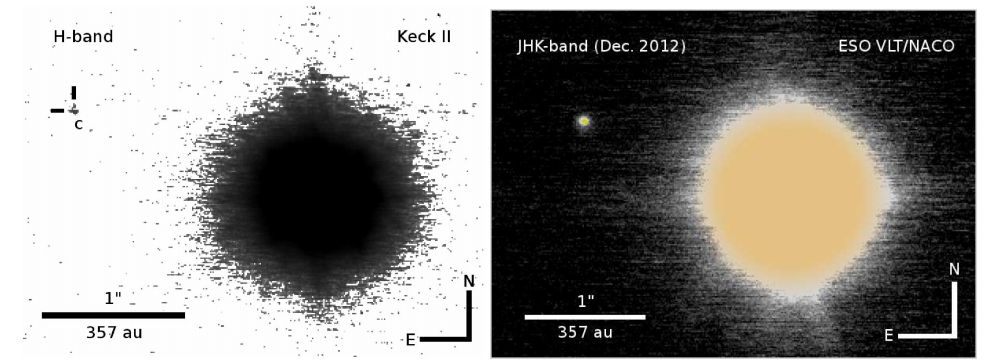
A direct image has been taken of a planet so far away from his star that it takes twenty-seven thousand years for completing one orbit, and it shares the system with another planet which completes its orbit in just eleven hours.

The planet CVSO 30c seen to the left of its star.
Credit:  Keck II telescope (left image) and (right image) VLT (ESO / Schmidt et al.)

 
An international observation campaign has allowed to photograph a planet around CVSO 30 star which is part of a curious system: the newly found CVSO 30c orbits the star at a extreme distance (more than twenty times the distance between Neptune and the Sun), and contrasts with its partner CVSO 30b, found in 2012, that is only at 1.2 million kilometers from the star (Mercury, the planet closest to the Sun, is 58 million kilometers away from it). It is the first system found with these characteristics, and their weird orbits could be due to the fact that both planets interacted to each other in the past and there was a dispersion process.

Up to now, most of the more than two thousand found planets orbiting other stars have been detected thanks to indirect methods, which study the influence of the planets on their stars. Barely sixty have been found with direct imaging, a very instrumental demanding method, but allowing exploring remote regions of the star where indirect methods are less effective.

The confirmation that the little dot on the images was indeed a planet has been possible thanks to the combined use of Keck (Hawaii), VLT (Chile) and Calar Alto Observatory telescopes. “CVSO 30c has been a surprise as it is at 660 Astronomical Units - an Astronomical Unit, or AU, is equivalent to hundred and fifty million kilometers, the distance between the Earth and the Sun -.  Neptune is the most external planet of our Solar System, and it is at 30 AUs” , Jesús Aceituno, Calar Alto Observatory (CAHA, MPG/CSIC) Deputy Director points.

A unique system


Besides, this planet shares system with another one found in 2012 through indirect methods. Although both planets have a similar mass (between one and four times the mass of Jupiter), both of them have a relative distance never saw in the planetary system found up to now: while one is as close to its star that it completes its orbit in barely eleven hours, the other takes about twenty-seven thousand years for finishing it.

Researchers think about several possibilities in order to explain this distance disparity, but the most probable explanation points to the fact that both planets were formed within the internal regions of the system, and a gravitational interaction, happened in the past, resulted in the dispersion. This is a mechanism invoked to explain what are known as “Hot Jupiters”, gas giants very close to its star and which its detection constituted a surprise: in so short distances, the temperature prevents condensation of volatile ice to form gaseous planets, so they should have migrated to the inner regions by orbital resonances with other bodies.

This planetary system is a suitable object for studying these planetary dispersion theories, as well as for inquire on the first planet development phases: CVSO 30 star is a very young one, with only 2.5 million years (our Sun has 5 million years), and researchers are studying how it could form planets so quickly.


The German-Spanish Calar Alto Observatory is located at Sierra de los Filabres, north of Almería (Andalucía, Spain). It is jointly operated by the Instituto Max Planck de Astronomía in Heidelberg, Germany, and the Instituto de Astrofísica de Andalucía (CSIC) in Granada, Spain. Calar Alto has three telescopes with apertures of 1.23m, 2.2m and 3.5m. A 1.5m aperture telescope, also located at the mountain, is operated under control of the Observatorio de Madrid.


Reference:


T.O.B. Schmidt et al. "Direct Imaging discovery of a second planet candidate around the possibly transiting planet host CVSO 30 ". Astronomy & Astrophysics. DOI: http://dx.doi.org/10.1051/0004-6361/201526326


Contact:

Instituto de Astrofísica de Andalucía (IAA-CSIC)
Unidad de Divulgación y Comunicación
Silbia López de Lacalle - sll[arroba]iaa.es - 958230532

http://www.iaa.es
http://www-divulgacion.iaa.es


Tuesday, July 05, 2016

Discovery of miniature planetary formation disk will enable observation of planetary gestation in real time

Image obtained by ALMA of the protoplanetary disk around young star XZ Tau B.
Source: Osorio et al.

Comparison between the XZ Tau B disk and the disk around star HD 169142, of normal size.
Source: Osorio et al.


Young star XZ Tau B displays a dwarf protoplanetary disk which may evolve up to five hundred times faster than bigger disks and display observable changes in just a few months 

In the course of the last few decades, the discovery of thousands of planets around other stars has unveiled a wide variety of planetary systems whose architecture defies our understanding of planet formation. The search for disks of gas and dust around young stars, from which planetary systems stem, is fundamental to explain newly observed worlds, and a recent finding confirms that miniature systems can exist. 

The discovery, made by an international team led by researchers from the Institute of Astrophysics of Andalusia  (IAA-CSIC), was made in the vicinity of XZ Tau B star which, with less than five million years of existence (the Sun, for comparison, is five billion years old), is so young that it has not yet completed its contraction process.

"This young star is surrounded by a disk of gas and dust only three Astronomical Units in radius, with a central cavity which seems to have been created by protoplanets orbiting around it, says Mayra Osorio, IAA-CSIC researcher in charge of the project. One Astronomical Unit is the equivalent of the distance from the Earth to the Sun (150 million kilometers). In comparison, the typical size of disks studied so far oscillated between fifty and a hundred astronomic units".
 
With a size tens of times smaller than our Solar System, which is about one hundred Astronomical Units long, the disk around XZ Tau B not only confirms the models that indicated that dwarf disks could exist but it also fits the finding by the Kepler satellite of extremely compact systems, containing various planets the size of the Earth (or several Earths) orbiting around their star inside a space no bigger than one Astronomical Unit.  

"The XZ Tau B disk could therefore be the precursor to these types of compact systems and suggests that there could be a great number of very small protoplanetary disks left to discover”, says Enrique Macías, IAA-CSIC researcher involved in the finding. "Highly sensitive instruments with a high spatial resolution such as ALMA, with which we have studied XZ Tau B, are allowing us to study systems that now seem borderline but which are undoubtedly much more common than we used to think".

The XZ Tau B disk displays, moreover, two very interesting traits. First, its small size implies that it will develop between fifty and five hundred times faster than bigger systems. "Changes which in heretofore observed disks would take decades or centuries to observe will occur here in a matter of months. It is one of the very scarce phenomena in Astrophysics where a full monitoring could be carried out in human time scales”, says Mayra Osorio (IAA-CSIC).

The second characteristic trait of this disk resides in its belonging to a triple stellar system. “It is known that the existence of companion stars influences the size of protoplanetary disks, so the in-depth study of this small disk will bring information not only about how planets are formed but also about how multiple star systems emerge and evolve over time,” says Enrique Macías.


Reference: 

M. Osorio et al. "A dwarf transitional protoplanetary disk around XZ Tau B". The Astrophysical Journal Letters, 825, L10 (2016). http://dx.doi.org/10.3847/2041-8205/825/1/L10


Contact:

Instituto de Astrofísica de Andalucía (IAA-CSIC)
Unidad de Divulgación y Comunicación
Silbia López de Lacalle - sll[arroba]iaa.es - 958230532

http://www.iaa.es
http://www-divulgacion.iaa.es