Showing posts with label Cepheus B. Show all posts

Saturday, June 01, 2019

NASA's Spitzer Captures Stellar Family Portrait

Cepheus B • Cepheus C • V374 Ceph
 Credit: NASA/JPL-Caltech

This image was compiled using data from NASA's Spitzer Space Telescope using the Infrared Array Camera (IRAC) and the Multiband Imaging Photometer (MIPS) during Spitzer's "cold" mission, before the spacecraft's liquid helium coolant ran out in 2009. The colors correspond with IRAC wavelengths of 3.6 microns (blue), 4.5 microns (cyan) and 8 microns (green), and 24 microns (red) from the MIPS instrument.

The green-and-orange delta filling most of this image is a nebula, or a cloud of gas and dust. This region formed from a much larger cloud of gas and dust that has been carved away by radiation from stars.

The bright region at the tip of the nebula is dust that has been heated by the stars' radiation, which creates the surrounding red glow. The white color is the combination of four colors (blue, green, orange and red), each representing a different wavelength of infrared light, which is invisible to human eyes.

The massive stars illuminating this region belong to a star cluster that extends above the white spot.

On the left side of this image, a dark filament runs horizontally through the green cloud. A smattering of baby stars (the red and yellow dots) appear inside it. Known as Cepheus C, the area is a particularly dense concentration of gas and dust where infant stars form. This region is called Cepheus C because it lies in the constellation Cepheus, which can be found near the constellation Cassiopeia. Cepheus-C is about 6 light-years long, and lies about 40 light-years from the bright spot at the tip of the nebula.

The small, red hourglass shape just below Cepheus C is V374 Ceph. Astronomers studying this massive star have speculated that it might be surrounded by a nearly edge-on disk of dark, dusty material. The dark cones extending to the right and left of the star are a shadow of that disk.

The smaller nebula on the right side of the image includes a blue star crowned by a small, red arc of light. This "runaway star" is plowing through the gas and dust at a rapid clip, creating a shock wave or "bow shock" in front of itself.

Some features identified in the annotated image are more visible in the IRAC data alone.

The Jet Propulsion Laboratory in Pasadena, California, manages the Spitzer Space Telescope mission for NASA's Science Mission Directorate in Washington. Science operations are conducted at the Spitzer Science Center at Caltech in Pasadena. Space operations are based at Lockheed Martin Space Systems in Littleton, Colorado. Data are archived at the Infrared Science Archive housed at IPAC at Caltech. Caltech manages JPL for NASA.


Wednesday, August 12, 2009

Cepheus B: Trigger-Happy Star Formation


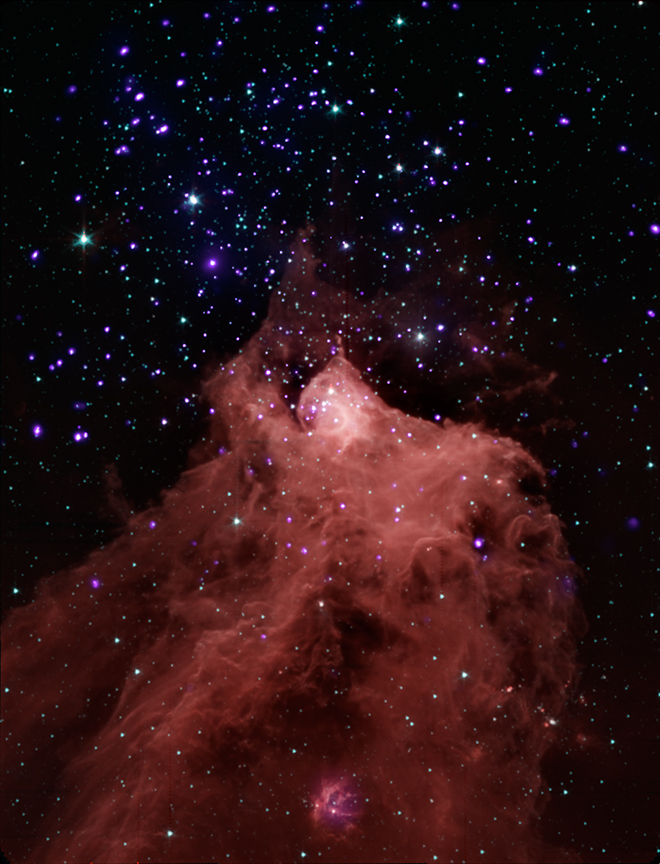
This composite image, combining data from the Chandra X-ray Observatory and the Spitzer Space Telescope shows the molecular cloud Cepheus B, located in our Galaxy about 2,400 light years from the Earth. A molecular cloud is a region containing cool interstellar gas and dust left over from the formation of the galaxy and mostly contains molecular hydrogen. The Spitzer data, in red, green and blue shows the molecular cloud (in the bottom part of the image) plus young stars in and around Cepheus B, and the Chandra data in violet shows the young stars in the field.

The Chandra observations allowed the astronomers to pick out young stars within and near Cepheus B, identified by their strong X-ray emission. The Spitzer data showed whether the young stars have a so-called "protoplanetary" disk around them. Such disks only exist in very young systems where planets are still forming, so their presence is an indication of the age of a star system.

These data provide an excellent opportunity to test a model for how stars form. The new study suggests that star formation in Cepheus B is mainly triggered by radiation from one bright, massive star (HD 217086) outside the molecular cloud. According to the particular model of triggered star formation that was tested -- called the radiation-driven implosion (RDI) model -- radiation from this massive star drives a compression wave into the cloud triggering star formation in the interior, while evaporating the cloud's outer layers.

The labeled version of the image (rollover the image above) shows important regions in and around Cepheus B. The "inner layer" shows the Cepheus B region itself, where the stars are mostly about one million years old and about 70-80% of them have protoplanetary disks. The "intermediate layer" shows the area immediately next to Cepheus B, where the stars are two to three million years old and about 60% of them have disks, while in the "outer layer" the stars are about three to five million years old and about 30% of them have disks. This increase in age as the stars are further away from Cepheus B is exactly what is predicted from the RDI model of triggered star formation.

Different types of triggered star formation have been observed in other environments. For example, the formation of our solar system was thought to have been triggered by a supernova explosion, In the star-forming region W5, a "collect-and-collapse" mechanism is thought to apply, where shock fronts generated by massive stars sweep up material as they progress outwards. Eventually the accumulated gas becomes dense enough to collapse and form hundreds of stars. The RDI mechanism is also thought to be responsible for the formation of dozens of stars in W5. The main cause of star formation that does not involve triggering is where a cloud of gas cools, gravity gets the upper hand, and the cloud falls in on itself.

Fast Facts for Cepheus B:

Scale: Image is 15 arcmin across
Category: Normal Stars & Star Clusters, White Dwarfs & Planetary Nebulas
Coordinates: (J2000) RA 22h 56m 46.99s | Dec +62° 40' 0.0012"
Constellation: Cepheus
Observation Date: 03/11/2003
Observation Time: 8 hours
Obs. ID: 3502
Color Code: X-ray (Violet); IR (Red, Green, Blue)
Instrument: ACIS
References: Getman, K.V., et al. (2009), ApJ, 699, 1454