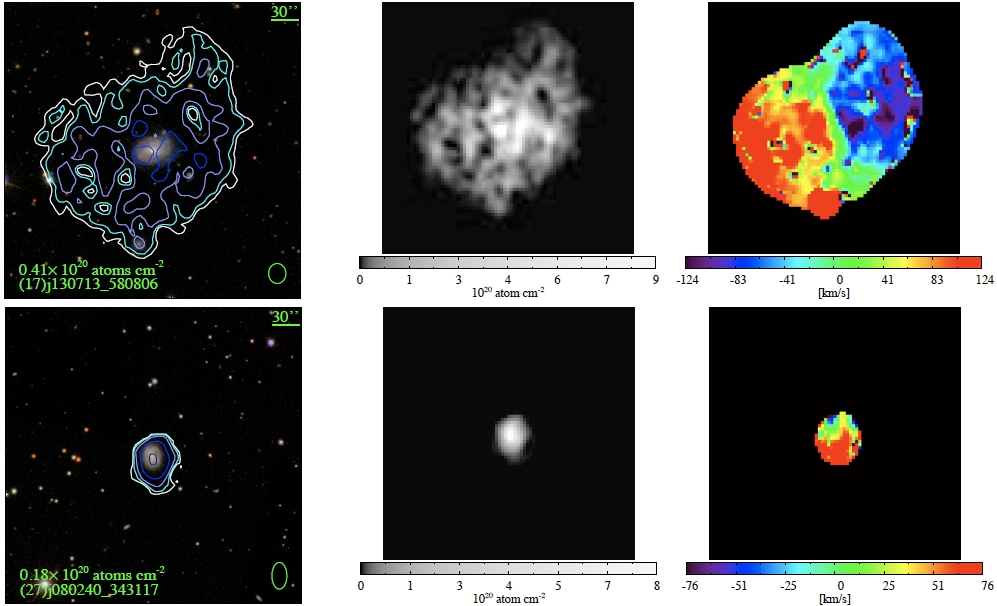
Fig. 1:
The top and bottom rows show two galaxies with very different gas disk
morphologies. From left to right: the column density contours for
neutral hydrogen overlaid on optical images from the Sloan Digital Sky
Survey, the neutral hydrogen itself, and the velocity maps of the
neutral hydrogen.

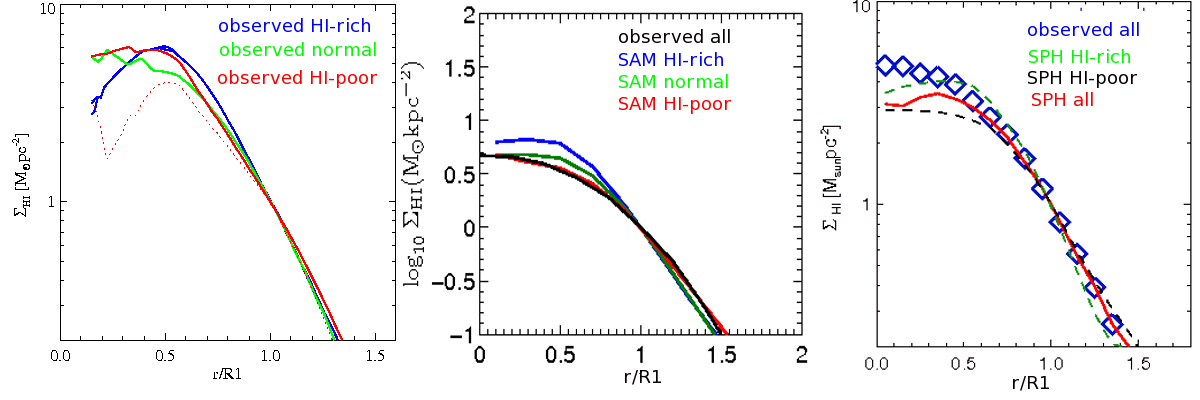
Fig. 2:
The median radial profiles of different galaxies (blue: gas rich, green:
normal, red: gas poor). For all galaxies, the radius has been scaled to
R1, where the gas surface density reaches 1 solar mass / square parsec.
The observed profiles in the left plot are compared to results from semi-
analytical models (SAM, middle) and results from smoothed particle
hydrodynamical simulations (SPH, right).

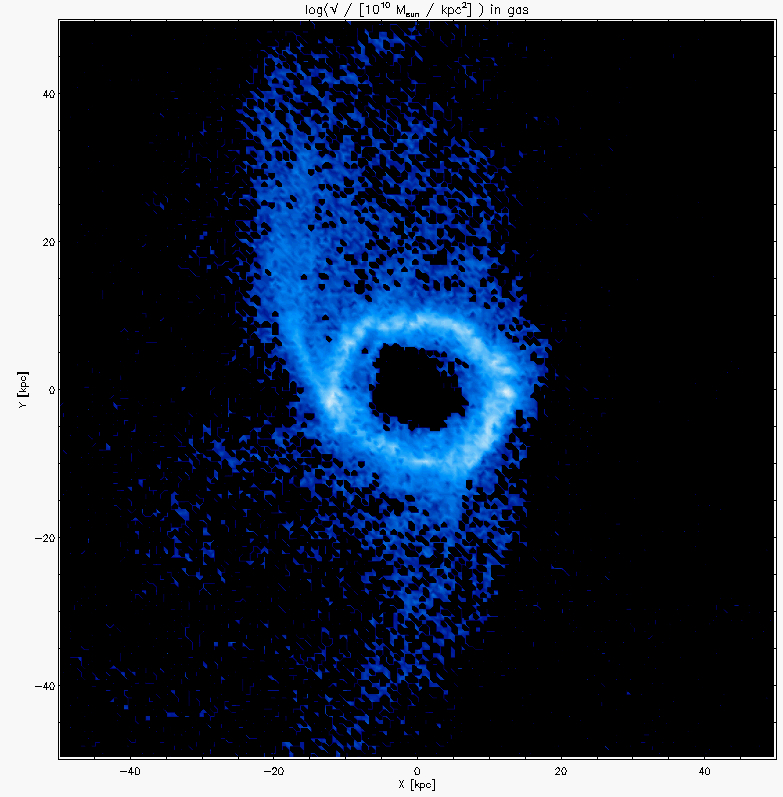
Fig. 3:
An extreme case of gas accretion in a ring-shape. This simulated galaxy
at a redshift z~0.5 was the result of smoothed particle hydrodynamical
simulations. (Image provided by Michael Aumer)
How is cold gas accreted in galaxies? Observers and theorists from MPA
have joined their efforts to investigate the radial distribution of
atomic gas in unusually gas-rich nearby galaxies. They found a universal
shape for the radial profiles of the gas in the outer regions of the
observed galaxies, and obtained remarkable agreement with simulations.
In half the galaxies, the atomic gas may have been accreted in
the form of "rings"
Every astronomy student learns that in galaxies stars form from huge
gas clouds. However, the details of the accretion and distribution of
gas in galaxies is still unclear. Therefore, an international group of
scientists at MPA and ASTRON in the Netherlands joined forces and
carried out the Bluedisk project to map neutral hydrogen in a sample
of 25 very gas-rich galaxies as well as a similar-sized sample of
“control” galaxies with similar masses, sizes and distances, but
normal gas content. Their main tools were the Westerbork Synthesis
Radio Telescope (WSRT) as well as elaborate computer simulations (see Research Highlight May 2013).
There have been many efforts over the past three decades to map the
distribution of cold, atomic gas in galaxies using radio synthesis
telescopes. The first analyses showed that the atomic gas exhibits a
wide variety of detailed features. These can be attributed to
irregularities in the galaxy such as spiral arms, rings, bars, warps
etc. Studies of larger samples revealed basic scaling
relations that provide hints of the mechanisms regulating the evolution
of galaxies.
In contrast to the stellar surface density, which peaks in the centre
of the galaxy and drops steeply with radius, the radial distribution
of the atomic gas often flattens or even declines near the centre of
the galaxy. In the outer regions, the gas disks usually extend to a
larger distance from the centre than the stellar disks, and are
well-fit by exponential functions.
Thanks to improvements in the WSRT instrumentation and data analysis,
the observations by the Bluedisk team reached significantly lower
column densities than previous surveys, i.e. they were able to map the
gas in regions where the gas has low density. This sample is
thus also well-suited for direct comparison with theoretical
models. Observers and theorists worked together closely to improve
their understanding of the radial distribution of the cold, atomic gas
and to find a physical explanation for its structure.
The study revealed an interesting observational phenomenon: in the
outer regions of all the galaxies, the gas exhibits a homogeneous
surface density profile (if the sizes of the gas disks are properly
scaled). This profile is well-fit by an exponential function with a
universal scale-length. This universal profile appears to hold for all
galaxies, irrespective of their stellar properties, gas masses, sizes,
or morphologies (for an example see figure 1).
This is remarkable, because the gas-rich galaxies
contain on average 10 times more gas than the control sample.
In addition, the team found surprising agreement between their
universal profile and results from simulations, both for
smoothed-particle hydrodynamical simulations and for semi-analytic
models of disk galaxy formation (see figure 2). It remains something
of a mystery why the agreement with the smoothed-particle
hydrodynamical simulations is quite so good.
In the semi-analytic models, the universal shape of the outer radial
profiles is a direct consequence of the assumption that infalling gas
is always distributed exponentially. However, there are observational
indications that the atomic gas could be accreted in the form of
"rings". Therefore, more work is underway on the theoretical side
using smoothed particle hydrodynamical simulations to try and
understand how gas settles onto the simulated galaxies in more detail
(see figure 3).
Jing Wang & Guinevere Kauffmann
Further reading:
Wang, J.; Fu, J., Aumer, M., Kauffmann, G., et al.,
"An observational and theoretical view of radial distribution of HI gas in galaxies",
2014, submitted to MNRAS.
http://arxiv.org/abs/1401.8164