Showing posts with label supermassive galaxy. Show all posts

Friday, April 04, 2025

Astronomers Find Giant Dinosaur of a Galaxy

This JWST image shows the Big Wheel galaxy (in the center) and its cosmic environment. The galaxy is a gigantic rotating disk lying 11.7 billion light-years away. Its spiral disk stretches across 100,000 light-years, making it larger than any other galaxy disk confirmed at this epoch of the universe. The blue blob and some of the other larger objects in the image are galaxies in the nearby universe. The smaller objects tend to be distant galaxies; however, the larger galaxy to the lower left of Big Wheel is part of the same remote galactic structure as Big Wheel. Credit: NASA/ESA


Newfound galaxy is one of the biggest ever found in distant universe

A team of astronomers has stumbled upon a humungous spiral galaxy, about five times more massive than our Milky Way galaxy and covering an area two times as big, making it among the largest known galaxies. The most surprising trait of the galaxy, however, is not its colossal size but the fact it existed in the early cosmos when the universe was only 2 billion years old.

"This galaxy is spectacular for being among the largest spiral galaxies ever found, which is unprecedented for this early era of the universe," says Charles (Chuck) Steidel (PhD '90), the Lee A. DuBridge Professor of Astronomy at Caltech. "Ultimately, this galaxy would have been stripped of gas and would not have survived to the modern day. It is like finding a live dinosaur, before it became extinct."

Steidel was part of an international team of astronomers, led by the University of Milano-Bicocca, that made the discovery and published its findings on March 17 in Nature Astronomy. The team's observations were made using James Webb Space Telescope (JWST), a partnership between NASA, the European Space Agency, and the Canadian Space Agency.

The researchers serendipitously noticed the large anomalous galaxy in JWST images taken of a nearby quasar—a powerful, active supermassive black hole. The team then followed up with JWST to learn more about the object's size, precise distance, rotation speed, and mass. Because the speed of light is finite, observations made of objects in the distant universe capture light from a bygone era. The JWST data revealed that the colossal specimen is not only surprisingly large, but also spins at great speeds. This led the team to nickname the galaxy "Big Wheel."

Prior to the discovery, it was thought that disk-shaped galaxies in the early universe were considerably smaller. (Disk galaxies include spiral galaxies as well as other flat, circular galaxies without spiral arms). Big Wheel is about three times larger than any previously discovered galaxies with similar masses at similar cosmic times, and it is also at least three times larger than what is predicted by current cosmological simulations. The galaxy's radius stretches across 100,00 light-years.

The finding begs the question: How did the galaxy get this big so fast? The team is not sure but suspects the answer has to do with the fact that it lives in a very dense area of space packed with a lot of young galaxies that will eventually coalesce into a giant cluster of gravitationally bound galaxies.

"Exceptionally dense environments such as the one hosting the Big Wheel are still a relatively unexplored territory," concludes co-author Sebastiano Cantalupo of the University of Milano-Bicocca. "Further targeted observations are needed to build a statistical sample of giant disks in the early universe and thus open a new window on the early stages of galaxy formation."

The Nature Astronomy study titled "A giant disk galaxy two billion years after the Big Bang," was funded by the European Research Council, the Fondazione Cariplo foundation, NASA, and the Australian Research Council.

Source: Caltech/News


Friday, May 21, 2010

Cannibalistic Galaxy Bends Light and Reveals its Monstrous Appetite

Gemini Legacy Image: R. Carrasco et al., Gemini Observatory/AURA

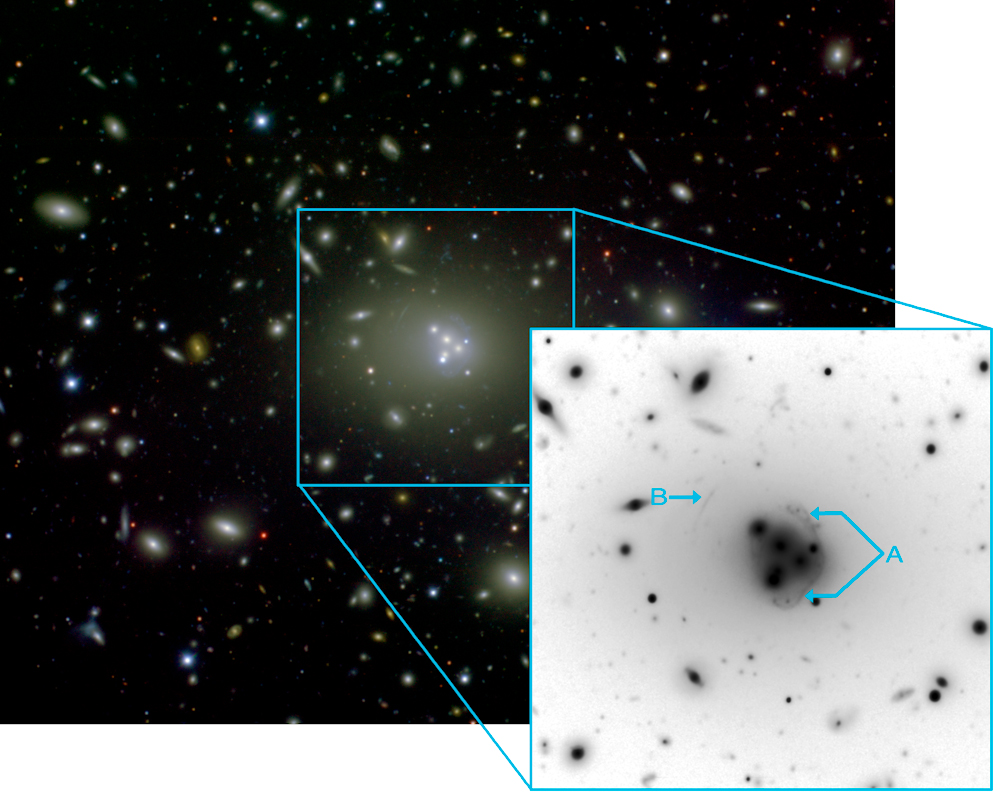
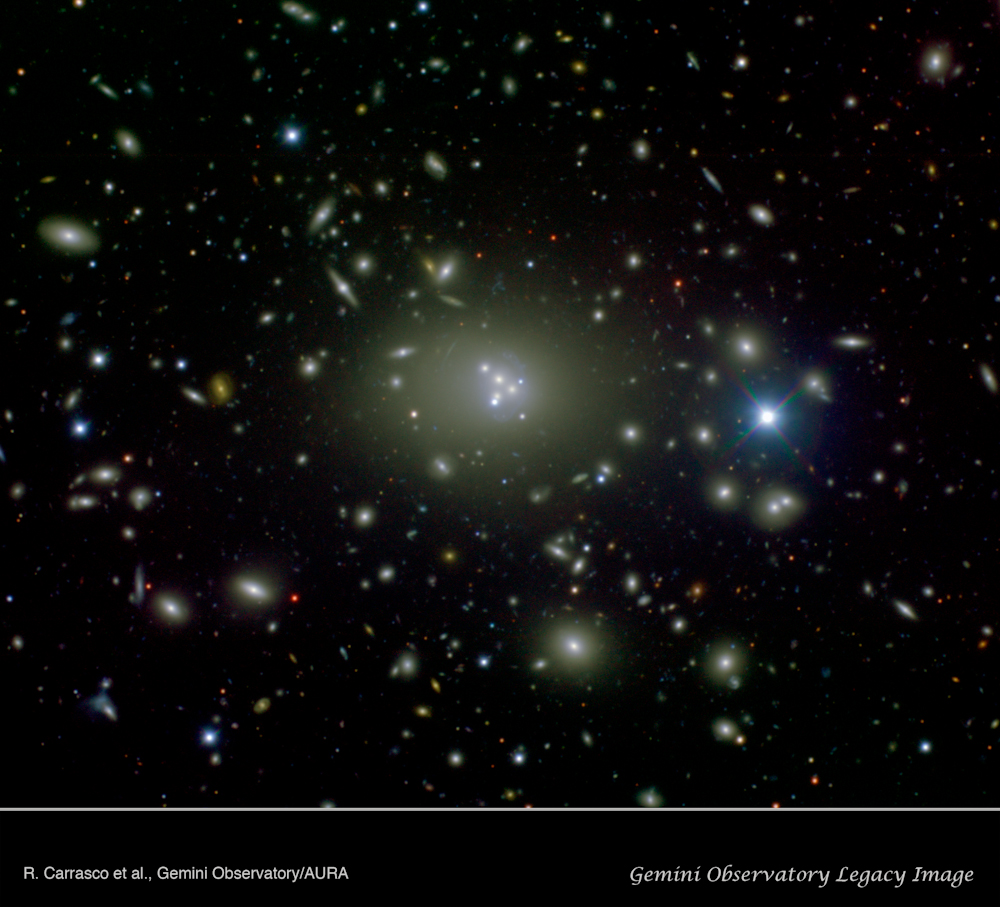
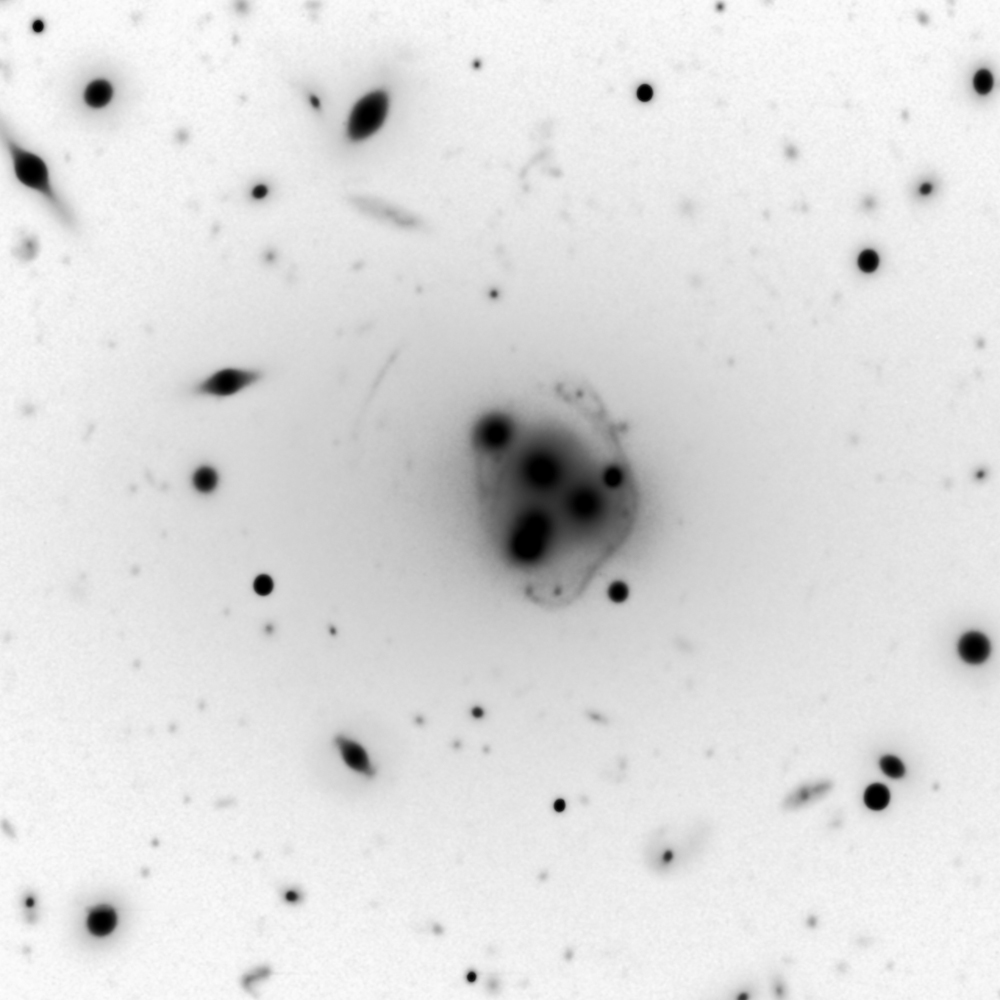
Central region of Abell 3827 as imaged using the Gemini Multi-Object Spectrograph on the Gemini South telescope in Chile. The central supermassive galaxy (ESO 146-IG 005) is clearly visible among its cluster companions as well as the remains of at least four nuclei that are being “digested” by the large galaxy. The central galaxy is thought to be the most massive galaxy in our local universe (out to about 1.5 billion light years). The field of view of this image is approximately 5 x 5 arcminutes and is a color composite made from g-, r- and i-band images combined and processed by Travis Rector (University of Alaska Anchorage). The inset (black on white image) is the single g-band image processed to reveal the gravitational lensed background galaxy arcs more clearly. Labeled on the inset are the most visible arcs from the closer background galaxy (z = 0.2 and labeled "A") and an arc from the more distant background galaxy (z = 0.4 and labeled "B"). This composite, labeled image, as well as all individual images, without text/labels, are available at full-resolution with the following links:

composite JPG 569 KB | TIFF 24.9 MB

text-free background image JPG 705 KB | TIFF 22.7 MB

inset image JPG 311 KB | TIFF 8.3 MB

A newly discovered gravitational lens in a relatively nearby galaxy cluster is leading astronomers to conclude that the cluster hosts the most massive galaxy known in our local universe. The study also reaffirms that galactic cannibalism is one reason that this galaxy is so obese, tipping the scales at up to 30 trillion times the mass of our Sun.

The supermassive galaxy is located at the core of the galaxy cluster Abell 3827, which lies some 1.4 billion light-years away. This galaxy and hundreds of its smaller cluster companions are visible in a dramatic new image released by the Gemini Observatory. The image is part of an upcoming paper in The Astrophysical Journal Letters that reports on the study of the massive galaxy using the gravitational lens formed by its core (also visible in the image) to provide new measurements of the galaxy’s extreme mass.

Although this bright galaxy (known as ESO 146-IG 005) dominates the core of Abell 3827, “the magnitude of its appetite has not been fully appreciated,” said Gemini astronomer Rodrigo Carrasco, who is a member of the team that used the 8-meter Gemini South telescope in Chile to study this galaxy and its cluster. The Gemini observations revealed, for the first time, the effects of gravitational lensing near the core of ESO 146-IG 005.

A gravitational lens is created when a massive object (in this case the core of the super-massive galaxy) distorts its local space. Light from a background galaxy (in this case two galaxies) that is passing by appears deflected from its original path. From our perspective, we see the background galaxies’ light reshaped as a ring-like structure and arcs around the lensing object. These arcs from both galaxies are clearly visible in the new Gemini images.

“The gravitational lens we discovered allowed us to estimate for the first time the mass of this monster galaxy very accurately. The inferred mass is a factor of 10 bigger than previous estimates derived from X-ray,” said Carrasco. “Assuming our model is correct, this is by far the most massive galaxy known in our local universe.”

The exceptional galaxy was not simply born massive; it has grown by consuming its companions in perhaps the most extreme example of ongoing “galaxy cannibalism” known. “This unabashed cannibal is something of a messy eater, with the partially digested remains of at least four smaller galaxies still visible near its center,” said team member Michael West, astronomer at the European Southern Observatory who first observed this system more than a decade ago and says that he was immediately struck by the complex morphology of this giant cannibal galaxy (see West’s Astronomy Picture of the Day August 31, 1998). “Eventually this galaxy will grow even bigger judging by the number of nearby galaxies already within its gravitational grasp.”

These observations yield important insight into the process of galaxy growth, especially of elliptical galaxies; these galaxies do not appear to acquire their full mass quickly in the early universe, but instead show significant growth through mergers and cannibalism at later times, after many of their stars have formed. The resulting galaxies, such as this one can be extremely massive.

The Gemini observations were made using the Gemini Multi-Object Spectrograph (GMOS) on the Gemini South telescope in Chile. Follow-up spectroscopic observations used the same instrument to confirm the distances (redshifts) of the two background galaxies whose light is diverted by the massive galaxy. These two galaxies were found to lie at about 2.7 and 5.1 billion light-years away (z= 0.2 and 0.4 respectively).

In addition to R. Carrasco and M. West, the team includes Gemini astronomers P. Gomez, H. Lee, R. Diaz, J. Turner, B. Miller, M. Bergmann, and T. Verdugo (University of Valparaiso, Chile). Complete results appear in Carrasco et al. “Strong Gravitational Lensing by the Super-Massive cD Galaxy in Abell 3827”,The Astrophysical Journal Letters 715, L1, 2010.

The Gemini Observatory is an international collaboration with two identical 8-meter telescopes. The Frederick C. Gillett Gemini Telescope is located at Mauna Kea, Hawai'i (Gemini North) and the other telescope at Cerro Pachón in central Chile (Gemini South), and hence provide full coverage of both hemispheres of the sky. Both telescopes incorporate new technologies that allow large, relatively thin mirrors under active control to collect and focus both optical and infrared radiation from space.

The Gemini Observatory provides the astronomical communities in each partner country with state-of-the-art astronomical facilities that allocate observing time in proportion to each country's contribution. In addition to financial support, each country also contributes significant scientific and technical resources. The national research agencies that form the Gemini partnership include: the US National Science Foundation (NSF), the UK Science and Technology Facilities Council (STFC), the Canadian National Research Council (NRC), the Chilean Comisión Nacional de Investigación Cientifica y Tecnológica (CONICYT), the Australian Research Council (ARC), the Argentinean Consejo Nacional de Investigaciones Científicas y Técnicas (CONICET) and the Brazilian Conselho Nacional de Desenvolvimento Científico e Tecnológico CNPq). The observatory is managed by the Association of Universities for Research in Astronomy, Inc. (AURA) under a cooperative agreement with the NSF. The NSF also serves as the executive agency for the international partnership.

Media Contacts:

  • Peter Michaud
    Gemini Observatory, Hilo, HI
    Email: pmichaud"at"gemini.edu
    Cell: (808) 936-6643
    Desk: (808) 974-2510
  • Antonieta Garcia
    Gemini Observatory, La Serena, Chile
    Email: agarcia"at"gemini.edu
    Phone (Desk): 56-51-205628

Science Contact: